





Railroad Spike Protection: Meaning in Hoodoo and How to Use Spikes Safely
What railroad spikes mean in hoodoo, where the practice of nailing down a property comes from, and how to set spikes at the four corners safely, legally and respectfully.


Search any American folk magic shop and you will find rusty railroad spikes sold in sets of four. This guide explains where the practice comes from, what practitioners say the spikes do and how to set them without hitting a gas line or trespassing on a railroad. It does not promise that a spike keeps anyone out, and it does not replace locks, lights or neighbors.
Contents
In hoodoo, the African American folk magic tradition, railroad spikes are used to protect a home by driving one iron spike into the ground at each corner of the property, often after dressing it with a protective oil. The idea is to fix the property in place, keep harm out and keep the household from being driven away; practitioners call it nailing down or tying down the property. It draws on much older beliefs about iron as protective, found in European, African and American folklore. It is a spiritual practice with no measurable effect on safety, and before driving anything into the ground in the United States you should call 811 to have buried utility lines marked.
Hoodoo developed among enslaved Africans and their descendants in the American South as a blend of African, European, Native American and Christian elements.
Source/tradition: Chireau, Black Magic, University of California Press, 2003; Anderson, Conjure in African American Society, LSU Press, 2005
Trespassing is the leading cause of rail-related deaths in the United States.
Source/tradition: Federal Railroad Administration, U.S. Department of Transportation (accessed 2026)
811 is the free national call-before-you-dig number in the United States.
Source/tradition: Common Ground Alliance, 811 Know What's Below (accessed 2026)
Iron repels fairies and harmful spirits.
Source/tradition: British and Irish folklore, Briggs, An Encyclopedia of Fairies, 1976
Nails from a gallows protect against disease and violent death.
Source/tradition: Ozark folklore recorded by Vance Randolph, 1947
Four railroad spikes dressed with protective oil are driven in at the corners of a property to nail it down.
Source/tradition: Practitioner accounts, Dr. E.'s Conjure Blog 2008; New World Witchery 2011
Railroad spikes at the corners protect a home from burglary, eviction or harmful magic.
Source/tradition: No evidence
VERIFIED = verifiable in scientific or official sources · TRADITIONAL = historically or culturally recorded · LIVED PRACTICE = widely practiced, experiential knowledge · NOT PROVEN = spiritual interpretation, not scientifically established.
Quick answer
In hoodoo, the African American folk magic tradition, railroad spikes are used to protect a home by driving one iron spike into the ground at each corner of the property, often after dressing it with a protective oil. The idea is to fix the property in place, keep harm out and keep the household from being driven away; practitioners call it nailing down or tying down the property. It draws on much older beliefs about iron as protective, found in European, African and American folklore. It is a spiritual practice with no measurable effect on safety, and before driving anything into the ground in the United States you should call 811 to have buried utility lines marked.
What railroad spike protection is
Railroad spike protection is a home-protection practice in which iron spikes, the large square-shanked nails that hold rails to wooden ties, are driven into the ground at the four corners of a property. Some practitioners add a fifth spike at the front door or under the porch steps. The spikes stay there, often for as long as the household lives on the land.
The practice is most closely associated with hoodoo, also called conjure or rootwork, the folk magic tradition that developed among enslaved Africans and their descendants in the American South. Today it is also used by witches and folk practitioners of many backgrounds, sometimes with little awareness of where it came from.
A standard railroad spike is roughly six inches long with a hooked head. It is heavy, plain and made to stay put under enormous loads. That character is exactly what practitioners want from it.
Why iron? The older roots of the practice
Long before railroads, iron had a reputation for keeping harm away. In Britain and Ireland, iron was believed to repel fairies; a knife over the door, scissors under a pillow or a horseshoe on the barn were common precautions, as Katharine Briggs documents in her studies of fairy lore. German, Scandinavian and Slavic folk custom used iron nails and blades in similar ways.
West and Central African traditions also held iron and the blacksmith in special regard. Ironworking was associated with power and transformation, and the smith was often a ritual figure. Scholars of African American religion such as Yvonne Chireau and Jeffrey Anderson describe hoodoo as a blend of African practices, European folk magic, Native American plant knowledge and Christian scripture, so iron's protective reputation reached it from more than one direction.
Nails in particular were everyday materials of American folk magic. Vance Randolph recorded Ozark beliefs about nails taken from a gallows as protection against disease and violent death, and Harry Middleton Hyatt's collections include nails driven into fruit trees to keep them bearing. The railroad spike is, in effect, the biggest nail most people can get their hands on.
Railroad spikes in hoodoo and conjure
In hoodoo the spike is part of a family of practices known as nailing down. One version described by practitioners begins inside: progressively larger nails are driven into the corners of each room, then into the corners of the house, and finally railroad spikes go into the ground at the corners of the land. The purpose is twofold, to keep harmful influences out and to keep the household in, so that it cannot be evicted, foreclosed on or otherwise driven off.
A rootworker writing as Dr. E. described the simpler form in 2008: one spike pounded into the ground at each of the four corners of the property to tie it down, each dressed first with a protective formula such as Fiery Wall of Protection. We have written separately about the origins of Fiery Wall of Protection and why that name became so common in conjure shops.
The railroad itself gives the spike part of its meaning. Railroads moved people north during the Great Migration and carried freight, mail and news across the country. Some practitioners say a spike that has held a working rail carries some of that strength and steadiness. That is a living interpretation within the practice, not a historical record.
A note on respect
Hoodoo grew out of Black Southern life under slavery and segregation, and for many families it is still a heritage, not a hobby. You do not need anyone's permission to put iron in your yard, but if you use the word hoodoo, learn from Black practitioners and writers, credit the tradition and buy from Black-owned shops where you can.
What practitioners say a spike does
Ask practitioners what the spikes do and you will usually hear three things. First, boundary: the four spikes mark the edges of what you are protecting, the same way a fence marks the edges of what you own. Second, fixing: the spike holds the home in place, which is why the practice is popular among renters who fear eviction and homeowners who fear foreclosure. Third, warding: iron at the corners is said to turn away harmful work, ill wishes and unwanted visitors.
Some practitioners also mention timing. Spikes are often set during a waxing moon for drawing stability, or a waning moon for driving out trouble, and sometimes at dawn. Others ignore timing and simply set them when they move in. Both approaches are in use, and there is no single authoritative rule.
None of this is measurable. Whether you find it meaningful depends on whether you work within a tradition that treats iron and boundaries as real, and on how the ritual changes your own attention to the place where you live.
Temple Tip
Before you set a spike, walk the boundary once, slowly, from corner to corner. Many people discover they do not actually know where their property line runs. The survey plat from your closing papers or your county's online parcel map shows it. A spike set on your neighbor's land protects the wrong yard and can start a real dispute.
Where to get spikes, and where not to
Old spikes turn up at flea markets, salvage yards, antique malls and in folk magic shops, which buy them from track maintenance crews and scrap dealers. New spikes are sold by hardware and farm suppliers. Either works; many practitioners prefer used ones for the reason above.
What you should not do is pick spikes up along an active railroad. Railroad property is private, and walking on tracks is trespassing in every state. According to the Federal Railroad Administration, trespassing is the leading cause of rail-related deaths in the United States, and trains cannot stop in time. A loose spike on the ballast may also be part of track that crews are about to repair. Buy your spikes.
Rail-trails, the paths built on abandoned rail lines, are a gray zone. Many are public parks where removing objects is prohibited. Leave what you find there in place.
How to set spikes at the four corners
One common way to set spikes, drawn from practitioner descriptions. Adapt it to your own tradition.
- Call 811 first. In the United States, 811 is the free national call-before-you-dig number. Utility companies mark buried gas, electric, water and cable lines, usually within a few business days. A six-inch spike can reach shallow lines, and hitting one is dangerous and expensive.
- Cleanse the spikes. Many practitioners wash old spikes in salt water or smoke them, then let them dry. Brush off loose rust so the oil can reach the iron.
- Dress each spike. Rub a few drops of a protective oil along the shank while stating, aloud or silently, what you are protecting and from what.
- Start at the front. Work clockwise from the front corner of the lot, or from the corner nearest your door. Drive each spike in fully with a hammer or small sledge, head down or flush with the soil.
- Speak at each corner. A short sentence of your own, a psalm (Psalm 91 is a common choice in conjure) or a simple statement of intent. Keep it the same at all four corners.
- Close the circle. When the fourth spike is in, walk back to the front door and, if you like, light a candle inside the house to finish the work.
Spikes compared with other doorway protections
How railroad spikes compare with other American doorway and boundary protections
| Practice | Tradition | Where | Visible? | Effort |
|---|---|---|---|---|
| Railroad spikes | Hoodoo / conjure | Four corners of the land | Barely | One afternoon, then permanent |
| Red brick dust | Hoodoo / New Orleans | Doorstep and threshold | Yes | Renewed regularly |
| Haint blue paint | Gullah Geechee / Lowcountry | Porch ceiling, shutters | Yes | Painting project |
| Horseshoe over the door | European folk custom | Above the door | Yes | Minutes |
| Salt line | Many traditions | Thresholds, windowsills | Faintly | Renewed regularly |
If a spike feels too permanent, red brick dust on the doorstep is a renewable alternative from the same tradition, and haint blue porch ceilings show how protection became part of Southern architecture.
Quiz: is a spike the right protection for you?
Four questions to see whether spikes suit your situation or whether another protection fits better.
Voices from practice
Practitioners often describe setting spikes as one of the first things they do in a new home, along with a floor wash and a candle, and say the physical effort of driving iron into the ground is part of what makes the ritual feel finished.
Renters commonly report that they adapted the practice rather than skipping it: nails in flowerpots at the corners of a balcony, or spikes pushed into the soil of a front bed that can be pulled out when they move.
Rootworkers who teach often caution that spikes are a foundation, not a cure. If someone feels under attack, they tend to recommend cleansing and practical steps first and treat the spikes as the boundary that comes afterward.
What we don't promise
We do not promise that railroad spikes protect your home from burglary, fire, eviction, illness or anyone's ill will. There is no evidence that iron in the ground changes what happens on a property. Locks, lighting, insurance, a lease you understand and neighbors who know you are what measurably keep a household safe.
We do not claim that the practice is ancient in its railroad form. Railroads date from the nineteenth century, and the documented sources for spikes in conjure are practitioner accounts rather than old archival records. The older layer is the general belief in iron and nails, which is well documented.
And we will never tell you that you are cursed or that you need spikes. If fear is driving you, talk to someone you trust first.
Practically: how to work with this
- Read before you hammer. Spend an evening with one serious source on hoodoo history, such as Chireau's Black Magic or Anderson's Conjure in African American Society.
- Check your boundaries. Find your property line on the plat or county parcel map and confirm the four corners.
- Call 811. Request a utility locate at least a few business days ahead and wait for the marks.
- Buy four spikes. From a shop, salvage yard or hardware supplier, never from active track.
- Set them in one session. Cleanse, dress, drive them in clockwise and speak your intention at each corner.
- Keep a record. Note the date and the corners in a notebook. If you sell the house, you will know where the iron is.

From our shelf
Fiery Wall of Protection 7-Day Candle
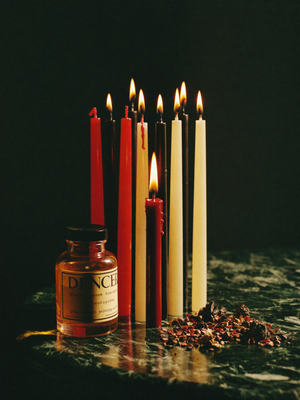
Practitioners who set spikes at the corners of a property often dress them with a Fiery Wall of Protection formula and keep a candle of the same name burning inside while they work. A candle is a focus for intention, not a security system. Currently $10.95.
More in protection and entryway and front door.
Frequently asked questions
What do railroad spikes mean in hoodoo?
They are used to nail down or tie down a property: four spikes at the corners mark a protected boundary, keep harmful influences out and are said to keep the household from being driven away by eviction or foreclosure.
Where do you put railroad spikes for protection?
Traditionally one at each of the four corners of the property, driven fully into the ground. Some practitioners add a fifth at the front door or under the porch steps.
What oil do you put on railroad spikes?
Practitioners commonly use a protective formula such as Fiery Wall of Protection. Others use olive oil prayed over, or an oil from their own tradition. The oil carries intention; it is not chemically active.
Is it illegal to take railroad spikes from the tracks?
Railroad property is private, and walking on tracks is trespassing. Taking spikes can also be theft and can affect track that is due for repair. Buy spikes from shops, salvage yards or hardware suppliers.
Do I need to call 811 before driving in a railroad spike?
Yes, it is the safe choice. 811 is the free national call-before-you-dig number in the United States, and a spike can reach shallow buried lines. Utility companies will mark them for you.
Can I use railroad spikes if I rent?
Ask your landlord before putting anything permanent in the ground. Many renters use large nails in planters or soil they can remove when they move out.
Sources & further reading
- Chireau, Yvonne P. Black Magic: Religion and the African American Conjuring Tradition. University of California Press, 2003.
- Anderson, Jeffrey E. Conjure in African American Society. Louisiana State University Press, 2005.
- Randolph, Vance. Ozark Magic and Folklore (originally Ozark Superstitions, 1947). Dover reprint, 1964.
- Briggs, Katharine. An Encyclopedia of Fairies. Pantheon, 1976.
- Dr. E. Protecting the Home Hoodoo Style. Dr. E.'s Conjure Blog, November 19, 2008.
- Cory (New World Witchery). Blog Post 140: Pins and Needles. newworldwitchery.com, October 13, 2011.
- Federal Railroad Administration. Trespasser Deaths and Injuries; Highway-Rail Grade Crossing and Trespass Prevention. U.S. Department of Transportation, accessed 2026.
- Common Ground Alliance. 811: Know What's Below, Call Before You Dig. Accessed 2026.
More from Practical Magic & Rituals
All stories →
Fast Luck Oil: Meaning, History, Ingredients and How to Use It


Seven Knob Candle: Meaning, Colors and How to Burn One Knob a Day

