

Collection: Fluorite
Seven fluorite pieces, from a $14.95 banded point to a one-of-one 20.4 kg Elmwood cluster, with a carved skull, a dodecahedron and a raw pendant between them.
In short: fluorite is soft, naturally banded calcium fluoride that changes color with the light — the classic desk and study stone.
-
Rainbow Fluorite Point — Multi-Color Crystal Point for Clarity
Regular price $14.95Regular priceUnit price / perSale price $14.95 -
Elmwood Fluorite Cluster — 20.4 kg Purple Cubes with Sphalerite
Regular price $4,290.95Regular priceUnit price / perSale price $4,290.95 -
Purple Fluorite Skull — Carved Crystal Skull for Focus & Clarity
Regular price $73.95Regular priceUnit price / perSale price $73.95 -
Fluorite Dodecahedron — Polished Sacred-Geometry Crystal for Focus & Calm
Regular price $79.95Regular priceUnit price / perSale price $79.95 -
The Cleansing Stone — Natural Fluorite for Clarity & Clear Energy
Regular price $17.95Regular priceUnit price / perSale price $17.95 -
Fluorite Comfort Stone — Mental Clarity & Focus for Study
Regular price $6.95Regular priceUnit price / perSale price $6.95Sold out -
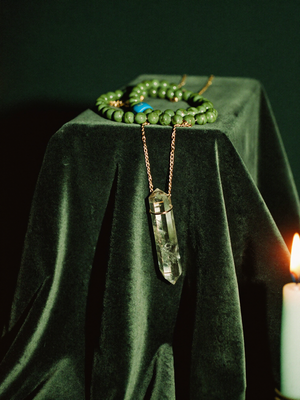
Green Fluorite Necklace — Raw Crystal Pendant for Clarity
Regular price $26.95Regular priceUnit price / perSale price $26.95
Fluorite: the stone that grows in cubes and changes with the light
Fluorite is calcium fluoride, and it does two things few other stones do. It grows in genuine cubes — sharp, interlocking boxes you could measure — and it lays its color down in bands as it forms, so green, violet and water-clear can run through a single piece. It is also the mineral that gave fluorescence its name. Everything on this page follows from that: the color is structural rather than applied, and on the raw pieces the shape is the stone’s own.
How to judge a piece
Banding over saturation. Sharp, legible color zones and good translucence are what fluorite is bought for; a muddy, evenly colored piece is the weaker stone even when the color is stronger. Nothing added. Multi-color fluorite is natural — a coated or dyed piece should say so. On a cluster, read the edges. Fluorite is soft and cleaves easily, so crisp cube corners are the mark of careful handling. Expect variation. The points and dodecahedra are sold assorted; the photograph shows the style, not your stone.
Choosing a form
Form decides the price far more than grade. To stand on a desk: the Rainbow Fluorite Point at $14.95 (tower or massage-wand base) and The Cleansing Stone at $17.95. To give a desk a focal point: the hand-carved purple fluorite skull from Brazil at $73.95 and the twelve-faced dodecahedron at $79.95, yellow- or purple-banded. To wear: the raw green fluorite pendant in gold-toned wire at $38.95. To hold: the $6.95 Comfort Stone, sold out as this page is written. For a collection: the Elmwood cluster, 20.4 kg of purple cubes with sphalerite, one specimen only, $4,290.95.
Two more options sit inside other listings’ dropdowns: green fluorite in the faceted obelisk towers from $17.95, and fluorite or green fluorite in the raw wire-wrapped necklace at $18.95.
How to use it, and how to keep it
In contemporary crystal practice fluorite is associated with focus, organized thinking and mental clarity, and traditionally with the third eye and heart chakras — which is why it lives on desks rather than nightstands. The simplest practice is also the most rewarding: look at your piece under three lights — a lamp from above, raking side light and daylight at a window. Care follows its softness. At about 4 on the Mohs scale, with cleavage in four directions, it scratches against quartz and keys and can split if dropped. Store it on its own, give polished pieces only a brief cool rinse and dry them at once, keep hot water away, dust carvings and clusters with a dry brush, and lift a cluster from underneath, never by a crystal.
From the magazine: Fluorite meaning, properties and uses · Which crystals cannot go in water · Mohs hardness for crystals · How to cleanse crystals · Third eye chakra explained. For more stones chosen for the same work, see Clarity & Intuition and Desk & Workspace.
Frequently asked questions
Why does my fluorite look like a different color every time?
Because fluorite grows in layers colored by different trace elements, and how much of each band you see depends on the light behind it. Look at it under an overhead lamp, in side light and at a window — most people only ever see one version of the stone they own.
Is rainbow fluorite dyed or treated?
No. The green, violet and clear banding is natural growth. Every piece on this page is either raw or cut and polished, with nothing added.
Can fluorite go in water?
Briefly. A polished point can take a quick rinse in cool water if you dry it straight away, but avoid hot water, soaking and sudden temperature changes. Carvings, clusters and the wire-wrapped pendant are better cleaned dry.
Why does fluorite scratch and chip so easily?
It is about 4 on the Mohs scale — softer than quartz and a steel key — and it has perfect cleavage in four directions, so a hard knock can split it along an internal plane. Keep it apart from harder stones and jewelry.
What is fluorite traditionally used for?
In contemporary crystal practice it is associated with focus, organized thinking and mental clarity, and linked to the third eye and heart chakras. These are traditional associations, not health claims.
Which fluorite should I start with?
The $14.95 Rainbow Fluorite Point is the most affordable piece and suits a desk. For something to wear, the raw wire-wrapped necklace at $18.95 or the green fluorite pendant at $38.95; for a desk centerpiece, the skull or the dodecahedron.
Offered as traditional, devotional and decorative objects, not medical devices. Nothing here is intended to diagnose, treat, cure or prevent any condition.


