

Collection: Meditation
Thirteen pieces made for sitting, not merely usable while sitting: two 108-bead malas, six incense blends led by sandalwood, a handpan and a 432 Hz tongue drum, an amethyst palm stone, chakra oil, a journal and ceremonial cacao. $10.00 to $3,390.95. In short: pick the one sense — hands, smell, sound or taste — and the shelf picks itself.
-
Boundless Belize — Heirloom Pure 100% Ceremonial Cacao for Meditation
Regular price From $32.95Regular priceUnit price / per$295.00Sale price From $32.95Sale -
Sensory Handpan, Bb2 Amara 9 Notes — Vintage Copper Meditation Handpan
Regular price $3,390.95Regular priceUnit price / per$3,650.00Sale price $3,390.95Sale -
10" Steel Tongue Drum, B Minor 432 Hz — 8-Note Drum for Meditation
Regular price $308.95Regular priceUnit price / per$340.00Sale price $308.95Sale -
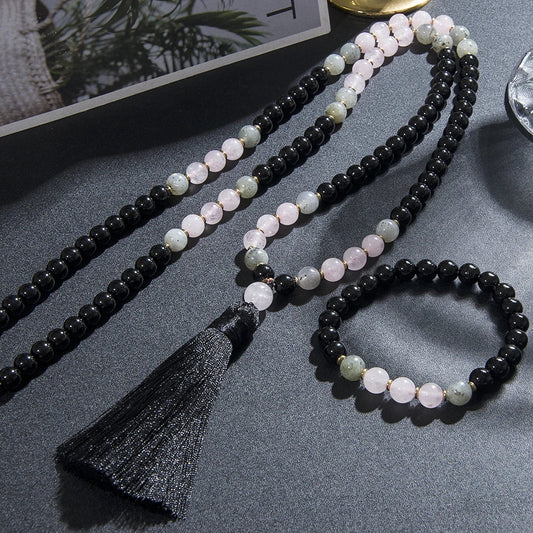
Black Onyx, Rose Quartz & Labradorite Mala — 108-Bead Meditation Necklace
Regular price From $26.95Regular priceUnit price / perSale price From $26.95 -
Polished Crystal Pyramid — Assorted Stones for Altar & Meditation
Regular price From $30.95Regular priceUnit price / perSale price From $30.95 -
Carnelian & Gobi Agate Mala Necklace — 108 Beads for Daily Meditation
Regular price $208.95Regular priceUnit price / perSale price $208.95Sold out -
Mindful Mornings Journal — Lined Notebook for Your Morning Ritual
Regular price $22.95Regular priceUnit price / perSale price $22.95 -
Chakra Balancing Ritual Oil — Energy Alignment for Meditation & Yoga
Regular price $9.95Regular priceUnit price / perSale price $9.95 -
Amethyst Palm Stone — Polished Calm & Intuition Stone for Meditation
Regular price $14.95Regular priceUnit price / perSale price $14.95 -
Sagrada Madre Kundalini Sacred Incense — Grounding Ritual Sticks for Meditation
Regular price $17.95Regular priceUnit price / perSale price $17.95 -
Sagrada Madre Sandalwood Incense 30-Pack — Hand-Rolled Sticks for Meditation
Regular price From $36.99Regular priceUnit price / perSale price From $36.99 -
Sagrada Madre Sacred Incense Collection — Four Blends for Meditation & Spirit Work
Regular price From $17.95Regular priceUnit price / perSale price From $17.95 -
Sagrada Madre Sandalwood Tao Premium Incense — Warm Woods for Meditation
Regular price $18.95Regular priceUnit price / perSale price $18.95
Choose the sense, not the object
Thirteen pieces, from a $10.00 half-ounce of chakra oil to a $3,390.95 handpan — a spread of more than three hundred to one, which tells you immediately that this is not a page with a single right answer on it. What sorts it is not price and not material. It is which sense you are handing your attention to, because a sitting practice fails in one of two ways: nothing to do, or too much to do. Every object here is a solution to the first problem and a risk of creating the second.
- Hands — the $26.95 108-bead mala, the $14.95 Amethyst Palm Stone, the polished crystal pyramid from $30.95.
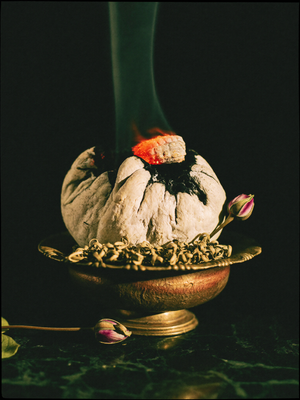
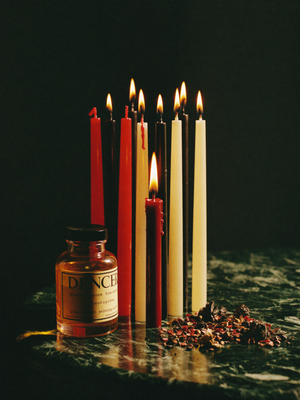
- Smell — four incense listings covering six named blends, $24.95 to $171.95, and the only things here that also tell the time.
- Sound — the $308.95 steel tongue drum and the $3,390.95 Sensory Handpan.
- Taste — Boundless Belize ceremonial cacao, $32.95 for a half pound up to $263.95 for five.
- Skin — the $10.00 Chakra Balancing Ritual Oil, sandalwood and rose over a coconut base, the cheapest way onto this page.
- Words — the $22.95 Mindful Mornings Journal, undated and unprompted, which is the point: there is no system here to fall behind on.
One thing worth saying before any of it: none of this is required. A sitting practice needs a place to sit and a decision to sit there. These objects make the decision easier to keep, which is a real and modest job, and the honest reason to buy one.
Incense is the cheapest meditation timer you can buy
Every incense line on this page burns for roughly sixty minutes a stick and can be put out and relit for shorter sessions. That is not a detail about scent. It is a clock that does not glow, buzz or ask to be unlocked, and it is the reason incense outlasts every meditation app anyone has ever downloaded.
The Sandalwood 30-Pack is the one to do the arithmetic on: $57.95 for thirty thick sticks works out to about $1.93 for an hour-long sit, which is the cheapest timed hour on this page. Worth knowing before you add the multi-box options to the cart: the two- and three-box prices save roughly one percent — $114.95 against $115.90, $171.95 against $173.85. Buy the extra boxes because you know you will use them, not because the discount is doing anything.
On which blend: sandalwood is the default for good reason and this page offers it twice, as the 30-pack and as the $26.95 Sandalwood Tao Premium, warm and woody and happy to disappear into the background. Kundalini at $24.95 runs the other way — deep, resinous, built for the sit where you look up and forty minutes have gone. And the Sacred Incense Collection gives you four blends for four different modes, $24.95 each or $97.95 for one of each, which again saves about two percent over buying them separately. If your practice has one mode, buy one box; if it has four, the set is genuinely the cleaner purchase.
Practical matters nobody mentions until it is too late: How to Choose an Incense Burner covers the dish you will need, because an hour-long stick drops an hour's worth of ash. Burning Incense in an Apartment is the one to read if you share walls or have a sensitive smoke alarm. Planetary Incense by Day of the Week is for anyone who wants the scent to follow a cycle rather than a mood. More of everything in Incense Sticks & Cones and Incense Burners & Holders.
Two instruments, and why one costs eleven times the other
Both instruments here are built on the same idea: every note belongs to one scale, so there is no wrong note and no theory to learn before the first useful sound. That is what makes them meditation instruments rather than musical ones. The gap between them is $308.95 and $3,390.95 — a factor of about eleven — and it is worth knowing what it buys.
The 10-inch steel tongue drum has eight octavated notes in B minor, a rounded bell-like voice somewhere between a handpan and a music box, and wooden mallets in the box. Played with fingertips it is soft and close; with the mallets it gains definition. For a solo sitting practice it does the whole job. The Sensory Handpan in Bb2 Amara is a nine-note stainless steel instrument in vintage copper with an engraved design, and it arrives fully kitted — padded carrying bag, stainless protection cover, velvet bag. The difference is resonance, sustain and hand feel, and it is real. It is also the difference between an object you try and an instrument you commit to.
The drum is tuned to 432 Hz, which deserves an honest sentence rather than a claim. 432 Hz is a tuning preference with a long and contested argument behind it, not a demonstrated property of sound; people who prefer it describe it as warmer, and that preference is a perfectly good reason to choose it. 432 Hz vs 440 Hz lays out what the debate actually is and what the evidence does and does not show. If sound is the direction you are going, the fuller range sits in Sound & Vibration, split between Crystal Singing Bowls and Drums, Gongs & Bells — bowls are rubbed, drums and gongs are struck, and that is the first fork in the road.
Malas, a palm stone, and one pyramid you do not get to choose
A mala is a counting tool before it is a necklace. One hundred and eight beads, one breath or one mantra each, and your hands are given a job so your mind stops supervising. The Black Onyx, Rose Quartz & Labradorite Mala is strung in 8 mm beads of three stones covering what most practices want at once — something steady, something soft, something that moves in the light. $26.95 for the necklace, $32.95 with a matching bracelet, so the bracelet adds six dollars. The second mala on this page, in carnelian and Gobi Desert agate, is currently out of stock. How to Use Mala Beads covers the count, the guru bead and what to do when you lose your place, which you will.
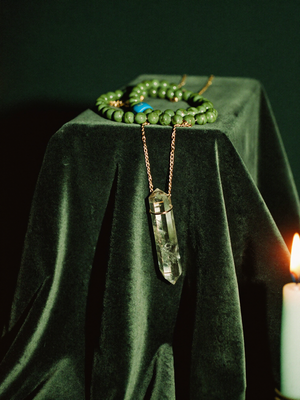
The $14.95 Amethyst Palm Stone is the simplest object here: polished, weighted, and traditionally linked to the third eye and crown chakras. The weight does as much work as the stone. One care note that applies to every amethyst you will ever own — its purple is UV-sensitive and will pale over months in direct sun, so keep it off the bright windowsill it is destined for. Amethyst Meaning has the history and the working practice; How to Charge Crystals covers moonlight and selenite, both of which are safe for it.
The Polished Crystal Pyramid needs one warning that the price list hides: the options are weight ranges, not stones. $30.95 buys 106 to 120 grams, $42.95 buys 121 to 180, $61.95 buys 181 to 265 — and the stone that arrives is assorted from amethyst, tiger eye, black obsidian, rose quartz, dumortierite, golden healer quartz and lepidolite. If you want a specific mineral, buy it from Crystals & Stones instead; if you want the shape, this is the cheaper route to it. The form is not decorative — four faces meeting at a point pull the eye upward, which is why pyramids keep ending up at the center of altars and grids. How to Make a Crystal Grid is the practical follow-on, and Crystal Spheres & Pyramids has the rest.
Cacao: the same price, a third less cacao
Boundless Belize is heirloom-designated cacao grown by around three hundred family farms of one to five acres in the foothills of southern Belize, three quarters of them Indigenous Q'eqchi' and Mopan Maya, and produced by Maya Mountain Cacao. It is the reference point for a ceremonial cup: expansive rather than sharp, made to widen a sitting rather than speed it up.
The sizes repay a minute of arithmetic, because two of them cost exactly the same and are not the same amount. One pound is $62.00 and the box of twelve one-ounce servings is also $62.00 — which means the single-serve format costs about a third more per ounce (roughly $5.17 against $3.88). That is not a trick; you are paying for portioning, and for a first-time buyer it is arguably worth it. But if you already know you will drink it, the loose pound is the better buy, and the five-pound bag at $263.95 is the cheapest of all at about $3.30 an ounce.
What Is Ceremonial Cacao? explains how it differs from cocoa powder and drinking chocolate, and How to Hold a Cacao Ceremony at Home covers preparation and a sensible serving. One caution worth stating plainly: cacao is a stimulant food — it carries theobromine and caffeine — so a ceremonial serving is considerably stronger than a mug of hot chocolate, and if you take regular medication it is worth a word with a pharmacist first. The wider Ceremonial Cacao range has the other origins, and Tea Meditation is the gentler version of the same idea if cacao is too much.
What this page cannot do for you
No cushion, no bench, no bell, no timer — the furniture of a practice is not sold here, and you do not need it to start. What is here is the part that gives attention somewhere to land. If you want to put the whole thing somewhere permanent, How to Set Up an Altar in a Shared Room is written for people without a spare corner, and Altar & Home has the surfaces and cloths.
Two pieces of honest reading, and they are the ones we would rather you read than skip. I Felt Nothing During the Ritual is for the very common experience of sitting down, doing everything correctly and registering nothing at all — which is not failure and usually not even unusual. Spiritual Bypassing: 9 Signs is for the opposite risk: using a practice to step around something that needs to be dealt with rather than sat with. The 7 Chakras Explained is the background for the oil, the pyramid and half the incense on this page, and Heart Chakra goes deepest of the seven.
None of this treats a condition and none of it is medicine. These are traditional practices and well-made objects. If what you are carrying is heavier than a practice can hold, that is worth taking to someone qualified — a cup of cacao and an hour of incense are a good companion to that conversation, never a replacement for it.
Frequently asked questions
What are mala beads for, and why 108?
A mala is a counting tool. One hundred and eight beads let you track one mantra or one breath per bead through a full round without counting in your head, which is the entire point — your hands take the job so your attention can stay where you put it. The number has several traditional explanations across Hindu and Buddhist practice and no single agreed origin; what matters practically is that 108 is long enough to settle into and short enough to finish. The larger guru bead marks the start and end of a round, and you turn back rather than crossing over it. The mala on this page is strung in 8 mm black onyx, rose quartz and labradorite at $26.95, or $32.95 with a matching bracelet.
How do I time a sitting without looking at my phone?
Burn a stick of incense. Every incense line on this page runs about sixty minutes a stick and can be extinguished and relit, so one stick is one hour and half a stick is half an hour, with no screen involved. At $57.95 for thirty thick sticks, the Sandalwood 30-Pack puts an hour-long sit at about $1.93. If an hour is more than you want, light the stick, sit until you notice you have stopped, and put it out — the remaining length is your next session.
Which incense is best for meditation?
Sandalwood, if you want one answer and no further thinking. It has carried more sitting practice than any other single note, it is warm and woody rather than sweet, and it is content to stay in the background instead of becoming the event. This page offers it as the $57.95 thirty-stick box and as the $26.95 Sandalwood Tao Premium. If your practice runs long and you want something that deepens rather than lifts, the $24.95 Kundalini stick is resinous and enveloping and built for exactly that. And if you sit in more than one mode, the Sacred Incense Collection gives four named blends for four different jobs.
Is 432 Hz actually better than 440 Hz?
There is no good evidence that it is, and there is a long argument about it that is worth understanding before you pay extra for it anywhere. 432 Hz is a tuning preference: some listeners describe it as warmer or rounder, and that preference is a perfectly reasonable basis for choosing an instrument. It is not a demonstrated property of sound and it does not do anything measurable to a body. The steel tongue drum here is tuned to 432 Hz, and our article 432 Hz vs 440 Hz sets out where the claim comes from and what the research does and does not support.
Which crystal is best for meditation?
Amethyst is the traditional companion for sitting practice and has been for a very long time — associated with quieting an overactive mind and linked with the third eye and crown chakras. The $14.95 Amethyst Palm Stone here is the straightforward version: polished, weighted for the hand, and the weight is doing as much work as the color. One practical caution that applies to all amethyst: the purple is UV-sensitive and will fade over months in direct sunlight, so it should not live on a sunny windowsill. Moonlight or a selenite plate are the safe ways to reset it.
What is ceremonial cacao, and how is it different from hot chocolate?
Ceremonial cacao is the whole bean, stone-ground with nothing removed — unlike cocoa powder, which has had the cacao butter pressed out, and unlike drinking chocolate, which has had sugar and milk solids added. The result is bitter, fatty and considerably stronger, and it is prepared as a drink rather than a dessert. Boundless Belize is heirloom-designated and grown by around three hundred small family farms in southern Belize. One caution: cacao is a stimulant food, carrying theobromine and caffeine, so a ceremonial serving is not comparable to a mug of cocoa. If you take regular medication, ask a pharmacist before a full serving.
I sit down and feel nothing. Am I doing it wrong?
Almost certainly not. Feeling nothing is the most commonly reported experience of a sitting practice and it is not a sign of failure, insufficient belief or the wrong equipment. Practices are largely cumulative and mostly unglamorous; the interesting part tends to show up in the hours afterward rather than during. Our article I Felt Nothing During the Ritual goes through the reasons this happens and what, if anything, to change. The one thing not to do is buy a more expensive object in the hope that it will feel like more.
Do I need a cushion, a bench or a bell to start?
No, and none of them are sold on this page. A sitting practice needs somewhere to sit and a decision to sit there; everything else is optional support. If you want one object to begin with, the $10.00 Chakra Balancing Ritual Oil is the cheapest way in and asks nothing of you but a moment before you sit, and the $14.95 amethyst palm stone gives your hands something to do. The $22.95 Mindful Mornings Journal is undated and unprompted on purpose, so there is no streak to break and nothing to fall behind on.