




Planetary Incense by Day of the Week: A Practical Guide to the Seven-Day Cycle
Use the weekday assignments as a scheduling system rather than a rule. Their real value is that they make practice regular — and regular beats elaborate every time.


This guide explains how the planet-to-weekday system works, where it comes from, and how to run a planetary incense practice that survives contact with a real schedule. It will not tell you that burning the right stick on the right day changes what happens in your bank account or your love life — no one can honestly promise that.
Contents
Each day of the week has carried a planetary association since Roman times: Sun on Sunday, Moon on Monday, Mars on Tuesday, Mercury on Wednesday, Jupiter on Thursday, Venus on Friday, Saturn on Saturday. A planetary incense practice means burning an incense matched to that planet's theme on its day. You do not need all seven days: pick the two or three themes you actually care about, burn the matching stick with a minute of focused intention, and skip the rest without guilt. The value is rhythm, not obligation.
The seven-day week with planetary day names is documented in Roman sources by the first century CE
Source/tradition: Cassius Dio, Roman History 37.18-19; Pompeii graffiti
Incense smoke contains fine particulate matter; ventilation while burning is advisable
Source/tradition: U.S. EPA, Indoor Air Quality guidance
Planet-to-scent correspondences such as solar frankincense and venusian rose descend from medieval astrological magic
Source/tradition: Picatrix (11th c.); Agrippa, Three Books of Occult Philosophy, 1533
Modern practitioners assign one theme per weekday and burn a matching incense as a weekly rhythm
Source/tradition: Contemporary practice as described in the article
Starting with two or three days rather than all seven makes the practice more sustainable
Source/tradition: Practitioner experience
Burning a planet's incense on its day influences outcomes in the corresponding area of life
Source/tradition: Spiritual interpretation; no scientific evidence
VERIFIED = verifiable in scientific or official sources · TRADITIONAL = historically or culturally recorded · LIVED PRACTICE = widely practiced, experiential knowledge · NOT PROVEN = spiritual interpretation, not scientifically established.
Quick answer: Each day of the week has carried a planetary association since Roman times — Sun on Sunday, Moon on Monday, Mars on Tuesday, Mercury on Wednesday, Jupiter on Thursday, Venus on Friday, Saturn on Saturday. A planetary incense practice means burning an incense matched to that planet's theme on its day: clarity and confidence on Sunday, intuition on Monday, courage on Tuesday, communication on Wednesday, growth on Thursday, love on Friday, boundaries on Saturday. You do not need all seven days. Pick the two or three themes you actually care about, burn the matching stick with a minute of focused intention, and skip the rest without guilt. The value is rhythm, not obligation.
Where the planet–weekday assignment comes from
The seven-day week with planetary day names is not a modern invention and not a New Age one. It is documented in Roman sources by the first century CE — graffiti at Pompeii lists the days by their planetary names, and the historian Cassius Dio, writing in the early third century, describes the system and attributes it to the Egyptians. The order follows the so-called Chaldean sequence of the seven classical planets arranged by their apparent speed, distributed across the twenty-four hours of each day; the planet ruling the first hour gives the day its name. You can still hear the system in English (Sun-day, Moon-day, Saturn-day) and even more clearly in the Romance languages, where Tuesday through Friday carry Mars, Mercury, Jupiter, and Venus almost unchanged.
Medieval astrological magic took this inheritance and built practice on top of it. The Picatrix, an eleventh-century Arabic compendium translated into Latin in the thirteenth century, matches planets to materials, scents, and workings. Cornelius Agrippa's Three Books of Occult Philosophy (1533) systematized the correspondences that most modern practitioners still use: solar frankincense, lunar jasmine and camphor, martial dragon's blood, mercurial lavender, jovial cedar, venusian rose, saturnine myrrh. When you burn a Venus incense on a Friday, you are participating in a chain of practice that is comfortably over a thousand years old — whatever else you believe about it, the lineage is real.
The seven days at a glance
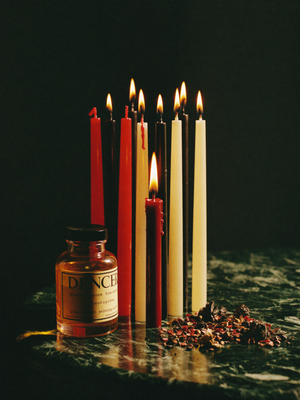
Here is the full cycle as most modern practitioners work it. The colors are traditional associations, useful for choosing candles or altar cloths to match.
Gold · confidence, vitality, visibility. Scents: frankincense, orange, bay.
Silver/white · intuition, dreams, emotional reset. Scents: jasmine, sandalwood, camphor.
Red · courage, drive, hard conversations. Scents: dragon's blood, ginger, pine.
Orange/mixed · communication, study, trade. Scents: lavender, storax, mastic.
Deep blue/green · growth, luck, generosity. Scents: cedar, nutmeg, sage.
Green/pink · love, beauty, reconciliation. Scents: rose, benzoin, vanilla.
Black/dark gray · boundaries, endings, discipline. Scents: myrrh, cypress, patchouli.
You do not need all seven days
The fastest way to kill this practice is to treat it as a seven-day obligation. Nobody sustains that past week three, and the guilt of the missed Wednesday then poisons the Thursday. The weekday system was never a law even in its own tradition — Agrippa's correspondences were a menu for timing specific workings, not a daily chore chart.
A better approach is to choose by friction. Ask yourself which two or three themes in the list above name something you are actually working on this season. If you are job hunting, that is Sun (visibility), Mercury (communication), and Jupiter (opportunity). If you are recovering from a hard year, it might be Moon (emotional reset) and Saturn (boundaries). Burn only on those days. A two-day practice you keep for six months is worth more than a seven-day practice you keep for two weeks.

If you want to work with this yourself, this is what we use:
Cosmos Incense — Planetary Sticks, Choose Your Planet · $16
View the planetary sticksHow to actually burn it: two minutes that count
The mechanics are simple, but the difference between "lighting a stick" and "practice" is about ninety seconds of attention. Light the tip, let it flame for a few seconds, blow it out so it smolders, and place it in a proper holder — never balanced on a shelf edge. Then, before you walk away, stay with it for one minute. Name the day's theme out loud or silently in one sentence: "Today is for saying the difficult thing clearly." That sentence is the practice. The incense is the anchor that makes you say it.
Ventilation matters more than most incense guides admit. Incense smoke is fine particulate matter, and the sensible practice — confirmed by every indoor-air-quality guideline — is a cracked window, a modest amount of smoke, and never burning unattended. One stick, not five. If smoke is a problem in your home, a room spray can do the anchoring job on days when smoke cannot.
Morning or evening? Matching the burn to the theme
Tradition assigns planetary hours as well as days, but for a livable practice the useful split is simpler: active themes in the morning, reflective themes in the evening. Sun, Mars, Mercury, and Jupiter workings tend to land better before the day starts — you burn Tuesday's stick before the difficult meeting, not after it. Moon, Venus, and Saturn themes usually belong to the evening: intuition, tenderness, and boundaries are things you review when the day is done. This is convention and common sense rather than doctrine; if your only quiet fifteen minutes is at 6 a.m., that is your planetary hour.
When you miss a day
You will miss days. The tradition itself gives you the answer to this: every weekday returns in seven days. You do not "make up" a missed Friday on Saturday with Friday's incense — the whole logic of the system is that Saturday has its own quality. Skip it, and let the next Friday come to you. A practice with built-in forgiveness is a practice you keep. If you find yourself missing the same day every week for a month, that is information: either the theme does not matter to you right now (drop it), or it matters so much you are avoiding it (which is worth sitting with).
Sticks, cones, or loose resin?
For a weekday practice, the format question matters more than beginners expect, because friction decides whether the practice happens.
| Format | Setup time | Burn length | Best for |
|---|---|---|---|
| Sticks | Seconds | 30–60 min | Daily and weekday rhythms — lowest friction |
| Cones | Seconds | 15–25 min | Short sessions, small rooms |
| Loose resin on charcoal | 5–10 min | As long as you feed it | Full rituals, sabbats, deep sessions |
The honest recommendation for this particular practice is sticks. Charcoal and resin produce a richer smoke and belong to the older tradition, but a format that takes ten minutes to set up will not happen on a random Wednesday. Save resin for the workings that deserve a whole evening, and browse our sacred smoke & cleansing collection when you are ready to go deeper.
Temple Tip
Keep the week's sticks in a small dish on the altar in day order, left to right. When the visual cue is already standing there, the practice starts itself — you reach for the next stick the way you reach for your keys. Rummaging in a drawer is where weekday practices go to die.
Which day should you start with?
Answer three questions and get a starting day that matches where you are right now.
1. What would help most this month?
2. When do you realistically have ten quiet minutes?
3. What usually stops a new habit for you?
Voices from practice
People who keep this practice for years tend to report the same two things. First, that the weekday themes quietly became a review structure: Friday evenings started prompting honest questions about their relationships whether or not the incense was lit. Second, that the practice shrank before it stuck — almost everyone who maintains a planetary rhythm today started with one or two days after an ambitious seven-day attempt collapsed. The consistent lesson from lived practice: the calendar carries the practice, not willpower.
What we don't promise
We sell incense, so read this section with that in mind — and hold us to it. Burning a planetary incense will not cause raises, reconciliations, or luck. There is no scientific evidence that scent correspondences influence external outcomes, and we will not pretend otherwise. What a structured scent practice can honestly offer: a reliable cue for reflection, a scent-anchored routine (smell is a strong memory and habit anchor in ordinary experience), and a connection to a documented, centuries-old symbolic system. If a seller promises you more than that, hold on to your money.
Practically: how to work with this
- Read the seven themes above and pick the two that name something real in your life right now.
- Decide the time slot for each — active themes morning, reflective themes evening.
- Put the sticks and holder where you will see them at that time.
- On the day: light, blow out to a smolder, one sentence of intention, one cracked window.
- Missed it? Skip it. The day comes back in a week.
- After four weeks, keep, swap, or add one day. Never jump to all seven at once.
Frequently asked questions
Do I have to burn incense every day for this to work?
No. The weekday system is a menu, not a law. Most long-term practitioners work two or three days that match what they are focused on and skip the rest entirely.
What if I miss my planet's day?
Skip it and wait for it to come around again in seven days. Burning Friday's incense on Saturday works against the logic of the system, and a practice with built-in forgiveness is one you will actually keep.
Which planetary day is best for beginners?
The one whose theme names a current concern. If nothing jumps out, Sunday (clarity and confidence) and Monday (rest and intuition) form a natural pair: one opens the week, the other settles it.
Is the planet–weekday link historically real or a modern invention?
Historically real. Planetary day names are documented in Roman sources by the first century CE, and the correspondence tables most practitioners use descend from medieval works like the Picatrix and Agrippa's Three Books of Occult Philosophy (1533).
Is daily incense burning safe indoors?
Use it moderately: one stick at a time, a cracked window, never unattended, and out of reach of pets and children. Incense smoke contains fine particulates, so people with respiratory conditions should be sparing or choose a smokeless alternative like a room spray.
Keep reading
- How to burn a smudge stick without wasting half the bundle
- White sage smudging, honestly: origins and respectful use
- New moon candle ritual: working the cycle without wasting it
Sources & further reading
- Cassius Dio, Roman History, Book 37.18–19 (early 3rd century CE) — earliest extended account of the planetary week.
- Picatrix (Ghāyat al-Ḥakīm), trans. Dan Attrell & David Porreca, Penn State University Press, 2019.
- Heinrich Cornelius Agrippa, Three Books of Occult Philosophy (1533), ed. Donald Tyson, Llewellyn, 1993.
- Eviatar Zerubavel, The Seven Day Circle: The History and Meaning of the Week, University of Chicago Press, 1985.
- U.S. EPA, Indoor Air Quality — Indoor Particulate Matter (ongoing guidance) — on smoke, particulates, and ventilation.
Wednesday belongs to Mercury, which makes the planetary week a natural rhythm to keep through a retrograde. The three 2027 windows are listed in our Mercury retrograde 2027 calendar.
More from Sacred Smoke & Cleansing
All stories →
Burning Cedar: Meaning, How to Do It and Safety


Camphor Incense: Meaning, Uses and Safety
