Collection: Onyx
Eight onyx pieces, four of them buyable today, from a $26.95 mala to a $1,287.95 tennis necklace. Black onyx absorbs light and reads as flat shadow; cream and green onyx are banded and go translucent at a thin edge. Both $68.95 incense holders are sold out as this page is written.
-
Gemstone Sphere Incense Holder — Cream Onyx
Regular price $68.95Regular priceUnit price / perSale price $68.95 -
Smile Incense Holder — Hand-Carved Black Onyx
Regular price $68.95Regular priceUnit price / perSale price $68.95 -
Burr Star Puzzle — Cream Onyx and Green Serpentine
Regular price $220.95Regular priceUnit price / perSale price $220.95 -
Round Jewel Box — Carved Wood and Black Onyx
Regular price $150.95Regular priceUnit price / perSale price $150.95 -
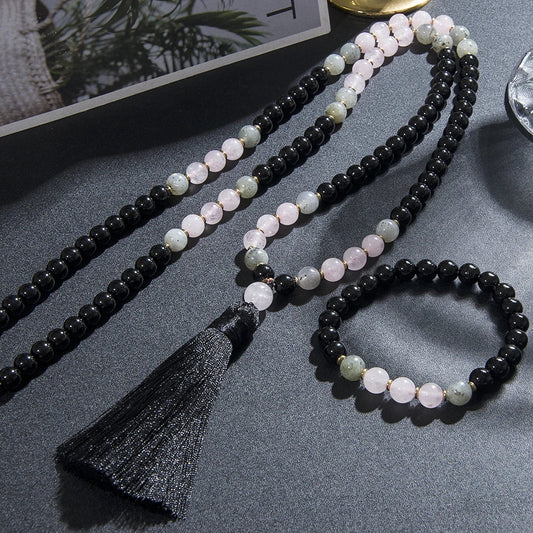
Black Onyx, Rose Quartz & Labradorite Mala — 108-Bead Meditation Necklace
Regular price From $26.95Regular priceUnit price / perSale price From $26.95 -
Green Onyx Bowl — 8-Inch Stone Bowl for Altar & Offerings
Regular price $61.95Regular priceUnit price / perSale price $61.95Sold out -
Tennis Necklace in Punk Rocks — Tiger Eye & Onyx Silver Necklace
Regular price $1,040.95Regular priceUnit price / perSale price $1,040.95 -
Luna Moth Enamel Ear Cuff — Onyx & Glass Talisman, No Piercing
Regular price $123.95Regular priceUnit price / perSale price $123.95
What onyx is, and why one word covers two different stones
Black onyx is a chalcedony — a microcrystalline form of quartz, about 7 on the Mohs scale, opaque and hard. Cream onyx and green onyx are not that at all. They are banded carbonate stone, much closer to a marble: soft enough to scratch with a key, translucent where the wall is thin, and vulnerable to anything acidic. The gem trade has used one name for both materials for a very long time. Nearly everything worth knowing about the pieces here follows from that split.
What every piece here is doing with light
Two makers who have nothing to do with each other describe onyx the same way in their own product text: it is the stone that takes light out of a room. One writes that onyx and iridescent enamel do opposite things with light, one absorbs it and one throws it back. Another writes that the onyx in a woven collar reads flat black and absorbs the light while the tiger eye and peridot beside it throw it back. That is a description of the material, and it explains why onyx is almost never sold alone here. Of the ten onyx pieces in the shop, seven are onyx plus a partner, and the partner is nearly always reflective: gold plate, iridescent enamel, glass, tiger eye, green serpentine. Only the bowl and the two carved incense holders are onyx by itself.
How to judge quality
On pale onyx, read the banding. Cream and green onyx are bought for the bands and for the glow at a thin edge. Legible layering and clean translucence beat strong color.
On black onyx, read the polish and the edges. There is no banding to assess, so the workmanship is the whole story: an even, unscratched surface and crisp carved edges.
Ask about treatment, and expect a yes. Dyed-and-heated black chalcedony is the industry standard and perfectly sound. A seller who states it plainly is telling you they know what they are selling.
On set pieces, judge the setting. In a plated cuff or a woven collar the stone outlasts everything around it; the plating and the base metal decide the piece's life, not the onyx.
Choosing a piece
The range runs from $26.95 to $1,287.95, and that factor of forty-eight tells you nothing useful, because a strand of beads and a sterling tennis necklace are not doing the same job. Compare like with like and the prices stop moving: the two carved incense holders from the same workshop are both exactly $68.95, one in black onyx and one in cream. Same maker, same form, same task, identical price. The only difference is whether the stone absorbs the candlelight or passes it through. That is the decision this page is really asking you to make, and the price will not make it for you.
Honestly named
There is no loose onyx in this shop: no tumbled stone, no pocket stone, no point, no sphere. Every other major stone here has a cheap way in and onyx does not. Ten pieces name onyx in the title, and eight of those ten are published and appear on this page; the other two are unpublished, including a $29.00 red string bracelet that would otherwise be the cheapest onyx in the shop by a long way. Six further pieces contain genuine onyx without saying so in the title — two layering chokers, the gold version of the Luna Moth ear cuff, the black onyx option on the Planchette Ring, and two pieces that are currently unpublished.
What you can actually buy today
Four of the eight published pieces are sold out as this page is written, and we would rather say so here than let you find out at the cart: both $68.95 incense holders, the eight-inch green onyx bowl at $61.95 and the Luna Moth enamel ear cuff at $153.95. What is in stock is the 108-bead mala at $26.95, the carved jewel box at $150.95, the burr star puzzle in cream onyx and green serpentine at $220.95 and the tennis necklace at $1,287.95. The argument this page makes about the material still holds; it is simply that the two holders it is built around are not available at the moment, and the pale-stone answer today is the burr puzzle rather than the sphere holder or the bowl.
Frequently asked questions
Is black onyx dyed?
Usually, and that is normal rather than a fault. Most commercial black onyx in the trade is banded chalcedony that has been dyed and gently heated to an even black — a practice that goes back to antiquity, because uniformly black natural chalcedony is uncommon. It is a stable, permanent treatment and the stone is still genuine chalcedony. What matters is that a seller says so. Cream and green onyx are a different material again and are not dyed; their banding is natural growth.
What is the difference between black, cream and green onyx?
More than color. Black onyx is a chalcedony — a form of quartz, around 7 on the Mohs scale, opaque, hard and happy with water. Cream and green onyx are banded carbonate stone, closer to a marble, far softer and translucent at a thin edge. The trade calls both of them onyx. In practice it means the black piece will shrug off handling and the pale piece will not.
Can I put onyx in water, and how do I clean it?
A black onyx bead or carving can take a brief rinse in cool water and a dry cloth. Cream and green onyx should not be soaked, and they must be kept away from anything acidic — vinegar, citrus, descaler and most bathroom cleaners will etch a permanent dull mark into the polish. The shop's own note on the green onyx bowl says exactly this. For any piece set into wood, enamel or plating, follow the softest material in the piece, not the stone.
What is onyx traditionally used for?
In contemporary crystal practice onyx is associated with boundaries, steadiness and holding a line — which is why it turns up here at thresholds: a box on a nightstand, a holder at the edge of a desk, a bead you can reach for. Several of the pieces on this page say so in their own descriptions. These are traditional associations, not health claims — nothing on this page is intended to diagnose, treat, cure or prevent anything.
Why is the cheapest onyx here $26.95?
Because the shop does not sell a loose onyx stone. Most minerals here start at a $2.95 to $6.95 tumbled or palm stone; onyx has none — no pocket stone, no point, no sphere, no tumbled piece. The cheapest way in is the 108-bead mala at $26.95, and after that the two carved incense holders at $68.95 — both of which are sold out as this page is written, so the mala is currently not just the cheapest way in but the cheapest onyx you can actually buy. If you wanted a single black stone to carry, this is the one material in the shop that cannot give you one.
Which piece should I start with?
Decide what you want the light to do, then check the stock note above, because this page is thin at the moment. If you want a dark object that reads as a silhouette on a shelf, the lidded jewel box at $150.95 is the one in stock; the Smile incense holder at $68.95 does the same job and is sold out as this page is written. If you want a piece that glows when a lamp is behind it, the burr star puzzle in cream onyx and green serpentine at $220.95 is the pale stone you can buy today; the cream onyx sphere holder at $68.95 and the eight-inch green onyx bowl at $61.95 are both listed but sold out. The two holders cost the same and do the same job, so when they return the only real question is which way you want the stone to behave.