

Collection: Tiger's Eye
Nine pieces under one name, and three different stones: golden tiger's eye, blue hawk's eye, and tiger iron banded with hematite and red jasper. $1.95 pebbles to a $1,287.95 necklace.
In short: Turn the stone — if a band of light slides across it, it is tiger's eye; if the surface stays flat, it is not.
-
French Tiger's Eye & Malachite Cuff — Brushed Gold, Made in Paris
Regular price $280.95Regular priceUnit price / perSale price $280.95 -
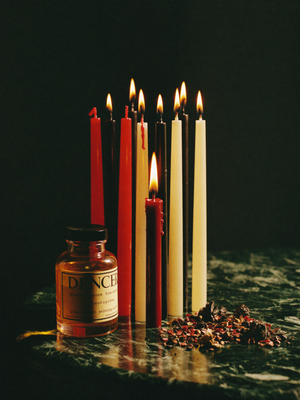
Tiger's Eye Clean Crystal Candle — Unscented Soy Candle for Courage & Personal Power
Regular price $28.95Regular priceUnit price / perSale price $28.95 -
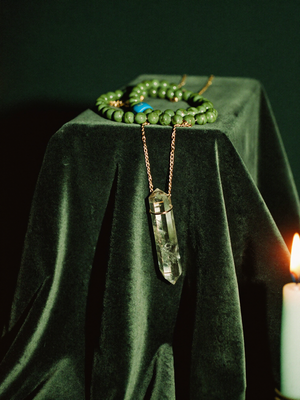
Amethyst Mala Necklace — Carnelian, Apatite & Tiger's Eye Beads
Regular price $147.95Regular priceUnit price / perSale price $147.95 -
Triple Protection Trio — Obsidian, Tiger's Eye & Hematite Stone Set
Regular price $8.99Regular priceUnit price / per$20.00Sale price $8.99Sale -
Blue Tiger Eye Tumbled Pocket Stone — Hawk's Eye Clarity & Calm Crystal
Regular price $4.95Regular priceUnit price / perSale price $4.95 -
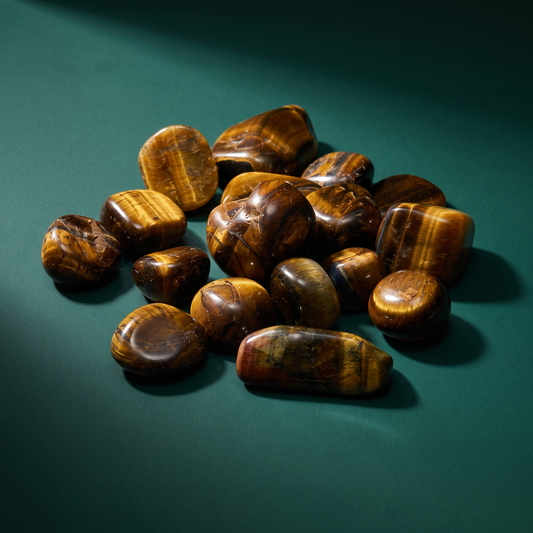
Tiger Eye Tumbled Pebbles — Focus & Grounding Crystal Grid Stones
Regular price $1.95Regular priceUnit price / perSale price $1.95 -
Tiger Iron Tumbled Pocket Stone — Strength, Vitality & Grounding
Regular price $6.95Regular priceUnit price / perSale price $6.95 -
Tiger Eye & Poison Dart Tennis Necklace — Gold Statement Necklace
Regular price $1,040.95Regular priceUnit price / perSale price $1,040.95 -
Tennis Necklace in Punk Rocks — Tiger Eye & Onyx Silver Necklace
Regular price $1,040.95Regular priceUnit price / perSale price $1,040.95
Tiger’s eye: three stones under one name
Golden tiger’s eye formed when crocidolite fibers were completely replaced by silica — hence the warm golden-brown. Blue tiger eye, sold as hawk’s eye, is the same process left unfinished: more of the original blue-gray mineral survives, so the stone reads cool. Tiger iron is neither, or all three — a natural banding of tiger’s eye with hematite and red jasper in gold, gray and deep red. One name, three formations — the color tells you which you hold.
How to tell a good piece
Everything depends on chatoyancy: the silky band of light that slides across the surface as you turn the stone. It comes from the parallel fiber structure and it is directional — rotate a bowl of pebbles a quarter turn and the character changes. A piece whose band sits still, or reads flat brown from every angle, was cut across the fiber rather than along it. On tiger iron judge the banding instead: three distinct layers, no two pieces alike.
Choosing between them
Warm and cool are traditionally used for opposite things. Golden tiger’s eye is associated with the Solar Plexus and Root chakras — drive, focus, nerve. Hawk’s eye with the Throat and Third Eye: the pause before you speak. Tiger iron sits between them, traditionally a stone of stamina rather than of one decision.
By format: loose pebbles for grids and bowls, pocket stones for carrying, the $8.99 Triple Protection Trio if you want it raw beside obsidian and hematite, the crystal candle if you want it burning rather than held. Worth saying plainly — no piece of jewelry here is tiger’s eye on its own. The Paris cuff carries four stones, the mala five, and both tennis necklaces set it against onyx, amethyst or colored glass. For the stone unmixed, stay at the tumbled end of the page.
Care
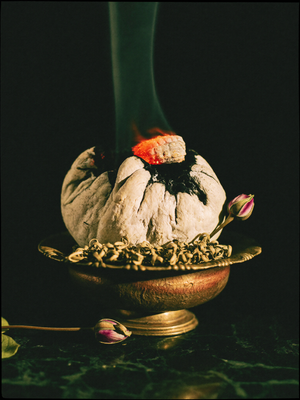
Tiger’s eye is a quartz, hard enough for daily handling, so a rinse and a proper dry does a loose stone no harm. Care follows the most fragile part of a piece, not the stone: plated necklaces and the Paris cuff stay away from water, perfume and lotion, and strung malas come off before a shower — the cord fails long before the beads. Smoke or a night beside selenite cleans everything here without risk.
From the magazine: Solar plexus chakra explained · Throat chakra explained · Bronzite vs. tiger’s eye · How to make a crystal grid · How to cleanse crystals. For every stone, candle and oil sold for the same purpose as the trio, see Protection.
Frequently asked questions
What is chatoyancy?
The band of light that moves across the stone as you turn it, caused by parallel mineral fibers. It is the quickest identity test: no moving band, no tiger’s eye.
What is the difference between golden and blue tiger’s eye?
Formation. Golden is fully silicified; blue tiger eye, or hawk’s eye, keeps more of the original blue-gray crocidolite. Golden is traditionally associated with drive, hawk’s eye with perspective and speech.
What is tiger iron?
A natural blend of tiger’s eye, hematite and red jasper banded together; the pocket stones here come from Africa. The gold, gray and red layers are why every piece looks different.
Can tiger’s eye get wet?
A loose tumbled stone, yes — rinse in cool water and dry it. Set pieces, no: plating, soft companion stones such as malachite, and strung cord are the limiting factor.
Which piece should I start with?
A single pocket stone to carry, the raw trio for a protection pouch, the bag of pebbles for a grid or a bowl, the candle if you want it lit rather than held.
Is tiger’s eye sold here on its own?
As a stone, yes. As jewelry, no — every wearable piece on this page combines it with at least one other material.
Offered as traditional and decorative objects, not medical devices. Nothing here is intended to diagnose, treat, cure or prevent any condition.