Collection: Incense Burners & Holders
Sixteen pieces for smoke work: trays that catch stick ash, one deep ceramic bowl for charcoal and smudge bombs, an abalone shell for bundles, and the herb-pressed disks themselves. $3.95 to $80.95.
In short: Match the vessel to the format, not to the look.
-
Moon Phase Incense Holder — Hand-Carved White Marble with Brass
Regular price $42.95Regular priceUnit price / perSale price $42.95Sold out -
Jalini Hamsa Moon Phase Incense Holder — Hand-Painted Ceramic
Regular price $20.99Regular priceUnit price / perSale price $20.99 -
Lalita Evil Eye Incense Holder — Hand-Painted Jaipur Blue Pottery
Regular price $27.99Regular priceUnit price / perSale price $27.99 -
Indukala Moon Incense Holder — White Marble with Brass Inlay
Regular price $38.95Regular priceUnit price / perSale price $38.95 -
Marble Incense Holder — Oval and Square, Reclaimed Stone
Regular price $23.95Regular priceUnit price / perSale price $23.95 -
Gemstone Sphere Incense Holder — Cream Onyx
Regular price $68.95Regular priceUnit price / perSale price $68.95 -
Smile Incense Holder — Hand-Carved Black Onyx
Regular price $68.95Regular priceUnit price / perSale price $68.95 -
Jyotisha Celestial Incense Holder — Mango Wood with Brass Inlay
Regular price $20.99Regular priceUnit price / perSale price $20.99 -
Anka Incense Holder — Brass Tray with Marble Sphere
Regular price $80.95Regular priceUnit price / perSale price $80.95 -
Abalone Shell — 5-Inch Natural Smudge Bowl
Regular price $24.95Regular priceUnit price / perSale price $24.95 -
Flower of Life Incense Burner — 10-Inch Printed Wood Holder
Regular price $3.95Regular priceUnit price / perSale price $3.95 -
Eve Incense Holder — Handmade Stoneware Dish for Incense
Regular price From $34.95Regular priceUnit price / perSale price From $34.95 -
Sagrada Madre 7-Day Smoke Cleansing Charcoal Tablets — One Disk a Day
Regular price From $27.95Regular priceUnit price / perSale price From $27.95 -
Sagrada Madre Smoke Cleanse Charcoal Disks — Herb-Infused Smudging Disks
Regular price From $24.95Regular priceUnit price / perSale price From $24.95 -
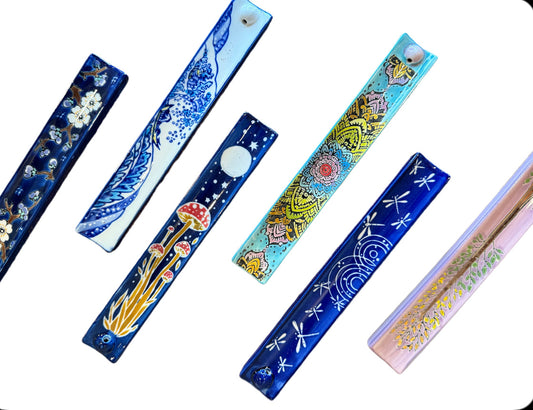
Motifs Incense Holder — Handpainted 9-Inch Ash Catcher Tray
Regular price $31.95Regular priceUnit price / perSale price $31.95 -
Ceramic Incense Burner — Smudge Bowl for Charcoal & Cleansing Rituals
Regular price $31.95Regular priceUnit price / perSale price $31.95
How to choose an incense burner, holder or bowl
Every vessel on this page does the same basic job: it holds burning material safely and catches what falls off it. The reason there are sixteen of them is that smoke comes in three formats, and each one falls apart differently. A stick sheds a long, light trail of ash for its whole length. A charcoal disk sits in one place and burns hot all the way through. A bundle needs somewhere to rest between passes without going out. Choose for the format you actually burn, not for the piece you like the look of. Our buyer's guide to incense burners walks through the same decision in more detail, and sticks versus cones explains why almost everything here is built around a stick.
Twelve of these are stick holders. One is a bowl. One is a shell.
This is the single most useful thing to know before you spend anything. Sixteen products, of which two are the charcoal itself and fourteen are vessels. Of those fourteen, twelve are built around a stick — a dish, a tray or a carved block with a hole in it. One, the ceramic smudge bowl at $48.95, is a deep vessel made to hold burning material in place: charcoal disks, smudge bombs, pyramids and triangles. It comes in ivory and marble finishes; the yellow one is sold out at the moment. The fourteenth is the five-inch abalone shell at $24.95, wide and shallow, for bundles — and there is exactly one left in stock. So if you burn charcoal and buy a marble dish because it is beautiful, you have bought the wrong object. Sticks are covered here at every price from $3.95 to $80.95. Charcoal is covered by exactly one piece.
For sticks, length beats price
Ash escapes for two reasons: the tray is shorter than the stick, or the burning tip sits past the end of it. Both are geometry, and neither is fixed by spending more. The longest ash catcher on this page is also the cheapest — the ten-inch Flower of Life tray in printed wood at $3.95, in five colorways (natural, pea green, forest green, red and pink; the pattern itself is explained in sacred geometry symbols explained). The nine-inch handpainted Motifs tray costs $48.95 and comes in eight designs — dragonfly, plum blossom, cherry blossom, blue wave, mandala, tree of life, seven chakras and dragon. Per inch of catching surface that is $0.40 against $5.44, a factor of nearly fourteen, and the cheaper one catches marginally more. If you want the seven-chakra tray to mean something rather than just look like something, the seven chakras explained is the place to start; the dragonfly has its own page in dragonfly symbolism.
What the extra money buys is material and permanence. Hand-carved white marble with brass inlay comes twice: the Indukala round moon holder at $38.95, a radiating crescent around a single center hole, and the Moon Phase holder at $42.95 with two holes and the lunar cycle laid into the stone — the second one is currently sold out. Onyx comes in two colors at $68.95, the cream onyx sphere (currently out of stock), which glows faintly at the edges when a candle sits beside it, and the black onyx Smile holder (currently out of stock), a curved lip that catches the ash if the stick leans forward. The Eve dish is hand-thrown stoneware from Wisconsin at $34.95. Two pieces come out of Jaipur's blue-pottery workshops, ground quartz rather than clay, low-fired and painted by hand: the Jalini hamsa and moon-phase dish at $20.99 and the Lalita evil eye dish at $27.99 — the two motifs are covered in what the hamsa hand means and evil eye protection. The Jyotisha holder at $20.99 is sustainably harvested mango wood with a brass constellation inlaid; the name is the Sanskrit word for Vedic astrology. At the top of the range, the Anka holder at $80.95 is a Fair Trade brass tray with a white marble sphere. Marble and stone do something wood cannot — they do not scorch, do not warp, and take a thousand wipes. If a piece is going to live out on the altar or the windowsill permanently, that is what you are paying for. If you want ash caught and put away in a drawer, spend $3.95 and stop.
Two smaller notes on the range. The reclaimed-marble holder at $23.95 is cut from stone-processing offcuts and comes as an oval and a square designed as a pair rather than as alternatives; only the square is in stock right now, and the oval measures 0.8″ H × 4″ W × 3.35″ D — small, so seat the stick carefully. The hand-thrown Eve dish is three inches across and comes in ten finishes at two prices: six smooth glazes at $34.95, and four heavier “Gloopy” glazes at $51.95, where the stick stands upright through a center hole instead of leaning into a slot. Same maker, same form, same size — the $17.00 step is glaze, not function.
Sand is the step people skip
A shell is not a fireproof bowl. Line the base with a shallow layer of sand or salt and rest the lit bundle on that, never on bare nacre. This is the most common reason an abalone shell cracks in its first session; the shell here is five inches across, up to 165 g, from Mexico, and why abalone became the smudging dish covers both the tradition and the handling. The same layer earns its keep under a charcoal disk in the ceramic bowl: it insulates the base, stops the disk sliding, makes the cold ash easy to tip out, and gives you somewhere to bury an ember when you want the smoke to stop before the material has finished. A dish of builders sand costs almost nothing and outperforms most purpose-made accessories. If you are working with bundles, how to burn a smudge stick properly covers lighting and putting one out, and what to burn instead of white sage is worth reading before you choose the bundle itself.
About the charcoal on this page
Two products, both with the herbs and resins already pressed into the disk — this is not blank charcoal for burning your own loose resin, which the shop does not sell on its own. The six-scent Smoke Cleanse disks at $24.95 a box run rue, frankincense, lavender, palo santo, white sage, and cinnamon with anise, and give roughly 45 to 60 minutes of steady smoke per disk. The 7-Day box at $27.95 is seven disks built around one theme — sandalwood and yagra, myrrh and benzoin, rose and lavender, or an assorted box that changes blend daily, copal among them — which works out at $3.99 a disk. In both cases the charcoal itself stays lit about twenty minutes after the herbs have burned off, so plan the end of the session as well as the start.
Worth checking before you add a multipack: the bundles here are convenience, not a discount. Six single boxes of the herb-infused disks cost $149.70; the six-box set is $146.95, a saving of $2.75, or 1.8%. Four single 7-day boxes cost $111.80 against $110.95 for the four-box set — $0.85, or 0.8%. Buy the set because you want one of each scent, not because you expect it to be cheaper. If you do want to burn loose resin rather than pressed disks, burning resin on a charcoal disc without scorching it explains the technique, and the ceramic bowl is the vessel for it. Plants you should never burn as incense is the list to check before anything home-gathered goes on a disk.
Ventilation, and where the rest of the smoke lives
Stable, heat-tolerant surface with clear space above it. Nothing burning is left unattended, everything stays away from children and pets, and the vessel cools completely before it is emptied or moved — ceramic, stone and shell all hold heat far longer than they look like they do. Open a window before you light a disk; an hour of charcoal smoke is a great deal of smoke for one room, and in a small apartment it will find a detector. Burning incense in an apartment deals with alarms and airflow specifically, the room-by-room route covers working through a whole home, and spray or smoke is the honest comparison for anyone who cannot open a window at all. If the holder is going to sit on an altar, how to set up an altar and an altar in a shared room cover placement. For what goes in these vessels, see Incense Sticks, Smudge Sticks & Sage and the wider Sacred Smoke & Cleansing range; the stone pieces have cousins in Onyx and Bowls, Trays & Vases. Herbs, resins and smoke are traditionally used for cleansing and focus; those uses are not scientifically established, and nothing here replaces medical, legal or financial advice.
Frequently asked questions
Can I burn a charcoal disk in a wooden or marble incense holder?
No. Charcoal disks heat through the whole disk and stay lit for around twenty minutes after the herbs have burned off. They need a deep, heat-tolerant ceramic bowl or a dish of sand. The wood trays and the flat marble and stone dishes on this page are made for sticks — they are too shallow to contain a disk and, in the case of wood, the wrong material entirely. One piece here is built for charcoal: the ceramic smudge bowl at $48.95.
Do I need sand in an abalone shell?
Yes. A shallow layer of sand or salt in the base is what stops the shell cracking, and it is the step most people skip. Rest the lit bundle on the sand rather than directly on the bare nacre, carry the shell with a hand underneath it, and let everything burn out and cool fully before you tip out the ash. Never run a warm shell under water. If a shell does crack, it still works as a jewelry or offering dish.
Why does my incense stick still leave ash on the shelf?
Almost always the angle, not the holder. A stick seated too upright drops its ash behind the tray; tilted slightly forward along the tray, the ash lands where it should. The second cause is length: a ten-inch stick needs a tray at least that long, which on this page means the $3.95 wood tray or the nine-inch Motifs tray with the stick angled low. Emptying the old ash between burns also helps — a bed of ash insulates the stick and makes the burn uneven.
What is the difference between the $3.95 wood tray and the $48.95 handpainted one?
An inch of length and the material. The printed wood tray is ten inches and the handpainted tray is nine, so the cheaper one catches slightly more ash. What the $45 buys is a ceramic surface that does not scorch, eight hand-painted motifs, and a piece made to stay out on a shelf between burns rather than go into a drawer. For catching ash alone, the wood tray does the job.
Is Jaipur blue pottery safe to use with incense?
Yes, for sticks. It is fired at a low temperature and made from ground quartz rather than clay, so it is more delicate than stoneware: treat it as a dish, not a burner, keep it to one stick at a time, and never put charcoal in it. Wipe it with a soft damp cloth, no scouring and no dishwasher. The two pieces here are the hamsa moon-phase dish at $20.99 and the evil eye dish at $27.99.
How do I clean a marble or onyx incense holder?
Dry cloth for ash, which lifts off stone without water. Resin residue comes off with a little warm water on the stone only; keep it off inlaid brass, which marks more easily than the marble around it. No abrasives on polished onyx, and do not leave oily resins standing on bare marble, because the stone is porous and can mark over time.