




How to Smudge Your House: The Room-by-Room Route, Step by Step
A room-by-room route through a whole home, what to burn, which direction to walk, what to say at the door, and the ventilation and safety notes most guides leave out.


A room-by-room route through a whole house, what to burn, what to say, and the ventilation and safety notes most guides leave out. It also says plainly where the word "smudging" comes from and who it belongs to. It does not claim that smoke removes anything from your home that could be measured.
Contents
To smudge your house, open a window in every room first, then light the bundle for five to ten seconds and blow the flame out so it smolders. Holding a heatproof dish underneath, start at the front door and walk clockwise along the walls of every room, letting smoke reach corners, closets, windows, doorways and the bathroom. Return to the front door, say out loud what the house is for, and press the bundle out in sand. Tidy before, not after. A one-bedroom takes about ten minutes and a house twenty to thirty, plus fifteen minutes of open windows afterwards.
Burning plant material indoors produces fine particulate matter and temporarily degrades indoor air quality; ventilation is the standard mitigation.
Source/tradition: US Environmental Protection Agency, indoor air quality guidance on combustion sources
Birds have respiratory systems that are unusually sensitive to airborne particulates and fumes, which is a standard veterinary caution for households that burn anything indoors.
Source/tradition: Standard avian veterinary guidance on inhaled toxins and particulates
White sage, Salvia apiana, is subject to documented harvesting pressure on wild stands in Southern California and is tracked as a species of concern.
Source/tradition: United Plant Savers species assessment, Salvia apiana
Burning aromatic plants and resins to purify a space is documented across a very wide range of cultures, including Catholic censing, Japanese ko-do, South Asian dhoop and European folk practice.
Source/tradition: Standard ethnobotanical and religious-studies literature on incense and censing
Smudging names specific ceremonies belonging to particular Native American and First Nations peoples; smoke cleansing is the accurate general term for the practice described here.
Source/tradition: Indigenous practitioner statements and cultural-appropriation literature on the term
Thresholds, doors and windows are treated as the significant boundaries of a dwelling across European and Mediterranean folk protective practice.
Source/tradition: Davies, Popular Magic: Cunning-folk in English History (2007)
Clockwise movement is used to bring in and settle, counterclockwise to clear and banish, and the room order runs from the front door around the perimeter and back.
Source/tradition: Contemporary practitioner literature and shop practice
Smoke removes negative energy, spirits, curses or bad luck from a building.
Source/tradition: No controlled evidence of any measurable difference between a cleansed and an uncleansed space
Burning herbs disinfects a home or improves indoor air quality.
Source/tradition: Contrary to measured effect: combustion raises indoor particulate levels. Not a health claim.
VERIFIED = verifiable in scientific or official sources · TRADITIONAL = historically or culturally recorded · LIVED PRACTICE = widely practiced, experiential knowledge · NOT PROVEN = spiritual interpretation, not scientifically established.
Quick answer: Open a window in every room first. Light the bundle, let it flame for a few seconds, then blow it out so it smolders. Start at the front door, walk clockwise through the whole house holding a heatproof dish underneath, and let the smoke reach corners, closets, doorways and windows. Finish where you started, say what the house is for, and put the bundle out in sand or a dish. A one-bedroom takes about ten minutes; a house takes twenty to thirty.
How do you smudge your house?
Seven steps, in this order. The order is the part that matters — almost every failure in this practice is a sequencing problem rather than a technique problem.
- Tidy first, and open a window in every room. Both are practical and both are traditional. Smoke needs somewhere to go, or you are just moving it around a sealed box.
- Decide what this is for, in one sentence, before you light anything. "This house is calm now" is a different act from "whatever happened in here is finished."
- Light the bundle and blow the flame out. You want an ember and a steady thread of smoke, not a torch. Hold the flame on it for five to ten seconds, then blow it out firmly.
- Carry a heatproof dish underneath the whole time. A shell, a ceramic bowl, a saucer of sand. Embers fall, and they fall on carpet.
- Start at the front door and move clockwise through every room. Corners, closets, behind doors, window frames, thresholds.
- Return to the front door and close it out loud. Say the sentence you decided on in step two.
- Extinguish properly. Press the lit end into sand or dry earth until no smoke rises, then leave it somewhere fireproof for twenty minutes before walking away.
What does smudging your house actually do?
Two honest answers, and they are different sizes.
In the tradition, burning aromatic plants clears stagnant or hostile energy from a space and marks it as reset. Some version of that idea appears in an enormous range of cultures — Catholic censing, Japanese kōdō, South Asian dhoop, European folk smoking of houses at midwinter, and the smudging ceremonies of many Native American and First Nations peoples. The universality is real and it is worth respecting.
Outside the tradition, what happens is this: you walk deliberately through every room of your home, you look into corners you have not looked into for months, you open every window, and you say out loud what you want the place to be. Then the whole house smells different, which is the strongest available signal to a human brain that something has changed. That is not a small thing, and it does not require the smoke to remove anything.
We are careful about which of those we claim, because we sell the bundles.
A word about the word "smudging"
"Smudging" is the English name for specific ceremonies belonging to specific Native American and First Nations nations, in which particular plants are burned in particular ways by people with standing to do it. It is not a generic verb, even though it is used as one — including in the search that probably brought you here, and including in the headline of this article.
What most people are actually doing, and what this guide describes, is smoke cleansing: burning aromatic plants to reset a space. That practice is genuinely near-universal and nobody needs permission for it. Using the accurate word costs you nothing and it avoids claiming a lineage that is not yours.
The related question — whether to buy white sage at all, given the pressure on wild stands in Southern California and the objections raised by Indigenous writers — has a real answer that deserves its own space. We set it out in white sage smudging, honestly.
What do you need to smudge a house?
Three things, and only three: something that smolders, something heatproof to catch it, and moving air.
The bundle. Size it to the job. A four-inch stick clears a room and burns out; a larger bound bundle stays lit long enough to walk a whole floor without relighting halfway down a hallway, which is the most common annoyance in this practice.
The dish. Abalone shell is traditional and beautiful; a ceramic bowl or a saucer with a half-inch of sand is entirely equivalent and safer, because sand also extinguishes. Never use plastic, never use a good wooden dish.
Air. Windows open before you light anything. This is a fire-safety and air-quality point as well as a traditional one — smoke has to leave.
Optional and genuinely useful: a feather or a folded card to direct smoke into corners, and a lighter with a long neck if the bundle is dense. Everything else sold alongside this is decoration.
| What you burn | Smoke | Stays lit | Best for |
|---|---|---|---|
| Bound herb bundle | Heavy | Up to 2 hours | Walking a whole house in one pass |
| Small 4 in. stick | Medium | 10–20 min | One or two rooms, apartments |
| Palo santo stick | Light | Needs relighting | Sensitive noses, small spaces |
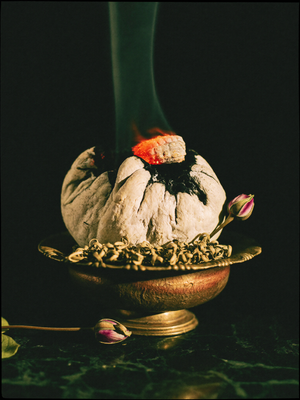
| Resin on charcoal | Very heavy | 30–60 min, stationary | One room, set down not carried |
| Incense stick | Light | 40–50 min | A workable substitute — see below |
| Spray or mist | None | n/a | Rentals, alarms, asthma, babies, pets |
If you have relit a bundle three times in a hallway, the problem is the format, not you.
If you want to work with this yourself, this is what we use:

Smudge Stick — Palo Santo, Rosemary & Rue Cleansing Bundle
We list this one rather than a small stick because of the number that decides a whole-house pass: up to two hours of burn time. A bundle this size walks every room, every doorway and the cupboard under the stairs without going out on the landing. Palo santo, rosemary and rue — and no white sage, which sidesteps the sourcing question entirely. $15.00
See the cleansing bundleDo you smudge clockwise or counterclockwise?
Clockwise to bring in and settle, counterclockwise to clear out and banish. That is the convention in most European-derived folk practice, and it is the one nearly all English-language guides are quietly using when they say "move clockwise."
The practical version: if you are cleansing a home after an argument, an illness, a break-up or a previous tenant, one counterclockwise pass to clear followed by one clockwise pass to settle is the complete form. If you are doing routine maintenance on a home that is basically fine, one clockwise pass is enough and the second lap is theater.
Nothing goes wrong if you get this backwards. It is a convention for organizing your attention, not a mechanism, and a confident counterclockwise walk beats an anxious clockwise one every time.
Do you open the windows when you smudge?
Yes — before you light anything, and in every room you are going to walk through, not just the one you are standing in.
Traditionally the open window is the exit: what you are clearing needs a way out, and a sealed room gives it nowhere to go. Practically, burning plant material produces fine particulate matter, and a closed house concentrates it. Ventilation is the single thing that turns this from a smoky ordeal into a ten-minute practice, and it is also what keeps your smoke alarms out of it.
Leave them open for ten to fifteen minutes after you finish. That interval is part of the ritual in most traditions and it is also just how air exchange works.
Should you clean your house before or after smudging?
Before. Every tradition that has an opinion says before, and the practical logic is obvious once stated: you would not polish a floor and then walk over it in muddy boots.
It does not have to be deep cleaning. Open the curtains, clear the surfaces, take out the trash, put the dishes away, make the beds. Fifteen minutes. The point is that you are not asking smoke to do a job that a bin bag does better, and that walking through a tidy house makes the corners visible — which is where the practice actually happens.
Afterwards, the only cleaning left is emptying your dish once the ash is cold.
Room by room: the route through a whole house
Start at the front door on the inside, facing in. Walk the perimeter of the whole home in one continuous line and come back to where you started. Do not zigzag; the continuity is most of what makes it feel like an act rather than a chore.
The specific places smoke should reach, in the order you meet them:
The entryway. Doorframe, threshold, the inside of the front door, and the coat hooks. This is the boundary of the house and every threshold tradition in Europe and the Mediterranean treats it as the important one.
Every room, along the walls. Follow the walls rather than crossing the middle. Corners hold the attention here — floor corners and ceiling corners both — because corners are where stagnation is imagined to gather and, unromantically, where dust actually does.
Windows, mirrors and drains. Windows and mirrors are treated as openings in nearly every folk tradition; drains and vents are the same idea updated. A few seconds each.
Closets, cupboards and under the stairs. Open the doors. The half of the house you keep shut is exactly the half that never gets included, and including it is the difference people notice.
Bedrooms last on each floor. Go lighter here — heavy smoke in a bedroom is unpleasant to sleep in for a night afterwards. Around the bed, the headboard, under it if you can reach.
Basement and garage if you have them, then back up.
The front door again, from the inside. Close the circle. Say the sentence. Then put it out.
Temple tip
Do the bathroom. Everyone skips it because it is small and unglamorous, and it is the room in the house where the door is shut most of the time, where the window is smallest, and where the drain is. Ten seconds in the bathroom does more for how a home feels than a second lap of the living room — and if you have ever finished a cleansing and thought something was still off, that is usually where it was.
What do you say when you smudge your house?
Say what you want the house to be, in the present tense, in your own words. That is the whole formula, and no memorized prayer will outperform a sentence you actually mean.
Three forms that people use, depending on what the house needs.
Clearing something specific. "What happened here is finished." Name it if you can. This is the version for after an illness, a fight, a break-up, or a tenant who left something behind.
Claiming a new place. "This is our home now." The most common reason people search for this at all is a move, and moving in is the moment the practice fits most naturally.
Routine reset. "This house is clear and quiet." Short enough to repeat in every doorway without it becoming a performance.
Say it at the front door at the end, out loud. If someone else lives there, have them say it too — a house cleansed by one person over the objections of another has an obvious problem that no amount of smoke addresses.
How long does it take to smudge a house?
Ten minutes for a one-bedroom apartment, twenty to thirty for a three-bedroom house including closets, and about fifteen minutes of open windows afterwards.
If it is taking an hour, you have turned it into a project, and projects do not get repeated. The version you will still be doing next year is the short one.
How often should you smudge your house?
When something changes — not on a schedule. There is no correct interval, and any page giving you a fixed one is inventing it.
The moments practitioners consistently name: moving into a new place, after illness or a period of conflict in the home, after a lot of people have been through, at the turn of a season or a year, and when you notice you have started avoiding a particular room. That last one is the most useful signal on the list.
Monthly with the new moon is a common rhythm because it is easy to remember. Weekly whole-house cleansing is a sign of anxiety rather than practice, and a daily five-minute reset of a single room does more good than a monthly ordeal — the short-form version is in how to cleanse a room with smoke or spray.
When is the best time to smudge your house, and can you do it at night?
Whenever you will actually do it. Yes, night is fine — there is no tradition holding that smoke stops working after dark, and the "never at night" rule circulating online has no source behind it.
Morning suits a clearing, because you get the whole day of open windows and daylight afterwards, and because the practical business of airing out a house is easier before evening. Evening suits a claiming or a settling. Practitioners who work with the moon use the waning moon for clearing out and the new moon for beginning again.
The one timing rule worth keeping is unglamorous: do not do it in the fifteen minutes before you need to leave the house. You should not be extinguishing a bundle in a hurry.
Can you smudge your house wrong?
You can do it unsafely, and you can do it thoughtlessly. Beyond that, no — there is no error state where you make things worse, and the fear that there might be is doing more harm than any mistake you could make with a bundle of herbs.
The genuine mistakes are these. Leaving an ember unattended, which is a house fire rather than a spiritual failure. Working in a sealed room, which is unpleasant and pointless. Doing it while distracted, which produces a house that smells of rosemary and nothing else. And doing it at someone — cleansing a home you share as a move in an argument is a use of the practice that no tradition endorses.
If you finish and feel nothing shifted, the usual cause is that you never said what it was for. Go back to the front door and say it.
How to smudge your house without sage
Sweetgrass deserves a separate mention here, because it is not a substitute for sage at all. In the traditions it comes from it is used afterwards, to welcome rather than to clear — what a sweetgrass braid is actually for, and how to keep one lit.
Rosemary, cedar, juniper, mugwort, lavender, bay and pine all smolder well, are widely available, and carry their own long documented histories in European and Mediterranean practice. None of them requires you to buy white sage.
There are two separate reasons people look for an alternative, and they deserve separating. The first is supply and respect: white sage is under real pressure from illegal harvesting of wild stands in Southern California, and Indigenous writers have objected to its mass-market sale. The second is simply that a lot of people do not like the smell, which is a good enough reason on its own.
Rosemary is the most direct substitute — it is the herb of memory and protection in European folk practice, it grows on a windowsill, and a bundle of it burns cleanly. We compared the realistic options, including which ones are pleasant indoors, in what to burn instead of white sage, and set the two most common choices against each other in palo santo vs sage.
Can you smudge your house with incense instead?
Yes. A stick of incense is a perfectly legitimate substitute, and censing with resin and incense is the older and more widely documented practice of the two — it is what happens in churches, temples and shrines across most of the world.
The practical difference is that a stick will not stay lit while being carried at walking pace through a drafty hallway. Two workarounds: carry it in a portable burner with the tip shielded, or set lit sticks in each room in turn and walk the route between them. Resin on charcoal is heavier and more traditional still, but it is genuinely stationary — you set it down in a room, you do not carry it around a house. The mechanics of getting resin to smolder rather than scorch are in how to burn resin incense on a charcoal disc.
If burning anything at all is off the table — a rental with linked alarms, an infant, a cat, a housemate with asthma — a botanical mist does the ritual without the smoke, and there is no version of this practice in which that counts as cheating. Those are in the ritual oils and sprays collection.
Is it safe? Smoke, pregnancy, asthma and pets
Burning any plant material produces fine particulate matter, and indoor smoke in a closed room measurably degrades air quality for as long as it hangs there. That is true of incense, of candles and of a herb bundle, and it is the reason the open window is the first instruction in this article rather than a footnote.
Sensible precautions, none of which are exotic. Ventilate throughout and for fifteen minutes afterwards. Keep smoke away from birds specifically — birds have respiratory systems that are unusually sensitive to airborne particulates, and this is a well-established veterinary caution. Take cats and dogs out of the room you are working in and let them back once it has cleared. Go light in bedrooms and light in any room where a baby sleeps.
If you are pregnant, asthmatic, or living with anyone who has a respiratory condition, this is a question for your doctor rather than for a shop, and the smoke-free options above exist precisely for that case. We are not going to tell you it is fine; we do not know your situation, and nothing on this page is medical advice.
What to do after smudging your home
Four things, none of which take long, and all of which are what people mean when they say a cleansing did or did not "hold."
Leave the windows open. Ten to fifteen minutes. The exit is part of the practice.
Extinguish properly and check twice. Press the lit end into sand or dry earth until nothing rises. Leave it in a fireproof dish for twenty minutes before you consider it done. A bundle that looks out can smolder for a surprisingly long time.
Put something in. Every tradition that clears also fills — light a candle, open a window to sun, cook something, put on music. An emptied space that stays empty is the most common complaint after a cleansing, and it has a five-minute fix.
Do the small thing you have been avoiding. Not mystical. If a cleansing changes how a house feels for a week and then it goes back, the cause is usually a real, physical, unfinished thing that the smoke was standing in for.
If you keep stones at thresholds or on windowsills as part of the same reset, they will have been sitting in the smoke — which is a cleansing method in its own right. How to cleanse crystals covers what smoke is safe for, and it is safe for everything.
Voices from practice
We do not publish invented testimonials, so this is a summary of patterns visible in public practitioner discussion rather than quotes attributed to anyone.
The most common first-time report is not about energy at all — it is about the bundle going out repeatedly, and the answer is almost always that it was lit for two seconds instead of ten, or that it was a small stick being asked to walk a whole house. The second recurring theme is a correction that Indigenous practitioners make regularly and patiently: that smudging names their ceremonies specifically, and that "smoke cleansing" is the accurate term for what most people are doing. The third is that experienced practitioners describe the tidying and the open windows as inseparable from the practice, while beginners treat both as preliminaries to skip.
What we don't promise
We sell the bundles, so this goes here rather than in small print.
There is no evidence that smoke removes negative energy, spirits, curses or bad luck from a building, and no evidence that a cleansed house differs in any measurable way from an uncleansed one. Burning herbs does not disinfect a home, does not improve indoor air quality — it temporarily worsens it — and is not a treatment for anything. If a house has damp, a smell, a pest problem or a broken relationship in it, smoke will not touch any of those, and it is not a substitute for a landlord, a doctor or a difficult conversation. Nothing here is a health claim.
What a whole-house cleansing reliably does is mark a break. You go into every room, you look at the parts of your home you have been ignoring, you open every window, and you say out loud what you want the place to be. That is a real act with a real effect on the people who live there, and it does not need the smoke to do anything at all.
Practically: how to work with this
- Tidy for fifteen minutes and open every window. Non-negotiable, and it is half the practice.
- Decide the sentence before you light anything. Clearing, claiming or resetting — pick one.
- Match the bundle to the building. A four-inch stick for one room; a full bundle for a house, or you will be relighting it on the stairs.
- Dish underneath, always. Sand in it if you have sand.
- Front door, clockwise, along the walls, closets open, bathroom included, back to the front door.
- Say it out loud at the end, and have everyone who lives there say it if they will.
- Put it out in sand, then check it again twenty minutes later.
- Put something in. Candle, sunlight, cooking, music. Do not leave the house empty.
Bundles, resins, charcoal and burners are all in the sacred smoke and cleansing collection if you are starting from nothing. If you have never got a bundle to smolder steadily rather than flare and die, how to burn a smudge stick properly is the mechanics.
What should you burn in your home?
Four questions. No email required.
The same smoke method applied to a person rather than a room is covered in how to cleanse your aura.
Once the house is cleansed, a sound-marked threshold is the usual way people keep the boundary present between cleansings. Witch bells for door protection explains where to hang one and what the tradition can honestly claim.
Frequently asked questions
How do you smudge your house step by step?
Tidy and open a window in every room. Decide in one sentence what this is for. Light the bundle for five to ten seconds and blow the flame out so it smolders. Holding a heatproof dish underneath, start at the front door and walk clockwise along the walls of every room, into corners, closets, windows and the bathroom. Return to the front door, say your sentence out loud, and press the bundle out in sand.
Do you smudge clockwise or counterclockwise?
Clockwise to bring in and settle, counterclockwise to clear out. For a home after conflict, illness or a previous tenant, one counterclockwise pass to clear then one clockwise pass to settle is the full form. For routine maintenance, one clockwise pass is enough. Nothing goes wrong if you reverse it — it is a convention for organizing attention, not a mechanism.
Do you open windows when smudging?
Yes, before you light anything, in every room you will walk through, and leave them open for ten to fifteen minutes afterwards. Traditionally the open window is the exit for what you are clearing. Practically, burning plant material produces fine particulate matter and a sealed house concentrates it — ventilation is what keeps this a ten-minute practice rather than a smoky ordeal.
Should you clean your house before or after smudging?
Before. Clear the surfaces, take out the trash, open the curtains — fifteen minutes is enough. Every tradition with an opinion says before, and the practical reason is that smoke should not be asked to do a job a bin bag does better. Walking through a tidy house also makes the corners visible, which is where the practice actually happens.
How often should you smudge your house?
When something changes rather than on a schedule. The moments practitioners name are moving in, after illness or conflict in the home, after a lot of people have been through, at the turn of a season, and when you notice you are avoiding a particular room. Monthly with the new moon is a common rhythm because it is easy to remember. Weekly whole-house cleansing is usually anxiety rather than practice.
Can you smudge your house at night?
Yes. No tradition holds that smoke stops working after dark, and the "never at night" rule circulating online has no source behind it. Morning suits a clearing because you get a whole day of open windows afterwards; evening suits claiming or settling a space. The only timing rule worth keeping is not to start fifteen minutes before you have to leave the house.
Can you smudge your house wrong?
You can do it unsafely — an unattended ember is a house fire — and you can do it distractedly. There is no error state where you make things worse. If you finish and feel nothing shifted, the usual cause is that you never said out loud what it was for. Go back to the front door and say it.
How do you smudge a house without sage?
Rosemary, cedar, juniper, mugwort, lavender, bay and pine all smolder well and carry long documented histories in European and Mediterranean practice. Rosemary is the most direct substitute — herb of memory and protection, and it burns cleanly indoors. Incense sticks and resin on charcoal are equally legitimate, and a botanical mist works where you cannot burn anything at all.
Is smudging safe around pets, babies and asthma?
Burning any plant material produces fine particulate matter, so ventilate throughout and for fifteen minutes afterwards. Birds are unusually sensitive to airborne particulates and should be kept well away — that is a standard veterinary caution. Move cats and dogs out of the room you are working in. If you are pregnant, asthmatic or live with someone who has a respiratory condition, ask your doctor rather than a shop, and use a smoke-free mist instead. This is not medical advice.
Smoke clears a room. If the thing you want off is on you rather than in the house, the water equivalent is a spiritual bath for cleansing and protection.
Sources & further reading
- Ronald Hutton, The Triumph of the Moon: A History of Modern Pagan Witchcraft, 2nd ed. (Oxford University Press, 2019) — on the twentieth-century assembly of the domestic practices described here.
- Owen Davies, Popular Magic: Cunning-folk in English History (Hambledon Continuum, 2007) — on thresholds, house protection and European folk practice around doors and windows.
- Rosita Arvigo and Michael Balick, Rainforest Home Remedies and the wider ethnobotanical literature on copal and palo santo use in Central and South America.
- United States Environmental Protection Agency, indoor air quality guidance on combustion sources and fine particulate matter (epa.gov) — the basis for the ventilation advice.
- United Plant Savers species assessment for white sage, Salvia apiana (unitedplantsavers.org) — on harvesting pressure on wild stands.
- Michael I. Norton and Francesca Gino, "Rituals Alleviate Grieving for Loved Ones, Lovers, and Lotteries", Journal of Experimental Psychology: General 143:1 (2014), 266–272 — on why deliberate ritual acts measurably change how people feel without any external mechanism.
More from Sacred Smoke & Cleansing
All stories →
Burning Cedar: Meaning, How to Do It and Safety


Camphor Incense: Meaning, Uses and Safety
