




How to Cleanse Crystals (Without Ruining Them)
Seven ways to cleanse a crystal and exactly which stones each method will damage — water dissolves selenite, salt scratches soft stones, sunlight fades amethyst permanently — plus how to charge one afterwards.


Seven ways to cleanse a crystal, which stones each method will damage, and how to charge one afterwards. This is written around the part most guides skip — water dissolves selenite, salt scratches soft stones, and sunlight bleaches amethyst permanently. It does not claim that cleansing changes anything measurable about the stone.
Contents
Smoke, sound and moonlight cleanse any crystal without risk to the stone. Water is the method that destroys them: selenite dissolves, pyrite and hematite rust, opal and turquoise crack as they dry, and anything dyed or glued comes apart. Hardness does not predict it — chemistry does.
Selenite is a form of gypsum at Mohs 2 and is water-soluble; calcite is Mohs 3 and reacts with acids; pyrite and hematite are iron-bearing and rust in water.
Source/tradition: Klein & Philpotts, Earth Materials, 2nd ed. (2016); Schumann, Gemstones of the World, 6th ed. (2020)
Amethyst, citrine, rose quartz, fluorite, kunzite and smoky quartz fade under prolonged UV exposure because their colour centres are light-sensitive, and the change is not reversible.
Source/tradition: Schumann, Gemstones of the World (2020); GIA Gem Encyclopedia care guidance
A substantial share of tumbled and polished material on the market is dyed, heated, coated or reconstituted, and water can lift such treatments out.
Source/tradition: GIA Gem Encyclopedia, treated-material guidance
Cleansing crystals with smoke, salt, running water, moonlight, sound or a selenite plate is standard practice across contemporary crystal work, with cleansing framed as clearing and charging as filling.
Source/tradition: Contemporary crystal literature; Hutton, The Triumph of the Moon, 2nd ed. (2019) on its twentieth-century formation
Practitioners commonly cleanse a stone when it is new, after others have handled it, and on a monthly lunar rhythm, and experienced collectors tend to cleanse less elaborately than beginners.
Source/tradition: Verbreitete Praxis; public practitioner forums and community discussion
Selenite does not itself require cleansing and can therefore cleanse other stones indefinitely.
Source/tradition: Spirituelle Deutung; the claim is not testable. The physical fact about selenite is its water solubility
Crystals absorb, hold and release energy, and cleansing removes what a stone has taken on.
Source/tradition: Spirituelle Deutung; no demonstrated mechanism and no measurable change in the stone. The documented effect of ritual acts is on the person performing them — Norton & Gino, J. Exp. Psychol. Gen. 143:1 (2014)
VERIFIED = verifiable in scientific or official sources · TRADITIONAL = historically or culturally recorded · LIVED PRACTICE = widely practiced, experiential knowledge · NOT PROVEN = spiritual interpretation, not scientifically established.
Quick answer: Smoke, sound and moonlight cleanse any crystal without risk. Water, salt and sunlight will each damage specific stones permanently. Never put selenite, malachite, pyrite, hematite, calcite or lapis lazuli in water; never leave amethyst, citrine, rose quartz or fluorite in direct sun. If you are unsure what a stone is, use smoke or moonlight — those two are safe for everything.
How do you cleanse crystals?
Pick a method your particular stone can physically survive, apply it for a few minutes with your attention on it, and stop. That is the whole procedure. The complexity in this subject is almost entirely about which method will wreck which mineral, not about technique.
Every method below is a way of marking a break — a deliberate point where you set down whatever the stone has been carrying for you and start again. That framing matters, because it explains why the method that suits your life is better than the method a guide insists on. A stone you actually cleanse monthly under running smoke does more for you than a moon-water ritual you perform twice and abandon.
What follows is ordered by risk. The first three methods are safe for every stone you are likely to own. The last four are effective and traditional, and each one has a list of stones it will destroy.
Which crystals cannot be cleansed in water?
Selenite, halite, malachite, calcite, pyrite, hematite, lapis lazuli, turquoise, opal, amber and coral should not be cleansed in water, along with anything dyed, coated or glued. Hardness is not the test — pyrite is harder than glass and still rusts. What matters is whether the mineral dissolves, oxidises, or is held together with something that water gets into.
Hardness is the rule everyone repeats, and it is the wrong one. Pyrite is Mohs 6 to 6.5 — harder than window glass — and it is one of the worst stones you can wet, because it oxidises. Obsidian is 5 to 5.5 and is completely fine. What actually decides it is chemistry: minerals that dissolve, minerals that rust, minerals that lose water from their own structure, and anything porous, dyed or glued. We set out all four mechanisms with a full stone-by-stone table in crystals that cannot go in water. Selenite is 2 and will literally dissolve — it is a form of gypsum, and a soak turns a polished wand into a chalky mess that does not come back. Calcite is 3. Fluorite is 4. Malachite is soft, copper-bearing, and reacts badly enough that handling the resulting slurry is not a good idea. Pyrite and hematite are iron-bearing and rust.
| Stone | Avoid | Why |
|---|---|---|
| Selenite | Water, salt water | Gypsum, Mohs 2 — water-soluble, dissolves and clouds |
| Malachite | Water, salt | Soft, banded, copper-bearing — surface degrades and the residue is not something to handle |
| Calcite | Water, salt, acids | Mohs 3, reacts with anything acidic — even lemon in the water |
| Pyrite, hematite | Water | Iron-bearing — they rust, and the shine does not return |
| Lapis lazuli, turquoise | Water, salt | Porous, frequently dyed or stabilised — water lifts the treatment out |
| Fluorite, opal, moonstone | Salt, prolonged water, heat | Soft or water-bearing — salt scratches, heat crazes opal |
| Amethyst, citrine, rose quartz | Direct sunlight | Colour centres are light-sensitive — UV fades them, permanently |
| Amber, coral, pearl | Salt, heat, sun | Organic, not mineral — they dry, crack and dull |
When in doubt about an unidentified stone, treat it as if it were on this list. The cost of being cautious is nothing; the cost of being wrong is the stone.
How to cleanse crystals with smoke
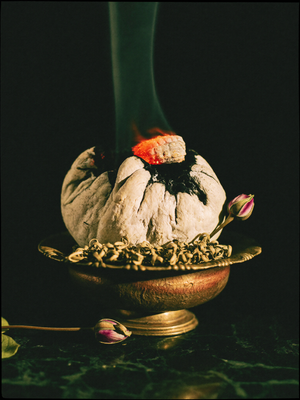
Safe for every stone, which is why it is the default. Light a bundle or a stick, let it catch and then blow the flame out so it smoulders, and pass the stone through the smoke for thirty seconds to a minute, turning it so the smoke reaches all sides.
Practical notes that matter more than they sound. Open a window — smoke cleansing in a sealed room is unpleasant and sets off alarms. Work over a heatproof dish so embers land somewhere safe. And do not hold porous or dyed stones directly in heavy resinous smoke for long, because soot will settle into the surface; a few seconds is enough.
Which plant you use is a real question with a real answer, and it is not only about scent. White sage carries a live cultural and sustainability argument that is worth understanding before you buy — we set it out in white sage smudging, honestly and compare the two most common options in palo santo vs sage. If you have never got a bundle to smoulder properly rather than flare and go out, how to burn a smudge stick covers the mechanics.
If you want to work with this yourself, this is what we use:

Palo Santo Smudge Spray — Smokeless Cleansing & Calm
Made with pure palo santo essential oil. We list it here because it solves the specific problem this article is about: it needs no water, no soak and no ember, so it works on selenite, pyrite and malachite where water would ruin them — and in a rental with a smoke alarm two feet from the altar. Mist the air above the stone rather than the stone itself. $22.00
See the Palo Santo sprayHow to cleanse crystals with sound
Also safe for everything, and the best option if you cannot burn anything at all. Strike a bowl, bell or chime and hold the stone within the sound for as long as the tone lasts, or set several stones around a singing bowl and let it ring out two or three times.
Sound suits people who find smoke fussy and water risky. It is also the fastest — a cleansing that takes fifteen seconds is a cleansing you will actually keep doing. The one caution is physical: do not put a stone inside a metal singing bowl and then strike it. You will chip both.
How to cleanse crystals with moonlight
Safe for every stone, and the method most people mean when they say they cleanse and charge in one go. Put the stones on a windowsill or outside overnight and bring them in by morning. Before cleansing anything, it is worth knowing which crystals should not be kept together, because most visible damage happens in storage rather than in cleansing.
Full moon is traditional; new moon is used by some practitioners for clearing rather than filling. Neither is more correct. The practical points are that glass does not block moonlight meaningfully, so an indoor sill is fine, and that you should bring the stones in before the sun climbs — a night outside is harmless, a morning of direct sun is not, for the light-sensitive stones in the table above.
Moonlight is also the method most likely to become a habit, because it requires nothing of you except remembering. That is a genuine advantage over methods that need setup.
How to cleanse crystals with selenite
Lay the stone on a selenite plate, bowl or wand for a few hours or overnight. Safe for the stone being cleansed, and popular because it needs no smoke, no water and no weather.
The lit version of the same method, along with what it will and will not do, is in selenite lamps.
The tradition holds that selenite does not itself need cleansing. That claim is not testable, but the practical convenience is real: a selenite plate is a permanent fixture you can leave on a shelf and use daily. Keep the plate itself away from water and from damp bathrooms, because selenite is the most water-vulnerable stone in common circulation.
How to cleanse crystals with salt
Effective and traditional, and the method with the widest damage radius. Dry salt is safer than salt water. Bury the stone in a bowl of dry sea salt for a few hours, then brush it clean and discard the salt.
Salt is abrasive and hygroscopic. On a soft or polished stone it leaves microscopic scratches that dull the finish over repeated use, and salt water combines that with everything in the water column of the table above. Never use salt on selenite, malachite, calcite, turquoise, opal, moonstone, amber or coral. On hard, unpolished quartz it is genuinely fine.
The salt gets discarded afterwards in every version of the tradition — it is not reused, and it does not go back in the kitchen.
How to cleanse crystals with water
Only for hard, untreated, non-porous stones: clear quartz, smoky quartz, amethyst, agate, jasper, carnelian and similar quartz-family stones. Hold under cool running water for a minute, then dry completely.
Three cautions. Cool water, not hot — thermal shock cracks stones with internal fractures, and most tumbled stones have some. Dry properly, because trapped moisture in a crack does damage over time. And check what you actually have first: a great many stones on the market are dyed, heated, coated or reconstituted, and water lifts treatments straight out. If you have not tested a stone against that possibility, real vs treated crystals covers how to tell.
Temple tip
Write the stone's name on a slip of paper and keep it in the pouch or box. Almost everyone who has ruined a crystal ruined it because they could not remember whether the purple one was amethyst or fluorite, and fluorite is soft enough that salt marks it. Naming the stone once, at the point of purchase, prevents nearly every accident in this article. Our guide to birthstones by month goes through the chart month by month and says where each list came from.
How often should you cleanse crystals?
There is no correct interval, and anyone giving you a fixed schedule is inventing it. The three moments that practitioners consistently name are these.
Stones set out in a grid are the exception to "cleanse when it feels right": the usual rhythm is once midway through the cycle and again when you take the grid apart. That schedule, and the rest of the method, is in how to make a crystal grid.
If the stone is one you carry for warding, crystals for protection sets out which stones the tradition names and what each can physically survive. When a stone is new to you, before you use it for anything. After it has been handled by other people, or worn through something you found heavy. And when you notice you have stopped paying attention to it — which is less a property of the stone than a signal about you, and arguably the most useful of the three.
Beyond that, monthly with the moon is a common rhythm because it is easy to remember, not because thirty days is meaningful.
What is the difference between cleansing and charging?
Cleansing is subtraction, charging is addition. In the traditional framing, cleansing clears what a stone has picked up; charging fills it with a specific intention or with a general energy source.
In practice they overlap heavily, and several methods do both — moonlight is the obvious case, which is why "cleanse and charge under the full moon" is a single instruction rather than two. Where the distinction earns its keep is that charging usually involves you stating something, and cleansing usually does not. If you want the stone to carry a particular intention, you have to say what it is.
How do you charge a crystal?
Four common methods, in order of how safe they are for the stone. The full treatment — timings, moon phases, what a window does and what to say — is in how to charge crystals.
Moonlight. Overnight, safe for everything, cleanses at the same time. The default.
Intention. Hold the stone, say what it is for in one sentence, and put it somewhere you will see it. No risk to the stone at all, and it is the method that carries the actual mechanism — you have attached a decision to an object you will keep encountering.
Earth. Buried in soil for a day, traditional for grounding work. Wrap it in cloth first so you can find it again, and skip this for anything water-soluble, because soil is damp.
Sunlight. Effective and traditional, and the one that destroys collections. Amethyst, citrine, rose quartz, fluorite, kunzite and smoky quartz all fade under UV, and the fade is permanent — the colour centres are physically altered and there is no restoring them. If you want to use sun, twenty minutes of early morning light is the version that is defensible. We wrote the full list in which crystals fade in sunlight.
Do you have to cleanse a crystal before wearing it?
Traditionally yes for a new stone, and there is a practical argument alongside the traditional one: a tumbled stone from a shop has been handled by dozens of people and has shop dust on it. A wipe with a dry cloth is worth doing regardless of whether you accept the energetic framing.
For worn jewellery specifically, smoke and sound are the sensible methods, because settings, glues and metals react badly to soaking. If you are working out which side to wear a piece on, that is its own small tradition — see which wrist to wear a crystal bracelet on.
Voices from practice
We do not publish invented testimonials, so this is a summary of patterns visible in public practitioner discussion rather than quotes attributed to anyone.
The single most repeated warning in crystal communities is about selenite and water, and it is repeated because people keep learning it the expensive way — the standard post is somebody who ran a selenite wand under the tap and watched the surface go chalky. The second most common theme is the opposite of what beginners expect: experienced collectors tend to cleanse less often and less elaborately than newcomers, and the advice given to beginners is overwhelmingly to pick one easy method and keep doing it rather than to rotate through seven. The third recurring note is that people who buy a stone without knowing what it is are the ones who damage it.
What we don't promise
We sell cleansing tools, so the line goes here rather than in small print.
There is no evidence that crystals hold, absorb or release energy, and no evidence that cleansing changes any measurable property of a stone. Nothing on this page is a health claim, and a crystal is not a treatment for anything. The damage warnings above are the part of this article that is straightforwardly physical and testable — selenite really does dissolve, amethyst really does fade — and we have kept those separate from the traditional framing on purpose.
What cleansing reliably does is mark a break. You set the stone down, you do something deliberate with it, and you pick it back up having decided that whatever it was carrying is finished. That is a real act, and it does not need the stone to do anything.
Practically: how to work with this
- Identify the stone before you do anything to it. If you cannot name it, use smoke, sound or moonlight and nothing else.
- Check it against the damage table. Ten seconds now against a stone you cannot replace.
- Pick one method and keep it. Consistency beats variety here by a wide margin.
- Give it your attention for the minute it takes. Cleansing a stone while scrolling is cleaning, not practice.
- Charge it by saying what it is for — one sentence, out loud or written. This is the step people skip and then wonder why nothing feels different.
- Dry anything that got wet, completely, and discard salt rather than reusing it.
- Put it where you will see it. A charged stone in a drawer is a stone in a drawer.
Tools for the smoke and spray methods are in the sacred smoke and cleansing collection if you need to start from nothing.
Which cleansing method suits your stone?
Four questions. No email required.
For the stone people ask about most often in this context, along with why we prefer dry methods for it, see black tourmaline meaning.
If you would rather look your stone up than work it out, the crystal meanings chart lists forty of them with hardness, water tolerance and sun fading in one place.
Selenite is the stone most often recommended for this job and the one least able to survive water, which we go through in how to use selenite.
Frequently asked questions
What is the easiest way to cleanse crystals?
Moonlight, because it requires nothing but putting the stones on a windowsill overnight, and it is safe for every stone including water-soluble ones. Smoke is the fastest active method at under a minute. Both work on anything, which is why they are the two to default to when you are unsure what a stone is.
Which crystals should not be put in water?
Selenite, malachite, calcite, pyrite, hematite, lapis lazuli, turquoise, halite, amber and coral, plus anything dyed, coated or reconstituted. Ignore the Mohs-5 rule repeated all over the internet: pyrite is Mohs 6 to 6.5 and rusts, obsidian is 5 to 5.5 and is fine. Solubility and oxidation decide it, not hardness. Selenite is the critical one — it is water-soluble and will dissolve.
Can you cleanse crystals with salt?
Yes, on hard unpolished stones. Dry sea salt for a few hours, then brush clean and discard the salt. Salt is abrasive and hygroscopic, so avoid it entirely on selenite, malachite, calcite, turquoise, opal, moonstone, amber and coral, and expect it to dull a polished finish over repeated use.
How often should I cleanse my crystals?
There is no correct interval. The three moments practitioners consistently name are: when a stone is new to you, after other people have handled it or you have carried it through something heavy, and when you notice you have stopped paying attention to it. Monthly with the moon is a common rhythm because it is easy to remember.
What is the difference between cleansing and charging a crystal?
Cleansing clears; charging fills. Cleansing is framed as removing what a stone has picked up, charging as giving it a specific intention or exposing it to an energy source. Several methods do both at once, which is why moonlight is described as cleansing and charging in a single instruction. Charging usually involves you saying what the stone is for; cleansing usually does not.
Can I cleanse crystals in sunlight?
You can, but it permanently fades amethyst, citrine, rose quartz, fluorite, kunzite and smoky quartz. UV alters the colour centres physically and the colour does not come back. If you want to use sun, twenty minutes of early morning light is the defensible version; an afternoon on a south-facing sill is how collections get bleached.
Do I need to cleanse a new crystal before using it?
Traditionally yes, and there is a practical argument alongside it: a tumbled stone from a shop has been handled by many people and carries shop dust. A wipe with a dry cloth plus smoke or moonlight covers both the traditional and the practical case without any risk to the stone.
Does selenite need to be cleansed?
The tradition holds that it does not, which is why selenite plates are used to cleanse other stones. That claim is not testable. What is testable is that selenite must be kept away from water and damp rooms — it is gypsum, Mohs 2, and water-soluble.
Water is not only a risk to stones — it is also one of the oldest cleansing tools people use on themselves. If that is where you were heading, our guide to the spiritual bath for cleansing and protection covers the herbs, the salt and the method, including a version that needs no bathtub.
Rose quartz is the stone people most often ruin by cleansing it wrongly. For what it is used for in the first place, see crystals for love, and which pink stones are actually glass.
Sources & further reading
- Cornelis Klein and Anthony Philpotts, Earth Materials: Introduction to Mineralogy and Petrology, 2nd ed. (Cambridge University Press, 2016) — standard reference for hardness, solubility and the mineral properties behind the damage table.
- Walter Schumann, Gemstones of the World, 6th ed. (Sterling, 2020) — species-by-species care, treatment and light-sensitivity notes.
- Gemological Institute of America, Gem Encyclopedia care and cleaning guidance (gia.edu) — on treated, dyed and stabilised material and why water lifts treatments.
- Ronald Hutton, The Triumph of the Moon: A History of Modern Pagan Witchcraft, 2nd ed. (Oxford University Press, 2019) — on the twentieth-century formation of the practices described here.
- Michael I. Norton and Francesca Gino, "Rituals Alleviate Grieving for Loved Ones, Lovers, and Lotteries", Journal of Experimental Psychology: General 143:1 (2014), 266–272 — on why deliberate ritual acts measurably change how people feel without any external mechanism.
More from Crystals & Stones
All stories →
Epidote Meaning, Properties and Care


Jasper Stone Meaning, Types, Properties and Care
