Collection: Bowls, Trays & Vases
Eighteen vessels — stone bowls, marble and wood trays, terracotta and glass vases, catchalls and ash dishes, nearly all hand-carved, cast or thrown — no two match. Five take fire; of the four vases, only one holds water.
In short: choose by what it may hold — fire, water, or neither — the one thing you cannot change later.
-
Blue Angelite Catchall — Hand-Carved Gemstone Jewelry Dish
Regular price $68.95Regular priceUnit price / perSale price $68.95 -
Wood Leaf Trays — Hand-Carved Granadillo Serving Trays
Regular price From $126.95Regular priceUnit price / perSale price From $126.95 -
Anka Incense Holder — Brass Tray with Marble Sphere
Regular price $80.95Regular priceUnit price / perSale price $80.95 -
Less is More Tray — Hand-Carved Travertine Marble Tray
Regular price $231.95Regular priceUnit price / perSale price $231.95 -
Tauro Tray — Hand-Carved Black Marble Vanity Tray
Regular price $173.95Regular priceUnit price / perSale price $173.95 -
Ines Terracotta Vessel — Sculptural Handmade Vase
Regular price $220.95Regular priceUnit price / perSale price $220.95 -
Ella Terracotta Vessel — Scalloped Vase from Honduras
Regular price $255.95Regular priceUnit price / perSale price $255.95 -
White Marble Platter — Gray-Veined Serving Board
Regular price $138.95Regular priceUnit price / perSale price $138.95 -
Fluted Glass Vase — Hand-Blown Ribbed Glass Vessel
Regular price $103.95Regular priceUnit price / perSale price $103.95 -
Luxe Kansa Platter — Hand-Cast Bronze Serving Tray
Regular price $169.95Regular priceUnit price / perSale price $169.95 -
Her Vase — Sculptural Ceramic Vase for a Quiet Altar Corner
Regular price $231.95Regular priceUnit price / perSale price $231.95 -
Abalone Shell — 5-Inch Natural Smudge Bowl
Regular price $24.95Regular priceUnit price / perSale price $24.95 -
Green Onyx Bowl — 8-Inch Stone Bowl for Altar & Offerings
Regular price $61.95Regular priceUnit price / perSale price $61.95Sold out -
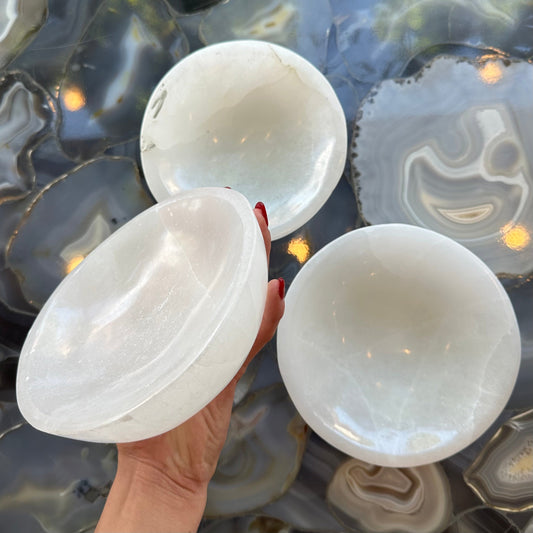
Selenite Bowl 6 in — Moroccan Crystal Dish for Altar & Jewelry
Regular price $55.95Regular priceUnit price / perSale price $55.95 -
Orthoceras Fossil Bowl — Polished Moroccan Limestone, 4–5 in
Regular price $24.95Regular priceUnit price / perSale price $24.95 -
Eve Incense Holder — Handmade Stoneware Dish for Incense
Regular price From $34.95Regular priceUnit price / perSale price From $34.95 -
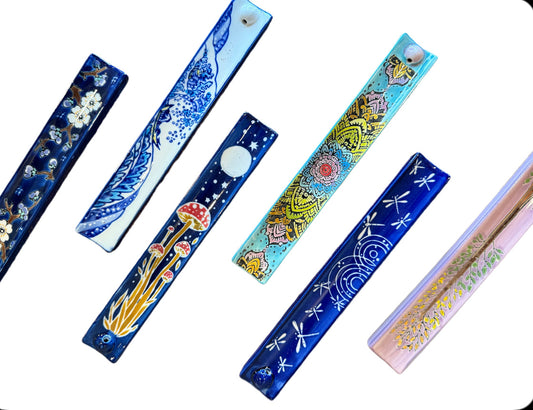
Motifs Incense Holder — Handpainted 9-Inch Ash Catcher Tray
Regular price $31.95Regular priceUnit price / perSale price $31.95 -
Ceramic Incense Burner — Smudge Bowl for Charcoal & Cleansing Rituals
Regular price $31.95Regular priceUnit price / perSale price $31.95
Altar and home vessels: what each material is allowed to hold
Eighteen pieces, $24.95 to $255.95. A vessel is the least discussed object in a practice and usually the one doing the most work — it catches the ash, gathers the rings, gives the candle something to stand on and marks where the altar begins and the furniture ends. What follows is the part that is easy to get wrong, and expensive to get wrong twice: not which one looks best, but which one is allowed to do what.
The material decides the job, and it decides it strictly
Five pieces here take fire. The ceramic incense burner and smudge bowl ($48.95) is made to hold burning material — charcoal discs, smudge bombs, pyramids, triangles. The 5-inch abalone shell ($24.95) is the traditional smudge vessel, wide and shallow, made to rest a bundle between passes. The 9-inch handpainted Motifs tray ($48.95, eight motifs) and the Eve stoneware dish ($34.95, or $51.95 in the thicker glazes) are for sticks and the ash they drop. The Anka holder ($80.95) takes one stick at an angle over a brass tray with a marble sphere. If you are still deciding what shape of burner suits how you actually burn things, the buyer's guide to incense burners walks through the trade-offs, and burning resin on a charcoal disc covers the one method that genuinely needs a heat-proof bowl.
Everything else is for dry, cool things. Wood and glass should never hold a live coal — that is not a house rule, it is the standard safety line for smudging vessels everywhere. The selenite bowl in particular is a beautiful object and a terrible ashtray.
Of the four vases, exactly one holds water. The hand-blown fluted glass vase ($103.95) takes a full bunch of fresh blooms. The Ella ($255.95) and Ines ($220.95) terracotta vessels from Sabana Grande in Honduras are unsealed and sold explicitly for dried stems or as sculpture, and the ceramic Her Vase ($231.95) is described the same way. Fill one of those with water and you will find out slowly, through the table.
Marble is the opposite trap. It shrugs off heat and loses to acid. Lemon, vinegar, wine, citrus oil and perfume etch it permanently, so they stay off the white marble platter ($138.95), the black marble Tauro tray ($173.95) and the travertine Less is More tray ($231.95, 11.8 by 9.8 inches). The hand-cast kansa bronze platter ($169.95) takes dry food — bread, fruit, cheese — with anything acidic in a small dish set on top of it.
The selenite bowl is the exception worth naming twice
The 6-inch selenite bowl ($55.95, from Morocco) is the only vessel here that glows. The walls are thin enough to be translucent and the fibrous grain carries light through them, so a ring or a tumbled stone sits in diffused white rather than against an opaque surface. Set one near a candle and it stops being a container.
It is also gypsum: 2 on the Mohs scale, softer than a fingernail, and slowly soluble. The bowl that makes everything in it look better is the one bowl that must never be washed, never hold water and never take a coal. This is the headline case for the wider rule in which crystals cannot go in water, and if the name on the label is bothering you, selenite versus satin spar settles it — same mineral, different habit. It is also the stone people are told to charge and cleanse other crystals with, which is a dry-contact method and nothing to do with water. More of the same material sits on the selenite shelf.
Hand-made, and the price band shows it
Eleven of the eighteen come through a single fair-trade artisan network: terracotta from Sabana Grande in Honduras, kansa bronze and hand-carved marble and travertine from India, granadillo leaf trays from the Petén in Guatemala, hand-blown glass. Four are cut stone and shell brought in by a lapidary supplier — a 260 g orthoceras fossil bowl ($24.95) carrying straight-shelled cephalopods out of the Devonian seabed of the Atlas Mountains, an 8-inch green onyx bowl banded pale to deep green from Pakistan, the Moroccan selenite bowl, and the abalone shell from Mexico. One is thrown and glazed by hand in Wisconsin, and two are handpainted ceramic. Every one of them varies in color, veining or outline, which is the point and also the reason two orders of the same piece will not match.
Two things are currently sold out and we would rather say so here than let you find out at the cart: the Blue Angelite catchall ($68.95) and the 8-inch green onyx bowl ($61.95). The yellow colorway of the ceramic burner is also gone; ivory and marble are in stock.
Where the sizes are worth doing arithmetic on
The granadillo leaf trays come in three sizes and are the one place on this page where the price does not scale with what you get. By listed weight the small is $126.99 for 0.77 lb, the medium $150.95 for 1.47 lb and the large $243.95 for 2.5 lb. Per pound that is roughly $165, $103 and $98 — so the small piece costs about two-thirds more per pound of wood than the large one, and the step from small to medium buys nearly twice the tray for under twenty-four dollars more. If you are undecided between small and medium, the medium is the better-value object; if you are undecided between medium and large, buy for the surface you own.
The entry point on this page is $24.95, and there are two pieces at it: the abalone shell if you burn things, the fossil bowl if you do not. Both are natural pieces held in very small numbers.
What a vessel is for, once it is on the altar
A bowl is where most practices quietly put their weight. It holds the offering, it holds the coins, it holds the thing you are done carrying. How to make a money bowl is the most literal version of that and a good first use for a stone bowl; how to tell whether an offering was accepted and what to do with it afterwards cover the end of the same process, which is the half nobody plans for. If the surface itself is the problem — no room, shared space, other people in the house — setting up an altar in a shared room is written for exactly that, and a tray is usually the object that solves it.
On the smoke side: lighting, smoldering and putting out a bundle properly is the technique the abalone shell exists for, using an abalone shell without cracking it is the specific care piece, and burning incense in an apartment deals with smoke alarms and neighbors before they deal with you. What goes in the vessel lives on the smudge stick shelf and across sacred smoke and cleansing. A pinch of dry salt or sand in the base of a burning vessel is the small habit that keeps it intact — which salt to use sorts out which kind.
What is not on this page
No cauldrons, no candle holders — those are on their own shelf — and no cheap catch-all dish; the least expensive vessel here is a hand-worked natural piece at $24.95, while the incense burner and holder shelf starts at $3.95 if a plain ash-catcher is all you need. Nothing here is a soap dish either: the marble and travertine trays hold water rather than draining it, which is the opposite of what a cold-processed bar wants. And nothing on this page is food-safe glazed stoneware in the industrial sense — the serving pieces are stone and bronze, used dry. For vessels that belong in a kitchen practice rather than an altar, see the ritual kitchen.
Frequently asked questions
Which of these can I actually burn incense, charcoal or a smudge bundle in?
Five of them, and the list is short on purpose. The ceramic incense burner is built to hold burning material and takes charcoal discs, smudge bombs, pyramids and triangles. The abalone shell is the traditional smudge vessel — wide, shallow and heat-tolerant, made to rest a bundle between passes. The 9-inch handpainted Motifs tray and the Eve stoneware dish are for sticks and the ash they drop, and the Anka holder takes a single stick at an angle over a brass tray. Everything else on this page — the marble, the travertine, the granadillo wood, the terracotta, the glass, the selenite — is for dry, cool things only. Wood and glass in particular should never hold a live coal.
Should I put sand or salt in the bottom of a burning vessel?
Yes, for anything that holds a charcoal disc or a loose bundle. A layer of sand or dry salt insulates the vessel from the heat, keeps the disc off the glaze and smothers embers when you are finished. It is the difference between a ceramic bowl that lasts for years and one that crazes. For an abalone shell it matters even more: the shell is natural material and a charcoal disc laid straight onto it is the usual reason one cracks.
Can I put water or fresh flowers in these vases?
In exactly one of them. The hand-blown fluted glass vase takes a full bunch of fresh blooms — change the water every two days and cut the stems on the diagonal. The Ella and Ines terracotta vessels from Honduras are unsealed and not watertight; the maker sells them for dried stems, pampas, branches or for standing empty as sculpture. Her Vase is described the same way. If you want cut flowers on an altar, the glass one is the only answer on this page.
Is a selenite bowl safe for water or for jewelry?
For jewelry, yes — that is precisely what it is for, and the translucent walls are the reason people buy it. For water, no. Selenite is gypsum, 2 on the Mohs scale, soft enough to scratch with a fingernail and slowly soluble in water. Do not wash it, do not use it as a coaster, do not set a burning coal in it. Wipe it with a dry cloth and it lasts indefinitely. It is also the stone most people are told to cleanse their other crystals with, which is a dry-contact method, not a bath.
Why does nothing on this page cost less than $24.95?
Because everything on it is carved, cast, thrown or blown by hand from stone, bronze, hardwood, shell or glass, and that is where hand-work lands. It is worth knowing that the shop does sell cheaper vessels — they simply are not this kind. If all you need is something to catch stick ash, the wider incense holder shelf starts at $3.95 for a printed wood holder and has hand-painted ceramic and marble options in the $20 to $24 range. What you get for the step up to this page is a piece of solid material that also works as an object when nothing is burning.
Will the piece I receive look exactly like the photograph?
No, and none of these makers claim it will. The onyx banding, the marble veining, the pitting in travertine, the grain in granadillo, the glaze on the Wisconsin stoneware and the iridescence inside an abalone shell all differ piece to piece. Sizes for the natural stone are given as ranges for the same reason. Expect the family resemblance rather than the copy — and if you are buying two of something to make a pair, expect them not to match.
How do I keep marble and travertine from staining?
Keep acid off it. Marble and travertine are calcium carbonate, so lemon juice, vinegar, wine, citrus oils and many perfumes etch the surface permanently — a dull mark that no cleaning removes. Serve dry food directly on the white platter and put anything acidic in a small dish set on top. On a vanity, stand perfume and toner bottles on their own base rather than letting them ring the stone. Wipe with a damp cloth and dry it; no dishwasher, no bleach, no descaler.
Which one should I buy first?
Start from what you already do. If you burn bundles or charcoal, the $24.95 abalone shell or the $48.95 ceramic burner covers it, and the abalone doubles as the most beautiful thing on the altar. If you burn sticks, the $34.95 Eve stoneware dish for a small surface or the $48.95 9-inch Motifs tray if ash on a pale rug is the problem you are solving. If your altar has no defined edge yet, a tray does more than any single object: it gathers what is loose and keeps wax and stone dust off the furniture. And if you want the piece people ask about, the selenite bowl glows from the inside and nothing else here does.