Collection: Selenite
Fourteen Moroccan selenite pieces, $4.95 to $119.95: a three-inch stick, a peach pocket sphere, an obelisk, a 10 cm charging plate, two polished spheres, two rough bars, a bowl and four lit lamps.
In short: Selenite is the stone people cleanse other stones with — and the one stone that must never be cleansed in water.
-
Selenite Charging Plate 10cm — Crystal Cleansing Disc for Stones & Jewelry
Regular price $9.95Regular priceUnit price / perSale price $9.95 -
Cleanse-All Selenite Lamp — 2 Pounds of Moroccan Liquid Light
Regular price From $69.95Regular priceUnit price / per$99.00Sale price From $69.95Sale -
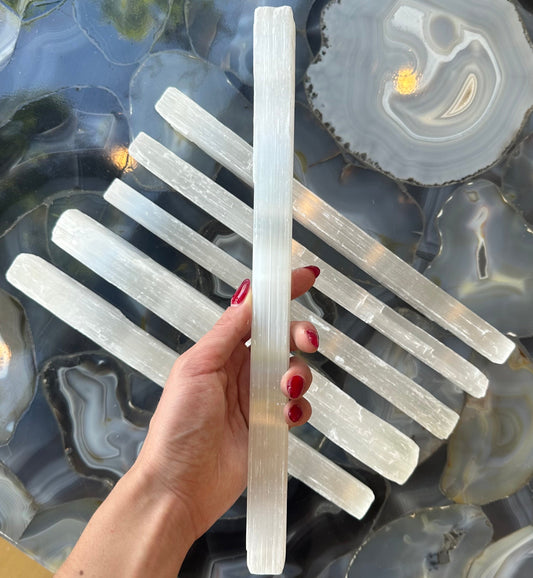
Rough Selenite Bar — 11.5" Raw Cleansing Crystal Wand for Altars
Regular price $18.95Regular priceUnit price / perSale price $18.95 -
Small Selenite Obelisk Tower — Cleansing Crystal Point for Your Altar
Regular price $6.95Regular priceUnit price / perSale price $6.95 -
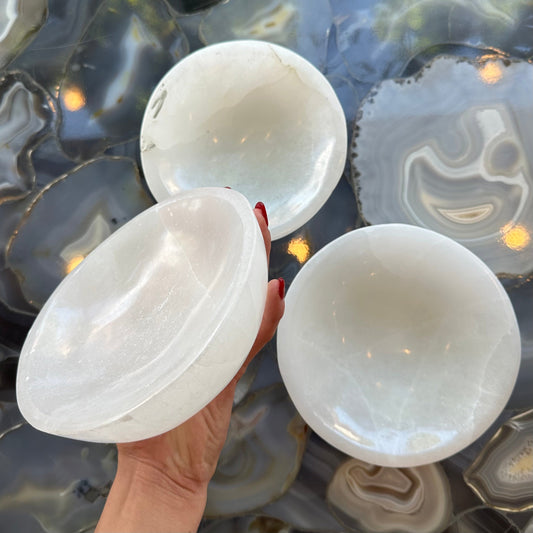
Selenite Bowl 6 in — Moroccan Crystal Dish for Altar & Jewelry
Regular price $55.95Regular priceUnit price / perSale price $55.95 -
Selenite Sphere 8 cm — Large Polished Moroccan Gypsum Ball
Regular price $36.95Regular priceUnit price / perSale price $36.95 -
Selenite Sphere 6 cm — Polished Moroccan Crystal Ball
Regular price $9.95Regular priceUnit price / perSale price $9.95 -
Rough Selenite Bar — Large Moroccan Crystal Log, 9 in
Regular price $30.95Regular priceUnit price / perSale price $30.95 -
Two-Tower Selenite Lamp — Deep Cleanse & Reset in Moroccan Crystal
Regular price $59.95Regular priceUnit price / per$99.45Sale price $59.95Sale -
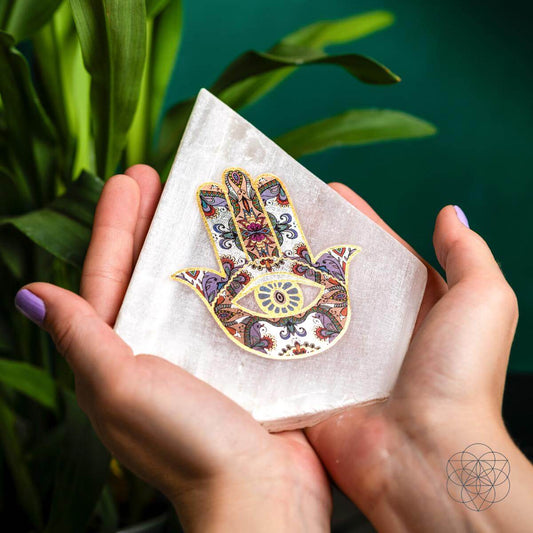
My Aura Spa Mood Lamp — Selenite & Hamsa Hand for Evening Calm
Regular price $59.95Regular priceUnit price / per$79.45Sale price $59.95Sale -
Selenite Cleansing Lamp — Crystal Charging & Calm Night Light
Regular price From $49.95Regular priceUnit price / per$70.00Sale price From $49.95Sale -
Selenite Tumbled Stone — Self-Cleansing Clarity for Aura & Crystals
Regular price $4.95Regular priceUnit price / perSale price $4.95Sold out -
Selenite Stick 3 in. — The Crystal That Cleanses Itself
Regular price $4.95Regular priceUnit price / perSale price $4.95 -
Peach Selenite Pocket Sphere — Comfort & Emotional Renewal
Regular price $5.95Regular priceUnit price / perSale price $5.95
Selenite: fourteen pieces, $4.95 to $119.95
Selenite is gypsum — calcium sulfate that crystallized out of ancient seas and lakes as they dried. That single fact explains everything unusual about owning it. Gypsum is 2 on the Mohs scale, softer than your own fingernail, and it is soluble in water. So the stone that the whole tradition uses to cleanse other stones is the one stone you must never cleanse with water. Almost every piece here comes from Morocco, which supplies most of the selenite in circulation; the peach pocket sphere is sourced from Morocco and Mexico. What follows is the buying side: the naming, what the price actually buys, and how not to damage it. For the wider rule this stone is the headline example of, see which crystals cannot go in water.
Selenite or satin spar: what you are actually buying
This is the most common worry US buyers arrive with, usually after reading that they have been sold the wrong thing. They have not. Selenite and satin spar are the same mineral. The two names describe crystal habit — the shape the gypsum grew in — and nothing else:
- True selenite grows as transparent, glassy plates you can very nearly read through. It splinters along its cleavage planes and rarely survives cutting and shipping, so it mostly stays rough and mostly stays with collectors.
- Satin spar grows as tightly packed parallel fibers. Those fibers produce the silky band of light that travels along a bar when you turn it, the same optical effect that makes a cat's-eye. It is marginally tougher, takes a polish, and survives being shaped.
Which means that essentially every polished tower, sphere, plate, bowl and lamp on the market — including all of them here — is satin spar sold under the name selenite. That is trade convention, not deception, and it is worth saying plainly rather than letting you find out from a video later. Nothing about the chemistry, the softness, the water problem or the traditional use differs between them. If you want the wider version of this question, real vs. treated crystals covers how to tell what you are actually buying across the rest of the shelf.
What the price buys, and it is mostly mass
Selenite is abundant and cheap to quarry, so unlike amethyst or tourmaline you are not paying for rarity or color grade. You are paying for how much of it there is, how much cutting waste the shape cost, and whether there is a lamp inside. Set against weight, the range here is unusually flat — and it flattens out some assumptions:
| Piece | Weight | Price | Per gram |
|---|---|---|---|
| 6 cm sphere | 250-300 g | $9.95 | $0.036 |
| Large rough bar | ~700 g | $30.95 | $0.044 |
| Medium rough bar | 330 g | $18.95 | $0.057 |
| Cleanse-All lamp | ~1,000 g | $69.95 | $0.070 |
| 8 cm sphere | 500-560 g | $36.95 | $0.070 |
| Small obelisk | 95 g | $6.95 | $0.073 |
| Two-Tower lamp | ~800 g | $59.95 | $0.075 |
Two things fall out of that. The 6 cm sphere is the cheapest crystal per gram on the page and the 8 cm sphere is roughly twice the price per gram for the same stone, because the block it comes out of is the scarce part. And the lamps are not the markup you would expect: at $0.070 and $0.075 per gram they sit alongside the plain polished spheres, with the walnut base and the LED unit effectively included. Whether that is good value depends entirely on whether you want light.
The two rough bars, and why the cheaper one is longer
This trips people up at checkout, so it is worth being explicit. The $18.95 bar measures 1" × 1" × 11.5" and weighs 330 g. The $30.95 bar, the one labeled large, is 9" long — two and a half inches shorter — but 2.5" × 1" in cross-section and around 700 g. So "large" here means twice the mass and more than twice the width, not more length.
Choose on the job, not the label. If you want to draw a line — along the back of an altar, a windowsill, a threshold — the longer $18.95 bar does it better and costs less. If you want one object with presence, something with enough bulk to be the anchor of the arrangement rather than part of it, the $30.95 bar is the one. Both are unpolished, so both show the fibrous grain and both shed a little at the ends.
Choosing a form
- To carry: the 3-inch stick at $4.95, or the peach pocket sphere at $5.95 — naturally peach-tinted gypsum, and the only warm-toned piece here. Bear in mind that a stone this soft will scuff in a pocket with keys.
- To anchor an altar: the small obelisk (3-6 cm, 95 g, $6.95) for a marked center point, or the large rough bar at $30.95 for weight. Towers are the traditional center of a grid — how to make a crystal grid sets out the layouts.
- As a base for other stones: the 10 cm charging plate, $9.95, in square, hexagon or round. Check the size against what you own before you buy.
- To look at: the 6 cm sphere ($9.95, one palm) or the 8 cm ($36.95, two hands and a stand — at that weight, use one). The 6-inch bowl at $55.95 is thin enough to glow when a candle sits near it. More shapes across the shop are in Spheres & Pyramids.
- Lit: four lamps, $49.95 to $119.95. The Cleansing Lamp is the entry point; the Cleanse-All is close to a kilogram of stone; the Two-Tower is cut from a single block; the Hamsa lamp pairs selenite with a hamsa hand for a bedside. The rest of the lit pieces are in Crystal Lamps.
If you are weighing a tumbled stone against a point against a tower in general, crystal shapes explained covers what each form is conventionally used for.
What it is used for
Selenite's role in modern crystal practice is narrow and consistent: it is the clearing stone, the one others are laid on or beside. That is why the charging plate and the flat bar exist as product categories at all. It is conventionally associated with the crown and third-eye centers — see the crown chakra — and the peach variety is additionally linked to the sacral. In room practice it tends to be used as the quiet, permanent fixture rather than the active tool: laid along a threshold, left on a windowsill, set at the center of a grid. How to cleanse crystals and how to charge crystals both cover where selenite fits against moonlight, smoke and sound; how to cleanse a room and cleansing a secondhand object cover the room-scale version. These are traditional practices, not treatments, and nothing here is a medical device.
Care: dry, dusted, and off the windowsill
Three rules cover it. Never water, never salt water — dust with a dry cloth and nothing else. Keep it off wet rooms and open windows: sustained humidity and condensation do the same job as a rinse, only slower, which is why bathroom shelves are where selenite quietly goes chalky. And expect marks, because at Mohs 2 a fingernail, a ring or a key will score it, and a short fall onto tile will chip or shatter a sphere. Use a stand for the 8 cm sphere and a felt pad under the wooden lamp bases. Unlike amethyst, sunlight is not the enemy here — the stones that fade are a different list — but a sunny sill usually means an openable window, which brings you back to moisture. If a piece does break, what it means when a crystal breaks covers both the practical and the traditional reading.
Selenite sits next to the harder end of the shelf in Quartz, and the full range is in Crystals & Stones. Smaller pieces to carry are in Tumbled & Pocket Stones, and everything under ten dollars is in Under $10.
Frequently asked questions
Can selenite go in water?
No. Selenite is gypsum, and gypsum is soluble in water. A rinse will dull the polish, a soak will pit the surface and leave a chalky bloom, and a piece left wet will eventually break down along its fibers. This is the exact opposite of quartz, which is why the general "rinse your crystals" advice is wrong here. Dust selenite with a dry cloth, and keep it off bathroom shelves and away from windows that get left open.
Is satin spar the same as selenite, and did I buy the wrong one?
You almost certainly bought satin spar, and so has nearly everyone else. Both are the same mineral, gypsum. The names describe crystal habit, not composition: true selenite grows as transparent, glassy plates, while satin spar grows as packed parallel fibers with the silky sheen that runs along a bar as you turn it. Satin spar is slightly tougher and takes a polish without shattering, which is why it is what gets made into towers, spheres, plates and lamps. The trade sells it as selenite, this shop included. It is not a downgrade and not a fake.
Does selenite ever need cleansing or charging itself?
In traditional practice it is the standing exception: selenite is the stone used to clear others and is held not to need clearing itself. That belief is convenient rather than coincidental, because the usual methods would ruin it. Water dissolves it and salt is worse. If you want to do something, set it in moonlight, which costs it nothing.
Why is my selenite flaking and shedding little fibers?
Because it is soft and fibrous, and this is normal rather than a defect. Selenite is about 2 on the Mohs hardness scale, softer than a fingernail, so rough and unpolished pieces shed fine splinters along the grain, especially at the broken ends of a raw bar. Polished pieces shed far less. Handle raw bars by the body rather than the ends, do not slide them across a surface, and stand them on a cloth or a felt pad if the shedding bothers you.
What does the charging plate actually do, and will my crystals fit on it?
In traditional practice the plate is where you rest other stones to clear them: ten to fifteen minutes for a quick pass, or overnight. That is a traditional use rather than a measurable effect. The practical question matters more, and the answer is size. The plate here is 10 cm across, which takes rings, a bracelet, a mala coiled up, or a handful of tumbled stones. A large cluster or a tower will not sit on it. If you want a surface for bigger pieces, a rough bar laid flat gives you a longer line to work with.
Why does the 8 cm sphere cost nearly four times the 6 cm one?
Two centimeters of diameter roughly doubles the weight, from 250-300 g to 500-560 g, but the price goes up 3.7 times. The difference is not the material, it is the block it had to be cut from. A larger sphere needs a larger unbroken piece of a soft, fibrous, easily fractured stone, and those are rare; cutting waste rises steeply with size. Per gram, the 6 cm sphere is the best-value polished piece on the page and the 8 cm is roughly double its price per gram. You are paying for scale, not for quality.
Which selenite piece should I start with?
The $4.95 three-inch stick. It is the piece the tradition is actually built around, it is small enough to lay beside whatever you already own, and nothing larger does a different job. If you already have a collection and want somewhere to put it, buy the $9.95 charging plate instead. If you want an object rather than a tool, the $9.95 six-centimeter sphere is the most stone for the money here.
Are the selenite lamps worth it, and what am I paying for?
You are paying for mass, a wooden base and an LED unit, not for better stone. The Cleanse-All is close to a kilogram of selenite for $69.95 and the Two-Tower is around 800 g for $59.95, which lands both at roughly the same price per gram as the polished spheres, with the electronics effectively thrown in. If you want the light, they are fair value. If you want the crystal, the bars and spheres give you more of it per dollar. Both lamps are mains-powered items: keep them dry, and do not put a lamp where a window can rain on it.