Collection: Amethyst
Nineteen amethyst pieces, from a $2.95 tumbled pocket stone to a 79.7 lb Bolivian collector cluster: palm stones, points, a scepter wand, three geodes, chevron spheres, two lit lamps, earrings, cuffs, a mala and an enamel panther bracelet.
In short: Water is fine at Mohs 7 — it is sunlight that bleaches amethyst, permanently.
-
Amethyst A+ Tumbled Pocket Stone (Small) — Spiritual Protection Crystal
Regular price $2.95Regular priceUnit price / perSale price $2.95 -
White Enamel Double Panther Bracelet — Laura Gray with Amethyst
Regular price $418.95Regular priceUnit price / perSale price $418.95 -
Amethyst Cuff Bracelets — Raw Druzy Bangle in Gold, Rose Gold & Silver
Regular price $32.95Regular priceUnit price / perSale price $32.95 -
Chevron Amethyst Sphere — Polished Crystal Ball for Calm & Focus
Regular price From $49.95Regular priceUnit price / perSale price From $49.95 -
Bolivian Amethyst Cluster — 79.7 lb Collector Specimen
Regular price $7,968.95Regular priceUnit price / perSale price $7,968.95 -
Amethyst Stalactite Geode Sculpture — Rare Polished Statement Piece
Regular price $551.95Regular priceUnit price / perSale price $551.95 -
Amethyst & Dogtooth Calcite Geode — Rare Collector Statement Sculpture
Regular price $858.95Regular priceUnit price / perSale price $858.95 -
Amethyst Geode Sculpture — Polished-Edge Statement Crystal for Altar & Home
Regular price $159.95Regular priceUnit price / perSale price $159.95Sold out -
Bolivian Amethyst Point — Large Anahi Mine Crystal, 3.25 lb
Regular price $367.95Regular priceUnit price / perSale price $367.95 -
Brazilian Amethyst Druze — Medium Raw Geode Piece, 5–8 in
Regular price $36.95Regular priceUnit price / perSale price $36.95 -
Amethyst Mala Necklace — Carnelian, Apatite & Tiger's Eye Beads
Regular price $147.95Regular priceUnit price / perSale price $147.95 -
Amethyst Scepter Wand — Polished Brazilian Point on Metal Stand
Regular price From $122.95Regular priceUnit price / perSale price From $122.95 -
Cycle Breaker — Chevron Amethyst Point for Course Correction
Regular price $19.95Regular priceUnit price / perSale price $19.95 -
The Calm Trio — Amethyst, Apatite & Howlite Stone Set for Quiet Minds
Regular price $8.99Regular priceUnit price / per$20.00Sale price $8.99Sale -
Portal to Peace — Amethyst Lamp for Stress Relief
Regular price $69.95Regular priceUnit price / per$99.95Sale price $69.95Sale -
Stress Less, Sleep More — Amethyst Halo Lamp for Calm
Regular price $59.95Regular priceUnit price / per$99.45Sale price $59.95Sale -
Amethyst Tumbled Pocket Stone — Calm Mind & Intuition Crystal
Regular price $4.95Regular priceUnit price / perSale price $4.95 -
Amethyst Palm Stone — Polished Calm & Intuition Stone for Meditation
Regular price $14.95Regular priceUnit price / perSale price $14.95 -
Amethyst Drop Earrings — Raw Stone, Boho Chic Pair
Regular price $27.95Regular priceUnit price / perSale price $27.95
Amethyst: nineteen pieces, $2.95 to $7,968.95
Amethyst is quartz colored violet by traces of iron and natural irradiation. That gives it a hardness of 7 on the Mohs scale — hard enough for daily wear, and not water-soluble — and one real weakness that almost every buyer discovers too late: the color is not permanently fixed, and light takes it away. The range here runs from a $2.95 pocket stone to a 79.7 lb Bolivian collector cluster, and the four things worth understanding before you choose are the labels, the price logic, the origin and the care. Amethyst meaning covers the history and symbolism; this page covers the buying.
Geode, cluster, druze, point: what the labels mean
These four words get used interchangeably online and they do not mean the same thing. Each describes a different stage of how the stone came out of the ground, and it is the single most useful thing to know when you are comparing two listings at very different prices.
- Geode — a hollow cavity in volcanic rock, lined on the inside with crystal, then cut open so you look into it. The three here are all Brazilian with the outer rind polished to a clean edge: the 6-inch, 967 g piece at $159.95, the stalactite geode at $551.95 (1.25 kg, with a hanging column that formed from dripping water and was then grown over in purple), and the dogtooth calcite specimen at $858.95, where a second mineral grew in the same cavity in sequence with the first.
- Druze (also druzy) — the crust itself, the field of tightly packed small terminations that lines a geode, broken out as a piece rather than kept whole. The Brazilian medium druze is $36.95: five to eight inches, up to 800 g, sold assorted because no two breaks from a geode are alike. This is the cheapest way to own a real crystal face rather than a polished surface.
- Cluster — many terminations grown on a shared matrix, freestanding rather than inside a cavity. There is one here and it is the 79.7 lb Bolivian specimen at $7,968.95: 18 by 14 by 13 inches, one of one, ships on a pallet.
- Point — a single crystal with a termination, either natural or cut and polished. The large Anahi Mine point is $367.95 at roughly 3.25 lb; the polished scepter wands run $122.95 to $245.95 on a metal stand; the $19.95 Cycle Breaker is the small one. Crystal shapes explained covers points, towers, spheres and tumbles across every stone.
What sets the price, and it is not weight
Per gram the ladder inverts. The big raw pieces are the cheap ones:
| Piece | Weight | Price | Per gram |
|---|---|---|---|
| Brazilian druze, medium | up to 800 g | $36.95 | ~5¢ |
| Polished-edge geode, 6 in. | 967 g | $159.95 | ~17¢ |
| Bolivian collector cluster | 36.2 kg | $7,968.95 | ~22¢ |
| Bolivian Anahi point | ~1.47 kg | $367.95 | ~25¢ |
| Stalactite geode | 1.25 kg | $551.95 | ~44¢ |
| Polished scepter wands | 152–294 g | $122.95–$245.95 | ~81–89¢ |
| Dogtooth calcite specimen | 780 g | $858.95 | ~$1.10 |
The 79.7 lb cluster is cheaper per gram than a geode a fortieth of its size, and the $858.95 specimen costs roughly twenty-four times per gram what the raw druze does despite being the smaller object. What you pay for is cutting, polishing, and at the top rarity of formation: the dogtooth piece is dearer than the stalactite piece although it is lighter, because two minerals grew in one cavity in sequence. Grade does not set price here either — the A+ tumbled stone is $2.95 and the standard one is $4.95. A+ describes color depth; the cheaper stone is simply smaller.
Brazil or Bolivia
Almost everything here is Brazilian: the geodes, the druze, the chevron spheres and both lamps. Brazil produces most of the world’s amethyst and it is why an honest, well-formed piece can cost $36.95. The two Bolivian pieces are the exception and the reason they carry different prices: the Anahi Mine in the Santa Cruz department is one of the few amethyst localities collectors name out loud, prized for deeply zoned, saturated violet where whole crystal faces catch light at once rather than glinting point by point. It is also the world’s main source of ametrine, the bicolor amethyst-citrine — stated plainly, there is no ametrine in the shop, only Anahi amethyst.
Chevron amethyst is a different stone
The $19.95 point and the spheres from $49.95 are chevron amethyst: amethyst that grew in alternating layers with white quartz, leaving V-shaped bands across the face. Those bands are phantoms — moments when the crystal stopped, gathered a layer of quartz and started again. Plain amethyst is uninterrupted violet; chevron amethyst is legible, and you can read the growth history off the surface. Choose accordingly rather than by price, because they are not better and worse versions of the same thing. Of the four sphere sizes, three are currently available: 60 mm at $49.95, 70 mm at $85.95 and the 4.25-inch at $367.95, with the 65 mm sold out.
Choosing a form
- To carry. Tumbled stones at $2.95 and $4.95, or the palm stone at $14.95, which is bought for its weight in the hand rather than its looks. The Calm Trio at $8.99 pairs amethyst with apatite and howlite — the cheapest way in if you want more than one stone. More in Tumbled & Pocket Stones.
- Desk or altar. The $19.95 chevron point, or the $36.95 raw druze — angle a druze toward a window or lamp rather than laying it flat, or hundreds of tiny terminations go dull all at once.
- Statement piece. The $159.95 polished-edge geode, then $551.95 and $858.95. All three want side light: raking light separates the darker zoning from the paler body, front light flattens it to one color.
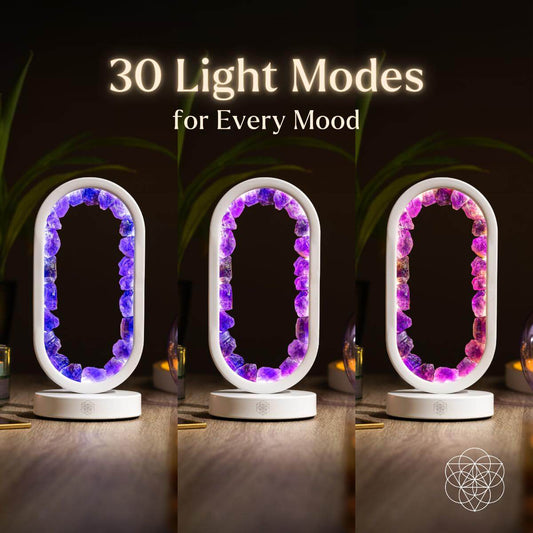
- Light. Two lamps, $59.95 and $69.95 — genuine Brazilian amethyst in a ring around an open center, thirty light modes, remote, and a timer on the $69.95 one. These are mains-powered lamps, not candle holders.
- To wear. The $32.95 druzy cuff in gold, rose gold and silver (open-backed, so it slides on from the side), $39.95 raw drop earrings, the $147.95 108-bead mala strung with carnelian, blue quartz, blue apatite and blue tiger’s eye, and at $418.95 the White Enamel Double Panther Bracelet, which is a fashion cuff with genuine amethyst set into it rather than a crystal-healing piece — worth knowing which one you are buying. A mala is a counting tool before it is a necklace: how to use mala beads.
- Room scale. The Anahi point at $367.95 — three of four individual pieces still available — and the 79.7 lb specimen at $7,968.95, which needs a surface that carries eighty pounds without flexing. Both sit in Fine Collector Minerals.
Is it real?
A fair question, and the format answers most of it. Lab-grown amethyst exists, is chemically identical to natural amethyst and is genuinely hard to tell apart without gemological equipment — but it turns up almost entirely in faceted stones and beads, because growing a convincing cluster or geode is not economical. Clusters, geodes and druze are the safest formats to buy, and named locality, individual photography and one-of-one listings matter more than any home test. The more common issue is not fakery but treatment: heat turns amethyst yellow-orange, which is how a great deal of commercial citrine is made, and dyed quartz is sold as amethyst at the very cheap end. Real vs. treated crystals goes through what to look for.
Care: light is the enemy, not water
The violet comes from irradiated iron and is not permanently fixed. Prolonged direct sun bleaches it toward pale lilac or gray-brown, and the change is irreversible. Heat does it faster. So the standard advice to charge crystals on a sunny windowsill is precisely wrong for this stone — see which crystals fade in sunlight, and how to charge crystals for the methods that do not cost you the color. Water, on the other hand, is fine: at Mohs 7 amethyst is hard and not water-soluble, which is the opposite of selenite. Which crystals cannot go in water explains why the Mohs rule alone is not enough. Two exceptions on this page: the lamps are electrical, and the enamel panther bracelet should be kept away from water, perfume and lotion. Routine cleaning is covered in how to cleanse crystals, and if a piece arrives chipped or splits later, what it means when a crystal breaks covers both the practical and the traditional reading.
Traditionally amethyst is worked with for calm, sleep and clear-headedness, and associated with the third eye and crown centers — crystals for anxiety and crystals for sleep set out what people actually use and what that does and does not mean. Those are traditional uses rather than scientifically established effects, and nothing here treats a condition or replaces medical care. More purple and violet stones in Clarity & Intuition and Calm & Grounding; the wider quartz family is in Quartz.
Frequently asked questions
Does amethyst fade in sunlight?
Yes, and it is the one thing that genuinely damages it. The violet comes from iron plus natural irradiation and is not permanently fixed, so prolonged direct sun bleaches the stone toward pale lilac or gray-brown. The change is irreversible. Heat does the same thing faster and turns it yellow-orange - which is how much commercial citrine is produced. Keep amethyst off a sunny windowsill and away from radiators, and charge it by moonlight rather than sunlight.
Can amethyst go in water?
Yes. At Mohs 7 it is hard and not water-soluble, so rinsing under the tap and drying with a soft cloth is fine. This is the opposite of selenite, which dissolves. Two exceptions on this page: the two lamps are mains-powered electrical items, and the enamel panther bracelet should be kept away from water, perfume and lotion.
What is the difference between a geode, a cluster and a druze?
A geode is a hollow cavity lined with crystal on the inside, cut open so you can look in. A cluster is many crystal terminations grown on a shared matrix, freestanding rather than enclosed. Druze is the crust itself - the field of tiny tightly packed terminations that lines a geode - broken out and sold as a piece. Druze is the cheapest way to own a genuine crystal face: $36.95 here against $159.95 for the smallest whole geode.
What is chevron amethyst?
Amethyst that grew in alternating layers with white quartz, leaving V-shaped bands across the face. The bands are phantoms: points where the crystal paused, gathered a layer of quartz and then continued growing. It is not a lesser grade of amethyst, just a different one - plain amethyst is uninterrupted violet, chevron amethyst shows its own growth history.
How do I know my amethyst is real?
The format does most of the work. Lab-grown amethyst is chemically identical to natural and hard to identify without gemological equipment, but it appears almost entirely in faceted stones and beads, because growing a convincing cluster or geode is not economical. Clusters, geodes and druze are the safest formats. A named locality, individually photographed pieces and one-of-one listings tell you more than any home test. The more common issue is treatment rather than fakery: heat-treated amethyst is sold as citrine, and dyed quartz turns up at the very cheap end.
Why is the A+ tumbled stone cheaper than the standard one?
Because it is smaller. A+ describes the depth of the color, not the size of the stone, so the $2.95 A+ small stone and the $4.95 standard one are priced by what you get in the hand rather than by grade.
Is a bigger amethyst better value?
Per gram, yes, and by a wide margin. Raw Brazilian druze works out at about five cents a gram, the 79.7 lb Bolivian cluster at about twenty-two, and polished scepter wands at eighty to ninety. The dogtooth calcite specimen is around $1.10 a gram - roughly twenty-four times the druze - despite being much smaller. You are paying for cutting, polishing and rarity of formation, not for the mineral.
Which amethyst should I start with?
The $4.95 tumbled pocket stone if you want something to carry, or the $19.95 chevron point for a desk. If you want the look of a real crystal face without spending three figures, the $36.95 Brazilian druze is the best value on the page.