




Copal Incense: What It Is and How to Burn It


Copal is one of the few materials on an American incense shelf with an unbroken line of use running back before the arrival of Europeans. It was burned in Mesoamerica for centuries before contact, it was burned through the colonial period, and it is burned this week — on home altars, at Day of the Dead ofrendas, in churches in Oaxaca and in apartments in Los Angeles and Chicago.
Contents
Copal is a soft, pale tree resin burned as incense in Mesoamerica since well before European contact; the word comes from the Nahuatl copalli, meaning incense. The classic Mexican material comes from trees of the Burseraceae family, above all Bursera bipinnata and Protium copal, and is sold as copal blanco, oro or negro. Geologically it is resin that has partly hardened without fully fossilizing, placing it between fresh resin and amber. Burn it on a lit charcoal disk in a heatproof vessel over sand or ash, or gently on an electric burner; a piece the size of a pea is enough for a room. Some resin sold as copal in the United States comes from entirely different tree families. Ventilate the room, and note that incense is not a treatment for any condition.
The word copal derives from the Nahuatl copalli, meaning incense.
Source/tradition: Standard etymological reference works on Nahuatl loanwords in Spanish and English
Copal is resin that has partly hardened without completing fossilization, placing it between fresh resin and amber; it stays soft and dissolves in solvents that do not affect amber.
Source/tradition: Standard mineralogical and geological description of sub-fossil resins
Copal has been recovered archaeologically as offering material from Maya and Mexica contexts, including the Sacred Cenote at Chichen Itza and offerings at the Templo Mayor in Mexico City.
Source/tradition: Published excavation reports from the Sacred Cenote and the Templo Mayor offering caches
Resin sold as copal comes from at least three unrelated botanical sources: Bursera and Protium in Mexico, Hymenaea in East Africa and Agathis in Southeast Asia.
Source/tradition: Botanical classification of commercial resins; copal denotes a hardening stage, not a species
The scent of copal smoke guides the dead to the altar prepared for them at Day of the Dead.
Source/tradition: Mexican Day of the Dead tradition, in continuous practice and widely documented ethnographically
Copal negro is the grade preferred for cleansing work, being the darkest and smokiest of the three Mexican grades.
Source/tradition: Mexican folk practice; the grades describe collection and color rather than potency
A pea-sized piece on a greyed-over charcoal disk, over at least an inch of sand, with the residue removed once the aroma turns sharp, is the working method.
Source/tradition: Common practice among resin users; dosing errors are the most frequent beginner problem
Burning copal removes negative energy from a room or a person.
Source/tradition: Devotional and folk-magical claim; no empirical support, and burning plant material produces fine particulates
VERIFIED = verifiable in scientific or official sources · TRADITIONAL = historically or culturally recorded · LIVED PRACTICE = widely practiced, experiential knowledge · NOT PROVEN = spiritual interpretation, not scientifically established.
That continuity is the reason it deserves a careful article rather than a paragraph. It is also the reason the word on the label is doing more work than most buyers realize, because several quite different resins are sold in the United States under this single name.
Quick answer
Copal is a soft, pale tree resin, burned as incense in Mesoamerica since well before European contact; the word comes from the Nahuatl copalli, meaning incense. The classic Mexican material comes from trees of the Burseraceae family, above all Bursera bipinnata and Protium copal, and is sold as copal blanco, copal oro or copal negro. Geologically, copal is resin that has partly hardened but not fully fossilized, which places it on the path between fresh resin and amber. It is burned on a lit charcoal disk in a heatproof vessel over a bed of sand or ash, or gently on an electric burner or mica plate; a piece the size of a pea is enough for a room. Some resin sold as copal in the United States is East African or Indonesian material from an entirely different tree family. Burning any incense produces smoke and fine particulates, so ventilate the room; incense is not a treatment for any medical condition.
What copal actually is
A tree that is cut or damaged pushes out resin to seal the wound. Left alone, that resin hardens over time, and given tens of millions of years and the right conditions, it becomes amber.
Copal is the stage before. It is resin that has begun to harden and lose its volatile fraction but has not completed fossilization — sub-fossil, in the technical description, or in the plainer version, young amber. That is why it stays comparatively soft, why it dents under a fingernail, and why it dissolves in solvents that leave true amber untouched. It is also why the mineral trade has a long history of copal being sold as amber to people who did not know the difference.
For burning, that immaturity is the entire point. The volatile compounds that a fully fossilized resin has lost over geological time are exactly what produces aroma when the material is heated. Amber makes poor incense. Copal is excellent incense for the same reason.
The name problem
Here is the part worth knowing before you buy. Copal is not the name of a species. It is a name for a stage of resin, and it gets applied to material from at least three unrelated botanical sources:
| Sold as | Actually from | Character when burned |
|---|---|---|
| Mexican copal (blanco, oro, negro) | Bursera species, chiefly Bursera bipinnata, and Protium copal | Bright, resinous, faintly citrus and pine; the classic Mesoamerican profile |
| East African copal | Hymenaea species, a legume, not a Burseraceae | Heavier and sweeter, closer to a soft amber note |
| Manila or Indonesian copal | Agathis species, a conifer | Sharper and more turpentine-like; often sold for varnish rather than for burning |
None of these is fake. They are simply different materials, and a label that says only copal tells you which stage of hardening you are getting and nothing about which tree. If the Mesoamerican profile is what you are after, look for the species name or the Mexican grade, not the bare word.
The Mexican grades
Mexican copal is sold by grade, and the grades describe how it was collected rather than how good it is.
Copal blanco is the pale, almost white material, tapped deliberately and allowed to harden in the air. It is the cleanest and lightest in aroma, and the grade most often used for offerings.
Copal oro is the golden grade, slightly darker and more resinous, with a fuller note.
Copal negro is the dark material, often collected from where it has run down the bark and gathered debris. It is the strongest and smokiest of the three, and the one most associated with cleansing work in Mexican folk practice.
Price tends to follow scarcity of the pale grades rather than any hierarchy of quality. A practitioner who wants a heavy, enveloping smoke wants the black one.
If you want to work with this yourself, this is what we use
Smoke Cleansing Charcoal Tablets · $27.95
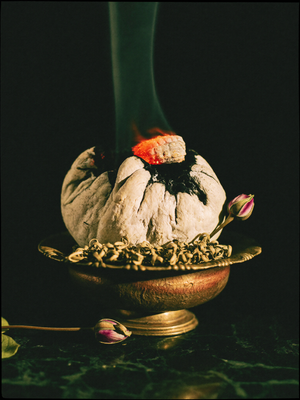
Resin does not burn on its own. It needs a heat source underneath it, and for copal the standard one is a quick-lighting charcoal disk in a heatproof vessel over sand. One disk carries a session comfortably, and a pack of them is the difference between owning resin and actually using it. Light the disk, wait for the sparking to finish and the surface to grey over, then set a piece of resin on top. If you would rather have no charcoal at all, a low electric burner or a mica plate over a tealight works too, more slowly and with much less smoke.
How to burn it
Copal is more forgiving than frankincense and less forgiving than a stick. The failures are all the same failure: too much heat, or too much resin.
- Prepare the vessel. A heatproof bowl, censer or shell with a bed of sand or ash at least an inch deep. The sand is not decoration; it takes the heat that would otherwise crack the vessel or scorch the table.
- Light the charcoal. Hold it with tongs, not fingers, and touch a flame to one edge until it catches and sparks across. Set it on the sand and wait three to five minutes until it is uniformly grey. Charcoal put to work too early smells of charcoal.
- Use a small piece. Pea-sized. First-time users routinely use five times too much and end up opening a window. You can always add a second piece.
- Expect it to melt before it smokes. Copal liquefies, bubbles, then releases. That is normal, and it is also why the vessel needs to be one you do not mind seasoning permanently.
- Lift it off when the note turns. When the smoke goes from resinous to acrid, the resin has given what it has. Nudge the spent residue aside with a spoon.
- Ventilate. Crack a window. This holds for every incense material, and for resin on charcoal more than most, because the smoke volume is high.
For the mechanics of charcoal in more detail — disk sizes, vessels, what to do when the disk keeps going out — see the dedicated guide on burning resin incense on charcoal.
Where copal is used, and by whom
The archaeological record is unusually clear here. Copal has been recovered as offerings from Maya and Mexica contexts, including material dredged from the Sacred Cenote at Chichen Itza and offerings excavated at the Templo Mayor in Mexico City, some of it shaped into figures or painted before deposition. This was not incidental use. It was a principal offering material.
After the conquest the practice did not stop; it moved. Copal was absorbed into Catholic ritual in Mexico and burned in churches alongside imported frankincense, and it has stayed in continuous domestic use in the same places ever since.
Today, in the United States, its most visible appearance is around Day of the Dead, on the first and second of November. Copal smoke on an ofrenda has a stated function in that tradition: the scent is understood to guide the dead to the altar prepared for them. If you are setting an ofrenda for the first time this fall, copal is not an optional aesthetic touch, it is one of the named elements.
Which raises a point of manners rather than of rules. Copal is a living tradition belonging to specific communities, not a generic cleansing product. Using it thoughtfully means knowing what it is for where it comes from — the same courtesy owed to any material with people still standing behind it.
Copal against the other smoke materials
| Material | Source | Traditional home | Notes for buyers |
|---|---|---|---|
| Copal | Bursera and Protium resin | Mesoamerica | Melts on charcoal; bright and resinous; several unrelated resins share the name |
| Frankincense | Boswellia resin | Arabia and the Horn of Africa | Higher melting point, sharper and more lemony; some species under pressure from over-tapping |
| Palo santo | Bursera graveolens wood | South America | Same botanical family as Mexican copal, burned as wood rather than resin; sourcing claims worth checking |
| White sage | Salvia apiana leaf | Southwestern North America | Culturally specific and commercially over-harvested; the most fraught of the four to buy casually |
The relationship between copal and palo santo is the one that surprises people: they are close botanical relatives, both Burseraceae, one used as resin and one as wood. If you are weighing up the smoke materials generally, the comparison of palo santo and white sage covers the sourcing questions in detail, and the piece on frankincense covers the other great resin of the trade.
Storage, dosing and the usual mistakes
Copal stays soft, and softness is a storage problem. In a warm room the pieces fuse into one lump, and in a plastic bag on a sunny windowsill they can go to a single sticky mass within a season.
Keep it cool, dark and airtight. A glass jar in a cupboard. Not the shelf above the stove.
If it has fused, half an hour in the freezer makes it brittle enough to break cleanly with the back of a spoon.
Dose downward. The single most common error is quantity. Resin on charcoal produces several times the smoke of a stick, and a room can be made unusable with a piece the size of a grape.
Do not leave it burning unattended, and keep the vessel away from anything that drapes. Charcoal disks run hot enough to scorch a surface straight through a thin dish.
A last honest note on effects. Copal is traditionally burned for cleansing, for offering and for prayer, and those are the claims this article is making — claims about what a tradition does, not about what a substance causes. Burning any plant material produces fine particulates. If anyone in the home has asthma or another respiratory condition, that matters more than any tradition does.
Frequently asked questions
What is copal made from?
It is hardened tree resin, most often from Bursera or Protium species in Mexico and Central America. Resins from unrelated East African and Indonesian trees are also sold under the same name, because copal describes a stage of hardening rather than a species.
Is copal the same thing as amber?
No, but they are stages of the same process. Copal is resin that has partly hardened without fully fossilizing, while amber has completed that process over millions of years. Copal stays softer, dissolves in solvents that do not affect amber, and burns far better.
How do you burn copal?
Set a lit charcoal disk on a bed of sand in a heatproof vessel, wait until it greys over, then place a pea-sized piece of resin on top. It will melt and bubble before it releases smoke. Remove the residue once the aroma turns sharp, and keep the room ventilated.
What is the difference between copal blanco, oro and negro?
The grades describe collection and color rather than quality. Blanco is the pale, deliberately tapped grade with the lightest aroma, oro is golden and fuller, and negro is dark, smokiest and most associated with cleansing work in Mexican folk practice.
Why is copal used for Day of the Dead?
In that tradition the scent of the smoke is understood to guide the dead to the altar prepared for them, which makes copal one of the named elements of an ofrenda rather than a decorative addition.
Can I burn copal without charcoal?
Yes. A low electric resin burner or a mica plate set over a tealight will warm the resin enough to release its aroma without igniting it. The result is gentler and much less smoky, which suits a small apartment better than charcoal does.
How should copal be stored?
In an airtight glass jar somewhere cool and dark, because the pieces fuse into a single mass in warmth. If that has already happened, half an hour in the freezer makes the lump brittle enough to break apart cleanly.