




Cold Moon 2026: Date, Time and a Cancer Hearth Ritual
The closest full moon of 2026 peaks on the evening of December 23, two days after the solstice. Times for every US zone, moonrise and hours above the horizon for eight cities, the Long Night Moon explained and a Cancer hearth ritual.

The Cold Moon of 2026 is the closest and brightest full moon of the year, it peaks on the evening of December 23 two days after the solstice, and it stays above the horizon longer than almost any other. Here are the times for every US zone and eight cities, why it is called the Long Night Moon, what a Cancer full moon means, and a hearth ritual you can do on the night before Christmas Eve.
Contents
The Cold Moon 2026 is full on Wednesday, December 23, 2026, at 8:28 p.m. Eastern, 7:28 p.m. Central, 6:28 p.m. Mountain and 5:28 p.m. Pacific. In UTC that is 01:28 on December 24, which is why many international calendars give the 24th. At 356,738 km from Earth it is the closest full moon of 2026, a supermoon with perigee only about eight hours later. It sits at 2 degrees of Cancer opposite a Capricorn sun, two days after the winter solstice of December 21 at 3:50 p.m. Eastern. It is also called the Long Night Moon because it stays above the horizon 15 to 17 hours across the US, 21.7 hours in Anchorage, and does not set at all in Fairbanks. On Christmas Eve the moon is still 98 percent lit. In practice it is a hearth moon: rest, home and family. No effect of the full moon on events or sleep is established.
The December 2026 full moon occurs on December 24 at 01:28 UTC, which is December 23 at 8:28 p.m. Eastern Standard Time.
At 356,738 km from Earth it is the closest full moon of 2026.
The December full moon stays above the horizon longer than summer full moons because it lies opposite the low winter sun.
The Old Farmer's Almanac attributes the name Cold Moon to the Mohawk and Long Night Moon to the Mohican.
A full moon just after the winter solstice is commonly worked as the first full moon of the returning light.
A Cancer full moon is read astrologically as a high point for home and family.
The full moon heals family conflicts or measurably changes sleep, mood or events.
VERIFIED = verifiable in scientific or official sources · TRADITIONAL = historically or culturally recorded · LIVED PRACTICE = widely practiced, experiential knowledge · NOT PROVEN = spiritual interpretation, not scientifically established.
Quick answer: The Cold Moon 2026 is full on Wednesday, December 23, at 8:28 p.m. Eastern (5:28 p.m. Pacific), already risen across the US. It is the closest full moon of 2026, a supermoon in Cancer, two days after the winter solstice. Christmas Eve night it is still 98 percent lit.
When is the Cold Moon in 2026?
The Cold Moon 2026 reaches full phase on Thursday, December 24, 2026, at 01:28 UTC, which in the United States is still Wednesday, December 23: 8:28 p.m. Eastern, 7:28 p.m. Central, 6:28 p.m. Mountain, 5:28 p.m. Pacific, 4:28 p.m. in Alaska and 3:28 p.m. in Hawaii.
This is the friendly kind of full moon. Unlike November's, which peaks on a weekday morning after moonset, the Cold Moon is exact in the evening, when the moon has already risen in every time zone in the lower 48. If you step outside on December 23 after dinner, you are looking at the full moon at its exact moment, give or take an hour.
A warning about calendars: many international sites list the date as December 24 because they use UTC. For anyone in the US the night to mark is the 23rd. Christmas Eve, the 24th, is the second-best night, with the moon still 98.6 percent lit at 7 p.m. Eastern.
Cold Moon 2026 by time zone
| Time zone | Exact full moon | Moon above the horizon then? |
|---|---|---|
| Eastern (EST) | Wed Dec 23, 8:28 p.m. | Yes, rising in the east |
| Central (CST) | Wed Dec 23, 7:28 p.m. | Yes |
| Mountain (MST) | Wed Dec 23, 6:28 p.m. | Yes, low in the east |
| Pacific (PST) | Wed Dec 23, 5:28 p.m. | Just risen, near sunset |
| Alaska (AKST) | Wed Dec 23, 4:28 p.m. | Yes, risen early afternoon |
| Hawaii (HST) | Wed Dec 23, 3:28 p.m. | Not yet; rises around sunset |
What time does the Cold Moon rise where I live?
The Cold Moon rises between about 3:50 and 5:15 p.m. local time on December 23, close to sunset, and sets after sunrise on December 24. On Christmas Eve it rises roughly an hour and a quarter later.
| City | Wed Dec 23: rise / set | Thu Dec 24: rise / set | Hours above horizon (Dec 23) |
|---|---|---|---|
| New York | 4:00 p.m. / 8:05 a.m. | 5:16 p.m. / 8:55 a.m. | 16.2 |
| Miami | 5:16 p.m. / 7:44 a.m. | 6:28 p.m. / 8:40 a.m. | 14.5 |
| Chicago | 3:52 p.m. / 8:06 a.m. | 5:09 p.m. / 8:55 a.m. | 16.2 |
| Denver | 4:14 p.m. / 8:10 a.m. | 5:31 p.m. / 8:59 a.m. | 16.0 |
| Los Angeles | 4:30 p.m. / 7:46 a.m. | 5:45 p.m. / 8:38 a.m. | 15.3 |
| Seattle | 3:49 p.m. / 8:56 a.m. | 5:11 p.m. / 9:38 a.m. | 17.2 |
| Anchorage | 2:22 p.m. / 11:47 a.m. | 4:14 p.m. / 11:55 a.m. | 21.7 |
| Fairbanks, Utqiagvik | Does not set: the moon circles the sky all day and night | 24 | |
Why is the Cold Moon called the Long Night Moon?
It is called the Long Night Moon because the December full moon, opposite the low winter sun, rides high in the sky and stays above the horizon for the whole long night, often 15 to 17 hours in the US. The name is attributed to the Mohican in the Old Farmer's Almanac's list.
The geometry is simple. A full moon is always opposite the sun. In December the sun hugs the southern horizon at noon and sets early, so the full moon opposite it climbs high at midnight and rises early and sets late. In 2026 the Cold Moon reaches 76 degrees above the horizon over New York at midnight, nearly overhead. Compare the full moon of June 29, 2026, which over New York never gets higher than 22 degrees and is up for less than nine hours.
How long the Cold Moon stays up, December 23–24
Our calculation, Skyfield with the JPL DE421 ephemeris; noon-to-noon local time.
One honest correction to a line you will read everywhere: in 2026 the November Beaver Moon rides almost exactly as high, 76 degrees over New York, and stays up about as long. The "longest night moon" title belongs to the December one in an average year, but the two are close this year because both fall near the Gemini–Cancer border of the sky.
Is the Cold Moon 2026 a supermoon?
Yes, and it is the closest full moon of 2026. At full phase it is 356,738 km (221,666 miles) from Earth, and it reaches perigee, its closest point of the month, only about eight hours later, so the two nearly coincide.
Compared with the year's most distant full moon on May 31, the Cold Moon appears about 14 percent wider and about 30 percent brighter. Fresh snow cover, where you have it, makes it look brighter still, because the ground reflects so much of the light back. It is the middle one of three supermoons in a row, after November's Beaver Moon and before the Wolf Moon of January 22, 2027, and the brightest of the three.
Why is it called the Cold Moon?
It is called the Cold Moon because it falls when winter cold sets in; the Old Farmer's Almanac attributes the name to the Mohawk. Other December names include the Long Night Moon (Mohican), Moon of the Popping Trees (Oglala), Frost Exploding Trees Moon (Cree), Snow Moon and, in Europe, the Moon before Yule.
The history is a little messier than the almanac list suggests. The explorer Jonathan Carver, whose 1778 book is the source of much of the modern list, attached the cold name to January rather than December. The month assignments were later fixed by the Old Farmer's Almanac. "Moon before Yule" is English and simply means the full moon that comes before Christmas; when the full moon falls after the solstice, as in 2026, some writers call it the Moon after Yule instead.
| Name | Attributed to | What it describes |
|---|---|---|
| Cold Moon | Mohawk (almanac) | The cold fastening its grip |
| Long Night Moon | Mohican | The longest nights of the year |
| Moon of the Popping Trees | Oglala | Sap freezing and cracking trunks |
| Frost Exploding Trees Moon | Cree | The same cracking frost |
| Snow Moon | Haida, Cherokee | Snowfall |
| Little Spirit Moon | Anishinaabe | A season of spirit and story |
| Moon before Yule | English usage | The full moon before Christmas |
What does the Cold Moon mean spiritually?
In modern moon practice the Cold Moon stands for the hearth: rest, home, family and the people you keep warm with. It is read as the moon of the longest nights, a time to stay in, tend what you have and let the year end, rather than push for something new.
That fits 2026 almost too neatly. The winter solstice falls on Monday, December 21, at 3:50 p.m. Eastern, and the Cold Moon follows two days later. In the Wheel of the Year this is still Yule, and a full moon in the days after the solstice is commonly treated as the first full moon of the returning light: the darkest stretch is over by the calendar, even if the cold has only just started.
The practical reading is the one most people already live in late December. The house is full or noticeably empty, the work year is closing, and the evenings are long. The Cold Moon gives that a name and an evening.
What does a full moon in Cancer mean?
The Cold Moon 2026 sits at 2 degrees of Cancer, opposite the sun in Capricorn. Astrologers read a Cancer full moon as an emotional high point around home, family, mothers and belonging, set against Capricorn's work, duty and public role. It is often described as the moon of "who is your home?"
The moon enters Cancer at about 5:00 p.m. Eastern on December 23, three and a half hours before the exact full moon, so the evening of the 23rd is Cancer from start to finish. Cancer is also the moon's own sign in traditional astrology, which is why practitioners treat this as one of the stronger full moons of the year for home and family work.
The Capricorn–Cancer axis is the one everyone feels in the last week of December: the year-end deadline against the family table. The useful version for a ritual is to decide, on purpose, where your attention goes for the next week.

If you want to work with this yourself, this is what we use
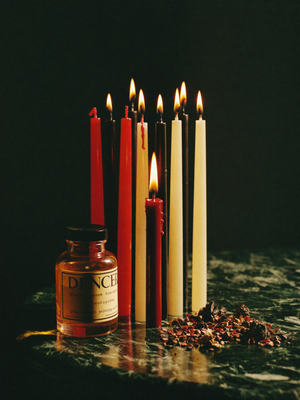
Cancer Oil Candle — Refillable Zodiac Candle for Comfort & Intuition
A small, steady oil candle scented with sea salt and orchid, with dried botanicals in the glass. Made for the table at the end of a loud day, which is what the Cold Moon evening is for. Refillable. $25.95
Ships within 3 business days; shipping is calculated at checkout. For December delivery, order early.
How do you do a Cold Moon ritual?
A Cold Moon ritual is a quiet hearth evening: light one candle where the household gathers, name who and what kept you warm this year, set down one thing you are not carrying into January, and leave water out under the moon overnight. It takes 20 to 30 minutes and can be done alone or with family.
The hearth ritual, step by step
- Choose the hearth. The kitchen table, the stove, the fireplace, or wherever people actually end up. Clear it of everything except one candle on a heat-proof plate.
- Light it at 8:28 p.m. Eastern (7:28 Central, 6:28 Mountain, 5:28 Pacific), or simply after dark on the 23rd. Turn off the overhead lights.
- Name the warmth. Say aloud, or write, three people or things that kept you warm in 2026. With others present, go round the table once.
- Set one thing down. Write one habit, worry or obligation you are not carrying into January on a slip of paper. Fold it away from you.
- Step outside for one minute. Look at the moon nearly overhead. This is the closest it gets all year. Bring the cold back in on your coat.
- Water under the moon. Leave a covered jar of water on a sill or step overnight. In freezing weather use a jar with room to expand, or keep it inside at a moonlit window.
- Close. Put the candle out when you leave the room. Burn or bin the folded slip the next morning, after Christmas Eve breakfast if that is your tradition.
Our general full moon ritual guide has variations if you prefer a longer practice, and how to make moon water covers what to do with the jar afterwards.
Can you do a full moon ritual on Christmas Eve?
Yes. On Christmas Eve 2026 the moon is still 98 percent lit, rises in the early evening and is up all night, so any full moon practice works that night too. Most traditions treat the night after the exact full moon as part of the full moon window.
For households that keep Christmas, the hearth ritual folds easily into Christmas Eve: one candle on the table, a round of "what kept you warm this year", no explanation needed. For pagan households it can sit inside the twelve nights that follow the solstice, which we cover in the twelve nights, dates and rituals.
Temple Tip
If you started the 13 wishes ritual on the solstice, the Cold Moon falls on your third night. Burn that night's slip by the light of the full moon rather than the usual candle alone. It costs nothing extra and ties the two practices together.
How does the Cold Moon connect to Yule and the solstice?
The Cold Moon 2026 comes two days after the winter solstice, on December 21 at 3:50 p.m. Eastern, so it falls inside the Yule season. In the Wheel of the Year the solstice marks the sun's rebirth; the full moon just after it is often worked as the first full moon of the growing light.
| Date | Event | What practitioners do |
|---|---|---|
| Dec 8, 7:51 p.m. | New moon in Sagittarius | Set the intention for the season |
| Dec 21, 3:50 p.m. | Winter solstice | Yule; vigil for the returning sun |
| Dec 23, 8:28 p.m. | Cold Moon, full in Cancer | Hearth ritual, moon water |
| Dec 31, midnight | Waning moon, 36% lit, in Libra | Letting go of the old year |
| Jan 7, 3:24 p.m. | First new moon of 2027, in Capricorn | Intentions for the new year |
| Jan 22, 7:17 a.m. | Wolf Moon, full in Leo | First full moon of 2027 |
For the solstice itself, see how to celebrate Yule and our winter solstice rituals. For the week after, New Year rituals for good luck picks up where this leaves off.
Which Cold Moon practice fits you?
Pick the line closest to your December.
Voices from practice: what people report
We do not publish invented testimonials. These are patterns that recur in public discussion of December full moon practice among practitioners, given as patterns and without names.
The most common report is that the December ritual is the one people actually keep, because it slots into an evening they were already spending at home. A second recurring theme is the light itself: people with snow on the ground describe the full moon night as bright enough to walk without a flashlight. And a familiar frustration is dates, with people realising too late that an international calendar listed the 24th when their full moon was on the 23rd.
What we don't promise
The Cold Moon will not heal a family rift, change your luck or make next year better. No study has shown that a full moon changes events, moods or relationships, and the evidence on the moon and sleep is mixed. What the ritual offers is a deliberate half hour at the darkest time of year, with a reason to look up.
The astrology is interpretation, and the name history is more tangled than most moon calendars admit. If the dark months bring low mood that does not lift, that is worth taking to a doctor; it is common, and it is treatable.
Practically: how to work with this
- Early December: order candles and anything you want to give before the holiday shipping crunch.
- December 8: new moon in Sagittarius; a good evening for the new moon ritual if you want to bookend the month.
- December 21: winter solstice, 3:50 p.m. Eastern.
- December 23: Cold Moon, 8:28 p.m. Eastern. Hearth ritual, one minute outside, moon water on the sill.
- December 24: 98 percent moon for anyone who missed the 23rd.
- Every time: candle on a heat-proof plate, clear of wrapping paper, trees and garlands, out when you leave the room.
Lunar tools are in our moon and lunar magic collection; a candle for each sign is in the zodiac candles.
Frequently asked questions
When is the Cold Moon 2026?
The Cold Moon 2026 is full on Wednesday, December 23, 2026, at 8:28 p.m. Eastern, 7:28 p.m. Central, 6:28 p.m. Mountain and 5:28 p.m. Pacific. In UTC that is 01:28 on December 24, which is why some calendars list the 24th.
Is the December 2026 full moon a supermoon?
Yes. At 356,738 km from Earth it is the closest full moon of 2026, with perigee only about eight hours later. It looks about 14 percent wider and 30 percent brighter than the year's most distant full moon in May.
Why is the December full moon called the Cold Moon?
Because it comes as winter cold sets in. The Old Farmer's Almanac attributes the name to the Mohawk. It is also called the Long Night Moon, because it stays above the horizon through the longest nights of the year.
What zodiac sign is the Cold Moon 2026 in?
The Cold Moon 2026 is in Cancer, at about 2 degrees, opposite the sun in Capricorn. The moon enters Cancer around 5:00 p.m. Eastern on December 23, so the whole evening of the full moon is in Cancer.
What does the Cold Moon mean spiritually?
In modern moon practice the Cold Moon stands for the hearth: rest, home, family and the people who keep you warm. Falling right after the winter solstice, it is often treated as the first full moon of the returning light.
What should I do on the Cold Moon?
Light one candle where your household gathers, name three people or things that kept you warm this year, write down one thing you are not taking into January, step outside to see the moon, and leave a jar of water out overnight.
Will there be a full moon on Christmas 2026?
Nearly. The exact full moon is on the evening of December 23. On Christmas Eve the moon is still 98 percent lit, and on Christmas evening about 94 percent, so it looks full to the eye on both nights.
Is the Cold Moon the last full moon of 2026?
Yes. The Cold Moon on December 23 is the last full moon of 2026. The next is the Wolf Moon on January 22, 2027, at 7:17 a.m. Eastern, in Leo.
Sources & further reading
- Old Farmer's Almanac, "Full Moon Names" (almanac.com, accessed 2026) — December names by nation, including Cold Moon (Mohawk) and Long Night Moon (Mohican).
- Dave Roos, "How Full Moons Got Their Names", HISTORY (2026) — Jonathan Carver's 1778 list and its later standardization.
- Jonathan Carver, Travels Through the Interior Parts of North America in the Years 1766, 1767, and 1768 (London, 1778).
- Ronald Hutton, The Stations of the Sun: A History of the Ritual Year in Britain (Oxford University Press, 1996) — midwinter customs and Yule.
- Richard Nolle, "supermoon" definition (1979), as used by NASA and most almanacs.
- Christian Cajochen et al., "Evidence that the lunar cycle influences human sleep", Current Biology (2013), and later failed replications.
- Moon phases, distances, moonrise, moonset, hours above the horizon and the solstice: our own calculation with Skyfield and the NASA JPL DE421 ephemeris (2026).
More moon guides: Beaver Moon 2026 · full moon calendar 2027 · winter solstice rituals · waning moon ritual for letting go
