




Crystal Combinations: Which Stones Work Together
Crystal combining runs on three conventions: stones with the same traditional assignment are used together, a grounding stone is added to an upper-chakra one, and clear quartz is treated as the universal addition. The five sets that recur everywhere are rose quartz with rhodonite and green aventurine for the heart; black tourmaline with obsidian and smoky quartz for protection; amethyst with clear quartz and kyanite for meditation; citrine with pyrite and green aventurine for abundance; and amethyst with lepidolite and rose quartz for sleep. Two to four stones with one named purpose is the standard advice, and it works because a small set is one you keep using. The only conflicts that can actually be demonstrated are physical: harder stones scratch softer ones, selenite and porous stones should not be washed, and oxidizing pyrite produces acidity that damages carbonates stored beside it. The energy claims are modern tradition and lived practice, not measured effects.

Pairing crystals is the part of crystal practice with the most rules and the least evidence. There are five or six combinations that everyone recommends, three principles behind them, and one genuine reason some stones should be kept apart that has nothing to do with energy at all. Here are the combinations that are actually used, where the rules came from, which pairings cause real physical damage, and how to build a set of your own without ending up with a drawer full of rocks and no idea what any of them is for.
Contents
Crystal combining runs on three conventions: stones with the same traditional assignment are used together, a grounding stone is added to an upper-chakra one, and clear quartz is treated as the universal addition. The five sets that recur everywhere are rose quartz with rhodonite and green aventurine for the heart; black tourmaline with obsidian and smoky quartz for protection; amethyst with clear quartz and kyanite for meditation; citrine with pyrite and green aventurine for abundance; and amethyst with lepidolite and rose quartz for sleep. Two to four stones with one named purpose is the standard advice, and it works because a small set is one you keep using. The only conflicts that can actually be demonstrated are physical: harder stones scratch softer ones, selenite and porous stones should not be washed, and oxidizing pyrite produces acidity that damages carbonates stored beside it. The energy claims are modern tradition and lived practice, not measured effects.
Set combinations such as rose quartz with rhodonite and green aventurine, or amethyst with clear quartz and kyanite, are the standard recommendations for specific purposes in crystal literature.
Source/tradition: Widespread combination practice in English-language crystal literature
Two to four stones with one shared purpose is the usual recommendation over larger sets.
Source/tradition: Common contemporary crystal practice
Only stones of comparable hardness and water tolerance should be cleaned or stored together: gypsum, sold as selenite, is slightly water-soluble, and oxidizing pyrite produces acidity that attacks calcite, amber and other carbonates nearby.
Source/tradition: Mindat.org; Mohs hardness scale; museum conservation guidance on pyrite decay
Quartz is piezoelectric, producing a voltage under mechanical pressure, which is unrelated to any claimed effect on neighbouring stones.
Source/tradition: Jacques and Pierre Curie, 1880; standard physics references on the piezoelectric effect
Stones with the same purpose combine their effect, and clear quartz amplifies any combination.
Source/tradition: Modern crystal tradition; no measured effect
Strongly activating and strongly calming stones cancel each other out and confuse the energy field.
Source/tradition: Modern crystal tradition; untestable as stated
VERIFIED = verifiable in scientific or official sources · TRADITIONAL = historically or culturally recorded · LIVED PRACTICE = widely practiced, experiential knowledge · NOT PROVEN = spiritual interpretation, not scientifically established.
At a glance
The working rule: two to four stones, one shared purpose
Principle one: stones with the same assignment are used together
Principle two: something grounding alongside something "high"
Principle three: clear quartz is treated as the universal addition
Status: lived practice and modern tradition, not a measured effect
The one real conflict: hardness, water and pyrite — physical, not energetic
What this article is, and what it is not
Two different questions get asked with nearly the same words, and they have completely different answers.
"Which crystals go together?" is a question about practice: which stones are conventionally used for the same purpose, and how people assemble a small set. That is this article.
"Which crystals should not be kept together?" is a question about storage and damage, and the honest answer is about hardness and chemistry rather than energy. We have a separate, longer piece on exactly that: which crystals should not be kept together. If your concern is a scratched stone or a bag of tumbles grinding against each other, start there.
The three principles, and where they came from
Almost every combination guide in English runs on the same three rules. They are worth stating plainly, along with what kind of claim each one is.
- Same purpose, used together. If two stones are assigned the same theme in crystal tradition, they are used as a pair. This is really a statement about intention, not about the stones: holding two objects that both mean "I am working on this" is a stronger reminder than holding one.
- Grounding plus "high." A dark, heavy stone — smoky quartz, black tourmaline, hematite, tiger's eye — is added to an upper-chakra stone such as amethyst or selenite, on the reasoning that the practice should not leave you floating. This is the most useful rule in the set, because it builds the come-back-down step into the ritual itself.
- Clear quartz with anything. Quartz is described as the amplifier that strengthens whatever it is next to. The idea almost certainly borrows its authority from a real fact — quartz is piezoelectric, which is why it keeps time in watches — but piezoelectricity is a voltage produced under mechanical pressure, and it has nothing to do with the claim. It is a good story, not a mechanism.
None of the three has been shown to do anything measurable. What they do reliably is make a practice easier to keep: a small, fixed set with a named purpose is something you will actually use, and a drawer of forty tumbles is not.
The combinations that are actually used
These five sets recur across English-language crystal books, shops and forums. The purposes are the traditional assignments; the notes are the practical part.
| Purpose | The usual trio | Practical note |
|---|---|---|
| Love and the heart | Rose quartz + rhodonite + green aventurine | All three are hard enough to share a pouch; the easiest set to carry |
| Protection and grounding | Black tourmaline + obsidian + smoky quartz | Obsidian is glass and chips; keep it from knocking against the tourmaline |
| Clarity and meditation | Amethyst + clear quartz + kyanite | Kyanite splits along its length and must be stored on its own |
| Abundance and opportunity | Citrine + pyrite + green aventurine | Pyrite is the one stone that can genuinely damage its neighbours — see below |
| Sleep and quiet | Amethyst + lepidolite + rose quartz | Lepidolite is a soft, flaky mica; it will not survive a pocket |
If you want the single-stone meanings behind these, the crystal meanings chart lists forty of them in one place.
 |
A set someone else assembled The Calm Trio — Amethyst, Apatite & Howlite, $8.99. This is the shortcut version of everything above: three stones chosen for one purpose, so you do not have to decide. Amethyst and howlite are the two most commonly named calming stones in English crystal practice; blue apatite is the throat-and-clarity stone that keeps the set from being purely sedative. Three tumbles, one pouch, under ten dollars. It is a set of reminders, not a treatment for anxiety — if anxiety is running your days, that is a conversation for a doctor. |
The combination rule that is actually true
Energy conflicts between stones cannot be demonstrated. Physical conflicts can be photographed, and there are three.
Hardness. Anything harder scratches anything softer, every time, with no exceptions and no ritual that helps. Quartz-family stones — clear quartz, amethyst, citrine, rose quartz, aventurine — sit at about 7 and are the usual culprits, because they are also the stones everyone owns. Keep anything below about Mohs 5 wrapped separately. Our Mohs hardness guide has the full table.
Water. Some stones should not be washed at all. Selenite is a variety of gypsum and is slightly soluble; a long soak will etch and eventually dissolve the surface. Malachite is a copper carbonate, soft and reactive. Turquoise and howlite are porous and absorb whatever is in the water, including the dye in neighbouring stones. If you want to rinse a set together, every stone in it has to be water-safe, and the moment one is not, that one gets smoke or sound instead. Methods are in how to cleanse crystals.
Pyrite. This is the real one. Pyrite is iron sulfide, and in humid air some specimens oxidize, a process collectors call pyrite decay. The reaction produces sulfates and acidity, which attacks calcite, aragonite, amber, shell and other carbonates stored nearby. Museum conservators keep affected specimens isolated and dry for exactly this reason. If your abundance set has pyrite in it, give the pyrite its own sealed container.
What about stones that "cancel each other out"?
The usual claim is that a strongly activating stone — carnelian, red jasper — works against a strongly calming one — howlite, lepidolite — and that holding both confuses your energy field. There is no measurement behind this, and no way to test it, so treat it as what it is: a convention.
It does, however, encode a sensible idea about attention. If you sit down with a set that stands for "be alert" and "wind down" at the same time, you have not set an intention; you have set two. A practice works better when the purpose is one sentence long. That is a point about you, not about the minerals, and it is the version worth keeping.
How to build your own set
Four steps, in order.
- Name the purpose in one sentence. Not "good energy." Something like: I want to stop checking my phone at midnight. Or: I want to send the application this week.
- Pick one anchor stone. The one whose traditional assignment matches that sentence. One stone, chosen deliberately, outperforms five chosen by color.
- Add one that pulls the other way. Something grounding if the anchor is an upper-chakra stone; something calming if the anchor is activating. This is principle two, and it is the one that keeps a set balanced.
- Add clear quartz only if you want to. It is the conventional third. It is also perfectly fine to stop at two.
Then live with it for a week before judging it. Keep the set in one place — pocket, desk, nightstand — and write one line a night about whether you did the thing in your sentence. At the end of the week you will know whether the set is doing its job as a reminder, which is the only job it has.
A quick check: which set fits this month?
The German edition of this article has an interactive finder. Here it is as a table.
| If this sounds like you | The conventional set | Where to keep it |
|---|---|---|
| You are trying to be gentler with someone, including yourself | Rose quartz + rhodonite + green aventurine | Pocket or bag; all three take handling |
| A person or a place is draining you | Black tourmaline + obsidian + smoky quartz | By the front door, or on the desk you dread |
| You sit down to meditate and cannot settle | Amethyst + clear quartz + kyanite | Where you sit; kyanite stored separately |
| You keep not asking for the thing you want | Citrine + pyrite + green aventurine | Workspace; pyrite in its own box |
| Your nights are short and loud | Amethyst + lepidolite + rose quartz | Nightstand, in a dish, not loose |
Wearing a combination, and laying one out
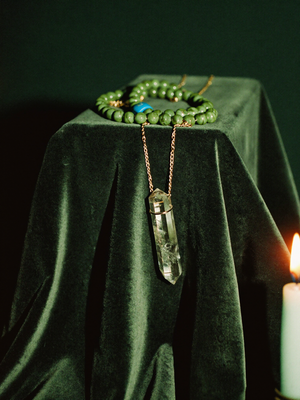
Two formats come up constantly. A multi-stone bracelet is the easiest combination to actually carry, and the main caution is hardness again: mixing a Mohs 3 bead with a Mohs 7 bead on one elastic cord means the soft one loses. Which wrist to wear it on is a tradition with its own logic, covered in which wrist for a crystal bracelet.
A crystal grid is the formal version of a combination: stones arranged in a geometric layout around a central anchor. It is a ritual structure rather than a mechanism, and it is a good one, because building it slowly is itself the practice. Layouts, stone counts and timing are in how to make a crystal grid, and the shapes you will see offered — points, spheres, palm stones, towers — are explained in crystal shapes explained.
Cleansing and charging a set
Treat the set as one object with the tolerances of its most delicate member. In practice:
- Rinse together only if every stone is water-safe. One selenite in the group means nobody gets a bath.
- Smoke, sound and a night on a quartz cluster work for everything, which is why they are the default for mixed sets.
- Moonlight is harmless to all of them. Direct summer sun is not: amethyst, rose quartz, citrine, kunzite and fluorite all fade. See crystals that fade in sunlight.
- Dry everything fully before it goes back in a pouch; trapped moisture is what wrecks porous stones.
- The full method list is in how to charge crystals.
Buying a set rather than assembling one
Pre-made trios and seven-stone kits are the most common way people start, and there is nothing wrong with that: the choosing is done, the stones are usually compatible, and the price is lower than buying three singles. Two things to check before you buy. First, that the listing names the actual stones rather than saying "assorted crystals," because assorted usually means dyed howlite and glass. Second, that nothing in the set is obviously dyed — uniform vivid color with darker pooling in the cracks is the tell. Our guide to real versus treated crystals has the tests, and aura quartz covers the coated stones that show up in beginner kits.
What people often report
We do not print invented testimonials. This is the pattern that recurs in English-language crystal forums, shop reviews and comment threads, written as typical accounts and attributed to no one:
- Almost everyone buys too many stones in the first year and ends up using two or three.
- People who keep a set going describe it as working like a visual to-do item: it is in the way, so the intention stays in mind.
- The most frequent damage story is a mixed bracelet where one soft bead went cloudy while the quartz beads stayed bright.
- Pre-made trios are repeatedly described as the thing that finally made a practice stick, because nothing had to be decided.
- The most common regret is a large "assorted crystal" lot that turned out to be mostly dyed agate.
What we do not promise
Combining crystals does not amplify anything measurable, does not attract money, love or protection, and does not treat anxiety, insomnia or any medical condition. The hardness, water and pyrite warnings on this page are checkable physical facts; the combinations themselves are modern tradition and lived practice, and we present them that way. If anxiety, sleeplessness or low mood are running your days, please talk to a doctor. If you are in crisis in the U.S., you can call or text 988 at any time. What a small, deliberate set of stones can honestly do is sit where you will see it and keep one sentence in front of you for a week.
Frequently asked questions
How many crystals should I combine?
Two to four with one shared purpose is the standard recommendation, and it is good advice for a practical reason: a small set with a named intention is one you will keep using. Large collections tend to sit in a drawer.
Which crystals go well together?
The five conventional sets are rose quartz with rhodonite and green aventurine for the heart; black tourmaline with obsidian and smoky quartz for protection; amethyst with clear quartz and kyanite for meditation; citrine with pyrite and green aventurine for abundance; and amethyst with lepidolite and rose quartz for sleep.
Do any crystals actually conflict with each other?
Not energetically, as far as anyone can show. Physically, yes: harder stones scratch softer ones, water ruins gypsum and porous stones, and oxidizing pyrite produces acidity that attacks calcite, amber and other carbonates stored beside it.
Can I cleanse combined crystals together?
Only if every stone in the set tolerates the same method. One selenite or malachite means no water for the whole group. Smoke, sound and a night on a quartz cluster are safe for mixed sets.
Why is clear quartz in every combination?
Because crystal tradition treats it as a universal amplifier. The idea is often justified by quartz being piezoelectric, which is true but unrelated — piezoelectricity is a voltage produced under pressure, not an effect on other stones.
Are ready-made crystal sets worth it?
For a beginner, usually yes: the stones are chosen for one purpose and are generally compatible, and it is cheaper than three singles. Check that the listing names each stone — "assorted crystals" often means dyed howlite and glass.
Can I wear several crystals on one bracelet?
Yes, but match the hardness. A soft bead strung next to quartz beads will go cloudy within months as the harder beads grind against it. Stones of roughly similar hardness last far longer on one cord.
What is the difference between a combination and a crystal grid?
A combination is simply a set of stones used together. A grid is a formal geometric layout with a central anchor stone, built as a ritual. The grid adds structure and a longer, slower setup, which for many people is the useful part.
Sources and further reading
- Hardness, solubility and mineral properties: Mindat.org, entries for quartz, gypsum (selenite), malachite, pyrite, lepidolite and kyanite; Walter Schumann, Gemstones of the World.
- Pyrite decay and its effect on neighbouring specimens: conservation literature on pyrite oxidation in mineral and fossil collections, including guidance published by natural history museum conservation departments.
- Piezoelectricity in quartz: Jacques and Pierre Curie, 1880; standard physics references on the piezoelectric effect and quartz oscillators.
- Disclosure of dyeing and imitation in jewelry sales: Federal Trade Commission, Guides for the Jewelry, Precious Metals, and Pewter Industries, 16 CFR Part 23.
- In the magazine: Crystals not to keep together · Crystal grids · Crystal meanings chart · Mohs hardness · How to cleanse crystals
- Questions about an order or a product: 28@templeofdesire.com
The spiritual meanings in this article are tradition and lived practice, not scientifically proven, and they are no substitute for medical care.