






Gratitude Practice: What the Research Actually Supports


Contents
A gratitude practice means deliberately naming specific things you are glad of, in a fixed format, on a schedule. The best-supported formats are a written list (three to five specific items), a gratitude letter delivered in person, and savoring — attending closely to one ordinary good thing while it happens. The research is real but smaller than the internet suggests: gratitude exercises reliably beat doing nothing, and beat active control conditions only modestly. Frequency matters more than most people expect — once a week outperformed three times a week in a 2005 study, because daily listing turns into a chore and the items get generic. Specificity is the whole mechanism: "my sister called on Tuesday when I was flat" does something that "my family" does not. Gratitude is not a treatment for depression, it does not require you to feel grateful about things that were genuinely bad, and a practice that makes you suppress a real complaint has stopped being gratitude and become avoidance.
Emmons and McCullough (2003, Journal of Personality and Social Psychology 84(2), 377-389) found that participants who listed things they were grateful for reported greater wellbeing and optimism than participants who listed hassles.
Source/tradition: Emmons & McCullough 2003, JPSP 84(2):377-389
In a randomized trial, the hand-delivered gratitude letter produced the largest short-term rise in happiness scores of the exercises tested, while nightly 'three good things' produced smaller but longer-lasting changes.
Source/tradition: Seligman, Steen, Park & Peterson 2005, American Psychologist 60(5):410-421
Meta-analyses find gratitude interventions clearly outperform doing nothing but only modestly outperform active control activities such as expressive writing, and have small effects on depression and anxiety symptoms.
Source/tradition: Davis et al. 2016, J Counseling Psychology 63(1):20-31; Cregg & Cheavens 2021, J Happiness Studies 22:413-445
Counting blessings once a week produced greater benefit than three times a week, most plausibly because frequent repetition makes the exercise routine and the entries generic.
Source/tradition: Lyubomirsky, Sheldon & Schkade 2005, Review of General Psychology 9(2):111-131
Naming what you are grateful for out loud, and to the person concerned, is a long-standing devotional and household practice across many cultures.
Source/tradition: Comparative practice; no single origin
Marking the practice with a fixed physical sequence - a candle, a held stone, a closed notebook - is how practitioners keep a weekly habit from dissolving into good intentions.
Source/tradition: Contemporary practice
A gratitude practice improves your circumstances, attracts abundance, or substitutes for treatment of depression or anxiety.
Source/tradition: No supporting evidence; meta-analytic effects on symptoms are small
VERIFIED = verifiable in scientific or official sources · TRADITIONAL = historically or culturally recorded · LIVED PRACTICE = widely practiced, experiential knowledge · NOT PROVEN = spiritual interpretation, not scientifically established.
Gratitude Practice: What the Research Actually Supports
A working guide to gratitude as a practice — the four formats that hold up, the evidence behind them at its real size, the frequency that keeps a journal from going stale, and the point at which gratitude stops helping and starts silencing you.
Quick answer
A gratitude practice means deliberately naming specific things you are glad of, in a fixed format, on a schedule. The best-supported formats are a written list (three to five specific items), a gratitude letter delivered in person, and savoring — attending closely to one ordinary good thing while it happens. The research is real but smaller than the internet suggests: gratitude exercises reliably beat doing nothing, and beat active control conditions only modestly. Frequency matters more than most people expect — once a week outperformed three times a week in a 2005 study, because daily listing turns into a chore and the items get generic. Specificity is the whole mechanism: "my sister called on Tuesday when I was flat" does something that "my family" does not. Gratitude is not a treatment for depression, it does not require you to feel grateful about things that were genuinely bad, and a practice that makes you suppress a real complaint has stopped being gratitude and become avoidance.
What a gratitude practice actually is
The word covers two different things, and confusing them is why so many people bounce off it. There is gratitude the emotion — the warm involuntary flash when someone does something generous. You cannot schedule that, and trying to is how people end up feeling like frauds at a notebook.
Then there is gratitude the practice: a deliberate, structured act of attention in which you look for specific things that went well and write them down or say them out loud. The emotion may follow. It often does not, especially in the first weeks. The practice works on attention, not on mood directly — it is training in noticing, and noticing is a skill that responds to repetition.
That distinction sets the standard for everything below. If a format requires you to already feel something, it is built wrong. If it only requires you to look and record, it will survive a bad week.
What the research shows — at its real size
Gratitude is one of the most studied practices in positive psychology, which cuts both ways: there is a lot of evidence, and enough of it now to see the effects are moderate rather than transformative.
| Study | What it tested | What it found |
|---|---|---|
| Emmons & McCullough, Journal of Personality and Social Psychology, 2003 | Weekly or daily lists of things to be grateful for, versus lists of hassles or neutral events | The gratitude groups reported better wellbeing and more optimism than the hassles groups. This is the founding study and the one most often overstated. |
| Seligman, Steen, Park & Peterson, American Psychologist, 2005 | The "gratitude visit" (write and hand-deliver a letter) and "three good things" nightly, in a randomized online trial | The gratitude visit produced the largest short-term rise in happiness scores of any exercise tested; "three good things" produced smaller changes that persisted longer. |
| Lyubomirsky, Sheldon & Schkade, Review of General Psychology, 2005 | How often the exercise is performed | Counting blessings once a week beat three times a week. The likeliest reason is adaptation: too-frequent repetition makes the act routine and the entries generic. |
| Davis et al., Journal of Counseling Psychology, 2016 | Meta-analysis of gratitude interventions | Clear benefit over doing nothing; only a small advantage over active control activities such as expressive writing. In other words, part of the effect is "structured reflective writing," not gratitude specifically. |
| Cregg & Cheavens, Journal of Happiness Studies, 2021 | Meta-analysis on depression and anxiety symptoms | Small effects on depressive and anxiety symptoms — enough to be worth doing alongside care, nowhere near enough to replace it. |
Read those two meta-analyses together and you get the honest summary: a gratitude practice is a cheap, low-risk habit with a modest, repeatable benefit. It is not a mood engine, and the studies that made the biggest headlines are the oldest and smallest ones.
The four formats worth your time
1. The specific list
Three to five items, each concrete enough that a stranger could picture it. Not "my job" but "Dana covered the 4 p.m. call so I could leave on time." The specificity is not a stylistic preference — vague entries are the failure mode that makes journals die in week three.
2. The gratitude letter
Write to someone who did something for you that you never properly acknowledged. Roughly 300 words, concrete about what they did and what it changed. The 2005 trial found the strongest short-term effect when the letter was delivered and read aloud in person. Mailing it works. Not sending it works least.
3. Savoring
Pick one ordinary good thing — the first coffee, the walk from the car — and give it your whole attention for two minutes without narrating it to anyone. This is the format for people who find writing performative.
4. Gratitude for the difficult thing — carefully
Not "I am grateful I got laid off." That is a lie and your nervous system knows it. The workable version is narrower: name one specific capacity or relationship that the hard period revealed. If nothing comes, the honest answer is that nothing has come yet, and you write that instead.
For the ritual version of the practice
If you keep a fixed evening practice, a scent marker helps the habit stick more than any notebook design will — you are giving the brain an unmistakable cue that this ten minutes is different from the rest of the evening. Our Grateful Ritual Incense (lavender, $24.95) is made for exactly that job: light it, write, let it finish, put the notebook away.
How to keep a journal that doesn't go stale
Almost every abandoned gratitude journal fails the same way: the entries get shorter, then abstract, then identical, then the notebook migrates to a drawer. Four rules prevent it.
- Once or twice a week, not daily. This is the single most counterintuitive finding in the literature and the easiest to act on. A weekly entry stays interesting; a daily one becomes homework.
- No repeats for 30 days. Ban yourself from writing the same item twice in a month. This forces the search wider and is what actually trains the noticing.
- Name a person where you can. Items involving other people produce more of the effect than items involving weather or objects.
- Write why, in one clause. "The bus was on time — which meant I wasn't walking in on the meeting late again." The which meant is doing the work.
A candle-and-stone practice for the end of the week
This is the practice version, not a spell, and nothing in it is claimed to change your circumstances. It exists because a physical sequence makes an abstract habit stick.
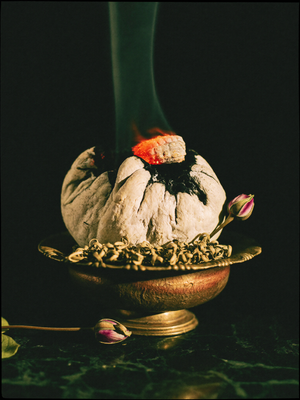
- Set a boundary. Phone in another room. Light a candle or incense — the point is a clear start and a clear end, not the scent.
- Hold one small stone in your closed hand while you think back over the week. Any stone. The object gives your hands something to do so your attention stays on the recall.
- Write three specific items, each with its "which meant" clause.
- Say one of them out loud. Speaking it makes it land differently than reading it does — this is the cheapest part of the practice and the one most people skip.
- Pick one to act on. If a person is in your list, tell them this week. This is the step that turns a private habit into something that changes a relationship.
- Put the candle out and close the book. A defined ending is why you will come back next week.
A seven-day starter — one prompt a day
| Day | Prompt | Why this one |
|---|---|---|
| 1 | Something a specific person did this week | Person-directed items produce the strongest response |
| 2 | Something your body did without being asked | Moves attention off achievement |
| 3 | Something that did not go wrong | Absent disasters are invisible by default |
| 4 | Something you own that still works | Counters the upgrade reflex |
| 5 | A skill you have that you no longer notice | Competence fades from view fastest |
| 6 | Something free that you used today | Infrastructure, daylight, a library card |
| 7 | The gratitude letter | The format with the largest measured effect |
When gratitude turns into avoidance
This is the part most gratitude content leaves out, and it matters more than any of the technique above.
A gratitude practice becomes harmful at the exact point where it is used to close a subject rather than widen one. If "at least I have a job" arrives every time you notice your manager is treating you badly, the practice is functioning as a mute button. That pattern has a name — spiritual bypassing — and gratitude is one of its most common vehicles, precisely because it looks like health from the outside.
The test is simple. After the practice, are you more able to name what is wrong, or less? A working practice widens the field of view. One that narrows it is doing something else.
Gratitude is also not treatment. The meta-analytic effects on depressive and anxiety symptoms are small. If you are persistently low, losing interest in things you used to care about, or not sleeping, that warrants a clinician rather than a better notebook — and a practice alongside care is fine, a practice instead of care is not.
Frequently asked questions
Does it count if I don't feel grateful while writing?
Yes. The practice trains attention; the feeling is a sometimes-consequence, not the entry requirement. Most people write for several weeks before anything shifts, and some never get the warm feeling and still report the benefit.
Morning or evening?
Whichever you will actually do. Evening has a small practical edge because the day's material is fresh and already sorted.
Is an app as good as paper?
No study cleanly separates the two. The practical difference is the phone, which arrives carrying everything else. Paper has no notifications, which is most of its advantage.
How long until it works?
Trials typically run two to ten weeks. Give it six weeks at once or twice a week before judging it — and judge it on whether you notice more, not on whether you feel happier on command.
What about Thanksgiving gratitude — the go-round-the-table kind?
It has the ingredients that work (spoken aloud, person-directed, witnessed), and one that undercuts them: obligation in front of an audience. If you want the effect, do the letter privately the same week.
Can I be grateful for something terrible that happened?
You can be grateful for something specific that came out of it — a person who showed up, a capacity you found. Being grateful for the harm itself is not a more advanced version of the practice; it is a way of agreeing not to look at it.
Related reading
- Spiritual bypassing: the signs — the failure mode described above, in full
- The heart chakra — where this practice sits in the subtle-body map, and where that map comes from
- A full moon ritual — if you want the weekly rhythm tied to something outside your calendar
Sources
- Emmons, R. A. & McCullough, M. E. (2003). Counting blessings versus burdens. Journal of Personality and Social Psychology, 84(2), 377–389.
- Seligman, M. E. P., Steen, T. A., Park, N. & Peterson, C. (2005). Positive psychology progress: empirical validation of interventions. American Psychologist, 60(5), 410–421.
- Lyubomirsky, S., Sheldon, K. M. & Schkade, D. (2005). Pursuing happiness: the architecture of sustainable change. Review of General Psychology, 9(2), 111–131.
- Davis, D. E. et al. (2016). Thankful for the little things: a meta-analysis of gratitude interventions. Journal of Counseling Psychology, 63(1), 20–31.
- Cregg, D. R. & Cheavens, J. S. (2021). Gratitude interventions: effective self-help? A meta-analysis. Journal of Happiness Studies, 22, 413–445.
Questions about an order or a product? Write to 28@templeofdesire.com.