




Inner Light: Meaning, Symbolism and Light Work
Inner light is the idea that something clear and steady already exists in a person and is periodically obscured rather than absent — so the work is subtraction, not construction. The image is close to universal, but it is worth knowing that the English word enlightenment is partly a translation artifact: the Sanskrit bodhi means awakening, not illumination, and the light framing was added on the way into European languages. Light work covers the practices built on that image: candle work, light meditation, deliberate exposure to daylight. One part of it is not metaphorical at all. Outdoor daylight is between ten and a hundred times brighter than a well-lit room, and that difference is the main signal that keeps human circadian rhythm aligned. Bright light exposure is also an established clinical treatment for seasonal affective disorder, which is a medical matter for a clinician rather than something to self-manage from a spiritual article. And the shadow half is not decoration: an inner-light practice that cannot look at what it dislikes is not clarity, it is avoidance with better lighting.

Contents
Inner light is the idea that something clear and steady already exists in a person and is periodically obscured rather than absent — so the work is subtraction, not construction. The image is close to universal, but it is worth knowing that the English word enlightenment is partly a translation artifact: the Sanskrit bodhi means awakening, not illumination, and the light framing was added on the way into European languages. Light work covers the practices built on that image: candle work, light meditation, deliberate exposure to daylight. One part of it is not metaphorical at all. Outdoor daylight is between ten and a hundred times brighter than a well-lit room, and that difference is the main signal that keeps human circadian rhythm aligned. Bright light exposure is also an established clinical treatment for seasonal affective disorder, which is a medical matter for a clinician rather than something to self-manage from a spiritual article. And the shadow half is not decoration: an inner-light practice that cannot look at what it dislikes is not clarity, it is avoidance with better lighting.
The Sanskrit and Pali term bodhi derives from a root meaning 'to wake up' and carries no reference to light; the English rendering as 'enlightenment' is a later European translation choice.
Source/tradition: Sanskrit etymology of bodhi (root budh-); history of nineteenth-century European Buddhist translation
Indoor lighting is typically 300 to 500 lux while outdoor daylight ranges from roughly 1,000 lux on an overcast day to around 100,000 lux in direct sun.
Source/tradition: Standard illuminance reference values
Human circadian timing is set primarily by light reaching specialized retinal photoreceptors, and typical indoor light levels provide a weak timing signal compared with outdoor daylight.
Source/tradition: Circadian photoreception research; intrinsically photosensitive retinal ganglion cells
Bright light exposure is an established clinical treatment for seasonal affective disorder, administered under defined protocols with contraindications.
Source/tradition: Clinical guidance on bright light therapy for seasonal affective disorder
Home candle fires in the United States peak in December, with unattended candles and proximity to combustible material among the leading factors.
Source/tradition: US fire service home candle fire statistics
Light is used as the central image for consciousness, truth and the divine across Mediterranean and Near Eastern traditions, including Latin illuminatio, Islamic Nur and the light imagery of Hebrew and Christian scripture.
Source/tradition: Comparative religious symbolism
Every person carries an inner light that is obscured rather than absent, so spiritual work is subtraction rather than construction.
Source/tradition: Widespread across mystical traditions; a doctrine rather than a finding
Lighting a candle to mark the boundaries of a defined period of reflection, and extinguishing it to close it.
Source/tradition: Widespread contemporary candle practice
Visualizing warm light moving through the body as a focusing and relaxation practice.
Source/tradition: Common contemporary meditation practice; functionally a body-scan attention exercise
Sending light to another person reaches them or affects their situation.
Source/tradition: No demonstrated mechanism; observable effects are on the sender
Strengthening the inner light through ritual clears blockages, raises a person's energy or produces healing.
Source/tradition: No evidence for an external effect; any benefit follows from attention, daylight and the actions taken
VERIFIED = verifiable in scientific or official sources · TRADITIONAL = historically or culturally recorded · LIVED PRACTICE = widely practiced, experiential knowledge · NOT PROVEN = spiritual interpretation, not scientifically established.
Light stands for consciousness, truth, healing and the divine in almost every tradition that has ever written anything down. That near-universality is exactly what makes the word slippery. Here is what the image is doing, where it came from, and the one place where light stops being a metaphor entirely.
Why light became the word for knowing
The metaphor is so pervasive it stops registering as a metaphor. We say a person is bright, that an idea dawned, that something came to light, that we see what you mean. Insight arrives as a flash. Confusion is being in the dark. None of this is decorative language — it is the structure we think about thinking with.
There is a plausible reason. Vision is the sense humans rely on for information about anything at a distance, and light is its precondition. A mind trying to describe understanding reaches for the nearest model of contact-at-a-distance available, and gets light.
What follows from that is the interesting part. Light has properties, and the metaphor quietly imports all of them: it reveals without touching, it does not negotiate with darkness but simply replaces it, and it makes things visible whether or not you wanted them visible. That last one is the property most inner-light practice tries to forget.
One honest correction: enlightenment isn't originally about light
This is worth knowing before using the vocabulary, because a great deal of Western spiritual writing rests on it without checking.
The Sanskrit and Pali term bodhi — the thing the Buddha is said to have attained — comes from a root meaning to wake up. It is awakening. It carries no reference to light at all. Early European translators, working in a Christian and then an Enlightenment-era intellectual context where illumination was the natural word for spiritual and rational insight alike, rendered it as enlightenment, and the term stuck so thoroughly that it now reads back into the original.
So when a modern reader assumes every tradition independently converged on light as the image of realization, part of what they are seeing is a nineteenth-century translation decision. The light image is genuinely ancient in the Mediterranean and Near Eastern traditions, where illuminatio, the Nur of Islamic mysticism and the light imagery of Hebrew and Christian scripture are the real thing. It was imported into the Indian material.
Why this improves the practice rather than damaging it. Awakening and illumination point in different directions, and both are useful. Illumination says: something was hidden and is now visible. Awakening says: you were doing this the whole time with your eyes shut. The second is less flattering and usually more accurate about what actually changes.
From the shop
Burst of Brilliance Ruzha Candle Spell Kit
Built around a beeswax candle cast in the Slavic sunburst — the Ruzha — with three herbs, a spiritual oil and a cloth bag for the remains. Made for the sitting after a flat stretch, when the intention is not to fix something but to start giving off light again.
The part that is not a metaphor
There is one place where light stops being an image and becomes a measurable input, and it gets curiously little attention in spiritual writing.
| Situation | Rough illuminance |
|---|---|
| Well-lit office or living room | 300–500 lux |
| Overcast winter day, outdoors | 1,000–5,000 lux |
| Bright overcast to full daylight in shade | 10,000–25,000 lux |
| Direct sunlight | up to around 100,000 lux |
Indoors on a grey day you are receiving on the order of one percent of what is available five steps outside the door. That gap is the whole point. Human circadian timing is set primarily by light reaching specialized receptors in the retina, and indoor lighting is, in circadian terms, close to darkness. Ten minutes outdoors on an overcast morning is a stronger timing signal than an entire day at a desk by a window.
Bright light exposure is also an established treatment for seasonal affective disorder, typically delivered as high-intensity light for a set period in the morning. That is a clinical matter with protocols, contraindications and interactions — it belongs with a clinician, not with a spiritual article, and it is mentioned here only so that nobody mistakes a candle for it. If the darkness you are describing is the kind that arrives every winter and lifts every spring, that is worth raising with a doctor.
The reason to put this in an article about inner light is simple. The oldest advice in the tradition is to seek the light, and it turns out that the literal version of that instruction is cheap, immediate and better supported than anything else on the list.
Light work, sorted by what it actually is
- Daylight exposure. Morning light outdoors, without a window in between. The one item here with a demonstrated physiological mechanism.
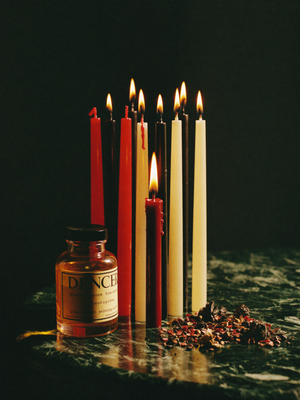
- Candle work. A flame as a focal point and as a boundary marker for a defined period of attention. What it reliably does is make a stretch of time distinct and hold the eyes still. That is not nothing — most people cannot sit with a question for ten minutes without an object.
- Light visualization. Imagining warm light moving through the body. Functionally a body-scan attention practice with a pleasant image attached.
- Sending light to someone. Honestly described, this is a structured way of holding a person in mind with goodwill. Whether anything reaches them is not demonstrated. What it does to the sender is the part that is observable.
Sorting them this way is not debunking. It is the difference between a practice you can keep when you are skeptical and one that collapses the first time you look at it directly.
A practice for the evening, and one for the morning
- Morning, outside, ten minutes. Within an hour of waking if possible, outdoors, no screen. Overcast counts. This is the load-bearing item.
- Evening, one candle, one question. Light it, sit, and put a single honest question in front of yourself — not an affirmation. What did I avoid looking at today? is the version that does the most work. Sit until the question has actually been answered rather than deflected.
- Write one sentence. Whatever surfaced, in one line, before you put the candle out. Unwritten, it evaporates by morning.
- Put it out and stop. The bounded end matters as much as the start. A practice with no edge becomes ambient and stops registering.
Candle safety, said plainly. Home candle fires in the United States peak sharply in December, and the most common single factor is a candle left burning unattended or too close to something that will catch. Never leave a flame in an empty room, keep a wide clear margin, and do not fall asleep with one lit. A ritual is not an exception to this.
Where inner-light practice goes wrong
There is a specific failure mode, it is common, and it has a name in wide circulation: using positivity as a way of not looking. The signs are recognizable. Every difficult feeling gets reframed within seconds of arriving. Other people's anger is treated as a lower vibration rather than as information. Grief has a deadline. The word light starts doing the work that the word please stop would do if said directly.
This matters here because the inner-light framing is unusually good cover for it. If light is your native state and darkness is only obstruction, then everything unpleasant becomes something to be cleared rather than understood — and a great deal of what is unpleasant is actually information.
The test is whether your practice has ever told you something you did not want to hear. If light work consistently makes you feel better and never once makes you uncomfortable, it has stopped illuminating anything. It is a lamp pointed at the wall.
Light and shadow are one operation
The traditional line is that shadow gives light depth, which is true and slightly too comfortable. The sharper version is that they are not two practices at all. A shadow only exists because something is lit; increase the light and you do not remove the shadow, you make its edges harder. Anyone who has actually done sustained attention practice recognizes this. Things get clearer and, for a stretch, worse.
That is not a sign of failing. It is the mechanism working as designed. The clarity the tradition promises is not the absence of the difficult material. It is seeing it well enough to stop tripping over it in the dark.
Frequently asked questions
What does inner light mean spiritually?
It is the idea that something clear and steady already exists in a person and is periodically obscured rather than missing — so the work is understood as removing what covers it, not building something new.
Is enlightenment really about light?
Only partly. The Sanskrit bodhi means awakening, from a root meaning to wake up, with no reference to light. European translators rendered it as enlightenment in a context where illumination was the standard word for spiritual insight, and the term stuck. The light image is genuinely ancient in Mediterranean and Near Eastern traditions; it was imported into the Indian material.
What is light work?
A group of practices built on the light image: deliberate daylight exposure, candle work, light visualization, and sending light to others. They differ sharply in what can be said about them — daylight exposure has a demonstrated physiological mechanism, the others are attention practices.
How much brighter is outdoors than indoors?
Typically ten to a hundred times. A well-lit room is roughly 300 to 500 lux; an overcast day outdoors runs into the thousands, and direct sun approaches 100,000 lux. Indoor lighting is, in circadian terms, close to darkness.
Can light help with winter low mood?
Bright light exposure is an established clinical treatment for seasonal affective disorder, delivered under specific protocols. That is a medical matter with contraindications and belongs with a clinician. If your low mood arrives every winter and lifts every spring, raise it with a doctor rather than managing it from a spiritual article.
What is the shadow side of inner-light practice?
Using positivity to avoid looking — reframing every difficult feeling immediately, treating other people's anger as a lower vibration rather than as information, putting a deadline on grief. The test is whether your practice has ever told you something you did not want to hear.
Do light and shadow work against each other?
No — they are one operation. A shadow exists because something is lit, and increasing the light sharpens its edges rather than removing it. Things getting clearer and briefly more uncomfortable is the mechanism working, not failing.