




Mabon in a Small Apartment: An Autumn Equinox You Can Actually Do Indoors
The autumn equinox falls Tuesday, September 22, 2026 at 22:05 UTC, with the Harvest Moon on Saturday, September 26. A Mabon for a rental with no garden, no fire pit and possibly a roommate - three elements, fifteen minutes, nothing bought that becomes clutter by October.


A Mabon you can actually hold in a rented apartment with no garden, no fire pit, no cornucopia and possibly a roommate — including the exact dates for 2026 and what to do when your smoke alarm sits six feet from your altar. It does not ask you to build a harvest table out of things you would have to buy for one evening.
Contents
The autumn equinox falls on Tuesday, September 22, 2026, at 22:05 UTC - early evening in the US - and the Harvest Moon follows on Saturday, September 26. A Mabon in a small apartment needs three things and no more: something that came from the season and you will actually eat, one small flame you can leave lit for under an hour, and a written list of what the year gave you and what you are putting down unharvested. The cornucopia, the bonfire and the garden harvest are optional set dressing borrowed from a rural festival most modern celebrants never lived in. Nothing about observing an equinox has been shown to change any outcome; it marks a turn you were going to pass through anyway.
The autumn equinox in 2026 falls on Tuesday, September 22 at 22:05 UTC, when the Sun crosses the celestial equator moving south.
Source/tradition: Royal Museums Greenwich, equinox reference; timeanddate.com seasons data (2026)
The Harvest Moon - the full moon nearest the autumn equinox - falls on Saturday, September 26, 2026, peaking at 12:49 PM Eastern, and rises at nearly the same time on several consecutive nights.
Source/tradition: The Old Farmer's Almanac, Full Harvest Moon September 2026; timeanddate.com Harvest Moon reference
Day and night are not exactly equal at the equinox: sunrise and sunset are measured from the edge of the solar disc rather than its center, and atmospheric refraction adds daylight, so the equilux falls a few days after the September equinox and varies with latitude.
Source/tradition: Royal Museums Greenwich; timeanddate.com equilux explanation
The name Mabon was applied to the autumn equinox by the American writer Aidan Kelly in the 1970s, borrowed from Mabon ap Modron of medieval Welsh literature, who has no pre-modern attested link to harvest or the equinox.
Source/tradition: Aidan Kelly, Crafting the Art of Magic (Llewellyn, 1991) and his later published accounts; Hutton, The Triumph of the Moon, 2nd ed. (2019)
Harvest festivals observed around the autumn equinox, with offerings of seasonal food, a kindled light and a reckoning of the year, are widespread across many cultures and long predate the modern Wheel of the Year.
Source/tradition: Hutton, The Stations of the Sun: A History of the Ritual Year in Britain (Oxford University Press, 1996)
Practitioners in shared or rented homes commonly fold the observance into a seasonal meal, use a temporary tray altar cleared the same evening, and substitute gathered park findings for a garden harvest.
Source/tradition: Contemporary practitioner discussion; summarized, not attributed
Observing the equinox changes circumstances, finances, relationships or health.
Source/tradition: No supporting evidence; no health or outcome claim is made
VERIFIED = verifiable in scientific or official sources · TRADITIONAL = historically or culturally recorded · LIVED PRACTICE = widely practiced, experiential knowledge · NOT PROVEN = spiritual interpretation, not scientifically established.
Quick answer: The autumn equinox falls on Tuesday, September 22, 2026, at 22:05 UTC — early evening in the US — and the Harvest Moon follows on Saturday, September 26. A Mabon in a small apartment needs three things and no more: something that came from the season and you will actually eat, one small flame you can leave lit for under an hour, and a written list of what the year gave you and what you are putting down. The cornucopia, the bonfire and the garden harvest are optional set dressing borrowed from a rural festival most modern celebrants never lived in. Nothing about observing an equinox has been shown to change any outcome; it marks a turn you were going to pass through anyway.
When is Mabon 2026, exactly?
The autumn equinox in the Northern Hemisphere falls on Tuesday, September 22, 2026, at 22:05 UTC. In US time zones that is 6:05 PM Eastern, 3:05 PM Pacific — a rare year where the moment itself is convenient for most people to actually observe.
You will see September 21 quoted in some calendars. That is not an error so much as a different convention: some listings fix Mabon to a nominal date, and some traditions treat it as a period rather than a moment, commonly the week of September 21 through 29. If you want the astronomical event, use September 22. If you want the festival, any evening that week is defensible and Tuesday-at-six is not a great dinner slot for most households.
The Harvest Moon — the full moon nearest the equinox — falls on Saturday, September 26, 2026, peaking at 12:49 PM Eastern. That is worth knowing for a specific practical reason: it lands on a Saturday, it is genuinely visible from a window, and it gives you a second, better-timed evening if the Tuesday does not work. The Harvest Moon is also the one full moon with an observable peculiarity you can see for yourself from an apartment — it rises at nearly the same time for several consecutive nights instead of the usual fifty-minute daily delay.
Why the standard Mabon guide does not fit a small apartment
Open any autumn equinox article and you will be told to build a cornucopia, decorate with gourds and sheaves of wheat, bake bread, hold a feast, walk your land, and burn a fire. Every one of those instructions assumes space, storage, a kitchen you are not sharing, and a relationship with a piece of ground.
This is not a modern failing. It is what happens when a harvest festival is reconstructed as a domestic ritual by people who are not farming. The imagery comes from agricultural life; the celebrants overwhelmingly do not have one. That gap is worth naming rather than papering over, because the usual response to it is to go buy a decorative gourd, and a decorative gourd is not a harvest.
The honest translation is this: the harvest festival is about reckoning. Counting what came in, admitting what did not, and accepting that the light is going. That does not require land. It requires an accurate list.
Temple tip
Do not buy a single decorative object for this. The rule that makes a small-space Mabon work is that everything on the altar must either be eaten, burned, or already live in your home. A gourd bought for one night becomes clutter by October and quietly teaches you that the festival is about shopping. An apple you eat afterwards teaches you the opposite.
The three things a Mabon actually needs
Strip it back and the festival has a food element, a light element, and a reckoning element. Everything else is regional decoration.
Something from the season you will eat. Apples, pears, grapes, blackberries, nuts, squash, root vegetables, new-season cider. One apple qualifies. What matters is that it is seasonal where you are and that it goes into you rather than onto a shelf. If you want the traditional layer: apples carry the strongest folkloric weight here, partly because a horizontally cut apple shows a five-pointed star of seeds.
One flame. The bonfire is not available to you. A single candle is the entire functional substitute — it marks the same thing, which is a light you deliberately kindle and deliberately put out while the days are shortening. The balance symbolism common at this sabbat is usually done with two candles, one light and one dark, lit together.
A written reckoning. Two lists. What the year actually delivered, and what you are letting go unharvested. The second list is the one that does the work, and it is the one people skip. An equinox is a balance point; a gratitude list alone is not balanced.
A fifteen-minute Mabon for one small table
This fits on a nightstand, a windowsill, a kitchen counter, or the corner of a desk. It takes about fifteen minutes and leaves no trace afterwards.
Clear a surface completely — this matters more in a small home than a large one, because contrast is the only thing that separates ritual space from ordinary space when you do not have a spare room. Lay a cloth if you have one; a scarf or tea towel in a dark or warm color is fine.
Put the food down. Light one candle for what came in and, if you want the balance form, a second dark one for what is ending. Sit for a minute without doing anything.
Then write the two lists by hand, out loud if you live alone. The harvest list first — concrete things, not moods. Then the unharvested list: the projects, plans and relationships that did not ripen this year and will not now. Say them plainly. This is the part that hurts slightly and is the reason the festival exists.
Eat the food. Snuff the candles rather than blowing them out if you want the traditional form. Put everything away. The whole point of a small-space practice is that it disassembles cleanly.
Working around the constraints of a rental
| Constraint | What to do instead |
|---|---|
| No garden or land | Walk one route you already walk and collect three fallen things — leaves, acorns, seed pods. Gathering from a park is the urban harvest, and it costs nothing. |
| No fire pit or open flame allowed | One tea light on a heatproof dish for under an hour. If flame is genuinely prohibited, a lamp you switch off deliberately at the end does the same symbolic job. |
| Smoke alarm close by | Skip incense and smoke cleansing entirely. Fragrance-free beeswax tea lights produce very little; a mist spray replaces smoke without an ember. |
| Roommates or family who do not share the practice | Do it as a meal. A seasonal dinner with two candles reads as dinner to everyone else and as Mabon to you. No explanation required. |
| No storage for seasonal decor | Use only consumables and things you already own. Nothing on the altar should survive to November. |
| No permanent altar space | A tray, a shelf, or a windowsill you set up and clear the same evening. A temporary altar is a valid altar. |
| Tuesday evening is impossible | Use the Harvest Moon on Saturday, September 26, or any evening in the September 21–29 window. The festival period is traditional; the exact minute is not required. |
If the shared-space problem is your main obstacle year-round rather than just at Mabon, we wrote about it separately in keeping an altar in a shared room.
What the equinox is doing astronomically — and what it is not
At the equinox the Sun crosses the celestial equator moving south, and the Earth's axial tilt is oriented perpendicular to the Sun–Earth line. That is the whole event: a geometric alignment, over in an instant, that happens twice a year.
The familiar claim that day and night are exactly equal is very nearly true and not quite. Sunrise and sunset are defined by the first and last sliver of the Sun's disc rather than its center, and atmospheric refraction lifts the image of the Sun above the horizon when it is geometrically below it. Both effects add daylight. The date of true twelve-hour balance — the equilux — falls a few days after the September equinox at mid-northern latitudes, and its exact date depends on how far north you are.
This is a small correction and it matters, because "perfect balance" is doing a lot of symbolic work in most equinox writing. The real event is a crossing point, not a moment of stillness. That is arguably a better image for what most people are actually marking: not a balanced life, but the moment you can no longer pretend the direction of travel is anything but darker.
If you want to work with this yourself, this is what we use:

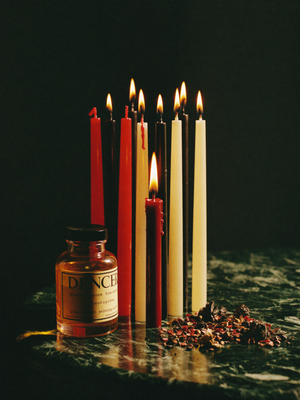
Pentacle Beeswax Tea Light Candles
Four beeswax tea lights, fragrance-free, roughly a one-hour burn each, in black, white, red, purple, yellow and pink. We list these for the small-space case specifically: a one-hour burn is a ritual you can finish in one sitting rather than a seven-day commitment sitting on a shared counter, fragrance-free keeps the peace with roommates and smoke alarms, and the black-and-white pair gives you the balance form the equinox asks for. $17.95 — ships within 3 business days.
See the beeswax tea lightsIs any of this actually old?
Partly, and it is worth being precise, because the amount of invented antiquity around this sabbat is unusually high even by the standards of the modern Wheel of the Year.
Harvest observances around the autumn equinox are genuinely widespread and genuinely old across many cultures. The specific name Mabon is not: it was applied to the autumn equinox by the American writer Aidan Kelly in the 1970s, borrowed from Mabon ap Modron, a figure in medieval Welsh literature who has no attested connection to harvest festivals or the equinox. The eight-sabbat Wheel of the Year itself was assembled in the mid-twentieth century.
None of that makes the festival fake. It makes it recent and traceable, which is a different thing, and we think a practice you can date honestly is stronger than one propped up on a false pedigree. We went through this in detail in is Mabon actually ancient?
Voices from practice
We do not publish invented testimonials, so this is a summary of patterns visible in public practitioner discussion rather than quotes attributed to anyone.
The most common frustration voiced by apartment-dwelling practitioners around the sabbats is not lack of space but lack of privacy — the difficulty is being observed, not being cramped, and the workaround people consistently land on is folding the ritual into a meal, which is legible to everyone else in the household as dinner.
The second recurring pattern is that people who keep small, repeatable seasonal practices report sticking with them for years, while those who attempt full reconstructed feasts tend to do it once. The third is that the unharvested list — naming what did not work out — is the element most often described as the one that made the observance feel like something rather than decoration, and also the element most often left out of published Mabon guides.
What we don't promise
We sell candles, so this goes in the article rather than the small print.
Observing an equinox does not change your circumstances, your finances, your relationships or your health. There is no evidence that seasonal ritual produces outcomes, and nothing on this page is a health claim. The astronomical facts here — the September 22 crossing, the September 26 Harvest Moon, the refraction correction — are checkable. The festival meanings are a modern tradition with a documented twentieth-century origin, and we have kept those two categories visibly apart.
What a Mabon observance reliably does is make you stop and take an accurate count at a point in the year when the light changes whether you notice or not. Writing down what came in and what did not is a real act with a real effect on how you enter the winter. It does not require the equinox to be doing anything to you.
Practically: how to work with this
- Pick your evening now. Tuesday, September 22 for the equinox itself; Saturday, September 26 for the Harvest Moon; anywhere in September 21–29 if neither works.
- Buy nothing decorative. Food you will eat, a candle you will burn, things you already own. That is the whole shopping list.
- Take one walk and gather three fallen things. A park, a street, a courtyard. This is your harvest and it is free.
- Clear the surface completely before you set up. Contrast is what makes a temporary altar work.
- Write both lists by hand — what came in, and what did not. Concrete things. The second list is the point.
- Eat the food and clear the altar the same evening. A practice that disassembles is a practice you will repeat.
- Never leave a candle unattended. Heatproof dish, away from curtains and anything that can catch, out of reach of pets and children — a one-hour tea light is still an open flame.
Candles for the light-and-dark pair are in the ritual candles collection; if you want scent without smoke for a small room, the ritual oils and sprays are the smoke-free option.
Which Mabon fits your apartment?
Four questions. No email required.
Frequently asked questions
When is Mabon 2026?
The autumn equinox falls on Tuesday, September 22, 2026, at 22:05 UTC — 6:05 PM Eastern, 3:05 PM Pacific. Some calendars list September 21, because certain traditions treat Mabon as a festival period rather than a single moment, commonly September 21 through 29. For the astronomical event, use September 22. The Harvest Moon follows on Saturday, September 26.
How do you celebrate Mabon without a garden or any outdoor space?
Substitute the gathering rather than skipping it. Take one walk you would take anyway and collect three fallen things — leaves, acorns, seed pods. Buy one piece of seasonal produce you will actually eat. That is your harvest, and it does the same job as a garden crop: it makes the season physically present rather than conceptual. Everything else fits on a tray.
What do you actually need on a Mabon altar?
Something seasonal you will eat, one candle, and something to write on. The cornucopia, gourds, wheat sheaves and scales are set dressing borrowed from rural harvest imagery. A useful rule for a small home is that everything on the altar must be eaten, burned, or already owned — nothing bought for one evening that becomes clutter by October.
Can I do a Mabon ritual if my roommates don't know I practice?
Yes, and the standard workaround is to do it as a meal. A seasonal dinner with two candles on the table is legible to everyone else as dinner. Write the two lists privately, before or afterwards, which takes ten minutes. The reckoning is the part that matters and it does not need an audience or a visible altar.
Are day and night exactly equal on the equinox?
Not exactly. Sunrise and sunset are measured from the first and last edge of the Sun's disc rather than its center, and atmospheric refraction makes the Sun visible when it is geometrically below the horizon. Both add daylight. The date of true twelve-hour balance, the equilux, falls a few days after the September equinox and shifts with latitude. The equinox is a crossing point, not a moment of stillness.
Is Mabon an ancient Celtic festival?
Harvest observances near the autumn equinox are old and widespread, but the name Mabon is not. It was applied to the autumn equinox by the American writer Aidan Kelly in the 1970s, taken from Mabon ap Modron, a figure in medieval Welsh literature with no attested link to harvest or the equinox. The eight-festival Wheel of the Year was assembled in the mid-twentieth century.
What is the Harvest Moon and why does it matter at Mabon?
The Harvest Moon is the full moon falling nearest the autumn equinox — Saturday, September 26 in 2026. Its observable peculiarity is that it rises at close to the same time for several nights running, instead of the usual delay of roughly fifty minutes per night, which historically extended working light into the evening during harvest. For a small-space practice it is useful simply because it is visible from a window and often falls on a more convenient evening than the equinox itself.
Sources & further reading
- Royal Museums Greenwich, "What and when is the autumnal equinox?" (rmg.co.uk) — equinox definition, timing and the seasonal geometry.
- timeanddate.com, equinox and Harvest Moon reference pages (timeanddate.com) — 2026 equinox and full moon timings, and the equilux correction.
- The Old Farmer's Almanac, "Full Harvest Moon: September 2026" (almanac.com) — Harvest Moon date, peak time, and the shortened moonrise interval.
- Ronald Hutton, The Stations of the Sun: A History of the Ritual Year in Britain (Oxford University Press, 1996) — documented harvest customs and the historical record behind the modern festival calendar.
- Ronald Hutton, The Triumph of the Moon: A History of Modern Pagan Witchcraft, 2nd ed. (Oxford University Press, 2019) — the mid-twentieth-century assembly of the eight-sabbat Wheel of the Year.
- Aidan Kelly, Crafting the Art of Magic (Llewellyn, 1991) and his later published accounts — the 1970s naming of the autumn equinox as Mabon.