




How to Keep Samhain When You Have to Work on Halloween Night
A Samhain for nurses, bartenders, retail staff, parents on candy duty and anyone else who will not be home at sunset on October 31: the three windows that actually exist, a pocket working that fits a fifteen-minute break, and why the date is looser than the posts suggest.

Halloween 2026 falls on a Saturday, which means a great many practitioners will spend it behind a bar, on a hospital floor, in a stockroom or walking a five-year-old dressed as a dinosaur from porch to porch. This guide is for them. It gives you the actual window Samhain occupies, three ways to keep the night when you are not free at sunset, and the one thing worth doing even if you have nothing else. It does not pretend a break room is a grove.
Contents
Samhain does not have to happen at midnight on October 31. In the older reckoning the festival runs from sunset on the 31st to sunset on November 1, many groups hold their main rite on the nearest free evening, and the astronomical cross-quarter day falls around November 7, 2026. That gives someone working Halloween night three honest windows: the morning before the shift, a fifteen-minute working on a break, and the day after. What matters is a named moment for the dead and a threshold crossed with attention, not the hour on the clock. We cannot promise the shift will feel meaningful or that a break-room practice will match a full ritual at home; we can promise it counts.
Halloween 2026 falls on Saturday, October 31, and the clocks go back in most of the United States at 2:00 a.m. on Sunday, November 1, 2026.
Source/tradition: Gregorian calendar; Energy Policy Act of 2005 (daylight saving rule, first Sunday in November)
The astronomical cross-quarter day between the September equinox and the December solstice, when the Sun reaches 15 degrees of Scorpio, falls around November 7 in 2026.
Source/tradition: Solar longitude tables, U.S. Naval Observatory Astronomical Applications
Title VII requires employers to accommodate sincerely held religious practice unless doing so imposes a substantial burden; Groff v. DeJoy (2023) raised that threshold above the older de minimis standard.
Source/tradition: Groff v. DeJoy, 600 U.S. 447 (2023); EEOC religious discrimination guidance
In the older Irish reckoning the day began at sunset, so the night of Samhain runs from dusk on October 31 into November 1; the festival appears in medieval Irish sources as a season-turn and assembly time.
Source/tradition: Hutton, The Stations of the Sun (1996)
American trick-or-treating descends in part from guising and souling customs in Ireland and Scotland, in which people went door to door in disguise for food, often in exchange for prayers for the dead.
Source/tradition: Rogers, Halloween (2002); Hutton (1996)
Many groups, including Reclaiming's Spiral Dance in San Francisco, hold their main Samhain rite on a weekend near the date rather than on October 31 itself.
Source/tradition: Public event practice of contemporary pagan communities
That a pocket stone grounds or protects the person carrying it, or that a Samhain working brings the dead closer, is not demonstrated.
Source/tradition: No evidence of effect
VERIFIED = verifiable in scientific or official sources · TRADITIONAL = historically or culturally recorded · LIVED PRACTICE = widely practiced, experiential knowledge · NOT PROVEN = spiritual interpretation, not scientifically established.
Quick answer
Samhain does not have to happen at midnight on October 31. In the older reckoning the festival runs from sunset on the 31st to sunset on November 1, many groups hold their main rite on the nearest free evening, and the astronomical cross-quarter day falls around November 7, 2026. That gives someone working Halloween night three honest windows: the morning before the shift, a fifteen-minute working on a break, and the day after. What matters is a named moment for the dead and a threshold crossed with attention, not the hour on the clock. We cannot promise the shift will feel meaningful or that a break-room practice will match a full ritual at home; we can promise it counts.
Why October 31 is looser than the posts suggest
The first thing to take off your shoulders is the clock. The idea that Samhain must be kept at midnight on October 31 comes from Halloween, not from anything old. The medieval Irish sources that mention Samhain treat it as a season-turn and an assembly time, and the day in that reckoning began at sunset, so the festival's night runs from dusk on October 31 into November 1. The Wiccan calendar that most American practitioners inherited fixed the date on the 31st for convenience, and Halloween did the rest.
Two other dates are in real use and both are respectable. Many groups, including some of the oldest public rituals in the country, hold their main rite on the nearest Saturday or on a weekend near the date because that is when people can come; the Spiral Dance in San Francisco has been kept that way for decades. And a minority of practitioners use the astronomical cross-quarter day, the point halfway between the September equinox and the December solstice, when the Sun reaches fifteen degrees of Scorpio. In 2026 that is around November 7. If you work the 31st, you are not scraping a leftover. You are choosing one of three doors that were always there.
What actually defines the festival is not a time but a pair of acts: the year turns, and the dead are named. Anything that holds those two can be Samhain. A twelve-hour shift can hold them; it just cannot hold them all at once.
The three windows a working night actually has
A working Halloween has a shape, and the practice should follow it rather than fight it. There are three windows, and most people have at least two.
The first is the morning, or whatever counts as morning before the shift. It is quiet, it is yours, and it is the only window where you can light a candle and speak out loud. This is where the year-turn goes: the naming of what ended and what you carry across.
The second is the break. Ten or fifteen minutes, probably in a break room, a car, a stairwell or the alley behind the kitchen. It is not private and it is not quiet, and it is the window closest to the actual night. This is where the dead go: a short naming, one stone in the hand, one breath. It is the heart of a working Samhain because it happens in the dark, on the date, in the middle of the world instead of hidden from it.
The third is the next day, which in the sunset-to-sunset reckoning is still Samhain until dusk on November 1. This is where the meal goes, the plate for the dead, the long candle, and anything else that needs a table. If you slept until noon after a closing shift, you have until sunset, and you have lost nothing.
The three windows, and what belongs in each
| Window | What it gives you | What to put there |
|---|---|---|
| Morning before the shift | Privacy, a flame, a voice | The year-turn: name what ended, name what you carry |
| A break during the shift | The actual night, the date, the dark | The dead: names, a stone, one breath |
| Before sunset on November 1 | A table, time, a proper candle | The meal, the plate, the long burn, divination if you do it |
Before the shift: the morning rite
Keep this short, because a rushed rite is worse than a small one. Ten minutes is enough. Sit somewhere you will not be interrupted, light one candle, unscented if you are going to work in a place where scent matters, and say the year out loud. Not all of it: what ended. A job, a lease, a relationship, a version of yourself that did not survive the summer. Name it plainly and do not decorate it. Then name what you are carrying across the threshold, which is usually smaller and stranger than you expect.
Take the stone you will carry through the shift, put it in the candle's light for the length of a breath, and put it in your pocket. That is the whole transfer. You are not charging anything; you are agreeing with yourself that this object is the day's handle. Snuff the candle rather than blowing it out if that is your habit; if not, blow it out. There is no rule here worth being late for.
If you have an ancestor practice already, this is also the moment to tell them you will be working tonight and that you will come back to the table tomorrow. Practitioners who keep ancestor altars tend to report that saying this out loud, however self-conscious it feels, is what stops the day from feeling stolen. If you are starting from nothing, our guide to ancestor work for beginners is the place to begin, and it is fine to begin after the shift.
On the break: a fifteen-minute working
This is the part most guides do not write, because most guides assume you are home. Here is a break-room Samhain that does not require a flame, a voice, or anyone noticing.
Go somewhere with a door or a wall at your back: a car, a stairwell landing, the far end of the loading dock, a bathroom stall if that is what there is. Take the stone out. Hold it in your closed hand and let it warm. Name the dead, silently or under your breath, one name per breath. Start with the one you lost most recently and go backward. Do not try to be complete; the list is not a roll call, it is a door. When you reach a name that stops you, stay there for three breaths and let it be the last one.
Then say, in whatever words are yours, that the year has turned and you are still here. Open your hand. Look at the stone for as long as it takes to feel the room come back, put it away, and go back to work. The whole thing takes four or five minutes; the rest of the break is for eating something.
What makes this real is not the stone. It is that you did it on the night, in the dark, surrounded by people in costumes who have no idea the door opened. Practitioners who have kept Samhain this way for years describe it as the version that felt most like the old descriptions of the festival: the dead close by in the middle of ordinary life, not shut away in a room with the lights off.
Temple Tip
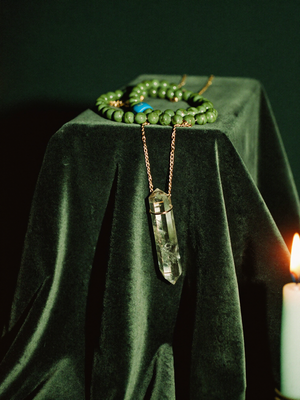
Choose a stone you can lose. The break-room working puts an object through a pocket, a locker, a hand-wash and a rush; a tumbled pocket stone that cost a few dollars will do this job better than a treasured piece, because you will actually carry it instead of worrying about it. Smoky quartz is the traditional grounding choice for exactly this kind of working night, and it looks like nothing in a pocket, which is the point.
The day after: keeping the second half
November 1 before sunset is still the festival in the older reckoning, and this is where everything that needs a table goes. Eat one real meal, even if it is at two in the afternoon and even if it is alone. Set a plate or a cup for the dead at the end of the table, or on the altar if you keep one, and serve it first. Light the proper candle, the one you did not have time for in the morning, and let it burn while you eat. If you read cards at Samhain, this is the reading; if you do not, do not start because a post said you should.
The people who find this hardest are the ones who feel they missed it. They did not. A festival that runs sunset to sunset is not over at midnight, and a meal at the second half of it is closer to how most agrarian feasts were actually kept than a candle-lit rite at 11:59 pm. Our step-by-step Samhain ritual can be done in full in this window; the ancestor altar guide covers the plate and the table.
One more thing about the day after: if the clocks have gone back, and in 2026 they do on the morning of November 1, you gain an hour. The evening practice for the clocks going back is built for exactly that stolen hour, and it dovetails with a late Samhain better than anything else on the calendar.
What a bar, a ward and a stockroom already give you
It is worth noticing what your workplace supplies without being asked. A bar on Halloween is a room full of people in masks, which is the oldest Samhain image there is: the guising, the disguise, the neighbor who is not quite the neighbor tonight. A hospital ward is the threshold made literal, and the people who work them know it. A stockroom or a closed kitchen at midnight is as liminal as any crossroads. You are not keeping the festival in spite of the setting; the setting is doing half the work.
Two things follow from this. First, you can let the costumes be the rite. Watch them with the eyes of someone who knows what masks were for, and it stops being a shift and becomes an observance. Second, if your work is care work, the dead may come up on their own tonight, in a patient's story or a coworker's aside. You do not need to do anything with that. Noticing it is the practice.
Where you are working, and what it already holds
| Setting | What it already is | The one thing to add |
|---|---|---|
| Bar, restaurant, venue | A room of masks, the guising itself | One silent name on the break |
| Hospital, hospice, care home | The threshold, literally | The stone in the pocket, nothing said |
| Retail, warehouse, kitchen | A closed, liminal space after hours | The morning rite before you go in |
| Trick-or-treating with children | The oldest form of the door-to-door custom | Pour a cup on the step when you get home |
If you are on candy duty with children
Walking a child from door to door on Halloween is not an interruption of Samhain. It is the closest living relative of the old custom: going house to house in disguise, receiving food, on the night the year turns. Folklorists trace American trick-or-treating to guising and souling customs from Ireland and Scotland, in which children and the poor went door to door for soul cakes in exchange for prayers for the dead. The candy is a very old thing wearing a very new wrapper.
So keep it as the rite. Before you leave, put a small cup of something on your own front step for whoever might come by that is not a child; when you get home, pour it on the ground. Let the child keep one piece of candy for the plate on the table tomorrow, and tell them who it is for if they are old enough to ask. That is a complete Samhain for a parent, and it is one that many practitioners look back on as the one that taught their children the festival without a single lecture.
What you do not need to do is stage a ritual for children who did not sign up for one, or feel that the evening was wasted because it was spent on a sidewalk. The sidewalk was the point.
What to skip
Three things show up in advice for working practitioners every year and are worth leaving out. First, midnight workings in the car in the employee lot. You will be exhausted, it is often a security issue, and a rite done badly at midnight is not better than one done well at eight in the morning. Second, hiding an altar in a locker or on a shelf at work. It is rarely worth the conversation if it is found, and it is not necessary; a pocket is an altar for one night. Our guide on wearing a pentacle at work covers what you are actually entitled to if you do want something visible.
Third, and most important, do not ask for the night off on religious grounds unless you actually need it and are prepared for the conversation. Title VII does require employers to accommodate sincerely held religious practice unless doing so is a substantial burden, and since the Supreme Court's 2023 decision in Groff v. DeJoy the bar for an employer to refuse is higher than it used to be. But a Halloween shift in hospitality or retail is exactly the kind of day where the burden argument is strongest, and a request made two days out will not go well. If the festival matters that much to you, ask in September next year, in writing, and propose a swap. This year, work the shift and keep the three windows.
Which Samhain window is yours?
Voices from practice
Practitioners who work nights in hospitality tend to describe the same discovery: the first Samhain they kept on a shift, badly and in a stairwell, stayed with them longer than the elaborate ones at home. The dead felt closer among the masks than in a quiet room. Several say they now volunteer for the Halloween shift.
From care work, the recurring note is different and quieter. Nurses and aides who practice often say they do not do anything visible on the night at all; the ward already is the threshold, and the stone in the pocket is enough. Their Samhain is the meal the next day, and the names they carry to it are sometimes not their own.
Parents describe the sidewalk version with something like relief. The pressure to produce a ritual disappears once trick-or-treating is understood as the ritual, and the cup on the step becomes the thing the children remember.
What we don't promise
We do not claim that a break-room working is equivalent to a full Samhain rite, or that the festival will feel meaningful on a shift; for some people it will and for others the night will simply be work, and both are honest outcomes. We do not claim that any stone, candle or practice protects you, grounds you in a measurable sense, or contacts the dead. We do not offer legal advice: the note on religious accommodation above describes the general shape of federal law, not your situation, and an employment lawyer or the EEOC is the right place for a real question. If the season is heavy for you, a practice is not treatment, and we would rather you spoke to someone than kept a perfect Samhain.
Practically: how to work with this
- The week before: decide which of the three windows you have. Write the morning rite on a card if you will be tired. Pick the pocket stone and put it by your keys.
- The morning of the 31st: ten minutes, one candle, the year named out loud, the stone in the light for a breath. Snuff the candle. Go to work.
- On the break: door or wall at your back, stone in the closed hand, the dead named one per breath, the year turned in your own words. Open the hand. Eat something.
- November 1 before sunset: one real meal, a plate or cup for the dead served first, the long candle, the reading if you read. Then the festival is over, and you did all of it.
- If you were on candy duty: a cup on the step before you leave, poured out when you return; one piece of candy kept for the plate tomorrow.
- Next September: if you want the night off, ask then, in writing, with a swap proposed.

From our shelf
Smoky Quartz Tumbled Pocket Stone — Grounding & Protection
The stone this guide is built around: small enough to go through a shift unnoticed, smooth enough to hold in a closed hand for four minutes, and inexpensive enough to lose without grief. Smoky quartz is the traditional grounding stone, and it is the one practitioners most often name for a working night. Ships within 3 business days. $4.95.
More in Tumbled & Pocket Stones and Travel & Pocket Size.
Frequently asked questions
Can I celebrate Samhain on a different day if I work on Halloween?
Yes. In the traditional sunset-to-sunset reckoning the festival runs from dusk on October 31 to dusk on November 1, many groups hold their main rite on the nearest free weekend, and the astronomical cross-quarter falls around November 7 in 2026. Any of these is a legitimate Samhain.
What is the minimum Samhain I can do on a work shift?
Name the dead. Four or five minutes on a break with a stone in your closed hand, one name per breath, and a sentence in your own words that the year has turned. Everything else can wait until the next day.
Do I have to do a ritual at midnight on October 31?
No. Midnight comes from Halloween, not from the older festival. The night of Samhain begins at sunset, and the second half of the festival is the daylight of November 1.
Is trick-or-treating with my kids a Samhain practice?
It is the closest living relative of the old guising and souling customs, in which people went door to door in disguise for food on the night the year turned. Kept with a cup on the step and a piece of candy for the plate, it is a complete observance.
Can I ask for Halloween off as a religious holiday?
Federal law requires employers to accommodate sincerely held religious practice unless it is a substantial burden, and the 2023 Groff v. DeJoy decision raised the bar for refusing. A Halloween shift in hospitality or retail is where the burden argument is strongest, so ask well in advance and propose a swap. We are not lawyers; the EEOC or an employment lawyer can advise on your case.
What if I sleep through November 1 after a night shift?
In 2026 the clocks go back that morning, so you have an extra hour, and the festival runs until sunset. A meal at three in the afternoon with a plate for the dead is a full second half.
Sources & further reading
- Ronald Hutton, The Stations of the Sun: A History of the Ritual Year in Britain (Oxford, 1996), chapters on Samhain, souling and guising.
- Nicholas Rogers, Halloween: From Pagan Ritual to Party Night (Oxford, 2002), on the American development of trick-or-treating.
- Groff v. DeJoy, 600 U.S. 447 (2023), and EEOC, "Religious Discrimination" guidance, on workplace religious accommodation under Title VII.
- U.S. Naval Observatory, Astronomical Applications Department, for sunset times and the 2026 solar longitude tables used for the cross-quarter date.
- Reclaiming, public materials on the annual Spiral Dance (San Francisco, since 1979), as an example of a Samhain rite held on a weekend near the date.
- In the magazine: Samhain ritual, step by step · The Samhain ancestor altar · Does the veil thin at Samhain? · When the clocks go back