



Acid for Squares Séance: Susan Slaughter (E115)
For the first time, Acid for Squares lets a spirit board speak. What happened in the séance, what research says about boards and pendulums, and which claims hold up.


A Halloween episode that turns into a test: on Acid for Squares, hosts Tanya Dahl and Cody Blue let a spirit board speak for the first time. Their guest is paranormal investigator Susan Slaughter, and midway through the recording Tanya describes a tall, white being with an elongated head that she says she saw the night before. Susan says she saw the same figure at her own séance the evening prior. Episode E115 (October 13, 2026) is more than a spooky hour: it shows how modern spirituality braids séance tools, aliens, channeling and AI into one story. Below we summarize the episode, put each central claim in context, and say plainly what is documented and what is not.
Contents
In episode E115 of Acid for Squares (Oct. 13, 2026), paranormal investigator Susan Slaughter leads the show's first séance with a spirit board and pendulum. Documented: the board's history (patent 1891) and the ideomotor explanation of its movement (Carpenter 1852, Faraday 1853). Not documented: that the dead, extraterrestrials or other beings communicate through the board; the matching drawings of a tall white being and the letter strings of the session were not independently verified.
Margaret Fox said publicly on October 21, 1888 that the Fox sisters' rapping sounds were self-produced, and retracted in 1889. Modern Spiritualism began in 1848 in Hydesville, New York.
Source/tradition: contemporary press reports 1888/1889; standard histories of Spiritualism
Spiritualism is real and one can communicate with spirits.
Source/tradition: no independently reproducible evidence
The talking board in its modern form traces to the Kennard Novelty Company (Baltimore) and U.S. Patent 446,054 of 1891; Parker Brothers took over the brand in 1966.
Source/tradition: U.S. Patent 446,054; Parker Brothers/Hasbro company history
Movements of boards, pendulums and dowsing rods arise from unconscious muscle movements (the ideomotor effect).
Source/tradition: Carpenter 1852; Faraday 1853; Chevreul 1833; Gauchou, Rensink and Fels, Consciousness and Cognition 2012
The planchette moves through the group's psychic energy, carrying contact from non-human beings.
Source/tradition: Susan Slaughter in E115; Spiritualist and channeling tradition
Extraterrestrials, elementals and cryptids communicate through the board.
Source/tradition: no independent evidence
Two people independently drew the same tall white being with an elongated head.
Source/tradition: self-report; popular-culture imagery since 1961/1987
Sleep paralysis commonly involves a felt presence and intruder hallucinations.
Source/tradition: Cheyne, Rueffer and Newby-Clark 1999, Consciousness and Cognition
Pendulums locate ailments in the body.
Source/tradition: no scientific evidence of efficacy
The letter strings RIB, CK, M and the hospital story about Andrew's acquaintance showed real contact.
Source/tradition: no resolution in the episode; Forer effect 1949
VERIFIED = verifiable in scientific or official sources · TRADITIONAL = historically or culturally recorded · LIVED PRACTICE = widely practiced, experiential knowledge · NOT PROVEN = spiritual interpretation, not scientifically established.
The Episode at a Glance
| Item | Details |
|---|---|
| Show | Acid for Squares (a "psycho-spiritual podcast") |
| Hosts | Tanya Dahl & Cody Blue |
| Guest | Susan Slaughter — per the episode description a paranormal investigator known for Ghost Hunters and Paranormal Caught on Camera; active on Instagram as "susanthedragonwitch" |
| Episode | E115: "We Did Our First Séance… and It Got Weird" |
| Date / length | October 13, 2026 · about 60 minutes |
| Link | youtube.com/watch?v=nXOwADEddz8 |
| Three key claims | 1) The spirit board is a legitimate, if "archaic," tool for spirit communication. 2) Such methods draw not only the dead but extraterrestrials, elementals and cryptids. 3) The board moves through the group's shared "psychic energy" — and with fear in the room, it gets "sketchy." |
Watch the Episode
Chapter Guide With Timestamps
- 0:00 — Teaser: the board moves before the first question is asked
- 1:55 — Welcome, guest and setup
- 3:01 — What is a séance? The Victorian era, Spiritualism, the Fox sisters
- 5:04 — From ghost hunting with cameras to personal spirituality
- 7:27 — The tools: spirit board, pendulum, dowsing rods, ghost box
- 9:15 — Why Susan teaches others, and "we are born psychic"
- 11:35 — Tanya's story: the tall white being and a medium friend
- 14:52 — Susan's séance the night before, drawings compared
- 19:36 — Pendulum exercise to "calibrate" the group
- 27:59 — The board moves: "AI," "ZB," "New York"
- 34:41 — Questions about AI, egregores and the "Z's" (Lee Harris)
- 39:50 — Letter strings "RIB," "CK," "M"
- 43:59 — A "human" contact, Andrew's acquaintance in the hospital
- 53:11 — Closing, reflections and Susan's safety advice
Note: sponsor reads run from about 24:54 to 27:45; they are not part of the content.
Deep Dive: Eight Claims From the Episode and What Holds Up
1. "Spiritualism is real" — and the Fox sisters were unfairly branded frauds
Susan tells it this way: the American Fox sisters began as genuine mediums, got swept up by fame and drifted into showmanship, and were later dismissed as frauds and phonies. What gets lost, she says, is that spirit communication is real (from 3:51). In her words at 4:09: "spiritualism is a very real thing and you can communicate with spirit."
Context: The Fox sisters set off modern Spiritualism in 1848 in Hydesville, New York. Margaret Fox said publicly at the New York Academy of Music on October 21, 1888 that the rapping sounds were produced by her own body, and she retracted that confession in 1889. Both halves of the story are documented; whether communication with the dead occurs is not. For the longer history, see our guide to what actually happens at an American Spiritualist camp.
2. The spirit board is an "archaic" but legitimate tool
Susan uses an oversized 1960s board and frames it as one stage of an evolution: first board, pendulum and rods, then "modern" communication with a ghost box and a headphone technique she calls the Estes method (spelled phonetically in the transcript). She chose the board today because there are three of them and she wanted to show the original tools (7:27–8:20).
Context: The talking board as we know it traces to the Kennard Novelty Company of Baltimore (founded 1890) and U.S. Patent 446,054 of 1891. William Fuld later took over production, and Parker Brothers (now Hasbro) owned the brand from 1966. Spiritualists had used rapping codes and alphabet tables earlier, so the board began as a parlor game and became an oracle only through its Spiritualist context. Our guide to getting rid of a Ouija board covers what matters in practice.
3. The board moves through the group's "psychic energy," not through ghosts
Near the end Susan says, in essence, that a ghost is not pushing the planchette; the combined psychic energy of the participants is moving it, and contact speaks through that group energy (54:52–55:30). She says you need at least two people, ideally three, a kind of "AC/DC current" between people. All three describe the planchette gliding "under the fingers" and even spinning.
Context: That exact picture — several people, light touch, a board that seems to glide on its own — is the textbook case of the ideomotor effect. William Benjamin Carpenter described it in 1852; in 1853 Michael Faraday used a sliding cardboard rig to show that table-turners were exerting unconscious pressure. A 2012 study by Gauchou, Rensink and Fels in Consciousness and Cognition even found that people could express knowledge through a Ouija-style method that they did not state aloud. Susan's explanation ("it's us") and the research overlap: both say humans move the board. They split on whether anyone else is helping — and there is no evidence for that.

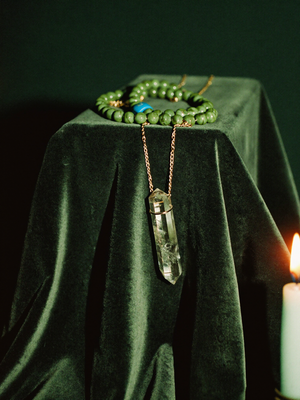
Stone Pendulum with Chain — $12.95. If you want to try the pendulum exercise from the episode yourself, this is a simple tool for watching your own micro-movements. It is an experiment with your own perception, not a diagnosis and not a remedy.
4. Not only spirits come through: extraterrestrials, elementals and cryptids
Susan says twice (0:50 and 19:11) that she has spoken with extraterrestrials, elementals and cryptids, and that many messages are "non-human." She does not treat that as a warning sign but as part of human experience and evolution (9:38–10:00).
Context: Boards as channels for "visitors" have a history. Pearl Curran produced texts from a purported "Patience Worth" on a Ouija board from 1913, and author Jane Roberts began her "Seth" sessions with a board in 1963. The step from ghost to alien is small in channeling circles, but a board naming an entity "extraterrestrial" only shows what the questioner and sitters bring to the table. Independent evidence for non-human conversation partners is missing.
5. Two drawings of the same figure — "tall white"
Tanya describes a recovered memory of an eight- or nine-foot being with a long white head and tiny face standing in the corner of a room. A medium friend, she says, showed her a picture that matched. Susan says she saw and sketched a very similar figure the night before, and the two reveal their drawings at the same moment (17:26–18:20). The hosts stress that both sketches carried a note of "tall white" (17:42).
Context: It is a powerful experience for those involved and weak evidence: the sketches were not independently checked, and the description (big head, small face, thin body) matches a widespread visual template of UFO popular culture, familiar since the Hill case (1961) and the cover of Whitley Strieber's Communion (1987). Two people who work in the same circle and talked beforehand are not an independent confirmation. We do not doubt that both sincerely recall what they saw.
6. Sleep paralysis and "something in the room"
Tanya says that the night before filming she had sleep paralysis for the first time since childhood and felt something pressing her head into the pillow (13:39–14:00). Susan says she woke in the night sensing something in the room and held back from her usual "sovereignty prayer" because it did not feel bad (14:00–14:35).
Context: Sleep research describes a "felt presence" and intruder hallucinations as common features of sleep paralysis; Cheyne, Rueffer and Newby-Clark examined this in Consciousness and Cognition in 1999. We do not assess Tanya's experience or offer an interpretation. We only note that such episodes are well documented and culturally shaped — someone steeped in alien narratives will tend to see different figures than someone steeped in ghost stories.
7. The pendulum follows the will — and the group gets "calibrated"
In the pendulum exercise (19:36–24:40) the sitters hold the pendulum still, then turn it clockwise and counterclockwise "with the mind, not the body." Cody finds clockwise easy and counterclockwise hard. Susan mentions that pendulums are also used in Reiki practice to locate ailments (23:11–23:20).
Context: Michel Eugène Chevreul showed in 1833 that a pendulum moves through tiny, unconscious muscle movements that follow imagination; the same mechanism drives dowsing rods. The exercise is a neat demonstration of how quickly expectation and motion coincide. A diagnostic use of the pendulum is not supported by evidence, and we make no health claims. For more, see Dowsing Rods: How to Hold Them and What Works.
8. The messages: "AI," "ZB," "Eight," "RIB," and a sick man named K
The heart of the episode is the board session (27:59–53:03). After the first question the planchette goes to "NY," then "AI," then repeatedly "ZB." Asked whether AI creates its own thought forms, the board answers "No" (36:50), then "Zero." Asked whether eight beings are present, it points to the eight (38:00); the group thinks of the "Z's" that Lee Harris says he channels (38:18). Later come the letters "RIB," "CK," "M" and several tries at "Man." A crew member, Andrew, is linked to the contact: an acquaintance who may be in the hospital or may have died. The episode ends without settling whether that person is alive (50:04, 55:26).
Context: Ambiguous letter strings, yes/no questions and a group eager to fill gaps are exactly the conditions in which people see hits (the Forer effect, 1949; confirmation bias). That the planchette seemed to "point" to Andrew is the group's own description — under ideomotor movement a board drifts slightly toward wherever someone is unconsciously looking or thinking. Whether Andrew's acquaintance actually died is not resolved in the episode; a hit would only count with a verifiable resolution. That Susan herself says some of the board's output was hard to decipher (51:22–52:44) speaks to honesty, not evidence.
When the Board Gets "Sketchy": Susan's Safety Advice
At the end Susan advises that anyone using the tool should come to the session from the "heart space," fearless and confident. If you are scared, she says, don't use it, because fear-based energy can produce messages that mirror the fear: "that's where it gets a little sketchy" (58:35). As a psychological observation it holds up: expectation shapes perception, and someone who brings fear reads ambiguity as threat. It is no substitute for medical or psychological help; if you struggle with anxiety, sleep problems or distress, talk with a professional.
What's New — and What Stays Contradictory
Susan Slaughter has appeared before (the hosts say episode 12). What is new is the shift from telling to demonstrating: for the first time the conversation becomes an experiment, and the format shows itself at work. Also new is the strong presence of AI in the board session ("AI," the question about thought forms); at the same time Susan warns that with AI it is getting hard to tell what is real (5:12–5:28). What stays contradictory: Susan says she no longer needs to prove anything (6:56–7:12), yet she also says she wants to start recording her séances because she gets "visitations" before meeting people (14:52–15:03). And the board is described both as group energy and as a channel for beings.
Voices From the Community
As of October 15, 2026, shortly after release, we read the top YouTube comments under the episode. The mood is friendly and enthusiastic; we found no skeptical voices there yet. Paraphrased and in places briefly quoted:
- YouTube, @StephanieLevy-…: Tanya's shriek of "I love our life" struck her as so honest and warm that the energy of the scene felt beautiful.
- YouTube, @mindfulsleepsounds…: "We need an update from Andrew!" — a wish for a resolution to the hospital story.
- YouTube, @Nefert28: finds it funny that the "Z's" wanted to say hi; they seem to be watching and to like the show.
- YouTube, @ShaunaAurora: wants to know what the "sovereignty prayer" (14:52) actually is.
- YouTube, @bendazenda: says they are "just as lost" as the group, enjoyed the episode and hopes for updates on Lee and Andrew.
- YouTube, @Dana.394: leaves a personal, encouraging message for Cody — an example of how strongly viewers read the scene as a real spiritual encounter.
What rarely shows up in comment sections is the sober question of how the board works without ghosts. That is what we have tried to answer above.
Why This Matters for the "New World"
The episode shows what spirituality feels like in 2026: not just church or the incense shop, but a podcast studio, an AI debate, an alien encounter and a spirit board in one room. Three things matter to us at Temple of Desire. First, curiosity: people are looking for ritual and shared attention again. Second, self-knowledge: whether you see ghosts or group psychology, the board lets you feel how strongly expectation, body and group work together. Third, responsibility: anyone using such tools needs clarity about what they experience and what they merely interpret. We support the debate and sell no certainties. If you try a session, do it in a safe setting with people you trust, and skip it if it frightens you.
Critical Questions the Episode Leaves Open
- How would the session have gone if nobody had asked about aliens, AI or the dead — does the board move without expectation?
- Would the same letter strings appear if every sitter were blindfolded or could not see the board?
- Is there a resolution to Andrew's acquaintance that makes the claim checkable?
- How independent are the two drawings if Susan and Tanya discussed experiences in the same circle beforehand?
- How does Susan tell a message from a counterpart apart from the group's fear or expectation — is there a criterion?
Glossary
- Séance
- A sitting in which participants seek contact with the dead or other beings; the core of 19th-century Spiritualism.
- Planchette
- The heart-shaped pointer that glides under the fingers across the letters of a spirit board.
- Ideomotor effect
- Tiny, unconscious muscle movements that follow an idea; it explains pendulums, dowsing rods and boards.
- Egregore
- From the Greek for "watchful"; in modern occult circles, a thought form fed by a group.
- Channeling
- A practice in which a person aims to relay messages from non-human or deceased beings.
- Sleep paralysis
- Brief inability to move while waking or falling asleep, often with vivid sensory experiences.
- Forer effect
- The tendency to accept general statements as personally accurate.
- Spiritualism
- A religious movement from 1848 built on contact with the dead.
Keep Reading
- What Actually Happens at an American Spiritualist Camp
- How to Get Rid of a Ouija Board: What Actually Matters
- Dowsing Rods: How to Hold Them and What Works
- Frederick Bligh Bond: The Architect Who Dug Glastonbury by Automatic Writing
- Acid for Squares E113: Kip Andersen on Christspiracy
FAQ
What is Acid for Squares episode E115?
A roughly hour-long Halloween episode from October 13, 2026 in which paranormal investigator Susan Slaughter leads the show's first séance with a spirit board and pendulum.
Who is Susan Slaughter?
Per the episode description she is a paranormal investigator known for the TV shows Ghost Hunters and Paranormal Caught on Camera, and she uses the Instagram name "susanthedragonwitch."
How does a spirit board work, according to research?
Through the ideomotor effect, participants move the planchette unconsciously themselves; Carpenter described this in 1852 and Faraday confirmed it experimentally in 1853.
Is using a spirit board dangerous?
There is no evidence of possession. If it frightens you, skip it; for persistent anxiety or sleep trouble, talk with a professional.
Did the episode prove anything?
No. It shows a striking experience for those involved; it offers no independent evidence of contact with spirits or extraterrestrials.
Where can I find Susan Slaughter?
On Instagram as "susanthedragonwitch"; she says in the episode that it is the only social platform she actively uses.
More from Occult & Hidden Knowledge
All stories →
Count Cagliostro: The Real Story of Giuseppe Balsamo


Acid for Squares E117: Twelve Nights, in Context
