





Shamanic Journeying: How the Drum Method Works


Contents
A shamanic journey is a light, self-directed trance induced by steady drumming at roughly 4-7 beats per second, in which the practitioner follows an imagined descent or ascent and works with what appears. The drum-and-recording method most Americans encounter comes from Michael Harner's 'core shamanism', published in 1980, not from any single Indigenous tradition. Start with a 15-minute recording that has a callback signal, one clear question, and a notebook. The practice is generally low-risk for stable adults; it is not a treatment for any condition.
Steady drumming in the range of about 4 to 7 beats per second is the tempo used in core-shamanic journey recordings, and laboratory EEG work has recorded increased theta-range activity in some listeners.
Source/tradition: Maxfield, M. (1990/1994), EEG studies of rhythmic drumming; Vaitl et al., Psychological Bulletin 131(1), 2005, review of altered states of consciousness
The specific drum-recording method taught in the United States was formulated by anthropologist Michael Harner and published as 'core shamanism' in The Way of the Shaman (1980).
Source/tradition: Harner, M., The Way of the Shaman, Harper & Row, 1980
Practices described as shamanic are documented across Siberia, the Americas, and parts of Asia, and differ substantially from one another; 'shamanism' is a scholarly umbrella term, not one tradition.
Source/tradition: Eliade, M., Shamanism: Archaic Techniques of Ecstasy, 1951 (English edition 1964); Atkinson, J., Annual Review of Anthropology 21, 1992
The division of the journey into a lower, middle and upper world, reached by descending or ascending, is the standard teaching frame in core shamanism and in many of the traditions it draws on.
Source/tradition: Comparative ethnographic descriptions; core-shamanic teaching literature since 1980
Setting an intention, using a recording with a callback signal, returning by the same route and grounding afterwards are the standard safety conventions practitioners follow.
Source/tradition: Widely taught convention in contemporary practice groups
A shamanic journey reveals information the traveller could not otherwise know, or produces contact with independently existing spirit beings.
Source/tradition: No controlled evidence; the experience is real and describable, its source is not established
Journeying treats, cures or replaces care for a medical or psychiatric condition.
Source/tradition: No clinical evidence; not a treatment
VERIFIED = verifiable in scientific or official sources · TRADITIONAL = historically or culturally recorded · LIVED PRACTICE = widely practiced, experiential knowledge · NOT PROVEN = spiritual interpretation, not scientifically established.
Quick answer
A shamanic journey is a light, self-directed trance brought on by steady drumming at roughly four to seven beats per second. You set one question, follow an imagined descent or ascent, and work with whatever appears. The drum-recording method most people in the US meet was formulated by anthropologist Michael Harner and published in 1980 as core shamanism — it is a modern synthesis, not one inherited tradition. To begin you need a fifteen-minute recording with a callback signal, one clear question, and something to write in. It is not a treatment for any condition.
Almost everything written about shamanic journeying in English falls into one of two piles. One pile promises contact with spirit guides and says nothing about where the method came from. The other pile dismisses it as fantasy and says nothing about what people actually experience. Neither is much use if you are holding a drumming recording and wondering what you are supposed to do for the next fifteen minutes.
This is the third option: what the technique is, who assembled it and when, what the laboratory work does and does not show, how to do it, and where the honest limits sit.
What a shamanic journey actually is
Mechanically, it is simple. You lie down, cover your eyes, and play a recording of a drum struck at a steady, monotonous tempo. You picture a real place in nature that you know, and from that place you go downward — into a cave mouth, a hollow tree, an animal burrow — or upward, along a tree, a mountain, a column of smoke. You keep your attention on the journey. Images, impressions, sensations and sometimes whole scenes arrive. When the drumbeat changes to a rapid callback rhythm, you return the way you came, and you write down what happened.
You are awake the whole time. You can stop at any point, and you will remember it afterwards, which is what separates this from a dream. Practitioners describe it as sitting somewhere between vivid daydreaming and lucid dreaming — if you have tried lucid dreaming, the quality of attention will be familiar, though a journey is far easier to enter and far easier to leave.
Where the drum method came from — the part usually left out
This matters more than it looks, because it is the difference between an honest description and a borrowed costume.
Practices that scholars group under the label shamanism are documented across Siberia, Central Asia, the Arctic, and the Americas. They are not one thing. The word itself entered European languages from the Tungusic šaman, by way of Russian accounts of Siberia, and was then applied — by outsiders — to a very wide range of practices that have no historical connection to one another. Mircea Eliade's 1951 survey did more than any other book to fix the umbrella term in place, and anthropologists have been arguing about how much it obscures ever since.
The specific method described in this article — a solo journey, a recording rather than a live drummer, three worlds, a callback signal, a workshop you can sign up for — is narrower and much more recent. Michael Harner, an anthropologist who had done fieldwork in the Amazon, distilled elements he considered common across traditions into a teachable system he called core shamanism, published in The Way of the Shaman in 1980. Nearly every drumming track, weekend workshop and how-to article in English descends from that book.
That is not a debunking. A method can be recent, synthetic and still worth practising. But it means that describing your practice as an ancient inheritance is inaccurate, and it means the appropriation question below is a real question rather than a scruple.
What the research on drumming actually shows
Here the honest answer is narrower than either camp would like.
There is laboratory work, most often cited from Melinda Maxfield's EEG studies around 1990, recording increased theta-range activity in some listeners exposed to sustained monotonous drumming. Broader reviews of altered states — Vaitl and colleagues in Psychological Bulletin in 2005 is the standard one — treat rhythmic auditory driving as one of several reliable, low-risk routes into a shifted state of consciousness, alongside breathing techniques, fasting and sensory monotony.
What that supports: sustained rhythm at this tempo changes measurable brain activity in some people, and the resulting state is describable, repeatable and mild.
What it does not support: any claim about where the content of a journey comes from. A shifted state is a condition for the experience, not an explanation of it, and certainly not evidence that the beings you meet exist independently of you. Anyone who cites the EEG work as proof of spirit contact has skipped several steps.
The sample sizes are small. The drumming-EEG literature is thin, mostly old, and rarely replicated with modern controls. Treat "drumming produces theta waves" as a plausible, modestly supported finding, not a settled fact — and notice that it would not change the practice either way.
The three worlds
| World | How you get there | What it is used for |
|---|---|---|
| Lower | A descent — cave, root, burrow, tunnel, water | Working with a power animal; old material; anything that needs to be met rather than solved |
| Middle | No descent or ascent; you travel outward from where you are | A concrete present-day situation you want to see more clearly |
| Upper | An ascent — tree, mountain, ladder, smoke, rope | Teachers, wider perspective, questions about direction rather than detail |
Beginners are almost always sent to the lower world first, because a descent is easier to hold in the mind than an ascent and because the material there tends to be less abstract.
For the part people skip
Mindful Mornings Journal — Lined Notebook for Your Morning Ritual
The step almost everyone drops is the one that makes journeying useful: writing it down within a few minutes, before the images reorganise themselves into a tidier story. A plain lined notebook is all this needs. Over a few months the repeated symbols become visible — and that pattern, not any single journey, is where the practice earns its keep.
See the journal — $22.95How to do it, step by step
- Pick the question before you lie down. One question, concrete, open. "What do I need to see about the way I am handling this move?" works. "Will I get the job?" does not — a yes-or-no question gives the mind nothing to build.
- Set up the room. Dark, quiet, phone off. Lie on your back. Cover your eyes with a cloth or the crook of your arm.
- Choose a real entrance. A place you have actually stood: a hollow at the base of a tree you know, a culvert, a cellar door, a spring. Real places are easier to return to than invented ones.
- Start a recording with a callback. Fifteen to twenty minutes for a first attempt. The callback — an abrupt change to a fast rhythm near the end — is what makes this safe and tidy rather than open-ended.
- Go down, and keep going. The tunnel or shaft usually takes a little while. If you stall, describe the walls to yourself in detail; specificity moves it along.
- Stay with the first thing. Do not audition it, do not improve it, do not ask whether you are making it up. That question is for afterwards.
- Come back on the callback. Same route, same entrance, out. Do not skip this even if the journey felt unfinished.
- Write it down immediately. Within two or three minutes, before it reorganises into a neater story. Details first, meaning later — ideally much later.
What the first time is usually like
Underwhelming, mostly. A handful of people get cinematic imagery on attempt one. Far more get fragments: a colour, a texture, a sense that something is to the left, one clear animal and then nothing. Some people do not see at all and instead know, or feel, or hear. All of these are how the practice works, not a failed version of it.
The most common beginner mistake is not lack of imagery. It is commentary — narrating and evaluating the journey while it happens, which reliably ends it. The second most common is stopping after two attempts because nothing dramatic occurred. Journeying behaves like most attention practices: it is dull for a while, and then it is not.
If you keep stalling in the tunnel
Switch senses. Instead of trying harder to see, ask what the air smells like, whether the ground is wet, whether it slopes. Imagination that has gone rigid in one channel usually loosens in another — and the visual material tends to come back once you have stopped demanding it.
Safety, grounding, and the one real contraindication
For a stable adult this is a low-risk practice. The conventions exist anyway, and they are worth keeping: one intention, a recording with a callback, the same route out, and something to eat and drink afterwards. Grounding is not mystical bookkeeping — you have been lying in the dark with your attention turned inward for twenty minutes, and it takes a few minutes to come back to a room.
The genuine caution: if you are currently experiencing psychosis, mania, dissociation, or are in an acute phase of trauma-related symptoms, deliberately inducing an altered state on your own is not a good idea. That is not a superstition about spiritual danger; it is the ordinary observation that a technique which loosens the boundary between inner imagery and perception is the wrong technique when that boundary is already unreliable. Work with a clinician first.
And the limit that matters most: a journey is not a diagnosis, a prophecy, or a second opinion. If a journey tells you to stop a medication, leave that instruction in the notebook and take it to a doctor. See also spiritual bypassing for the pattern where practice quietly replaces the thing that actually needs doing.
The appropriation question, answered plainly
It comes up constantly and it deserves better than either reflex.
Core shamanism is a modern Western synthesis. It is not a Native American practice, it does not carry anyone's authority, and nobody taught it to you in a lineage. Practising it is not, in itself, taking something from a living community. What does cause harm is the layer people add on top: calling yourself a shaman, charging for ceremonies framed as Indigenous, using specific closed rituals or regalia, or presenting a 1980 synthesis as ancestral knowledge. Indigenous writers have been objecting to exactly that for decades, and the objection is about misrepresentation and commerce, not about whether you may lie on your floor and listen to a drum.
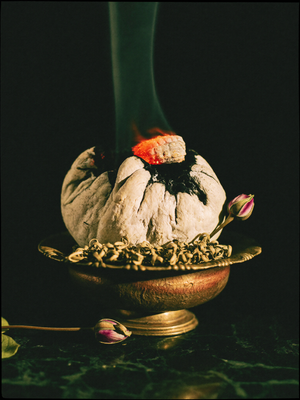
The workable line is accuracy. Say what the method is and where it came from. Do not claim a lineage. If you burn something to mark the start, there is no reason it has to be white sage — see what to burn instead and white sage, honestly for why that plant in particular carries a problem the others do not.
What journeying will not do
- It will not tell you facts you have no way of knowing. Journeys are made of your material.
- It will not treat a medical or psychiatric condition, and no one should offer it as such.
- It will not give you a power animal on a schedule. Sometimes nothing shows up for weeks.
- It will not settle a decision for you. At best it shows you which part of the decision you have been avoiding.
What it does do, fairly reliably, is give a structured, time-limited way to put a question to the part of yourself that does not answer in sentences — and a record you can read back. That is a real thing, and it does not need to be oversold.
Sources: Harner, M., The Way of the Shaman, 1980 · Eliade, M., Shamanism: Archaic Techniques of Ecstasy, 1951 (Eng. 1964) · Atkinson, J., "Shamanisms Today", Annual Review of Anthropology 21, 1992 · Maxfield, M., EEG studies of rhythmic drumming, 1990/1994 · Vaitl, D. et al., "Psychobiology of altered states of consciousness", Psychological Bulletin 131(1), 2005.
Questions about anything in this guide? Write to us at 28@templeofdesire.com.
Frequently asked questions
Do I need a real drum to start?
No. A recording through headphones is what nearly everyone uses, and it has an advantage a live drum does not: the callback signal is built in and arrives whether or not you are ready. A drum of your own is a later pleasure, not a requirement.
How long should a first journey be?
Fifteen to twenty minutes. Longer recordings are not more effective for a beginner; they mostly increase the odds of drifting into ordinary sleep.
What if I do not see anything?
That is the normal first result, and it is not a failure. Perception splits across senses, so try asking what the place smells like or whether the ground slopes instead of trying harder to see. Imagery usually arrives once you stop demanding it.
Is shamanic journeying dangerous?
For a stable adult, it is low-risk, and the usual conventions - one intention, a callback signal, the same route back, grounding afterwards - are enough. The real exception is an acute phase of psychosis, mania, dissociation or trauma symptoms, where deliberately inducing an altered state alone is a bad idea.
Is this a Native American practice?
No. The drum-recording method taught in the US is core shamanism, a modern synthesis published by Michael Harner in 1980. The harm people object to comes from claiming a lineage, calling yourself a shaman, or selling ceremonies framed as Indigenous - not from the practice itself.
How do I find my power animal?
Journey to the lower world with that single intention and notice what appears more than once across several journeys. One striking appearance is an image; a repeated one is a pattern worth taking seriously. Do not force a candidate because you like it.