





Sleipnir: What the Norse Sources Actually Say About Odin's Eight-Legged Horse


Odin's horse has eight legs, was born to Loki, and carries riders between the living world and the dead. All three statements are in the medieval sources. But the carved image of an eight-legged horse is older than the story explaining it — by roughly four hundred years. Here is what the texts actually record, what the stones show, and where explanation stops being evidence and becomes theory.
Contents
Sleipnir is Odin's grey, eight-legged horse, born to Loki in the shape of a mare and called the best of all horses in both Eddas. He is ridden down to Hel more than once, though in the most famous of those rides the rider is Hermodr rather than Odin. The decisive fact is chronological: eight-legged horses are carved on Gotlandic picture stones dated to roughly 700-1000, while Snorri Sturluson's birth story was written in the thirteenth century. The image is centuries older than the surviving explanation of it. No medieval source says why the horse has eight legs, and every answer in circulation - speed, a shaman's mount, a funeral bier carried by four bearers, a collapsed pair of Indo-European twin horses - is a modern hypothesis.
Sleipnir is Odin's eight-legged horse, named in both the Poetic Edda and Snorri Sturluson's Prose Edda and called the best of all horses.
Source/tradition: Grimnismal 44 (Larrington trans., 1999); Gylfaginning 15 (Faulkes trans., 1995)
Snorri Sturluson reports that Sleipnir was born to Loki, who took the shape of a mare and mated with the stallion Svadilfari.
Source/tradition: Gylfaginning 42 (Faulkes trans., 1995); independently listed in Hyndluljod
In the ride to Hel to ransom Baldr, the rider of Sleipnir is Hermodr, not Odin. Odin rides him to the dead separately in Baldrs draumar.
Source/tradition: Gylfaginning 49 (Faulkes trans., 1995); Baldrs draumar (Larrington trans., 1999)
Two Gotlandic picture stones, Tjangvide I (G 110) and Ardre VIII, depict a rider on an eight-legged horse and are dated to roughly 700-1000, several centuries before Snorri wrote.
Source/tradition: Gotlands Museum, Gotlandic Picture Stones - The Online Edition, GP 5 Alskog Tjangvide I; Lindow 2001:277
Tjangvide I was found in 1844 built into the foundation of a medieval house and carries a runic inscription raised in memory of a man named Hjorulfr.
Source/tradition: Gotlands Museum, GP 5 Alskog Tjangvide I, find context and runic inscription (GR I: G 110)
The oldest datable mention of the name is the kenning 'sea-Sleipnir' for a ship, in the 10th-century Husdrapa of the skald Ulfr Uggason.
Source/tradition: Skaldskaparmal 49 (Faulkes trans., 1995); Lindow 2001:277
Asbyrgi canyon in northern Iceland was cut by catastrophic glacial outburst floods from the Jokulsa a Fjollum, not by a hoof.
Source/tradition: Geological consensus; summarised in Vatnajokull National Park and Icelandic geological literature
Icelandic folklore holds that Asbyrgi is the hoofprint of Sleipnir, and that the hidden folk live in its cliffs. This is folk tradition and is not attested in the Eddas.
Source/tradition: Icelandic folk tradition; Simek 2007:294
Runes are said to be cut on Sleipnir's teeth, in the valkyrie's rune-list given to Sigurd.
Source/tradition: Sigrdrifumal (Larrington trans., 1999:169)
Modern heathen and reconstructionist practice invokes Sleipnir as a figure of travel, threshold and safe journeying. This is contemporary devotional use, not a documented pre-Christian rite.
Source/tradition: Contemporary practice; no medieval liturgy or offering text for Sleipnir survives
No surviving source explains why Sleipnir has eight legs. The shamanic-steed reading, the funeral-bier reading and the Indo-European divine-twins reading are all modern scholarly hypotheses.
Source/tradition: Lindow 2001:277 ('in some unclear way'); Davidson 1990:142-143; Mallory & Adams 1997:163
The identification of the Gotlandic rider as Odin specifically, rather than as a dead man arriving in the next world, is an interpretation and is not settled.
Source/tradition: Lindow 2001:277; Gustavson 2012:112, questioning any link between images and inscriptions
VERIFIED = verifiable in scientific or official sources · TRADITIONAL = historically or culturally recorded · LIVED PRACTICE = widely practiced, experiential knowledge · NOT PROVEN = spiritual interpretation, not scientifically established.
The short answer. Sleipnir is Odin's grey, eight-legged horse, called the best of all horses in both Eddas. Snorri says he was born to Loki, who took a mare's shape to sabotage a builder's contract. He is ridden to the land of the dead more than once — though in the most famous of those rides the rider is not Odin. Two Gotlandic picture stones carved between roughly 700 and 1000 already show an eight-legged horse, so the image circulated centuries before the surviving explanation was written down. Why he has eight legs is recorded nowhere; every answer you have read is a modern hypothesis.
The birth story — and who told it
The famous version is chapter 42 of Gylfaginning, in Snorri Sturluson's thirteenth-century Prose Edda.
A builder offers to fortify Asgard in three seasons. His price is the goddess Freyja, plus the sun and the moon. The gods accept on impossible terms — finish inside the deadline, with no man's help — and at Loki's urging allow him his stallion Svaðilfari. The stallion does twice the work of the builder. Three days from the deadline the wall is nearly done, and the gods realise they are about to lose the sun, the moon and Freyja because Loki talked them into a loophole.
They tell Loki to fix it. That night a mare runs out of the woods and calls to Svaðilfari; the stallion tears his tackle apart and follows, the builder chases both, and the night's hauling is lost. The wall goes unfinished, the gods work out that the builder is a giant, and Thor kills him. Some time later Loki — who had been the mare — gives birth to a grey foal with eight legs.
Two things are worth holding onto. This is a story about a broken contract, and Sleipnir is its byproduct rather than its point. And Snorri was a Christian Icelander writing two centuries after the conversion, organising inherited poems into something orderly. He is our fullest source and often our only one — which does not make him wrong, but does mean we are hearing the thirteenth century tell us about the ninth.
Every place Sleipnir actually appears
The complete attested record is small enough to put in a table. This is all of it.
| Source | What it says about Sleipnir |
|---|---|
| Grímnismál 44 (Poetic Edda) | Best of horses, in a list of the best of every kind of thing |
| Sigrdrífumál (Poetic Edda) | Runes are cut "on Sleipnir's teeth and on the sledge's strap-bands" |
| Baldrs draumar (Poetic Edda) | Odin saddles him and rides to Hel to question a dead seeress |
| Hyndluljóð (Poetic Edda) | Names Sleipnir among Loki's offspring, by Svaðilfari |
| Gylfaginning 15, 41, 42, 49 | Eight legs; Odin's; the birth story; the ride to Hel to ransom Baldr |
| Skáldskaparmál 16, 17, 58 | "Relative of Sleipnir" as a kenning for Loki; the race against Hrungnir; a horse-name list |
| Húsdrápa (10th c., skald Úlfr Uggason) | "Sea-Sleipnir" used as a kenning for a ship — the oldest datable mention |
| Hervarar saga | A riddle: who are the two that run on ten feet, with three eyes and one tail? |
| Völsunga saga 13 | The hero Sigurd's horse Grani is "of Sleipnir's kin" |
| Gesta Danorum I (Saxo, 12th c.) | A one-eyed old man carries Hadingus on a horse that runs over the sea |
Notice what is missing. No source explains the eight legs, none describes him beyond "grey," and there is no myth in which he does anything on his own initiative. He is a vehicle — the most celebrated in the mythology, but a vehicle. The riddle in Hervarar saga is the one place the sources play with him, and the answer is arithmetic: Odin and Sleipnir have ten feet between them, three eyes — because Odin has one — and one tail.

If you want to work with this yourself
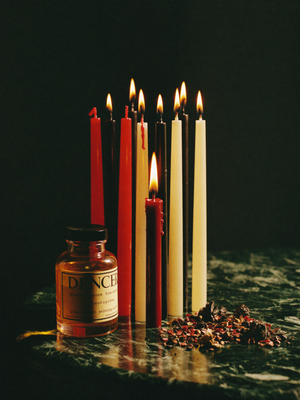
Road Opener 7-Day Candle — Abre Camino & New Doors
Every attested Sleipnir story is a crossing: over the sea, over Hel's gate, from one world into another. If you keep a practice around thresholds — a move, a decision, a beginning — this is the candle we burn for it. It comes from a different tradition than the Norse material above, and we would rather say so than pretend otherwise.
$11.95
See the Road Opener candleThe ride to Hel, and the detail most retellings get wrong
Sleipnir's best-known journey is the ride to recover Baldr, and Odin is not on his back.
After Baldr's death, in Gylfaginning 49, Hermóðr volunteers to ride down and offer Hel a ransom, and Odin's horse is fetched for him. He rides nine nights through valleys so dark he can see nothing, reaches the river Gjöll, and is stopped by its guardian Móðguðr — who remarks that five battalions of dead men crossed the day before and made less noise than he does alone. The living are loud in the country of the dead.
Then the detail that made the horse famous. At the gates of Hel, Hermóðr dismounts, tightens the girth, mounts, and spurs him — and Sleipnir clears the gate so high he comes nowhere near it. That is the entire basis of his reputation as the horse who goes where horses cannot: one jump, in one sentence.
Odin rides him to the dead as well, in Baldrs draumar, to wake a seeress. Both journeys go the same direction — down and north, toward information the living are not supposed to have. Sleipnir is not a war horse. He is what you use when the destination is not a place.
The stones that came before the story
Two carved limestone slabs from the island of Gotland show a rider on a horse with eight legs. Most scholars accept both as Sleipnir.
The better known is Tjängvide I (G 110), dug up in 1844 by a farmer building a potato cellar, who found it built into the foundation of a medieval house; it is now in the Swedish History Museum in Stockholm. It carries a runic inscription raised in memory of a man named Hjǫrulfr, a ship under sail, a woman holding a drinking horn out to the rider, and the eight-legged horse. Ardre VIII is by all probability the work of the same carver or workshop. Both belong to Lindqvist's type C/D, conventionally dated to roughly 700–1000.
This is the fact that reorganises everything else on this page. Whoever cut that horse into limestone was not illustrating Gylfaginning 42, because Gylfaginning 42 would not exist for centuries. The image came first. Snorri's mare-and-stallion story is the earliest surviving explanation of an eight-legged horse — and an explanation arriving four hundred years late is not the same thing as an origin.
Be careful about what the stone actually shows, though. A rider approaches a woman with a horn — read as Odin arriving in Valhalla, and equally as a dead man welcomed into the next world. A nineteenth-century reading tied the images to the death of the man the runes commemorate; more recent work questions whether the pictures on Gotlandic stones relate to their inscriptions at all. The horse has eight legs. The rest is interpretation.
Why eight legs? Four readings, none proven
No medieval source gives a reason. Four explanations circulate, worth separating by how much weight each can carry.
- Speed. Twice the legs, twice the pace. It fits the name and the sea-crossing, and it is also the reading that requires the least evidence and yields the least insight.
- The shaman's steed. Hilda Ellis Davidson argued that an eight-legged horse is the characteristic mount of a shaman travelling to the upper or lower world, citing an eight-legged foal in a Buryat story recorded by Mircea Eliade. The parallel is real; whether Norse religion contained anything usefully called shamanism is a live argument, not a settled fact.
- The bier. The most quietly persuasive, also Davidson's: a corpse carried by four bearers is carried on eight legs. She points to a Gondi funeral dirge from India, recorded by Verrier Elwin, describing a horse with eight legs and four heads and telling the dead man to catch the bridle and mount — where the "horse" is unmistakably the bier. If that image existed in the north too, a horse who carries riders to the land of the dead needs no further explanation.
- Two horses. The Encyclopedia of Indo-European Culture suggests the legs preserve an original pair — the horse-associated divine twins found across Indo-European traditions — collapsed into one animal. Comparative reconstruction is a legitimate method, and also the one most easily made to produce what the reconstructor is looking for.
John Lindow's summary is the honest one: the legs "have been interpreted as an indication of great speed or as being connected in some unclear way with cult activity." In some unclear way is the accurate state of the evidence, and anyone more confident is selling a preference as a finding.
Ásbyrgi: the hoofprint and the flood
In northern Iceland there is a canyon shaped like a horseshoe, roughly three and a half kilometres long, with sheer walls and a wooded floor. Icelandic folklore says Sleipnir set one hoof down there.
Geologists say Ásbyrgi was cut by catastrophic glacial outburst floods from the Jökulsá á Fjöllum — probably at least two, one around eight to ten thousand years ago and another roughly three thousand — after volcanic activity beneath the ice cap released an enormous volume of water at once. The river later shifted east past Dettifoss, which is why the floor is dry enough to grow birch.
Both accounts are worth keeping. The geology is what happened; the folklore is what people did with an impossible shape in the landscape, and as observation it is very good — the canyon really is hoof-shaped. It is not in the Eddas, though, and belongs to Icelandic folk tradition rather than Norse myth proper.
What you can take from this
Three things, none requiring belief in anything.
- Ask which century a claim comes from. "Sleipnir was born to Loki" and "an eight-legged horse was carved on Gotland" are both true, and not the same kind of true. That single question does more work than any amount of further reading.
- Watch for explanations that arrive after the fact. The image existed; the story explaining it came centuries later. That sequence is common — in mythology, in folk etymology, and in the way sacred sites acquire histories.
- Let "we don't know" stand. Nobody knows why the horse has eight legs. That is a real answer, and a better one than the four theories, because it leaves the carving strange.
The same approach applied to a goddess is in what the sources actually say about Freyja; the runes on Sleipnir's teeth belong to the system in the Elder Futhark, all 24 meanings; Odin's other animals are covered in raven symbolism and wolf symbolism.
What we don't promise
This article describes what medieval texts and carved stones record, and clearly separates that from modern interpretation. It does not claim that any figure described here exists, intervenes, or produces results. Candles, symbols and ritual practice are not substitutes for medical, psychological, legal or financial advice, and nothing here promises an outcome. If a decision carries real consequences, take it to someone trained for it.
Frequently asked questions
Why does Sleipnir have eight legs?
No surviving source says. Four modern explanations circulate — great speed, a shaman's mount, a funeral bier carried by four bearers, and a collapsed pair of Indo-European twin horses — and all four are hypotheses. John Lindow describes the legs as connected "in some unclear way with cult activity," which is an accurate statement of what is known.
Who are Sleipnir's parents?
According to Gylfaginning 42, the stallion Svaðilfari and Loki, who took a mare's form to lure the stallion away and make a builder miss his deadline. The poem Hyndluljóð independently lists Sleipnir among Loki's offspring by Svaðilfari.
Did Odin ride Sleipnir to rescue Baldr?
No. In Gylfaginning 49 the rider is Hermóðr, who borrows Odin's horse for the nine-night journey. Odin does ride Sleipnir to the dead elsewhere, in Baldrs draumar, to question a seeress.
Is there real archaeological evidence for Sleipnir?
Two Gotlandic picture stones, Tjängvide I and Ardre VIII, show a rider on an eight-legged horse and are generally accepted as depicting Sleipnir. They are dated to roughly 700–1000, which makes the image several centuries older than the written stories about him.
Did Sleipnir create Ásbyrgi canyon in Iceland?
That is Icelandic folklore, not Norse myth — the story is not in the Eddas. Geologically the canyon was cut by catastrophic glacial floods from the Jökulsá á Fjöllum, probably around 8,000–10,000 and again about 3,000 years ago.
What does the name Sleipnir mean?
Old Norse, generally rendered "the slipper" or "slippy," from a root suggesting gliding along. Andy Orchard gives "slippy"; P. M. C. Kermode gives "the slipper."
Sources
- Anthony Faulkes (trans.), Edda — Snorri Sturluson, Everyman, 1995. Gylfaginning 15, 41, 42, 49; Skáldskaparmál 16, 17, 58
- Carolyne Larrington (trans.), The Poetic Edda, Oxford World's Classics, 1999. Grímnismál, Sigrdrífumál, Baldrs draumar, Hyndluljóð
- John Lindow, Norse Mythology: A Guide to the Gods, Heroes, Rituals, and Beliefs, Oxford University Press, 2001, pp. 276–277
- H. R. Ellis Davidson, Gods and Myths of Northern Europe, Penguin, 1990, pp. 142–143 — the shaman's steed and the bier
- Rudolf Simek, Dictionary of Northern Mythology, trans. Angela Hall, D. S. Brewer, 2007, pp. 140, 294
- Andy Orchard, Dictionary of Norse Myth and Legend, Cassell, 1997, p. 151 — the name; Jesse Byock (trans.), The Saga of the Volsungs, University of California Press, 1990, p. 56 — Grani of Sleipnir's kin
- J. P. Mallory and D. Q. Adams (eds.), Encyclopedia of Indo-European Culture, Taylor & Francis, 1997, p. 163 — the divine twins reading
- Gotlands Museum, Gotlandic Picture Stones — The Online Edition: GP 5 Alskog Tjängvide I — find circumstances, dating, runic inscription, condition
- Ulla Loumand, "The Horse and its Role in Icelandic Burial Practices, Mythology, and Society," in Old Norse Religion in Long Term Perspectives, Nordic Academic Press, 2006, p. 133
More from the magazine: Freyja: what the sources actually say · Elder Futhark runes, all 24 meanings · Raven symbolism, explained