




Spiritual Cleansing: How It Works, How to Do One, and Who to Trust
A spiritual cleansing can be a salt bath that costs you nothing or a storefront bill that never ends. Here is what it is, where the methods come from, what research says about washing things away, a complete cleansing for tonight, and how to judge anyone who offers to do it for you.


Spiritual cleansing is one of the oldest ritual acts there is, and one of the most abused. The same words cover a salt bath you run yourself for the price of a box of salt, and a storefront "cleansing" that has cost some people their savings. We perform rituals for a living, so we have a stake in you being able to tell those apart. This guide covers what it is, where the methods come from, what research says, a complete cleansing you can do tonight, and what "spiritual cleansing near me" actually turns up.
Contents
A spiritual cleansing is a ritual that marks a clean break: you remove what you feel is clinging to a person, a home or an object, using water, salt, smoke, sound or prayer. Almost every culture has a version. You can do a complete one yourself with salt, water and an open window in about thirty minutes. No study has shown that a cleansing removes spirits, curses or "negative energy". Experiments on washing do suggest that a physical act of cleaning can help people feel separated from something that came before, though the findings are mixed. If you pay someone, pay a fixed price for a described piece of work. Walk away from anyone who finds a curse you did not ask about, asks you to hand over money or valuables to be "cleansed", or raises the price as you go.
Zhong and Liljenquist reported across four studies that recalling or copying an unethical act raised interest in cleaning products, and that cleaning the hands afterwards reduced willingness to volunteer.
Source/tradition: Zhong & Liljenquist (2006), Science 313(5792), 1451-1452
Direct replications with 595 participants in the United Kingdom, the United States and India found no Macbeth effect in any sample.
Source/tradition: Earp, Everett, Madva & Hamlin (2014), Basic and Applied Social Psychology 36, 91-98
A meta-analysis of 15 studies found a small overall effect (g = 0.17) that was nonsignificant in independent laboratories (g = 0.07).
Source/tradition: Siev, Zuckerman & Siev (2018), Social Psychology 49(5)
Burning candles and incense can be sources of indoor particulate matter, and exposure to incense smoke has been linked with several illnesses.
Source/tradition: U.S. EPA, EPA/600/R-01/001 (2001)
White sage grows wild only in southern California and northwestern Mexico, is listed as at-risk by United Plant Savers and has no federal or state protection in the United States.
Source/tradition: United Plant Savers, white sage profile
A federal jury convicted Rose Marks on all fourteen counts in a scheme that took about $25 million from more than twenty victims who were promised that curses would be removed and their money returned.
Source/tradition: U.S. Attorney's Office, Southern District of Florida, September 2013
Purification with water and hyssop, Shinto misogi, the limpia of curanderismo and the hoodoo spiritual bath are separate traditions that the modern phrase spiritual cleansing groups together.
Source/tradition: Leviticus 14, Numbers 19, Psalm 51; Roman, Japanese, Mexican and African American tradition
Cleansing is traditionally tied to occasions such as illness, death, a breakup, a move or the start of other ritual work.
Source/tradition: Common practice across folk traditions
Cleaning the home physically first, working from the back room to the front door and finishing with a wash of your own body gives a cleansing a clear end.
Source/tradition: Temple of Desire practice
In remote work the part a client can check is the documentation: who performed it, when, with what, and what was observed.
Source/tradition: Temple of Desire practice
That a cleansing removes spirits, curses or negative energy, or that a remote cleansing reaches a person at a distance, has not been shown in any controlled study.
Source/tradition: No controlled studies exist
VERIFIED = verifiable in scientific or official sources · TRADITIONAL = historically or culturally recorded · LIVED PRACTICE = widely practiced, experiential knowledge · NOT PROVEN = spiritual interpretation, not scientifically established.
Quick answer
A spiritual cleansing is a ritual that marks a clean break: you remove what you feel is clinging to a person, a home or an object, using water, salt, smoke, sound or prayer. Almost every culture has a version. You can do a complete one yourself with salt, water and an open window in about thirty minutes. No study has shown that a cleansing removes spirits, curses or "negative energy". Experiments on washing do suggest that a physical act of cleaning can help people feel separated from something that came before, though the findings are mixed. If you pay someone, pay a fixed price for a described piece of work. Walk away from anyone who finds a curse you did not ask about, asks you to hand over money or valuables to be "cleansed", or raises the price as you go.
What a spiritual cleansing is
A spiritual cleansing is a deliberate act of removal. Something has happened, or has built up, and you want it off you: the mood of a house after months of arguing, the feeling that follows a funeral, a run of bad weeks. The cleansing gives that wish a physical form. You wash, sweep, smoke, sprinkle or ring it out, and you say that it is done.
The word covers three different jobs, and it helps to know which one you are doing.
- Cleansing a person. Yourself, most often. Baths, washes, an egg or a bundle of herbs passed over the body, smoke wafted from feet to head.
- Cleansing a space. A home, a room, a shop, a car. Open windows, smoke or spray, salt on thresholds, a bell or clapped hands in the corners.
- Cleansing an object. Jewelry, tools, crystals, cards, something inherited or thrifted.
It also helps to know what cleansing is not. Cleansing removes what is loose. Uncrossing is the heavier working for something you believe was sent at you on purpose. Banishing sends away a specific presence or person. Protection comes last and keeps the cleared state from being disturbed again. We go through the sequence in uncrossing, banishing or protection: which comes first.
Where the methods come from
There is no single tradition called "spiritual cleansing". The phrase is a modern umbrella for practices that grew up separately, and it is worth knowing whose they are.
Water and hyssop. The Hebrew Bible describes purification with water and a bunch of hyssop, in Leviticus 14 and Numbers 19, and Psalm 51 turns it into a prayer: "Purge me with hyssop, and I shall be clean." The Jewish mikveh, Christian holy water and the washing before prayer in Islam all treat water the same way.
Misogi and harae. In Shinto, purification, harae, comes before nearly everything else. Misogi is the form done with water, and the rinsing of hands and mouth at a shrine entrance is its everyday version.
The limpia. In Mexican and Mexican American curanderismo, a limpia is a cleansing in which a healer sweeps the body with a bundle of fresh herbs or passes a raw egg over it, with prayer. We look at what the egg is and is not doing in egg cleanse interpretation.
Spiritual baths and floor washes. In hoodoo, the African American conjure tradition, cleansing is done with herb baths poured over the body from the head down, and with floor washes scrubbed from the back of the house toward the front door. Florida Water, a nineteenth-century American cologne, became a staple of this work.
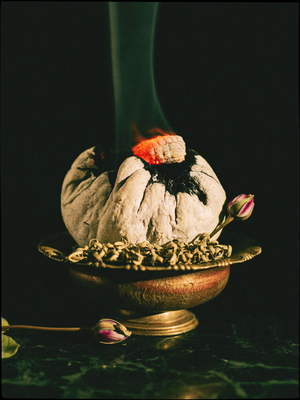
Smoke. Burning aromatic plants to purify is close to universal: frankincense in churches, juniper in the Scottish Highlands, rosemary around the Mediterranean. "Smudging" is narrower than it is usually used. It names ceremonies of specific Native American and First Nations peoples, with their own plants, prayers and protocol. Burning a herb bundle in your apartment is smoke cleansing, and that is the more accurate name.
The main methods compared
| Method | Best for | What you need | Watch out for |
|---|---|---|---|
| Salt bath or wash | Yourself, after a hard day, a visit, a breakup | Salt, water, optionally rosemary or bay | Broken or irritated skin; strong essential oils in bath water |
| Smoke | Rooms, objects that cannot get wet | Dried herb or resin, a fireproof dish, open windows | Asthma, pets, birds, smoke alarms, unattended embers |
| Spray or sprinkled water | Shared homes, offices, anyone who cannot use smoke | Water with salt, or Florida Water; a sprig of herb | Alcohol-based waters on wood finishes and near flame |
| Egg or herb sweep | A person, when the trouble feels attached to the body | A raw egg or a bundle of fresh herbs | Reading the egg as a diagnosis; it is not one |
| Sound | Corners, closets, stale rooms | A bell, or your hands | Nothing; it is the safest method there is |
Each of these has its own detailed guide here: the spiritual bath, smoke or spray for a room, and seven ways to cleanse your aura side by side. This page is the map.
Does spiritual cleansing work? What the research can and cannot tell you
Nobody has run a controlled trial of a limpia or a salt bath against bad luck, and nobody has measured a "negative energy" leaving a room. What psychologists have studied is the narrower question underneath: does physically washing change how people feel about something that just happened?
The famous starting point is a 2006 paper in Science by Chen-Bo Zhong and Katie Liljenquist, "Washing Away Your Sins". Across four studies, people who had recalled or copied out an unethical act showed more interest in cleaning products, and people who cleaned their hands afterwards were less inclined to make amends by volunteering. The authors called it the Macbeth effect.
It did not hold up cleanly. In 2014, Brian Earp and colleagues ran direct replications of one of those studies with 595 participants in the United Kingdom, the United States and India and found no effect in any sample. A 2018 meta-analysis of 15 studies by Jedidiah Siev and colleagues put the overall effect at small (g = 0.17) and at statistically indistinguishable from zero in laboratories independent of the original authors (g = 0.07).
In 2021, Spike Lee and Norbert Schwarz reviewed the cleansing experiments in Behavioral and Brain Sciences and argued that the effects are not really about morality. Their proposal is that washing works as a physical act of separation: it weakens the hold of whatever came just before, good or bad, and it does so more strongly the more the body is actually involved. Other researchers replied in the same issue that the evidence for cleansing effects is still not robust.
So the fair summary is this. There is contested, modest evidence that a physical act of cleaning can help a person feel that a previous event is behind them. There is no evidence that it removes anything outside the person. Whether there is something outside the person to remove is a matter of tradition and belief.
In practice: a cleansing should be physical, done with your own body, and clearly finished.

When you would rather not carry this one yourself
Most cleansings are best done by you, and the one below costs almost nothing. When the matter is heavy, you are worn out, or you have no private space, Ritual by a Master's Hand is the service where Leif Daniel plans and performs the ritual for you at his own altar. You book, then answer his questions in your own words. He chooses the approach, the materials and the timing for your case and performs the complete working himself. Afterwards you receive a written PDF report of what was done, when and why, plus a personal voice message from him. The price is fixed before you start and nothing is added later. He does not promise a specific outcome, and a ritual does not replace medical, psychological or legal help.
$397, one time: performed by a named person, documented in writing, no outcome promised
See how Ritual by a Master's Hand worksA simple spiritual cleansing you can do tonight
This is a full cleansing of yourself and your home using things you already own. It takes about thirty minutes. Do the home first and yourself last.
For a room-by-room smoke route instead, see how to smudge your house.
You need: a bowl of water, a tablespoon of salt, a sprig of rosemary or a few bay leaves (fresh or dried, or nothing at all), and a broom or a cloth.
- Name it. Say out loud, in one sentence, what you are clearing and why. "I am clearing this home of the last three months."
- Open a window. In every room if you can, one if you cannot. Something has to have a way out.
- Clean first. Take out the trash, clear one surface, sweep the floor toward the front door.
- Make the water. Stir the salt into the bowl. Add the rosemary or bay if you have it. Say what the water is for.
- Walk the home. Start at the room farthest from the front door. Dip your fingers or the herb sprig and flick a little water into each corner, then across each doorway. Work toward the front door. Clap or ring a bell in closets and corners where the air sits still.
- Finish at the door. Sprinkle the threshold, open the door, pour the remaining water outside or down a drain, and say: "It is done. What was here has gone."
- Wash yourself. Shower. At the end, rub a handful of salt over your arms, shoulders and the back of your neck and rinse it off from the head down. Put on clean clothes.
- Close it. Shut the windows. Eat something or make tea. Then leave it alone: do not go back over rooms to check whether it worked.
If you use smoke: sage, safety and better choices
Two things about smoke are worth knowing before you buy a bundle.
Smoke is smoke. A U.S. Environmental Protection Agency review of candles and incense states plainly that burning them can be a source of indoor particulate matter and that exposure to incense smoke has been linked with several illnesses. Skip smoke around anyone with asthma or other lung trouble, around babies, and around pet birds, which are especially sensitive to airborne irritants. Use spray, sound or water there.
White sage has a supply problem. Salvia apiana grows wild only in southern California and northwestern Mexico. United Plant Savers lists it as an at-risk plant, notes that it has no federal or state protection in the United States, and asks buyers to look for cultivated sources over wild-harvested ones. It is also a ceremonial plant for Native peoples of that region. You do not need it: rosemary, garden sage, bay, juniper and lavender have long histories of their own as cleansing smoke, and a single dried bay leaf burned in a dish is enough for a room.
"Spiritual cleansing near me": what you will actually find
Here is what that search tends to return.
- Botánicas. Neighborhood shops in Latino communities selling candles, herbs, baths and waters. Many have a healer on site or can refer you to one.
- Curanderas and curanderos. Traditional healers who perform limpias, usually found by word of mouth.
- Rootworkers and conjure practitioners. Workers in the hoodoo tradition who prescribe baths, washes and candle work. Reputable ones publish their prices.
- Clergy. A priest, pastor, rabbi or imam will often bless a home at no charge if you belong to that faith.
- Storefront psychics. The neon "Psychic Readings $10" sign. Some are harmless. This is also where the cleansing fraud described below most often begins.
Laws on paid spiritual services differ by state and city. The same checks apply everywhere: a real name, a price stated before the work, a description of what will be done, no diagnosis you did not ask for, and no pressure to decide today. Our guide on how to tell if a practitioner is any good goes through them in detail.
What a remote cleansing is
If nobody suitable is nearby, you will be offered cleansing at a distance. A person cannot be washed or smoked from another city. In a remote working, the practitioner performs a ritual on your behalf at their own altar, using your name, your situation and sometimes a photograph. Traditions that work this way hold that ritual does not depend on physical closeness. That is a belief, not a measured fact, and an honest practitioner will say so.
What you can verify in a remote working is the work itself: who did it, on what date, with which materials and words, and what they observed. If all you get back is the word "done" or one photograph of a candle, you have no way of knowing whether anything happened. A remote cleansing also does not replace the physical one at home, which stays with you. We describe the whole process in what to expect when a ritual is performed for you.
The cleansing scam, step by step
"Cleansing" is the single most common word in fortune-telling fraud, because it is the bridge between a cheap reading and an open-ended bill.
- A cheap or free reading. Its purpose is to learn what you are afraid of.
- An unrequested diagnosis. There is a curse, a dark attachment or generational negativity on you, your money or your family. You did not ask.
- A demonstration. Sometimes a prop is used to prove it: an egg cracked open to show something dark inside, water that changes color. These are stage tricks.
- A cleansing with a price. A few hundred dollars for candles and "materials".
- Escalation. The first cleansing was not enough. The curse is deeper.
- The money itself must be cleansed. You are told your cash, jewelry or gift cards are tainted and must be handed over to be purified, and will be returned when the work is finished. They are not returned, and you are told that telling your family or bank will break the work.
This is documented in court records. In 2008 the Santa Clara County District Attorney in California announced the sentencing of a woman who had persuaded a victim that she was cursed and needed spiritual cleansing, and had taken $108,000 in cash and gift cards. In September 2013 a federal jury in Florida convicted Rose Marks on all fourteen counts in a scheme that, according to the Department of Justice, took about $25 million from more than twenty victims. Prosecutors described how the defendants claimed they could remove curses or negativity from victims' lives and promised to return their money and valuables when the "work" was completed, then deposited the funds into accounts they controlled.
The rule that follows is short. A legitimate cleansing has a fixed price, a described scope and an end. It never requires you to hand over money or valuables for safekeeping or purification, and it is never the answer to a curse somebody else discovered on you. If you are already in a situation like this, stop paying, keep every message and receipt, tell your bank or card issuer, and report it to your local police and at ReportFraud.ftc.gov. We list twelve warning signs in how to spot a fake spell caster, and if the fear of a curse is what is driving you, start with how to know if you are cursed.
How often, and how to tell whether you need one
There is no test for whether a person or a house needs cleansing. Lists of "signs you need a spiritual cleansing" (tiredness, bad dreams, arguments) describe ordinary life. Be suspicious of any list that ends in a booking button.
Tradition ties cleansing to occasions instead:
- after an illness, a death or a funeral
- after a breakup, or when someone moves out
- when you move into a new home, before you unpack
- after a serious argument or an unwelcome visit
- before other ritual work, so that you start clear
Nothing shows that more frequent cleansing does more. We have separate guides for a home after a breakup and after a death in the family.
When a cleansing is the wrong tool
A cleansing marks a break. It does not fix causes, and some causes need something else first.
- Headaches, dizziness or nausea that ease when you leave the house. Check your carbon monoxide alarm and have the heating looked at before anything else. If an alarm sounds or several people feel ill at once, get outside and call 911.
- Weeks of low mood, dread, exhaustion or poor sleep. See a doctor or a therapist. A ritual can sit alongside care and cannot stand in for it. If you are in crisis, call or text 988 in the United States.
- Cleansing that you cannot stop. If you feel contaminated again within hours, repeat washes or rituals many times a day, or feel unable to rest until you have done them, more cleansing is feeding the problem. That pattern is something a mental health professional can help with.
- A person who frightens you. Salt on the threshold does not keep out someone with a key. The National Domestic Violence Hotline is 1-800-799-7233.
What we do not promise
Temple of Desire is a family business run by Leif Daniel and his wife Julia, under their real names. We sell ritual work, so here is the plain version. A cleansing, ours or anyone's, has not been shown to remove curses, spirits or bad luck. It does not treat any illness. It will not bring a person back, settle a court case or change another person's mind. What it can be is a clear, deliberate ending that you take part in. Start with the salt and the open window. If the matter is heavier than that, having it performed for you is an option, at a fixed price and with a written report, never with a promised result.
Frequently asked questions
What is a spiritual cleansing?
A spiritual cleansing is a ritual that removes what you feel is clinging to a person, a home or an object, using water, salt, smoke, sound or prayer, and marks a clear ending. Versions exist in nearly every culture, from Shinto misogi to the Mexican limpia and the hoodoo spiritual bath.
How do I do a spiritual cleansing myself?
Say in one sentence what you are clearing, open a window, tidy and sweep toward the front door, then walk the home from the back to the front sprinkling salt water in corners and doorways. Pour the rest outside, shower, rinse with a handful of salt from the head down and put on clean clothes. It takes about thirty minutes.
Does spiritual cleansing really work?
No study has shown that a cleansing removes spirits, curses or negative energy. Psychology experiments on washing suggest that a physical act of cleaning can help people feel separated from a previous event, but replications have been mixed and the effect is small. Treat a cleansing as a deliberate ending you take part in, not as a cure.
How much does a spiritual cleansing cost?
Doing it yourself costs the price of salt. Practitioners charge anything from a donation to a few hundred dollars, and prices vary widely by tradition and region. The amount matters less than the structure: a fixed price stated up front for described work is normal. A price that grows as new curses are found is the pattern of a known fraud.
Can a spiritual cleansing be done remotely?
A practitioner can perform a cleansing ritual on your behalf at a distance, using your name and situation. That it reaches you is a traditional belief and has not been demonstrated. What you can check is the documentation: who performed it, when, with what materials, and what they observed. The physical washing and clearing at home still has to be done by you.
Sources & further reading
- Zhong, C.-B. & Liljenquist, K.: "Washing Away Your Sins: Threatened Morality and Physical Cleansing", Science 313(5792), 1451 to 1452, 2006
- Earp, B. D., Everett, J. A. C., Madva, E. N. & Hamlin, J. K.: "Out, Damned Spot: Can the 'Macbeth Effect' Be Replicated?", Basic and Applied Social Psychology 36, 91 to 98, 2014
- Siev, J., Zuckerman, S. E. & Siev, J. J.: "The Relationship Between Immorality and Cleansing: A Meta-Analysis of the Macbeth Effect", Social Psychology 49(5), 2018
- Lee, S. W. S. & Schwarz, N.: "Grounded Procedures: A Proximate Mechanism for the Psychology of Cleansing and Other Physical Actions", Behavioral and Brain Sciences 44, e1, 2021
- U.S. Environmental Protection Agency: "Candles and Incense as Potential Sources of Indoor Air Pollution: Market Analysis and Literature Review", EPA/600/R-01/001, 2001
- United Plant Savers: "White Sage (Salvia apiana)", species at-risk profile
- Office of the District Attorney, County of Santa Clara: "Woman Sentenced for Duping Woman Out of $108,000 in Psychic Scam", December 9, 2008
- U.S. Attorney's Office, Southern District of Florida: "Jury Convicts Defendant in $25 Million Fraud Scheme", September 2013
- Leviticus 14; Numbers 19; Psalm 51:7
- Federal Trade Commission: ReportFraud.ftc.gov
- 988 Suicide & Crisis Lifeline: call or text 988 · National Domestic Violence Hotline: 1-800-799-7233
More from Anti-Scam
All stories →
Black Magic Removal: How Each Tradition Undoes It, and How to Spot the Fear Sale

