




Venus Retrograde 2026: Dates and What It Means


Roughly every eighteen months Venus appears to reverse for about six weeks. She is the rarest of the classical retrogrades and the one almost nobody sees coming. In 2026 the phase runs from October 3 to November 14 and carries her backwards out of Scorpio into Libra. Here are the dates, a clean separation of what the sky is doing from what the tradition claims, and an honest account of what you can expect.
Contents
Venus stations retrograde on October 3, 2026 at about 8 degrees 29 minutes of Scorpio and stations direct on November 14 at about 22 degrees 52 minutes of Libra, crossing back over the sign boundary around October 25; the wider shadow period runs from late August to mid-December. Some sources print November 13, which is a time-zone difference rather than a conflict. Nothing actually reverses: Venus orbits inside Earth's track and moves faster, so the apparent backward loop happens as she overtakes us around inferior conjunction, when she is closest to Earth. You can check it yourself -- she shows a large thin crescent in binoculars and switches from evening star in the west to morning star in the east. Venus retrogrades only about every eighteen months, making her the rarest classical retrograde. Her synodic period of roughly 584 days means five of them nearly equal eight years, so successive inferior conjunctions trace an almost-closed five-pointed figure; the Maya tracked this cycle in the Dresden Codex. Tradition reads the phase as review rather than initiation and advises against hard-to-reverse commitments, which is inherited guidance and not a measured effect.
Venus stations retrograde on October 3, 2026 at approximately 8 degrees 29 minutes of Scorpio and direct on November 14 at approximately 22 degrees 52 minutes of Libra.
Source/tradition: Ephemeris data for Venus 2026; the direct station falls near a date boundary, so some sources print November 13.
No planet reverses direction; retrograde motion is a line-of-sight effect, and for Venus it arises as she overtakes Earth on her faster inner orbit around inferior conjunction.
Source/tradition: Standard positional astronomy of the inferior planets.
During the retrograde Venus is near her closest approach to Earth and shows a large, thin crescent, and she switches from evening star to morning star across the phase.
Source/tradition: Phase geometry of Venus around inferior conjunction; observable with binoculars.
Venus goes retrograde only about every eighteen months for roughly forty days, making it the rarest of the classical retrogrades, while Mercury does so three times a year.
Source/tradition: Synodic period of Venus of about 583.92 days compared with that of Mercury.
Five Venus synodic periods (about 2,920 days) nearly equal eight tropical years (about 2,922 days), so successive inferior conjunctions trace an almost-closed five-pointed figure that drifts slowly.
Source/tradition: Orbital arithmetic of the Venus synodic cycle against the tropical year.
The Maya Dresden Codex contains a Venus table tracking the 584-day cycle with corrections against long-term drift.
Source/tradition: Venus table of the Dresden Codex; Maya naked-eye astronomy.
Venus retrograde is read as a period of return and review rather than initiation, with old contacts and unresolved questions resurfacing.
Source/tradition: Interpretive tradition of Western astrology, following from Venus as the planet of value and attachment.
Classical doctrine places Venus in exile in Scorpio and in domicile in Libra, so the 2026 loop is read as a movement from difficulty back to balance.
Source/tradition: Classical doctrine of domicile, exile and fall.
Astrological consulting practice advises against haircuts, tattoos, large aesthetic purchases and weddings during the retrograde.
Source/tradition: Standing advice within astrological consulting practice; widely repeated in contemporary popular astrology.
Venus retrograde causes former partners to return or relationships to end.
Source/tradition: No known physical mechanism; no better-than-chance results in studies of astrological prediction.
A haircut, tattoo or wedding held during Venus retrograde turns out worse than one held at another time.
Source/tradition: No evidence of any such connection has been produced.
VERIFIED = verifiable in scientific or official sources · TRADITIONAL = historically or culturally recorded · LIVED PRACTICE = widely practiced, experiential knowledge · NOT PROVEN = spiritual interpretation, not scientifically established.
The dates at a glance
Venus stations retrograde on Saturday, October 3, 2026 at roughly 8 degrees 29 minutes of Scorpio. She stations direct again on Saturday, November 14, 2026 at about 22 degrees 52 minutes of Libra. Between those two points lie about six weeks.
You will see November 13 printed in some places instead of the 14th. That is a time-zone artifact, not a disagreement: the station falls close to the date boundary, so sources computed for different zones land on different calendar days. If it matters to you, treat the turn as the night of the 13th into the 14th and stop worrying about the hour.
Two dates inside the phase are worth knowing. Around October 25 Venus crosses back over the sign boundary from Scorpio into Libra — in classical doctrine, back into one of the two signs she rules. And the phase ends on November 14 in a sign where Venus is at home, not the one where she began.
If you want the wider loop, count the shadow: Venus enters the stretch of sky she will cover three times at the end of August 2026, and does not clear it until the middle of December. For most people, though, the part you notice starts on October 3.
What is actually happening up there
No planet moves backwards. What we see is a perspective effect — and with Venus it is built slightly differently than with Saturn or Jupiter.
Venus orbits inside Earth's track and moves faster than we do. Her retrograde is not caused by us overtaking her; it is caused by her overtaking us, sweeping past on the inside lane. That happens right around inferior conjunction, when Venus passes between Earth and the Sun and is closer to us than at any other time.
Two consequences you can check yourself. First, because she is unusually close, a pair of binoculars will show Venus as a large but very thin crescent — like a young crescent moon in miniature. Second, she changes sides of the sky. Before the phase she is the evening star in the west after sunset; afterwards she is the morning star in the east before dawn. Compare the weeks either side and you are looking at the same planet at a completely different hour, from the opposite horizon.
That orbital geometry is also why the phase is rare. Mercury turns retrograde three times a year; Venus does it about every eighteen months and then for roughly forty days. If you are noticing one for the first time, there is a fair chance you will not meet another for a while.
The five-petalled figure — and why the Maya were watching
Here is the part of Venus that is genuinely remarkable, and it has nothing to do with interpretation.
Venus's synodic period — the time from one inferior conjunction to the next — is about 583.92 days. Five of those come to roughly 2,920 days. Eight tropical years come to about 2,922. The two very nearly match. Which means that if you mark where in the zodiac each inferior conjunction happens and join the points, five conjunctions later you are almost back where you started, and the figure you have drawn is a five-pointed star. Almost, but not quite: the pattern drifts by a couple of days each cycle, so it slowly rotates rather than closing perfectly.
This is not mysticism, it is orbital arithmetic, and it is the reason Venus and the number five have been tied together across a lot of unrelated cultures. It is also why the eight-year Venus rhythm shows up in calendars that had no contact with each other.
The most impressive of those was in the Americas. The Maya Dresden Codex contains a Venus table that tracks the 584-day cycle and includes corrections to keep it from drifting out of step over long spans — a piece of naked-eye astronomy done without lenses, and accurate enough that modern astronomers use it to check historical dating. Whatever you make of astrology, the observational tradition behind Venus's cycle is real, old and very good.
From the temple

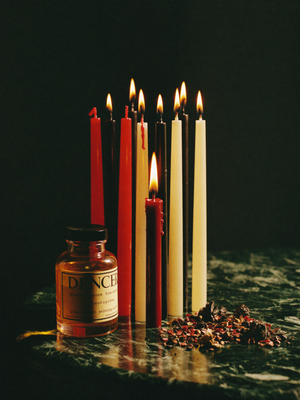
Scorpio Zodiac Spell Candle — $22.95
Venus turns back at 8 degrees of Scorpio and spends the first three weeks of the phase there — the part of the loop the tradition treats as the honest, uncomfortable half. If you want an object to sit with while you write down what is actually unresolved, this is what we use. Not to make anything happen. To mark that you sat down.
See the Scorpio candleWhat the tradition assigns to this phase
In classical astrology Venus stands for value and attachment — for what means something to us, and what we are willing to pay for it, in money and in attention. That the retrograde has always been read as a period of review follows directly from that.
What the tradition attributes to these weeks:
- Return rather than beginning. Old contacts resurface, unfinished questions in relationships come up, things you thought were settled are back on the table.
- Testing what things are worth. Not only in relationships — also what your work, your time and your possessions are actually worth to you.
- Caution with appearances. Consulting practice traditionally advises against big aesthetic commitments during these weeks, from the dramatic haircut to the expensive sofa.
- Not a wedding window. Classical doctrine does not regard the retrograde as a favorable time to formally seal a bond.
The 2026 sign sequence gets read on top of that: beginning in Scorpio, where Venus is held to be in exile, and ending in Libra, where she is at home. The tradition reads that as a movement out of difficult depths and back toward balance. What is at least notable is that the phase ends in her own sign rather than the one it started in.
All of these attributions are — and this belongs here rather than in a footnote — inherited. They are a stable, old, internally coherent body of astrological teaching. They are not a measurement.
About the haircut rule
This one deserves its own section, because it is the piece of Venus retrograde advice that travels furthest and gets stated most confidently. You will see it presented as a hard rule: do not cut your hair, do not get a tattoo, do not buy furniture, do not get engaged.
Two things are true at once. There is no evidence that a planetary position affects how a haircut turns out, and nobody has ever produced any. And the advice has a perfectly sane core that survives without the astrology: in a stretch of time when your own taste is in motion — when you are actively re-examining what you like and what you want — hard-to-reverse decisions about appearance tend not to age well. That is a statement about you, not about Venus.
So the honest version is: if you can easily postpone something irreversible, there is no cost to postponing it, and the tradition gives you a tidy reason to. If you cannot, go ahead. Nothing is coming for you. And if your wedding falls in October, get married; the sky has no opinion about it.
Why your sun sign is the wrong question here
The most common disappointment with transit articles happens right at this point, so let us be blunt: whether and how this phase touches you is not decided by your star sign.
Venus travels between roughly 8 degrees of Scorpio and 23 degrees of Libra. Whether that means anything for you depends on which house of your birth chart occupies that stretch and which of your own planets sit there. Two people with the same sun sign can have completely different six weeks — and one of them can have nothing at all.
Anyone who has experienced a Venus retrograde as unusually intense almost always finds the reason exactly there: a personal point that Venus passed over three times. Anyone who has never noticed one simply has nothing in that stretch of their chart. Both are normal.
What we don't promise
We do not promise you that anyone will come back. The idea of the phase as a period of return is old and internally coherent, but it is an interpretive tradition, not a forecast. If someone gets in touch, they have their own reasons.
We do not promise that planetary positions cause events. No physical mechanism is known, and studies of the hit rate of astrological statements have not produced better-than-chance results.
We do not advise you to postpone decisions that are actually due. If you have to resign, sign or move in during these weeks, do it. The tradition's recommendation is to look more closely — not to put your life on hold.
And we make no claims about health, fertility or finances. Those questions belong with a doctor, a lawyer or a financial professional, not with a transit.
How to actually use it
Write three sentences on October 3. What is open right now — in relationships, in money, in self-worth. Put the paper away. Take it out again on November 14. That single act turns a vague stretch of time into something you can actually check.
Answer slower than usual. If someone resurfaces, reply a day later than your impulse wants to. This is the most practically useful part of the whole tradition, regardless of whether you share its model.
Postpone the aesthetic stuff you can postpone. The big haircut, the couch, the tattoo. Not because something will go wrong, but for the reason given above.
Use October 25 as a halfway mark. From there Venus moves in her own sign. If you want to give the phase a structure, that is the natural midpoint.
And look east, not just inward. After inferior conjunction Venus reappears as the morning star. Finding her again deliberately is the loveliest part of these six weeks — and the only part you can verify yourself.
Frequently asked questions
When exactly is Venus retrograde in 2026?
Venus stations retrograde on October 3, 2026 at about 8 degrees 29 minutes of Scorpio, and stations direct on November 14, 2026 at about 22 degrees 52 minutes of Libra. Around October 25 she crosses back over the sign boundary from Scorpio into Libra. The wider shadow period runs from late August to mid-December 2026. Some sources print November 13 for the direct station; that is a time-zone difference, not a conflict.
How often does Venus go retrograde?
About every eighteen months, and then for roughly forty days. That makes her the rarest of the classical retrogrades — Mercury turns retrograde three times a year. The phase always coincides with inferior conjunction, when Venus is closest to Earth.
Does Venus really move backwards?
No. It is a perspective effect. Unlike the outer planets, it is not caused by Earth overtaking the planet but by Venus passing Earth on her inner, faster orbit. You can see the evidence yourself: before the phase Venus is the evening star in the west, and afterwards she appears as the morning star in the east.
Should you really avoid haircuts and weddings during Venus retrograde?
That is an inherited recommendation from astrological consulting practice, not a demonstrated connection. Its sensible core is to avoid hard-to-reverse commitments during a stretch when your own taste is in motion. If a date is already set and you cannot or do not want to move it, there is no established reason to cancel.
Does this affect me if I'm a Libra or Scorpio?
Not automatically. What matters is not your sun sign but which house of your birth chart falls between roughly 8 degrees Scorpio and 23 degrees Libra, and which of your planets sit there. Two people with the same star sign can experience these six weeks completely differently. Working that out needs a birth date, time and place.
Why is Venus associated with the five-pointed star?
Because of orbital arithmetic. Venus's synodic period is about 583.92 days, and five of those very nearly equal eight tropical years. If you plot where each inferior conjunction falls in the zodiac and connect them, five conjunctions trace an almost-closed five-pointed figure that drifts slowly over time. It is a real pattern in the sky, not a symbolic invention.
Sources & further reading
- Ephemeris data for Venus in 2026: station retrograde October 3 at approximately 8°29′ Scorpio; station direct November 14 at approximately 22°52′ Libra; retrograde re-entry into Libra around October 25.
- Celestial mechanics of the inferior planets: apparent retrograde motion around inferior conjunction, thin crescent phase at closest approach, transition from evening star to morning star.
- Synodic period of Venus, approximately 583.92 days; five synodic periods (about 2,920 days) approximate eight tropical years (about 2,922 days), producing the near-closed five-pointed pattern of inferior conjunctions.
- Maya Venus table in the Dresden Codex tracking the 584-day Venus cycle, including correction schemes to prevent long-term drift.
- Classical doctrine of domicile, exile and fall: Libra and Taurus as Venus's rulerships, Scorpio as her exile.
- On the limits: no known physical mechanism, and no better-than-chance results in studies of astrological interpretation.
- Further reading: What retrograde actually means · Mercury retrograde 2026 dates · How to work a new moon
More from Astrology & Zodiac
All stories →
NOAA Issues G1 Geomagnetic Storm Watch for October 2: Auroras Possible Across the Northern U.S.

Jupiter Retrograde 2026 and 2027: Dates, Degrees and the Shadow Period