




999 Angel Number: Endings and Completion


Most angel numbers are read as beginnings. The 999 is the one that speaks about endings — and that is exactly where its force comes from. In a practice that leans heavily toward manifestation and arrival, here is a sequence whose entire message is that something has finished.
Contents
In spiritual numerology 999 is read as the number of completion: a relationship, a job, a belief or a whole phase has reached its end point. The core message is fulfilment rather than loss, meaning what there was to learn has been learned. Nine is the last single digit and carries wisdom and completion; the digit sum 9+9+9 = 27 and 2+7 = 9 folds back to nine. In love it marks the close of a chapter or a confining pattern; on the twin flame path, the end of an intense separation phase, with the outcome left open. Angel numbers have no measured predictive power.
Nine is the last of the single digits in the base-ten system.
Source/tradition: Arithmetic.
Any whole multiple of nine has digits that sum back to nine.
Source/tradition: Property of base-ten arithmetic.
The digit sum of 999 is nine: 9+9+9 = 27, and 2+7 = 9.
Source/tradition: Arithmetic; anyone can check it.
999 is the emergency telephone number in the United Kingdom and Ireland, as 911 is in the United States.
Source/tradition: National emergency number allocations.
Nine carries wisdom, compassion and the completion of a cycle in Western numerology.
Source/tradition: Western numerology.
Naming an ending aloud, listing what it gave and cost, and taking one irreversible small action is a common closing practice.
Source/tradition: Contemporary ritual practice.
Seeing 999 indicates that a specific chapter of a person's life is ending.
Source/tradition: No evidence; the practice is interpretive, not predictive.
VERIFIED = verifiable in scientific or official sources · TRADITIONAL = historically or culturally recorded · LIVED PRACTICE = widely practiced, experiential knowledge · NOT PROVEN = spiritual interpretation, not scientifically established.
Read carelessly, that sounds like bad news. Read properly, it is the opposite. The tradition does not treat 999 as loss. It treats it as ripeness: a chapter that has delivered what it had to deliver, and can now be set down without anything having gone wrong.
Quick answer
In spiritual numerology 999 is read as the number of completion: a relationship, a job, a belief or a whole phase of life has reached its end point. The core message is not loss but fulfillment — what there was to learn has been learned, and room is opening for what comes next. Nine is the last of the single digits and carries wisdom, compassion and completion; the digit sum 9+9+9 = 27 and 2+7 = 9 folds back to nine and doubles down on the theme. In love, 999 is read as the close of a chapter or of a confining pattern; on the twin flame path, as the end of an intense separation phase, with the outcome left genuinely open between reunion and a peaceful parting. The practical instruction is unusually concrete for an angel number: finish something. Angel numbers are an interpretive practice with no measured predictive power.
Why nine carries endings
Nine is the last single digit. After it, the system runs out of new symbols and starts combining old ones. That structural position is where the entire meaning comes from: nine is the number that stands at the edge of the count, holding everything that came before it.
There is a piece of arithmetic that makes the point better than any symbolism. Multiply any whole number by nine and the digits of the result add back to nine. Nine times four is 36, and 3+6 = 9. Nine times seven is 63, and 6+3 = 9. Nine times 158 is 1,422, and 1+4+2+2 = 9. It never fails, for any whole number, because of how base-ten arithmetic works.
Numerologists have made a great deal of this, and for once the enthusiasm is aimed at something real. Nine absorbs whatever it touches and returns itself. As a symbol for the end of a cycle — the phase that takes in everything that happened and gives back a single settled thing — it is difficult to improve on.
Tripled, the tradition reads it as that quality at full volume. And the digit sum keeps the message from drifting: 9+9+9 is 27, and 2+7 returns to nine. The sequence loops back to itself rather than resolving into something new, which practitioners read as an ending that is genuinely an ending, not a transition into a disguised version of the same thing.
A note for American readers
If you have spent time on British spiritual forums you will have run into a joke that does not travel: in the UK and Ireland, 999 is the emergency number, the way 911 is in the United States. British practitioners have to write past a hard-wired association with ambulances that Americans simply do not carry.
The reverse is worth knowing too. For US readers 999 arrives comparatively clean — no emergency reflex, no cultural dread of the sort 666 carries. Whatever you make of it, you are meeting this one without much interference.
What the number is asking
The practice puts the emphasis on a distinction that is easy to state and hard to live: the difference between something that has ended and something that has failed. The tradition assigns 999 firmly to the first category.
| Something has failed | Something has completed |
|---|---|
| You want to go back and do it correctly | You would not repeat it, and you are not sorry it happened |
| The story still has a defensive edge | You can tell it plainly, including your own part |
| Ending it feels like giving up | Continuing it feels like going through the motions |
| There is one more thing to try | The remaining options are all variations on staying |
Most of what people call an ending is really the long refusal to have one. The right-hand column is the one the number is pointing at.
A marker for a cycle that has run out
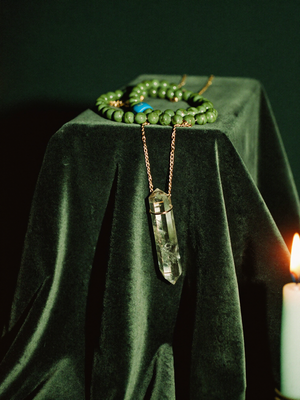
Traditional practice for closing work leans on objects that count — beads, knots, anything that makes a round and then stops. A mala is the plainest form of it: 108 beads, one round, a finish you can feel with your hands rather than decide about in your head.
Black Onyx, Rose Quartz & Labradorite Mala is the one our readers pick up for this kind of work — a 108-bead strand combining a grounding stone, a softening one and one associated with transition. Used for closing work, the point is simply the round: you start, you go all the way around, you stop. No mala completes anything for you; it gives the decision a shape and an end.
999 in love, work and the twin flame path
In relationships
Read as the close of a chapter — which is not automatically the close of the relationship. Long partnerships contain several endings: the end of the version that needed constant proving, the end of the arrangement that suited who you both were five years ago. The tradition reads 999 as a prompt to ask which chapter has finished, and whether the two of you are still living inside a structure that stopped fitting some time ago.
At work
The characteristic 999 situation at work is not the job you hate. It is the job you are actually good at, that no longer asks anything of you. Competence without stretch reads as comfort from the inside and as stalling from the outside. The number is read as a prompt to name what you have already learned here, and to be honest about whether the learning stopped a while ago.
For twin flames
Within twin flame practice 999 is read as the end of an intense separation or refining phase. Crucially, the tradition leaves the outcome open: completion of the phase, not a promise about the result. It may resolve toward reunion. It may resolve toward a settled, unresentful parting. Any source that reads 999 as a promised reunion signal has added something the number does not carry.
A closing practice
This one is deliberately short. The failure mode with endings is not insufficient ceremony — it is endless preparation for a ceremony that never happens.
- Name the thing in one sentence, out loud. "The version of this friendship where I do all the reaching out is over." Specific and finite. If it takes a paragraph, you have not found it yet.
- Write down what it gave you. Three things, honestly. This is the step that separates completion from resentment, and it is the one people skip.
- Write down what it cost. Also three. Skipping this one produces nostalgia instead of closure.
- Do one irreversible small thing. Archive the folder, return the key, cancel the standing invitation, delete the draft you keep rewriting. Small, real, and hard to undo by Thursday.
- Leave the next chapter blank on purpose. The strong temptation is to fill the gap immediately so it never becomes a gap. Endings only work if something is allowed to be empty for a while.
Honest limits
There is no evidence that repeated numbers convey information about the future, and there is a well-understood reason a sequence appears to multiply after you notice it: the frequency illusion, in which newly salient information seems suddenly ubiquitous. The change is in your attention.
Nor should 999 be treated as instruction. A number cannot know whether your marriage is finished or whether you are tired and it is February. The honest use is as a prompt: it gets the question asked, and the question is a good one. The answer has to come from evidence about your actual life.
One practical caution. If the ending being contemplated is a large one — a marriage, a career, a move away from your support network — that is worth thinking through with a person, not a number. And if what you are feeling is less "this chapter is complete" than a flat, persistent hopelessness, that is a different thing entirely and worth raising with a doctor or therapist.
Why endings are the part people skip
There is a structural reason completion gets so little attention in modern spiritual practice, and it is worth naming. Almost everything in the manifestation vocabulary is addition — calling in, attracting, drawing toward, opening to. The verbs all point one direction. A practice built almost entirely on acquisition has very little grammar for putting something down.
The result is a familiar shape: people accumulate intentions the way they accumulate browser tabs. Each was reasonable when opened. None was ever formally closed. And because nothing was closed, the sense of being behind never resolves, no matter how much gets added.
This is where a number that means finished earns its place. Not as prophecy, but as a counterweight in a vocabulary that badly needs one. The nine is the only part of the sequence that gives you permission to subtract.
The difference between closing and quitting
The objection people raise about endings is that they look identical to giving up from the outside, and sometimes from the inside too. The tradition's distinction is about direction rather than difficulty.
Quitting is leaving to escape the discomfort of the thing. Closing is leaving because the thing has delivered and continuing would only be maintenance. The test is not how hard it feels — both are hard — but what you imagine on the other side. If the picture is mostly relief, that is usually an escape. If the picture has something specific in it that you cannot start while this continues, that is usually a completion.
Neither answer is disqualifying. Plenty of things are worth quitting. It is simply useful to know which one you are doing, because they need different conversations afterward.
Worth adding: completion rarely announces itself. It usually shows up as a slow loss of interest in defending something, and it is easy to mistake that quiet for indifference when it is actually the ending already underway.
Related reading
- Angel numbers, explained — the structure behind the whole system
- 666 angel number — whose digit sum points here
- 111 angel number — the beginning at the other end of the cycle
- Cord cutting ritual — when the ending needs more than a sentence
Common questions
Does 999 mean someone is going to leave?
No. It is read as the completion of a phase, and phases end inside relationships as often as they end them. Nothing in the number specifies who or what.
Why does 999 reduce back to 9?
Because 9+9+9 = 27 and 2+7 = 9. This is a general property of nine in base ten: any multiple of nine has digits summing to nine.
Is 999 connected to 9/9?
Some practitioners treat September 9 as a 999 date and use it for closing work. That is a calendar convention rather than anything inherent in the number, but it is a perfectly serviceable excuse to sit down and finish something.
What if I see 999 and nothing in my life is ending?
Then nothing is ending. The practice is a prompt, not a diagnosis, and "I checked and everything is fine" is a legitimate outcome.
Is 999 a warning?
It is not read as a warning. The tradition treats it as a marker of ripeness, meaning a phase has delivered what it had to deliver, and reads the ending as an outcome rather than a threat.
What is the difference between 999 and 111?
They sit at opposite ends of the same cycle. The 111 is read as a beginning and the 999 as a completion, which is why practitioners often treat seeing both in a short span as one cycle closing while another opens.