






Akashic Records: Origin and Meaning
Akasha is Sanskrit for space, and it never meant a record. The archive was assembled by Theosophists in the 1880s and Americanised by Edgar Cayce. The full paper trail, and how to book a reading without getting hurt.


Contents
The Akashic Records are described as a complete cosmic archive of every soul’s thoughts, words and deeds. The Sanskrit word in the name is real and old: akasha is space or ether, one of the five classical elements. What it never means in those sources is a record. Nothing in the Sanskrit material describes akasha storing or replaying anything. The archive is a Victorian addition — the term was coined by Theosophists in the 1880s and reached America through Rudolf Steiner and then Edgar Cayce. The idea of a cosmic ledger is genuinely ancient. The Sanskrit label on it is about a hundred and forty years old.
Akasha is a Sanskrit term for space or ether and is one of the five classical elements in Indian thought.
In Nyaya-Vaisheshika philosophy akasha functions as the substrate of sound.
No classical Sanskrit source describes akasha as a record or archive, and there is no Sanskrit equivalent of the phrase Akashic Records.
H. P. Blavatsky wrote of indestructible tablets of the astral light in Isis Unveiled (1877) and The Secret Doctrine (1888) but did not use the term Akashic Records.
The compound term Akashic Records is credited to A. P. Sinnett, who drew on Olcott's Buddhist Catechism (1881) in Esoteric Buddhism (1883).
Rudolf Steiner published essays as From the Akasha Chronicle between 1904 and 1908, fixing the chronicle metaphor in German and then in English.
Edgar Cayce gave life readings from the 1920s in which he described reading a record, and around fourteen thousand were transcribed.
Linda Howe developed the Pathway Prayer Process in 2001; it is copyrighted and is the dominant taught access method today.
The image of a cosmic book of deeds appears independently in Hebrew scripture, Christian apocalyptic, Islamic tradition and Egyptian funerary texts.
A fixed opening, a defined question and a fixed closing do useful work in any divinatory practice by bounding the session.
The Akashic Records exist as an accessible archive of every soul's history.
A reading supplies information about the past or future that could not be arrived at otherwise.
Illness, poverty or a difficult relationship can be explained by what is written in the records.
Treating what surfaces in a reading as material about yourself, worth thinking about, rather than as information about the world.
Recording the session and rereading it a month later, when the atmosphere of the room has worn off.
VERIFIED = verifiable in scientific or official sources · TRADITIONAL = historically or culturally recorded · LIVED PRACTICE = widely practiced, experiential knowledge · NOT PROVEN = spiritual interpretation, not scientifically established.
Quick answer
The Akashic Records are described as a complete cosmic archive of every soul’s thoughts, words and deeds. The Sanskrit word in the name is real and old: akasha is space or ether, one of the five classical elements. What it never means in those sources is a record. Nothing in the Sanskrit material describes akasha storing or replaying anything. The archive is a Victorian addition — the term was coined by Theosophists in the 1880s and reached America through Rudolf Steiner and then Edgar Cayce. The idea of a cosmic ledger is genuinely ancient. The Sanskrit label on it is about a hundred and forty years old.
This is a piece about where a very popular practice actually comes from. It is not an argument that nobody should get a reading. It is the argument we keep making in this magazine: the practices are usually fine and the origin stories are usually wrong, and people who find that out later sometimes throw the whole thing away. Better to know which century you are standing in.
What akasha means in the language it comes from
In classical Indian thought akasha is one of the pancha bhuta, the five great elements: earth, water, fire, air and akasha. It is usually rendered as space, ether, or sky. In the Nyaya-Vaisheshika systems it has a specific technical job — it is the substrate in which sound occurs, the medium that makes hearing possible. In Vedantic material it stands for the subtlest and most pervasive of the elements.
None of those uses is archival. Akasha is not described as retaining an impression of what passes through it, and there is no Sanskrit term corresponding to Akashic Records. A practitioner who tells you the records are described in the Vedas is repeating something they were told. The concept arrived in English wearing a Sanskrit word, which is a different thing from arriving from India.
The nineteenth-century paper trail
Helena Blavatsky, who founded the Theosophical Society in New York in 1875, used akasha extensively and wrote in Isis Unveiled (1877) and The Secret Doctrine (1888) about the indestructible tablets of the astral light — a medium in which the past and even the future of human thought and action are recorded. The concept is fully there. The phrase is not: Blavatsky does not use Akashic Records.
The compound is credited to Alfred Percy Sinnett, a Theosophist and newspaper editor whose Esoteric Buddhism (1883) drew on Henry Steel Olcott’s Buddhist Catechism (1881) and brought the two halves — the Sanskrit element and the Western astral archive — together into a single readable idea. C. W. Leadbeater, in Clairvoyance (1899), then did the thing that made it a practice rather than a cosmology: he described reading the records as a trainable skill with stages, difficulties and beginner errors.
| When | Who | What they added |
|---|---|---|
| 1850s | Éliphas Lévi | The astral light as a universal medium retaining impressions — the archive, without the Sanskrit |
| 1877–1888 | H. P. Blavatsky | Akasha as a living force, plus the indestructible tablets of the astral light |
| 1883 | A. P. Sinnett | The compound term Akashic Records |
| 1899 | C. W. Leadbeater | Reading them recast as a trainable clairvoyant skill |
| 1904–1908 | Rudolf Steiner | From the Akasha Chronicle — the German Chronik fixes the archive metaphor |
| 1923 onward | Edgar Cayce | The American mass-market form: a personal file, read aloud, about your soul and your body |
| 2001 | Linda Howe | A fixed prayer protocol that made access teachable to beginners at scale |
The archive itself is genuinely ancient. That is the interesting part.
A cosmic register of deeds is one of the most widespread religious images there is. Exodus and the Psalms speak of a book in which days are written; Revelation has books opened at a judgement; Islamic tradition has the Lawh al-Mahfuz, the preserved tablet; Egyptian funerary texts weigh a life against a feather. What Theosophy did was take that very old image, detach it from judgement, and reattach it to a Sanskrit word for space. The result feels older than it is precisely because most of it is old — just not the Indian part.
 |
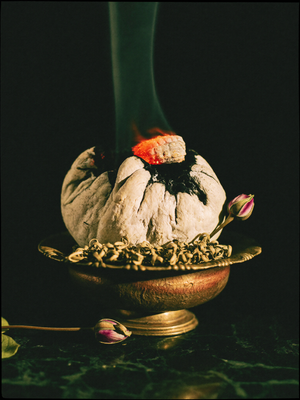
What we hold for this Saturn Cosmos Incense — Myrrh & Cypress for Saturday Myrrh and cypress, both old funerary resins, burned on the day named for the planet that has carried time, memory and consequence in Western astrology for two thousand years. If you are going to sit with the idea of a record of everything you have done, Saturn is the honest company to keep. It is a slow, dry, serious smoke. See the incense – $26.95 |
Cayce, and how the records became American
Edgar Cayce (1877–1945) is the reason this is a household idea in the United States rather than a Theosophical one. From the 1920s he gave what he called life readings, dictated in a self-induced sleep state, in which he described a subject’s past incarnations and the way those lives were shaping the present one. He said explicitly that he was reading a record. Around fourteen thousand of his readings were transcribed and preserved, which is unusual and genuinely valuable as a historical archive whatever one concludes about the source.
It also lets us do something rare in this territory: check. Where Cayce made statements about the physical world that could be tested — a date for the destruction of Atlantis, the discovery of a hall of records under the Sphinx, specific predictions about geological change in the twentieth century — the checkable ones did not come out. His health readings are harder to assess and the medical claims in them should not be acted on. This does not settle what the readings were. It does mean the record, if it is one, has not yet produced a verifiable fact that was not otherwise available.
How access is taught now
Almost every course you can book today descends from one method. Linda Howe developed the Pathway Prayer Process in 2001 and built a teaching centre around it, and it is now the dominant protocol: a fixed spoken opening that moves the reader into the record, a period of asking and receiving, and a fixed closing. The prayer text is copyrighted, so we describe it rather than reproduce it, which is the same policy we apply to any modern verse with an author.
Structurally the method is not exotic. A fixed opening and closing, a defined question, a state change, and a rule against wandering are the bones of most divinatory practice, and they do real psychological work regardless of what is being contacted — they mark a boundary, they slow the reader down, and they stop a session drifting into unbounded speculation. Those are the same reasons we recommend structure in preparing for a reading.
What a session can and cannot show
The material that comes out of an Akashic reading is typically biographical, emotional and thematic: a pattern you keep repeating, a relationship that feels older than it is, a fear with no obvious origin. It is usually recognisable, often moving, and almost never falsifiable. That is not an accusation. It is a description of what kind of statement it is.
The same problem we set out in past life regression applies here and applies more strongly, because there is not even a hypnotic state to argue about. A skilled reader, a receptive client and a rich symbolic vocabulary will reliably produce meaningful narrative. Meaningful narrative is what human beings produce. The sincerity of everyone involved is not in question and it is also not evidence.
A fair way to hold it
Treat what comes out of a reading the way you would treat a strong dream or a good therapy session: as material about you, generated with help, worth thinking about. Do not treat it as information about the world that you did not previously have. Almost everything valuable people report getting from these sessions survives that reframing intact.
If you are booking one
What a responsible practitioner does, and what should end the conversation
- Names a fixed price before the session and does not add to it afterwards. A reading that uncovers a problem only their extra service can fix is a sales structure, not a reading.
- Declines to give medical, psychiatric or legal direction, and says so unprompted. Anyone telling you what to do about a diagnosis or a prescription is out of their depth and into someone else's field.
- Answers the question you asked. Readings that drift into unsolicited warnings about a named person in your life are a red flag.
- Does not tell you the records show a curse, an entity or a block that requires payment to clear. This is the oldest structure in the trade and we cover it in detail in our piece on spotting a fake practitioner.
- Records the session or lets you record it. Anyone confident in what they are doing has no reason to refuse.
- Leaves you with something to do rather than something to fear. That is the whole difference between a useful reading and a harmful one.
If a reading tells you a relationship is karmically fated, read what we have written about karmic relationships before you act on it, and if it tells you an obligation was agreed before you were born, soul contracts covers where that idea came from too. Both concepts have the same nineteenth and twentieth-century paper trail as this one.
The line that matters
No reading of any kind should change your medical or psychiatric treatment. Do not stop a medication, delay a test, or decline a treatment because of something a reader told you, and be wary of any practitioner who frames illness as karmic debt. If a session leaves you frightened, destabilised or convinced something is deeply wrong with you, step away from the material and talk to someone qualified. In the US, the 988 Suicide and Crisis Lifeline handles mental-health crises of every kind, not only suicide.
Where each claim stands
| Claim | Standing |
|---|---|
| Akasha is a Sanskrit term for space or ether and is one of the five classical elements in Indian thought. | VERIFIED |
| In Nyaya-Vaisheshika philosophy akasha functions as the substrate of sound. | VERIFIED |
| No classical Sanskrit source describes akasha as a record or archive, and there is no Sanskrit equivalent of the phrase Akashic Records. | VERIFIED |
| H. P. Blavatsky wrote of indestructible tablets of the astral light in Isis Unveiled (1877) and The Secret Doctrine (1888) but did not use the term Akashic Records. | VERIFIED |
| The compound term Akashic Records is credited to A. P. Sinnett, who drew on Olcott's Buddhist Catechism (1881) in Esoteric Buddhism (1883). | VERIFIED |
| Rudolf Steiner published essays as From the Akasha Chronicle between 1904 and 1908, fixing the chronicle metaphor in German and then in English. | VERIFIED |
| Edgar Cayce gave life readings from the 1920s in which he described reading a record, and around fourteen thousand were transcribed. | VERIFIED |
| Linda Howe developed the Pathway Prayer Process in 2001; it is copyrighted and is the dominant taught access method today. | VERIFIED |
| The image of a cosmic book of deeds appears independently in Hebrew scripture, Christian apocalyptic, Islamic tradition and Egyptian funerary texts. | TRADITIONAL |
| A fixed opening, a defined question and a fixed closing do useful work in any divinatory practice by bounding the session. | TRADITIONAL |
| The Akashic Records exist as an accessible archive of every soul's history. | NOT PROVEN |
| A reading supplies information about the past or future that could not be arrived at otherwise. | NOT PROVEN |
| Illness, poverty or a difficult relationship can be explained by what is written in the records. | NOT PROVEN |
| Treating what surfaces in a reading as material about yourself, worth thinking about, rather than as information about the world. | LIVED PRACTICE |
| Recording the session and rereading it a month later, when the atmosphere of the room has worn off. | LIVED PRACTICE |
Frequently asked questions
Sources and further reading
- H. P. Blavatsky, Isis Unveiled (1877) and The Secret Doctrine (1888) — akasha and the tablets of the astral light.
- A. P. Sinnett, Esoteric Buddhism, 1883 — the earliest use of the compound term.
- C. W. Leadbeater, Clairvoyance, 1899 — reading the records as a trainable skill.
- Rudolf Steiner, Aus der Akasha-Chronik, essays 1904–1908.
- K. Paul Johnson and others on Theosophical source criticism; and the Edgar Cayce readings archive held by the Association for Research and Enlightenment.
- Éliphas Lévi, Dogme et rituel de la haute magie, 1854–1856 — the astral light as a retaining medium.