Do Solar Storms Affect Your Body? What Research Shows


Every few weeks the same headline moves through the feeds: a solar storm is hitting Earth. Then comes the second wave — headaches, palpitations, sleepless nights, all of it laid at the storm's door. This article separates what actually arrives from what gets blamed on it, why autumn is a genuinely special season for this, when you can realistically see aurora from the United States, and what the research on the body does and does not support.
Contents
A solar storm is several events, not one. Radiation from a flare reaches Earth in about eight minutes and disrupts shortwave radio; the slower coronal mass ejection takes one to three days and causes the geomagnetic storm itself. How severe that storm gets depends mainly on whether the magnetic field inside the arriving cloud points south, which lets it couple efficiently to Earth's field. Disturbance is measured on the Kp index from 0 to 9. As a rough guide for the Lower 48, aurora becomes possible along the northern border at about Kp 5, across the upper Midwest and New England at Kp 6, and into the mid-latitudes at Kp 7 and above. Strong storms cluster around the March and September equinoxes — the Russell-McPherron effect, documented since 1856. The effects on technology are established: currents induced in power grids and pipelines, degraded satellite navigation, disrupted shortwave radio. The limit: for effects on sleep, headache or heart rhythm the literature is weak and contradictory, and nothing about an individual case can be read off a Kp number. Persistent symptoms belong with a physician.
A solar storm comprises several processes: electromagnetic radiation from a flare arrives in about eight minutes, while the coronal mass ejection typically takes one to three days and triggers the geomagnetic storm on arrival.
Source/tradition: Standard space weather literature
The strength of a geomagnetic storm depends largely on the orientation of the magnetic field in the arriving cloud; a southward component couples efficiently to Earth's magnetic field.
Source/tradition: Magnetospheric physics; interplanetary magnetic field coupling
The Kp index runs from 0 to 9 and measures variation in Earth's magnetic field over three-hour windows; NOAA's Space Weather Prediction Center publishes it and the related G1 to G5 storm scale.
Source/tradition: NOAA Space Weather Prediction Center, Kp index and G-scale definitions
Geomagnetic activity is statistically elevated near the March and September equinoxes; this is explained by the Russell-McPherron effect, and the semiannual variation has been documented since 1856.
Source/tradition: Russell and McPherron; historical geomagnetic activity records
Solar Cycle 25 began in late 2019 and clearly exceeded NOAA and NASA forecasts: against an expected peak of roughly 115 sunspots, the monthly mean reached 216 in August 2024; activity has been declining since spring 2025.
Source/tradition: Observational data and forecasts for Solar Cycle 25
Geomagnetic storms induce currents in long conductors and can stress power grids, pipelines and rail systems, degrade satellite navigation and disrupt shortwave radio; the 1989 Quebec blackout and the 1859 Carrington event are the standard examples.
Source/tradition: Documented grid and communication disruptions from geomagnetically induced currents
Watching Kp values and storm alerts as a frame for interpreting how one feels on a given day is widespread lived practice in spiritual and ascension communities.
Source/tradition: Lived practice in online spiritual communities
The idea that cosmic events at the Sun announce a shift in consciousness or act directly on a person's energy field belongs to the transmitted stock of New Age and ascension literature.
Source/tradition: New Age and ascension literature since the 1980s
That a solar storm causes headaches, sleep problems, palpitations or exhaustion, or that a Kp value tells you anything about your own day, is not established; the available melatonin and heart-rate-variability studies are weak, contradictory, and largely lose significance in replication once autocorrelation is corrected for.
Source/tradition: Inconsistent study record; persistent symptoms belong with a physician
That incense, stones or rituals shield geomagnetic fields or cancel their effects is not established.
Source/tradition: No physical mechanism; no evidence
VERIFIED = verifiable in scientific or official sources · TRADITIONAL = historically or culturally recorded · LIVED PRACTICE = widely practiced, experiential knowledge · NOT PROVEN = spiritual interpretation, not scientifically established.
The quick answer
A solar storm is several events, not one. Radiation from a flare reaches Earth in about eight minutes and disrupts shortwave radio. The slower coronal mass ejection takes one to three days, and it is the arrival of that cloud that causes the geomagnetic storm. How severe the storm gets depends mainly on whether the magnetic field inside the cloud points south, which lets it couple efficiently to Earth's field. Disturbance is measured on the Kp index, 0 to 9. As a rough guide for the Lower 48: aurora becomes possible along the northern border around Kp 5, reaches the upper Midwest and New England around Kp 6, and pushes into the mid-latitudes at Kp 7 and above. Strong storms cluster near the March and September equinoxes — an effect documented since 1856. Effects on technology are established and taken seriously by grid operators. Effects on the human body are not: the literature is weak, contradictory, and nothing about your own night can be read off a Kp number.
What actually happens during a solar storm
The phrase "solar storm" bundles together several things that deserve to be kept apart, because they arrive at different times.
It starts with a flare, a burst of radiation at the solar surface. Its light and X-rays take about eight minutes to cross to Earth, like any light. If the flare is strong enough, that X-ray pulse disturbs the ionosphere and knocks out shortwave radio on the daylit side of the planet — immediately, with no warning at all.
More consequential is the coronal mass ejection, usually shortened to CME. Here the Sun throws off a cloud of charged gas carrying its own magnetic field. That cloud is slow, typically one to three days in transit. This is the only reason space weather forecasting exists at all: you can watch the ejection leave and estimate when and how hard it will land.
When the cloud meets Earth's magnetic field, the field is briefly compressed and deformed. That deformation is the geomagnetic storm proper. One detail still makes forecasting hard: if the magnetic field inside the cloud points south, it couples efficiently to Earth's field and the storm is strong. If it points north, comparatively little happens — even with a large, fast cloud.
Why now: Solar Cycle 25 and the equinox effect
Two things coincide in autumn, and both are well established.
The first is the solar cycle. The Sun runs through a roughly eleven-year swing in activity. The current cycle, number 25, began in late 2019 and came in substantially stronger than the official NOAA and NASA forecasts suggested: against a predicted peak near 115 sunspots, the monthly mean hit 216 in August 2024. Activity has settled down since spring 2025. That is not an all-clear — the declining phase of a cycle is historically known for delivering individual, unusually violent outbursts.
The second is the Russell-McPherron effect, and it is the real reason this article runs in September. As early as 1856 it was noticed that geomagnetic activity sits higher around the two equinoxes, in March and September, than through the rest of the year. The explanation is geometric: near the equinoxes, Earth's axis is tilted relative to the solar wind in a way that lets the wind's magnetic field couple more easily to Earth's. The same solar wind therefore produces stronger storms in September than in June or December.
So if you have the impression in autumn that something is always going on up there — the impression is correct. The cause is geometry, not mystery.
Aurora over the United States: what Kp value makes it realistic
The most practically useful number is the Kp index. It runs 0 to 9 and measures how large the swings in Earth's magnetic field are within a three-hour window. It is not a forecast of how beautiful the sky will be — it is a measure of disturbance — but it tracks the auroral oval closely enough to plan around.
| Kp value | NOAA storm level | Realistic viewing in the Lower 48 |
|---|---|---|
| Kp 5 | G1 | The northern border: northern Maine, Michigan's Upper Peninsula, northern Minnesota, North Dakota, Montana, northern Washington. Usually a faint glow low on the northern horizon. |
| Kp 6 | G2 | Upper Midwest and New England: most of Michigan and Wisconsin, upstate New York, Vermont, northern Iowa, Nebraska, Oregon. |
| Kp 7 | G3 | Mid-latitudes: Pennsylvania, Ohio, Illinois, Colorado, northern California. |
| Kp 8-9 | G4-G5 | Rare. In May 2024 aurora was reported as far south as Florida and southern Texas. |
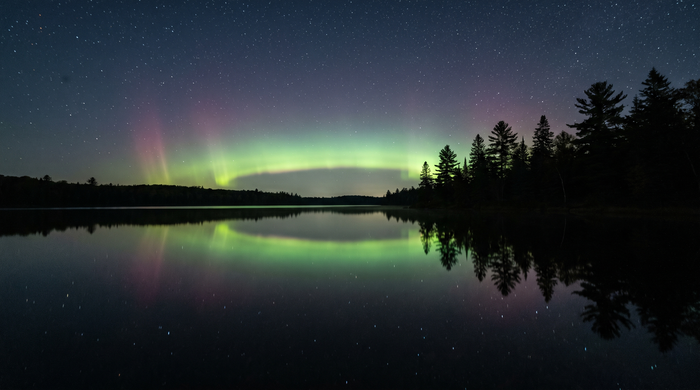
That May 2024 storm is the most useful recent reference point: a G5, the top category, and the strongest display in roughly two decades. Worth setting expectations, though — to the naked eye a weak aurora often reads as a pale gray, while a camera on a longer exposure shows vivid red and green. That is not a trick. It is the difference between a retina and a sensor.
What you practically need: a clear view north, real darkness away from streetlights, clear sky, and patience, because activity comes in bursts. NOAA's Space Weather Prediction Center publishes the current Kp and short-term forecasts for free, which is a better use of five minutes than ten posts with dramatic graphics.
What a storm does to technology
Here the effect is uncontested, measurable, and the reason agencies and grid operators take the subject seriously.
A geomagnetic storm induces currents in long conductors at Earth's surface — high-voltage transmission lines, rail systems, pipelines, undersea cables. The most famous example is the collapse of the Quebec power grid in March 1989, which left millions without power for hours. The strongest documented storm on record remains the Carrington event of 1859, which overloaded telegraph lines and pushed aurora into the tropics.
Then there are the effects that weigh more in ordinary life today. Satellite navigation degrades, because a disturbed ionosphere delays the signals. The heated upper atmosphere expands and drags harder on satellites in low orbits. Shortwave traffic drops out on the daylit side. Crews on polar routes and aboard the space station take a raised radiation dose.
All of that hits metal, electronics and orbits. It does not hit your apartment, your headache, or your home Wi-Fi.
And the body? The honest state of the research
This is the part most people open the article for — and the part where the most fudging happens, in both directions.
There is real research here, and it is not empty. One study of melatonin excretion found that changes in the time-varying magnetic field above roughly 80 nanotesla over three hours went along with lower nighttime melatonin. Several investigations exist on heart rate variability; the Normative Aging Study observed reduced variability during geomagnetic disturbances. And there are review papers discussing associations with psychological, neurological and cardiovascular endpoints, with melatonin named as a possible mediator.
Now the other half, which is rarely quoted alongside it. The heart-rate-variability findings contradict each other. In a replication study, significant correlations between solar or geomagnetic activity and heart rate variability largely vanished once the analysis corrected for autocorrelation — what survived was essentially an increase in a single very-low-frequency component. That is a typical pattern in this field: lay two long time series side by side without proper statistical correction and you will nearly always find associations that do not survive a stricter test.
Summarized honestly: there is a real but weak and inconsistent literature on geomagnetic activity and human physiology. There is no sound basis for explaining your headache, your sleepless night or your palpitations by a Kp value. And there is certainly no basis for postponing medical evaluation because of one.
Once you recognize this structure you start seeing it everywhere — we took the same pattern apart in what 7.83 Hz actually is, where a real physical quantity gets turned into an explanation for everything.
Why you still feel something — and why that is not a failure
It is worth taking seriously what actually happens here, rather than waving it away.
Storm alerts almost always arrive before the event, because the cloud is one to three days in transit. Which means: you know about it before you could possibly feel anything. From that moment you pay attention to yourself differently. A bad night that would otherwise have been filed under "just one of those nights" acquires an address. That attribution is not imagination in the dismissive sense — it is the ordinary working of a brain that looks for patterns.
On top of that, the second half of September has plenty going on anyway. Days shorten noticeably, morning light disappears, the heat comes on, the rhythm shifts. Anyone sleeping badly in that stretch has a whole row of obvious candidates to choose from. The solar storm is simply the most conspicuous one.
We did the same sorting work for the symptom lists that circulate online, in ascension symptoms and how to place them. And for the larger claim that a single solar event will change consciousness at a stroke, see what the solar flash claim actually says.
If you want to use the storm night
On an evening when your head has been out in space all day, something that pulls downward helps. Tibetan Handmade Incense at $12.95 is hand-rolled in Nepal and smells nothing like the sweet stick incense most people know — it is drier, woodier, more mineral. A stick lit at the window, the lights turned low, and the evening gets a floor under it. It is not a shield against anything, and it does not touch a magnetic field. It is a deliberate full stop at the end of a day.
What we do not claim
We are not telling you that a solar storm explains your symptoms. The available research on geomagnetic activity and melatonin or heart rate variability is weak, inconsistent, and partly overturned once autocorrelation is properly handled. Nothing about you personally can be derived from a Kp value.
We are not claiming any effect of incense, stones or ritual on geomagnetic fields. No such thing exists. What does exist is the effect of a deliberately shaped evening on how you feel, and that has nothing to do with space.
We make no health claims in either direction. Persistent sleep problems, headaches, palpitations or exhaustion belong with a physician. A cosmic event is a poor reason to wait.
And we are not promising you aurora. A high Kp raises the odds, nothing more. Cloud, moonlight and the storm's own moods decide in the end.
Practically: how to handle it
- Separate the three levels. Technology: established and relevant. Aurora: established and beautiful. Bodily effects: thinly researched and uninformative for any individual. Sorting these costs you nothing and buys clarity.
- Look it up rather than believing feeds. The Kp index is public and checkable in minutes at NOAA's Space Weather Prediction Center.
- Use the season. The weeks around the equinox are statistically the most active. If you have ever wanted to see aurora, now is the time to find a dark northern horizon.
- Keep a log before you name a cause. Two weeks with three numbers each morning — time to fall asleep, number of wakings, how rested you feel — answers the question about your sleep better than any cosmic explanation.
- Keep the ritual if it does you good. Taking a storm night as an occasion to dim the lights and settle earlier is a good idea. It stays a good idea even when the reason turns out to be something other than you assumed.
Frequently asked
Can a solar storm cause headaches or sleep problems?
There are studies reporting associations between geomagnetic activity and melatonin excretion or heart rate variability. The findings are weak and inconsistent, and in replication they largely disappeared once autocorrelation was corrected for. Nothing can be derived from them for an individual case. Persistent symptoms belong with a physician.
What Kp value do I need to see aurora in the US?
As a rule of thumb: Kp 5 along the northern border, Kp 6 across the upper Midwest and New England, Kp 7 into the mid-latitudes. You also need clear sky, real darkness away from streetlights and an open view north. With the naked eye a weak aurora often looks pale gray, while a longer camera exposure shows far more color.
Why do strong storms cluster in September and March?
That is the Russell-McPherron effect. Near the equinoxes, Earth's axis sits relative to the solar wind in a way that lets the wind's magnetic field couple more easily to Earth's. The same solar wind therefore produces stronger geomagnetic disturbance on average than in summer or winter. The elevated activity near the equinoxes has been known since 1856.
Is Solar Cycle 25 over?
The cycle began in late 2019 and ran well above forecast: against an expected peak near 115 sunspots, the monthly mean reached 216 in August 2024. Activity has calmed since spring 2025. The declining phase of a cycle does still tend to produce individual strong outbursts.
Can a solar storm take down the power grid?
In principle yes, and this is the one uncontested risk area. Geomagnetic storms induce currents in long conductors such as transmission lines, rail systems and pipelines. The Quebec blackout of March 1989 is the standard example. Satellite navigation, shortwave radio and satellite orbits are also affected — household appliances and home Wi-Fi are not.
How much warning is there?
It depends what is arriving. Flare radiation takes about eight minutes, like any light, and disrupts shortwave with no warning at all. The coronal mass ejection that drives the geomagnetic storm is much slower, typically one to three days. How strong the storm turns out depends largely on whether the magnetic field in the cloud points south — and that is known with confidence only shortly before arrival.
Sources and further reading
- Standard space weather literature on flares, coronal mass ejections and the coupling of the interplanetary magnetic field to the magnetosphere.
- NOAA Space Weather Prediction Center: definition and scaling of the geomagnetic Kp index and the G1-G5 storm scale, plus current forecasts.
- Russell and McPherron on the semiannual variation of geomagnetic activity; elevated activity near the equinoxes documented since 1856.
- NOAA and NASA forecasts and observational data for Solar Cycle 25, including the monthly mean sunspot number of 216 in August 2024.
- Documentation of the May 2024 G5 storm with aurora reported across much of the United States; the Quebec grid collapse of 1989; the Carrington event of 1859.
- Studies on geomagnetic activity and human melatonin excretion and heart rate variability, including the Normative Aging Study and the replication work correcting for autocorrelation.
- Further reading in the magazine: the solar flash claim · Schumann resonance: what 7.83 Hz actually is · placing ascension symptoms