




Fenrir: What the Norse Sources Actually Say About the Great Wolf


Fenrir is one of the most recognisable figures in Norse myth and one of the least carefully read. The written sources that actually describe him would fit in a few pages, they were set down by people separated by centuries, and they disagree with each other more than the confident retellings admit. This is what is written, who wrote it, and where the popular version quietly walks past the evidence.
Contents
Fenrir is the wolf-son of Loki and the giantess Angrboda, bound by the gods with three fetters and fated to kill Odin at Ragnarok. Nearly the whole narrative rests on a single chapter of Snorri Sturluson's Prose Edda, written around 1220, with older and partly conflicting hints in the Poetic Edda. The two disagree on how he dies: Voluspa gives Vidar a sword to the heart, Snorri the famous iron shoe. Most Viking-age 'Fenrir' carvings are unlabelled beasts that cannot be identified with confidence, and there is no attested cult of Fenrir anywhere in the sources.
Fenrir is the son of Loki and the giantess Angrboda, with Jormungandr and Hel as siblings.
Source/tradition: Snorri Sturluson, Gylfaginning 34 (Brodeur trans., 1916)
The gods bound him with three fetters in sequence: Laeding, Dromi and the dwarf-made Gleipnir.
Source/tradition: Gylfaginning 34
Tyr laid his right hand in the wolf's mouth as a pledge and lost it; all the gods laughed except him.
Source/tradition: Gylfaginning 34
The gods spared the wolf's life because they would not stain their sanctuary with his blood, not out of mercy.
Source/tradition: Gylfaginning 34
Gleipnir was made of six impossible things, and Snorri uses their absence today as proof of the story.
Source/tradition: Gylfaginning 34
Voluspa 54 has Vidar kill the wolf with a sword to the heart, while Snorri's kennings make the iron shoe the instrument.
Source/tradition: Voluspa 54 (Bellows trans., 1936); Gylfaginning 29 and Skaldskaparmal
Snorri never states that Skoll and Hati are Fenrir's sons; the link runs only through Hati's patronymic and Voluspa 40.
Source/tradition: Gylfaginning 12; Voluspa 40
An early 8th-century runic inscription from Ribe names the wolf, Odin and Tyr together, predating Snorri by some 500 years.
Source/tradition: Gronvik 1999, cited in Pluskowski, 'Fenrir Unearthed?'
The beast on the Tullstorp runestone (DR 271) is Fenrir at Ragnarok.
Source/tradition: Rundata DR 271; the stone commemorates a man named Ulfr ('wolf'), so the image may be a pun on his name
The animal on the Hunnestad stone rediscovered in 2020 is Fenrir.
Source/tradition: Arkeologerna (Swedish National Historical Museums) wrote 'a wolf-like creature, perhaps the Fenris wolf'; Pluskowski judges it doubtful
Fenrir is a spirit animal or guide who can be worked with.
Source/tradition: No attested cult, prayer or ritual addressed to Fenrir appears in any Norse source
Burning a protection candle produces a measurable effect.
Source/tradition: Contemporary practice; no evidence of effect beyond the practitioner's own focus
VERIFIED = verifiable in scientific or official sources · TRADITIONAL = historically or culturally recorded · LIVED PRACTICE = widely practiced, experiential knowledge · NOT PROVEN = spiritual interpretation, not scientifically established.
Who Fenrir is in the sources — and who wrote them down
Nearly everything narrative we have about Fenrir comes from one chapter of one book: chapter 34 of Gylfaginning, the first part of the Prose Edda, written in Iceland in the early thirteenth century and credited to Snorri Sturluson. There, Loki fathers three children on a giantess called Angrboda in Jotunheim: the wolf Fenrir, the serpent Jormungandr, and Hel.
When the gods learn of it and see by prophecy what is coming, Odin has all three brought to him. The serpent goes into the deep sea, where it grows until it encircles the land and bites its own tail. Hel goes down to Niflheim. The wolf, alone of the three, is raised at home among the Aesir — and only Tyr dared go to him with meat.
That detail does a lot of work. Fenrir is not a monster from outside. He is raised in the house, by the people he will destroy, and the god who feeds him is the god who will pay for binding him.
Behind Snorri sits an older layer. Voluspa, a Poetic Edda poem usually dated to around the tenth century, refers to the wolf repeatedly but never stops to explain him — it assumes an audience that already knows. This is the shape of the evidence for almost all Norse myth: allusive old poetry, and one Christian writer two centuries later who turned the allusions into a story. Where the two disagree, as they do about Fenrir, there is no third source to break the tie.
The three fetters: Laeding, Dromi, and the ribbon that held
The binding is told as three attempts, and the escalation is the point. The Aesir make a strong fetter called Laeding and invite the wolf to test his strength against it, flattering him into cooperating. He lashes out once and it breaks. They make a second, stronger by half, called Dromi, and try the same flattery: he will be famous if he breaks workmanship like this. He considers it, decides fame is worth the risk, and lets it be laid on him. He shakes himself, dashes it against the ground, and the fragments fly.
Snorri adds that both became proverbs — to loose out of Laeding and to dash out of Dromi, said of anything exceptionally hard. That is a small but telling note: the story was common enough in ordinary speech to have generated idioms.
Only then does Odin send Skirnir, Freyr's messenger, down to the dwarves, who make the fetter Gleipnir.
| Fetter | What it was | Outcome |
|---|---|---|
| Laeding | A very strong fetter, made by the Aesir | Broke at the first lash |
| Dromi | Stronger by half than Laeding | Broke; the fragments flew far |
| Gleipnir | Dwarf-made, soft and smooth as a silk ribbon | Held; tightened the harder he struggled |
Gleipnir's six ingredients are the sound a cat makes when it walks, a woman's beard, the roots of a rock, the sinews of a bear, the breath of a fish, and the spittle of a bird. What usually gets left out is what Snorri does next. His narrator immediately explains why these things are gone: a woman has no beard, a cat's leap makes no sound, there are no roots under a rock — the fetter used them up. It is an origin-joke and a claim to credibility in the same breath, and it tells you how Snorri wrote. He is not transcribing scripture. He is arguing with a listener who might not believe him.
The gods take the wolf out to the island Lyngvi on the lake Amsvartnir. Once he is bound, they run a chain called Gelgja through a rock called Gjoll, drive it deep, and hammer in a stone called Thviti as a pin. He gapes and snaps, so they wedge a sword upright in his mouth as a gag. The slaver running from his jaws becomes the river Van. He lies there until the end.
The detail almost everyone drops
The questioner in the frame story asks the obvious thing: why not simply kill the wolf, if the gods expected nothing but evil from him? The answer is not mercy. They held their sanctuary in such esteem that they would not stain it with the wolf's blood — even though the prophecies named him Odin's killer. The binding is not a rescue plan. It is a ritual-law problem solved badly, and knowingly.
Why Tyr put his hand in
The wolf is no fool. Shown the ribbon, he says plainly that there is no glory in snapping a thread that thin, and that if it is made with cunning it will never go on his feet. So he sets terms: someone puts a hand in his mouth as a pledge of good faith.
Snorri writes that each of the Aesir looked at his neighbour, and none was willing, until Tyr stretched out his right hand and laid it in the wolf's mouth. When the wolf lashed out and the fetter only hardened, the text gives one of the coldest lines in the Edda: then all laughed except Tyr. He lost his hand.
It is worth being precise about that scene. It is not a heroic sacrifice freely offered to save the world. It is a group of gods who have already decided to cheat, standing in a circle avoiding eye contact, and one of them absorbing the cost of the lie so the others do not have to. The laughter is the part that gives it away.

If you want to work with the theme yourself
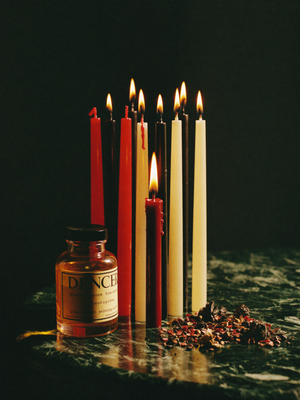
Fiery Wall of Protection 7-Day Candle
The story is about holding a boundary against something you cannot reason with. This is the candle we burn when we want that boundary to be deliberate rather than anxious — lit once, with a clear intention, and left to run.
The wolves that are not Fenrir
Popular family trees make this tidier than the text does. In Gylfaginning 12, Snorri explains the sun's haste: two wolves chase her. Skoll runs behind and will catch her; Hati Hrodvitnisson leaps ahead of her, after the moon. Asked where they come from, the answer is that a witch dwells east of Midgard in the forest Ironwood and bears many giants as sons, all in wolf shape — and from the mightiest of that line will come Managarm, the Moon-Hound, who will swallow the moon and spatter the heavens with blood.
Notice what Snorri does not say: he never calls Skoll and Hati the sons of Fenrir. The link is oblique — Hati's patronymic points to Hrodvitnir, used elsewhere as a name for Fenrir. Voluspa 40 gets closer, putting the old giantess in Ironwood and having her bear "the brood of Fenrir". The connection is real but loose, and the neat chart making Skoll and Hati his two sons is a modern tightening of a knot the sources left slack.
| Name | What the sources say | Relation to Fenrir |
|---|---|---|
| Fenrir | Bound on Lyngvi; breaks free at the end; kills Odin | — |
| Skoll | Chases the sun and will take her | Ironwood brood; sonship not stated by Snorri |
| Hati Hrodvitnisson | Runs ahead of the sun, after the moon | Patronymic points to Hrodvitnir, a Fenrir name |
| Managarm | Swallows the moon, bloodies the sky | Named as the mightiest of the Ironwood line |
| Garm | Bays at Gnipahellir; kills Tyr and dies of it | A separate creature, though often conflated |
That oddity is long noticed. Andy Orchard remarks that Tyr, who one would think might like to get his hand on Fenrir, is instead matched against Garm — part of why some scholars read the various wolves as versions of one figure rather than distinct animals. That reading is an interpretation, not a finding.
Two different deaths
Here the sources split, and it is the clearest example in the whole Fenrir material of why "the myth says" is a dangerous phrase.
In Voluspa 53, Odin goes to fight the wolf and falls. In stanza 54, his son Vidar comes against "the foaming wolf" and thrusts his sword full to the heart of the giant's son: his father is avenged. A sword, to the heart. The manuscripts are not even stable here — the Hauksbok version of the stanza differs from the Codex Regius text, a reminder that the poem reaches us through copies that already disagreed.
Snorri makes a different image famous. In Gylfaginning 29 he introduces Vidar as the silent god with a thick shoe, nearly as strong as Thor. In Skaldskaparmal, listing how poets may name him, he gives: the Silent God, Possessor of the Iron Shoe, Foe and Slayer of Fenris-Wolf, Avenger of the Gods. In Snorri's telling the shoe is not a costume detail. It is the weapon.
Both are "the sources". The older poem kills the wolf with a blade; the later prose builds the death around a boot. Modern retellings almost always pick Snorri and present it as the myth, without mentioning that the oldest surviving account says something else.
What the archaeology actually shows
This is where the gap between the internet and the evidence is widest, because Viking-age images do not come with labels.
The oldest firm trace of the pairing is not an image at all. A skull fragment from the Danish trading site of Ribe, dated to the early eighth century, carries a runic inscription naming the wolf, Odin and High Tyr together — putting the association some five hundred years before Snorri wrote it down. From the earlier Migration Period there is a bracteate from Trollhattan showing a figure with a hand in a beast's mouth, about as unambiguous a Tyr as the material offers.
After that it gets harder. The clearest narrative scene is not in Scandinavia but on the Isle of Man: Thorwald's Cross at Andreas shows a figure with a spear being devoured by a wolf, generally read as Odin at Ragnarok, with a figure trampling serpents on the reverse who is most likely the victorious Christ. The Gosforth Cross in Cumbria mixes Christian and Norse apocalyptic imagery so thoroughly that specialists disagree about which figure is which.
In Scandinavia, the Tullstorp runestone in Skane (DR 271, carved around the year 1000 in the Ringerike style) shows a ship and a beast, often read as Naglfar and Fenrir at the end of the world. That is a reasonable reading. It is also worth knowing that the inscription records the stone as raised in memory of a man named Ulfr — Old Norse for "wolf". The beast may be an apocalypse. It may equally be a pun on the dead man's name.
The most recent case is the most instructive. In December 2020, archaeologists working ahead of a sewer line outside Ystad found a carved stone face up in the foundations of an eighteenth-century bridge: the long-lost "Stone 6" of the Hunnestad monument, missing for roughly three hundred years. International coverage described a ferocious wolf, and much of it named the animal as Fenrir outright. The excavating body, Arkeologerna at the Swedish National Historical Museums, wrote something more careful — a wolf-like creature, perhaps the Fenris wolf. Aleksander Pluskowski, an archaeologist at Reading who has written a monograph on medieval wolves, went further, judging it doubtful that the animal represents the wolf at all: the "great beast" with tendrils is a defining motif of the Mammen and Ringerike styles and appears in contexts with nothing to do with Ragnarok.
The honest summary: the story is demonstrably older than Snorri, and a handful of images are widely accepted as Fenrir. But most Viking-age wolves are simply wolves in a decorative style. Naming them is a modern habit, not an ancient caption.
Fenrir is not a spirit animal, and the difference matters
Fenrir turns up in contemporary practice as something to invoke or draw strength from, usually on the strength of the chain imagery — bound power, rage held back. This has no basis in the sources, and it is a different thing from wolf symbolism generally.
In the material we have, Fenrir is not an archetype and not a guide. He is a named being in a story about a catastrophe the gods postpone by cheating, at a cost to the one who dealt honestly. There is no attested cult of Fenrir, no prayer to him, no ritual addressed to him.
If what draws you is the wolf as an image of loyalty, instinct, or belonging to a pack, that is a real and separate thread, and we have written about it in our piece on wolf symbolism and spiritual meaning. If what draws you is the Norse material itself, better entry points are the horse Sleipnir or the Elder Futhark runes.
What we do not promise
Nothing here is a method for protection, healing, or changing an outcome. Candles, stones and stories are not treatments and do not substitute for medical or psychological care. We are describing what a body of medieval literature says and what the archaeology does and does not support — no more than that.
Frequently asked questions
Is Fenrir Loki's son?
Yes, according to Snorri. Gylfaginning 34 names Loki as father and the giantess Angrboda as mother, with Jormungandr and Hel as full siblings. The older poetry treats the relationship as known rather than explaining it.
What was Gleipnir made of?
Six things: the sound of a cat's footfall, a woman's beard, the roots of a rock, the sinews of a bear, the breath of a fish, and the spittle of a bird. Snorri then explains that the fetter is why none of these can be found today.
Which hand did Tyr lose?
His right hand. Snorri is specific, and the Trollhattan bracteate — centuries older than the Prose Edda — shows a figure with a hand in a beast's mouth, suggesting the detail was long established.
Did Fenrir kill Odin?
In both surviving accounts, yes, and his son Vidar avenges him. The sources disagree about how: Voluspa says a sword to the heart, while Snorri makes the iron shoe the instrument.
Are Skoll and Hati Fenrir's sons?
Not in so many words. Snorri traces them to a giantess in Ironwood who bears sons in wolf shape; Voluspa calls that brood Fenrir's. The relationship is implied rather than stated.
Is there a real Viking image of Fenrir?
A few are widely accepted, most clearly Thorwald's Cross on the Isle of Man. Many more are claimed than can be demonstrated. The safe position is that an unlabelled wolf is a wolf until something in the scene identifies it.
Sources
- Snorri Sturluson, Prose Edda: Gylfaginning 12, 29 and 34, and Skaldskaparmal (Vidar's kennings). Cited from the public-domain translation by Arthur Gilchrist Brodeur (1916); the standard scholarly edition is Anthony Faulkes', published free by the Viking Society for Northern Research.
- Voluspa 40, 53 and 54, Poetic Edda, in the public-domain translation by Henry Adams Bellows (1936), with his notes on the Hauksbok and Codex Regius variants.
- Aleksander Pluskowski (Associate Professor of Archaeology, University of Reading), "Fenrir Unearthed?", on the Ribe skull fragment, the Trollhattan bracteate, the English and Manx sculpture, and the identification problem; and his monograph Wolves and the Wilderness in the Middle Ages (Boydell, 2006), chapter 9.
- Arkeologerna, Swedish National Historical Museums, press release on the rediscovery of Hunnestad "Stone 6", December 2020.
- Scandinavian Runic-text Database (Rundata), DR 271 (Tullstorp), Department of Scandinavian Languages, Uppsala University; with John McKinnell, Meeting the Other in Norse Myth and Legend (D. S. Brewer, 2005), p. 114.
- Andy Orchard, Dictionary of Norse Myth and Legend (Cassell, 1998), on Tyr and Garm.