






Fox Symbolism and Spiritual Meaning, Explained
Intelligence over force — plus the genetics that undo the European-import story, what the January screaming actually is, and the only North American canid that climbs trees.


The fox is the animal Americans quote and rarely look at. It lives in nearly every state, in cities as readily as farmland, and almost everything commonly said about it is off. The red fox is not a European import here. A fox out at noon is not a rabid fox. That scream at two in the morning is not a woman and not a fight. What is left, once the folklore is cleared away, is the more interesting animal: a small predator that survives by reading situations faster than anything its size has any right to.
Contents
The fox stands for intelligence rather than force: adaptability, discretion, reading a situation before entering it, and judging how much of yourself to reveal. Traditions that prize directness read those same traits as dishonesty, which is why the fox is a teacher in some cultures and a cheat in others. Three corrections matter for American readers. The red fox here is not a European import: genetic work led by Mark Statham found North American and Eurasian red foxes separated on the order of hundreds of thousands of years ago, and eastern US foxes are overwhelmingly of North American maternal ancestry. The scream people hear in January is a vixen's mating and contact call, seasonal and harmless, not a fight or an injured animal. And a fox out in daylight is not evidence of rabies — foxes move in daylight routinely, and a patchy, unsteady fox far more often has sarcoptic mange. The gray fox is the only canid in North America that regularly climbs trees. A 2011 study by Cerveny and colleagues found that foxes pouncing on unseen prey favour a north-northeast heading, suggesting a magnetic rangefinder — intriguing but not settled. Fox symbolism is a reflective frame for self-examination and has no demonstrated effect on events.
North American and Eurasian red foxes have been genetically separated for on the order of hundreds of thousands of years; eastern US foxes are overwhelmingly of North American maternal ancestry.
Source/tradition: Statham et al., Journal of Mammalogy 2012; range-wide synthesis 2013
The gray fox is the only canid in North America that regularly climbs trees, aided by forearms that rotate.
Source/tradition: National Park Service and state wildlife agency accounts
Fox screaming in winter is a mating and contact call, with breeding running roughly December to February and peaking around January.
Source/tradition: Wildlife agency guidance on red fox behaviour
Foxes are routinely active in daylight; daylight activity alone is not an indicator of rabies, and bald or unsteady foxes more often have sarcoptic mange.
Source/tradition: State wildlife agency guidance
Red foxes pouncing on prey they cannot see show a directional bias toward north-northeast, which has been interpreted as magnetic rangefinding.
Source/tradition: Cerveny et al., Biology Letters 2011 (single study; interpretation not settled)
Reynard in medieval European fable cycles functions as a satirical device aimed at clergy and nobility.
Source/tradition: Medieval European fable tradition
Kitsune in Japanese tradition are shapeshifting beings associated with Inari, distinct from the European trickster fox.
Source/tradition: Japanese religious and folkloric tradition
Waiting before responding, and asking a question instead of explaining, changes what people disclose in a conversation.
Source/tradition: Reflective exercise described in this article
The appearance of a fox is a message about your own instinct or an invitation to trust it.
Source/tradition: Symbolic interpretation; no supporting evidence
VERIFIED = verifiable in scientific or official sources · TRADITIONAL = historically or culturally recorded · LIVED PRACTICE = widely practiced, experiential knowledge · NOT PROVEN = spiritual interpretation, not scientifically established.
What the fox stands for
Fox symbolism runs on intelligence rather than force — getting where you are going by angle instead of by weight. Cleverness, adaptability, discretion, the ability to read a room before you enter it, and knowing how much of yourself to show.
Every culture that uses the fox as a symbol notices the same thing and judges it differently. Where a tradition values directness, the fox is a cheat. Where it values survival against odds, the fox is a teacher. The animal has not changed; the moral frame has. That instability is part of what makes it useful.
The fox tends to surface for people in situations that cannot be won head-on: an office where the stated rules are not the real ones, a family system where the direct conversation has been tried and failed, a negotiation where you hold less power. Its question is not how do I win this. It is what am I not seeing yet, and what am I giving away for free.
The American red fox is not the English one
Almost every US article about foxes repeats that red foxes were brought to North America by European colonists for hunting. It is a persistent story and largely wrong.
Genetic work led by Mark Statham and colleagues at UC Davis found that red foxes in North America and Eurasia have been separated for on the order of hundreds of thousands of years, and that the maternal ancestry of eastern North American foxes is overwhelmingly North American. Populations in the southeastern United States turn out to be closely related to native populations further north, which points to natural range expansion rather than descent from imported animals. Colonial-era introductions happened and left some genetic trace, but they are not the origin of the fox in your neighbourhood.
Why this matters beyond trivia
The introduction story quietly casts the fox as an interloper — a foreign animal getting away with something. That framing has done real work in how foxes are managed and talked about in the US.
The accurate version is a species that has been here through multiple glacial cycles, expanded on its own, and then proved unusually good at living alongside us. As a symbol that is a different animal entirely: not an opportunist who slipped in, but a long resident who adapted.
 |
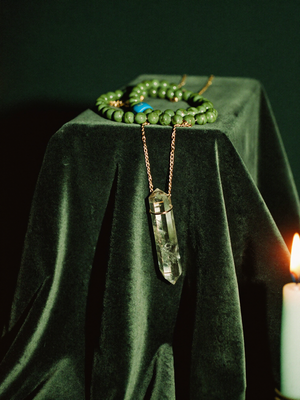
What we use Labradorite Bangle Bracelet Labradorite looks grey until the light hits it at the right angle, and then it does not. That is the fox point in an object: nothing is being hidden, you are simply not standing where you would see it yet. We wear it on days that call for watching a little longer before speaking. View — $38.00 |
Two foxes, and the one that climbs trees
North America has more than one fox, and most people never learn to tell them apart.
| Species | Where | How to tell | Worth knowing |
|---|---|---|---|
| Red fox | Nearly nationwide, including suburbs and cities | Rust coat, black stockings, white tail tip — the white tip is the reliable mark | Colour varies enormously: silver, cross and nearly black animals are all red foxes |
| Gray fox | East, South, Southwest and parts of the West Coast | Grizzled grey with rusty flanks, black stripe down the tail, black tail tip | The only canid in North America that regularly climbs trees — its forearms rotate, and it will go up a trunk to escape or to rest |
| Kit and swift fox | Arid West and short-grass prairie | Small, pale, very large ears | Both are far less commonly seen; the swift fox is a grassland recovery story |
| Arctic fox | Northern and western Alaska | White in winter, brown-grey in summer, short muzzle and ears | Not a US backyard animal outside Alaska |
The tree-climbing gray fox deserves its own line in any symbolic reading, because it breaks the category it was filed under. It is a dog that goes up a tree when the situation calls for it. If you were looking for an image of solving a problem with a move nobody in your class of animal is supposed to have, that is it.
That scream at two in the morning
This is the most-searched fox question in the United States and it frightens a lot of people, usually in January.
The sound is a fox, most often a vixen, and it is a contact and advertising call. Fox mating in the northern hemisphere runs roughly December through February with a peak around January, and a vixen is receptive for only a few days. The scream carries, and it sounds uncannily like a human in distress — which is why it generates police calls every winter. Males scream too, both in answer and at rivals.
It is not a fight, not an injury and not an animal in pain. It is seasonal, it lasts a few weeks, and it stops.
| What people think | What it usually is |
|---|---|
| A fox out in daylight must be rabid | Foxes are active around dawn and dusk and routinely move in daylight, especially when feeding young in spring. Daylight alone means nothing. |
| That patchy, bald, staggering fox has rabies | Far more often sarcoptic mange, which is common, treatable and not a danger to people in casual contact. Report it to your state wildlife agency or a licensed rehabilitator. |
| The screaming means two foxes are killing each other | Winter mating calls, peaking around January. Loud, seasonal, over in weeks. |
| A fox in the yard is a threat to my children | Red foxes weigh roughly ten to fifteen pounds. They avoid people. Keep small pets and poultry secured, and do not leave food out. |
| Feeding it will make it friendly | It makes it dependent and unafraid, which is how foxes end up killed as nuisance animals. Feeding wildlife is also illegal in many states. |
If a fox is genuinely behaving abnormally — approaching people, disoriented, aggressive — that is a call to animal control or your state wildlife agency, not something to handle yourself.
The mousing pounce, and the compass nobody expected
Watch a fox hunt in long grass or snow and you will see the arc: the animal freezes, listens, then launches nose-first in a high curve and comes down on something it never saw.
A 2011 study led by Jaroslav Cerveny reported something odd in thousands of observed pounces: successful strikes on unseen prey were strongly biased toward a north-northeast heading, and the bias largely disappeared when the fox could see its target. The proposed explanation is that the fox uses a magnetic sense as a rangefinder — lining up sound and field until the geometry is right, then committing.
The finding is intriguing rather than settled, and it deserves to be reported that way. But as an image it is hard to beat: the animal appears to be hesitating, and it is in fact taking a bearing. Most of what looks like indecision in a competent person is the same thing.
Temple tip
Practising the fox move: withhold the first response
The fox skill is not cunning. It is the gap between receiving information and acting on it — and it is trainable in a way that most so-called intuitive skills are not.
For one week, in any conversation where you feel the pull to explain, defend or fill a silence, wait three seconds and ask a question instead. That is the whole exercise. Not silence as a tactic, not withholding as a punishment. Three seconds and a question.
Two things usually show up. You learn more in those conversations than you did before, because people fill the space. And you notice how much you had been giving away purely to relieve your own discomfort — which is the thing the fox never does.
The trickster is not one character
English-speaking readers tend to collapse every clever animal into a single trickster archetype. The sources do not support it, and the differences carry the meaning.
- Reynard, in medieval European fable cycles, is a satirist's instrument. He wins against clergy and nobility, and the point is the target, not the fox.
- Kitsune in Japanese tradition are a genuinely different category: long-lived shapeshifting beings, gaining tails with age, associated with Inari and with rice, capable of both guardianship and harm. Reading them as European trickster foxes flattens a religious tradition into a fable.
- Huli jing in Chinese tradition are related but not identical, with their own long literary history and their own moral range.
- North American Indigenous traditions have their own trickster figures — frequently Coyote or Raven rather than Fox — and they belong to specific nations with specific stories. There is no pan-Indian fox teaching, and any source offering you one is inventing it.
The honest summary is that the fox is used as a symbol of intelligence wherever foxes and people overlap, and that each tradition draws a different line between clever and dishonest. That line is the actual subject.
Living alongside the urban fox
The red fox is one of the more successful urban carnivores in North America, and the practical measures are the same everywhere: secure trash, do not leave pet food outside, close off crawl spaces and decks before spring denning, keep chickens in a roofed and buried-apron run, and supervise small pets at dawn and dusk.
None of that requires disliking the animal. It is the same arrangement the symbol describes: you can respect something's intelligence and still not leave your door open.
What the fox asks
Fox questions are about information and self-disclosure. Where am I fighting straight at something that would move if I approached it from the side? What am I explaining to people who have not asked? What would I notice if I waited another beat before I spoke?
It pairs naturally with raven symbolism, the other great intelligence animal of North America, and it is a useful counterweight to the wolf, which is about belonging where the fox is about manoeuvre. If the discomfort behind the over-explaining is worth looking at, spiritual bypassing and the empath and highly sensitive person distinction both go there. Stones we keep for this sit in the crystals and stones collection.
What we don't promise
Fox symbolism is a reflective frame, not a mechanism. Nothing here will change events, sharpen anyone's actual perception, or influence another person's behaviour, and no stone or object mentioned has a health effect. Wildlife guidance is general information — for an animal behaving abnormally, contact your state wildlife agency, animal control or a licensed rehabilitator rather than handling it. Where a statement is established research we name it; where it is tradition or interpretation, we say so.
Frequently asked questions
What does the fox symbolize?
Intelligence over force: adaptability, discretion, reading a situation before entering it, and judging how much of yourself to show. Traditions that prize directness read the same traits as dishonesty, which is why the fox is a teacher in some cultures and a cheat in others. The animal is constant; the moral frame is not.
Were red foxes brought to America from Europe?
Mostly no, despite how often that is repeated. Genetic work led by Mark Statham at UC Davis found North American and Eurasian red foxes separated on the order of hundreds of thousands of years ago, and that eastern North American foxes are overwhelmingly of North American maternal ancestry. Colonial introductions occurred and left some trace, but they are not the origin of the species here.
Why do foxes scream at night?
It is a contact and mating call, most often from a vixen. Fox breeding in the northern hemisphere runs roughly December through February with a January peak, and the call carries and sounds disturbingly human. It is not a fight and not an animal in pain. It is seasonal and stops after a few weeks.
Does a fox out in daylight have rabies?
No. Foxes are most active around dawn and dusk and move in daylight routinely, especially when feeding young. A fox that is bald, patchy and unsteady far more often has sarcoptic mange. Genuinely abnormal behaviour — approaching people, disorientation, aggression — is a call to animal control, not something to assess up close.
Which fox can climb trees?
The gray fox, and it is the only canid in North America that does so regularly. Its forearms rotate in a way that lets it grip and ascend a trunk, and it will climb to escape a threat or simply to rest. Red foxes do not do this.
Is the fox a trickster in every culture?
No, and the differences matter. Reynard in medieval European fable is a satirical device. Kitsune in Japanese tradition are shapeshifting beings tied to Inari with a religious context that trickster framing erases. North American Indigenous trickster figures are more often Coyote or Raven, and they belong to specific nations rather than to a pan-Indian tradition.
Sources & further reading
- Mark J. Statham and colleagues on red fox phylogeography, including work on the origin of recently established US populations (Journal of Mammalogy, 2012) and a range-wide synthesis (2013); UC Davis Veterinary Genetics Laboratory summaries.
- Jaroslav Cerveny and colleagues, on directional preference in predatory attacks by the red fox, Biology Letters, 2011 — the magnetic alignment finding.
- US Forest Service research on North American red fox ancestry and ice-age lineages.
- State wildlife agency guidance on living with urban foxes, mange, and reporting abnormal behaviour.
- National Park Service and state agency accounts of gray fox tree-climbing behaviour.
- Medieval Reynard cycles; Japanese sources on kitsune and Inari; Chinese literary sources on huli jing.