





Ho'oponopono Meaning: Where the Four Phrases Come From


Four sentences that supposedly heal everything: I'm sorry. Please forgive me. Thank you. I love you. You will find them on coffee mugs, on Instagram tiles, on Etsy prints and in weekend workshops that cost a few hundred dollars. What almost never comes with them: those four sentences are a late 20th and early 21st century invention. Hawaiian ho'oponopono is something else. It is older, harder to package and a good deal less comfortable.
Contents
Ho'oponopono roughly means to set something right again. In Hawaii it was a guided family process: prayer, talking it out, admitting fault, mutual forgiveness and a ritual release of the matter, with everyone involved in the room. The solo version most people know today goes back to Morrnah Nalamaku Simeona, who reshaped it in the 1970s into Self-Identity through Ho'oponopono, drawing on Christian and Asian ideas. The famous four phrases, I'm sorry, please forgive me, thank you, I love you, spread worldwide after 2007 through Ihaleakala Hew Len and Joe Vitale's book Zero Limits. The story of a psychiatric ward emptied by his inner work has never been independently documented, and the claim that you carry one hundred percent responsibility for everything in your life does not apply to violence, illness or loss you have suffered.
Traditional ho'oponopono is documented ethnographically as a guided family process with prayer, discussion, confession, mutual forgiveness and a closing release.
Source/tradition: Mary Kawena Pukui, E. W. Haertig, Catherine A. Lee, Nana i ke Kumu (Look to the Source), vol. 1, Hui Hanai, Honolulu 1972; E. Victoria Shook, Ho'oponopono, East-West Center / University of Hawaii Press 1985
Morrnah Nalamaku Simeona (1913-1992) developed a solo practice called Self-Identity through Ho'oponopono (SITH) from the 1970s onward.
Source/tradition: Biographical accounts and teaching material from the SITH / Foundation of I circle
The worldwide spread of the four-phrase formula traces to Joe Vitale and Ihaleakala Hew Len, above all their book Zero Limits (Wiley, 2007).
Source/tradition: Publication history; Joe Vitale and Ihaleakala Hew Len, Zero Limits, John Wiley & Sons 2007
The account that Hew Len emptied a forensic psychiatric ward by working only on himself rests on statements by the people involved.
Source/tradition: Interviews and book accounts; no independent documentation, case numbers or published data
Native Hawaiian practitioners have criticized the marketing of a shortened technique under the name of a living family practice.
Source/tradition: Public statements by Hawaiian practitioners and cultural practitioners
Many people repeat the four phrases daily as a morning practice, often combined with journaling.
Source/tradition: Widespread contemporary practice in the US and Europe
Ho'oponopono heals illness, changes outside circumstances or erases memories.
Source/tradition: No controlled studies; the claims are untestable by their nature
You carry one hundred percent responsibility for everything that appears in your perception.
Source/tradition: No empirical basis; applied to victims of violence, illness or loss it can deepen guilt
VERIFIED = verifiable in scientific or official sources · TRADITIONAL = historically or culturally recorded · LIVED PRACTICE = widely practiced, experiential knowledge · NOT PROVEN = spiritual interpretation, not scientifically established.
This article separates the three layers that the word covers today: the traditional family practice, Morrnah Simeona's solo version and the internet mantra. It shows where the four phrases actually came from, why there is criticism from Hawaii, and why "one hundred percent responsibility" is a sentence to handle with care. What it does not offer: a promise that sentences heal anything.
Ho'oponopono at a glance
| Question | Short answer |
|---|---|
| Literal meaning | Roughly "to set right again": ho'o (to make) + pono (right, in balance), doubled for emphasis. |
| Traditional form | A guided family meeting with prayer, discussion, confession, mutual forgiveness and release. |
| Modern solo form | Self-Identity through Ho'oponopono (SITH), developed by Morrnah Simeona from the 1970s. |
| The four phrases | Popularized worldwide after 2007 by Joe Vitale and Ihaleakala Hew Len. |
| The famous hospital story | Told by the people involved; never independently documented. |
| What it can do | Train a real skill: looking at your own part without tearing yourself apart. |
What ho'oponopono originally was
The word is built from ho'o, to make or cause, and pono, which means right, proper, upright, in balance. The doubling ponopono intensifies it. Ho'oponopono therefore means something like: to set things right again, thoroughly.
In Hawaiian practice this was not a meditation and not a mantra. It was a family procedure. When something had broken inside an 'ohana, an extended family, whether a quarrel, a debt, a wrong done or an illness that people traced back to an unresolved conflict, everyone involved was called together. An elder or a respected healer led the session. There was opening prayer, a statement of the problem, each person's account, admission of wrongdoing, mutual forgiveness, and at the end a ritual cutting loose of the matter so that nobody would bring it up again. Sessions could run for hours, and a difficult matter could take several meetings.
The direction is what matters. Ho'oponopono was interpersonal. It needed the others in the room. It was about relationship, not about inner life, and certainly not about a technique that one person applies alone to themselves.
The best source for this form is Nana i ke Kumu (Look to the Source), published in 1972 by Mary Kawena Pukui, one of the most important Hawaiian scholars of the 20th century, together with psychiatrist E. W. Haertig and Catherine A. Lee, through the Queen Lili'uokalani Children's Center in Honolulu. The center worked with Hawaiian families and used the practice in social work. A later study by E. Victoria Shook, published in 1985, described how the process was being adapted for counseling in Hawaii at the time.
Morrnah Simeona and the turn to solo practice
The bridge to the West was built by one woman: Morrnah Nalamaku Simeona (1913-1992), recognized in Hawaii as a kahuna lapa'au, a healer. In the 1970s she decided to adapt the procedure to a society in which the extended family often no longer existed, where people have conflicts with someone who lives two thousand miles away, or who has died.
Her version is called Self-Identity through Ho'oponopono, SITH for short. The decisive step: she turned a group process into an individual one. You no longer need the other person. You work alone, in the form of a prayer, and ask a divine source to dissolve the entanglement.
Simeona was raised Christian and had studied Indian and Chinese philosophy as well as the readings of Edgar Cayce. That shows in SITH: a karmic framework in which memories from earlier contexts keep acting and can be "cleaned" or erased. It was well meant and it helped people. But it is not what an 'ohana did in the 19th century, and Simeona herself did not claim that it was.
For the karmic side of this thinking, see our piece on soul contracts, which grew from the same American New Age soil.
A reminder you can wear
Emotional Detox Dalmatian Jasper Bracelet
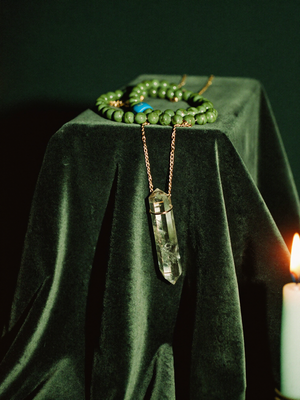
If you practice the four phrases, the hard part is not saying them, it is remembering to stop and look at your own part in the middle of an ordinary day. A plain stretch bracelet of cream and black spotted Dalmatian jasper works as a physical cue: touch it, ask the one question, move on. It does not cleanse anything and it does not forgive for you. It just sits on your wrist where you will see it. $19.95
See the bracelet →Ihaleakala Hew Len and the story that changed everything
Simeona's best known student is Dr. Ihaleakala Hew Len. Around him grew the story that made ho'oponopono famous worldwide. As he told it, he worked as a psychologist on a forensic unit at Hawaii State Hospital in the 1980s, never met the patients in person, only read their files and practiced ho'oponopono on himself while doing so, and over the following years the unit calmed down, patients were released and the ward was eventually closed.
That story is the engine of the whole popularization. It is also the weakest link in the chain. It rests on accounts by the people involved. There is no independent documentation, no case numbers, no published data anyone could check. Anyone who cites it as proof is citing an anecdote.
It became a mass product when marketing author Joe Vitale wrote about it, first online in 2006 and then in the book Zero Limits, co-written with Hew Len and published by Wiley in 2007. From there the four phrases went around the world, cut loose from SITH, cut loose from Hawaii, cut loose from everything that came before.
The three layers compared
When someone says "ho'oponopono" today, they can mean three very different things. This table separates them.
| Traditional | SITH (from the 1970s) | Popular version | |
|---|---|---|---|
| Who takes part | The whole family, with a leader | One person alone | One person alone |
| Core | Discussion, confession, forgiveness | Prayer, "cleaning" memories | Four phrases, repeated |
| Goal | Set the relationship right | Inner freedom, responsibility | Often: change in the outside world |
| Length | Hours to days | Daily practice | Minutes |
| Evidence | Documented ethnographically | Documented as a teaching | Effects not demonstrated |
Read left to right and it gets shorter, simpler and lonelier. It also sells better in exactly that order.
The criticism, and why it deserves to be taken seriously
Objections have come from Hawaii for years, and they run along two lines.
The first is cultural. A procedure tied to a language, a family structure and a cosmology gets sold as a four-sentence technique. The name stays, the content goes. If the charge of cultural appropriation feels exaggerated, try the reverse test: how would it sound if someone sold a workshop on "confession" that consisted of three sentences and no church? Native Hawaiian culture has already had its words and practices commercialized many times, from the hula to the word aloha on T-shirts, and ho'oponopono sits in that longer history. Our article on Pele's curse and lava rock from Hawaii deals with a related case.
The second is about content. The popular version works with the claim that you carry one hundred percent responsibility for everything that shows up in your perception. As self-encouragement it can be useful. As a worldview it is dangerous, because it turns people who were harmed into the cause of their harm. Someone who survived violence, who is sick, who was laid off, carries no responsibility for that, and a spiritual sentence that suggests otherwise does real damage. The same pattern turns up in other movements, from quantum healing to the famous water crystal photos; what Masaru Emoto's water crystals actually show is a good example of how it works.
What is left of the four phrases
Quite a lot, once you stop treating them as magic.
The four phrases trace a complete movement that does occur in real reconciliations: regret, a request, gratitude, warmth. That is not a Hawaiian secret teaching. It is the structure of every serious apology. Going through them quietly each day trains something harder than it sounds: turning your attention from "what did the other person do" to "what was my part," without taking yourself apart in the process.
That distinction is at the center of all shadow work. Seeing your part does not mean taking the blame. People who confuse the two do not end up in forgiveness, they end up in self-accusation, which feels spiritual but is only a quieter form of harshness toward yourself. Our introduction to shadow work and Carl Jung goes deeper into that difference, and the signs of spiritual bypassing shows what happens when forgiveness gets used to skip the uncomfortable part.
A self-check: how is it with your part?
The German original has a small interactive check. Here it is as a table. Pick the row that fits best and read across. It is a sorting aid, not a verdict.
| When you think about the conflict... | What that often means | The more useful next step |
|---|---|---|
| You mostly think about what they did | Your part has not been looked at yet | Write one sentence about your part, no excuses, no insults to yourself |
| You mostly think about what you did wrong | You may be taking on more than is yours | Write the fifth sentence: "And this part is not mine" |
| You keep repeating the phrases and nothing moves | The practice has become a way to avoid a conversation | If it is safe, talk to the actual person |
| You feel guilty for something done to you | The "100 percent" idea is working against you | Drop that idea and talk to someone you trust |
Voices from practice
What people report after working with the four phrases. Patterns from practice, not evidence, and no invented names:
- A common report: nothing changed in the situation itself, but the evening rumination did get shorter.
- Another: the "one hundred percent responsibility" idea backfired, and people started blaming themselves for things that had nothing to do with them.
- And one we hear again and again: learning that the original form was a family conversation led people to pick up the phone. That was more uncomfortable, and more useful, than any number of repetitions.
What we don't promise
- Ho'oponopono does not cure illness and is no substitute for medical or mental health care.
- The hospital story around Ihaleakala Hew Len is not independently documented. It is a story, not proof.
- The four phrases do not change the world outside you. What can change is how you deal with it, which is something different and still a great deal.
- "One hundred percent responsibility" does not apply to violence, illness or loss you have suffered. If that idea weighs on you, talk to a person about it. If you are in crisis, you can call or text 988 in the US at any hour.
Practically: how to work with this
Call it what it is. If you practice the four phrases, you are practicing a Western adaptation. That is completely fine. Just do not say you are practicing a Hawaiian tradition.
Aim them at one specific person. Not at "the universe." Having a face in mind is the difference between an exercise and a soothing formula.
Add a boundary. After the four phrases, say a fifth: "And this part is not mine." It protects you from the self-accusation trap.
Short and daily beats long and rare. Three minutes in the morning, same time each day. Repetition really is the working principle here, just a psychological one. What the research on gratitude practice supports is a useful comparison for what a daily habit can and cannot do.
Write it down. Two lines a day are enough. After four weeks you will see patterns that slip past you in your head.
If you can, talk to the person. That is the original form. It is less comfortable and it works differently.
Temple Tip: the one-sentence test
Before you say the four phrases, answer one question in writing: "What exactly was my part, in one sentence, without apologizing and without insulting myself?" If you cannot write that sentence, there may be no part of yours. That is a result too.
Frequently asked questions
What does ho'oponopono mean literally?
Roughly "to set things right again." Ho'o means to make or cause, pono means right or upright, and doubling it to ponopono strengthens the meaning.
Are the four phrases traditionally Hawaiian?
No. Traditional ho'oponopono was a guided family conversation with discussion, confession and mutual forgiveness. The short four-phrase formula belongs to the modern adaptation and became popular after 2007.
Who was Morrnah Simeona?
A Hawaiian healer who, from the 1970s, turned the family process into a solo practice called Self-Identity through Ho'oponopono (SITH). Christian and Asian influences went into her version.
Is the psychiatric hospital story true?
It is the central story of the popularization, but it rests on the accounts of the people involved. No independent documentation, case numbers or checkable data have been published.
Is practicing ho'oponopono cultural appropriation?
Hawaiian practitioners have criticized a short technique being marketed under the name of a living family practice. You can practice the adaptation, but call it an adaptation, not Hawaiian tradition.
Can ho'oponopono be harmful?
The phrases themselves, no. The problem is the claim that you are one hundred percent responsible for everything in your life. For violence, illness or loss that is not true and can deepen guilt. If that weighs on you, professional support is the right path.
Sources & further reading
Mary Kawena Pukui, E. W. Haertig and Catherine A. Lee, Nana i ke Kumu (Look to the Source), vol. 1, Hui Hanai / Queen Lili'uokalani Children's Center, Honolulu 1972 · E. Victoria Shook, Ho'oponopono: Contemporary Uses of a Hawaiian Problem-Solving Process, East-West Center / University of Hawaii Press, 1985 · Material on Self-Identity through Ho'oponopono from Morrnah Simeona's circle · Joe Vitale and Ihaleakala Hew Len, Zero Limits, John Wiley & Sons, 2007 · 988 Suicide & Crisis Lifeline (988lifeline.org).
This article places a spiritual practice in its history. It does not replace medical or psychological advice. Questions about an order or anything on this site: 28@templeofdesire.com.