



How to Celebrate Imbolc: Dates, Rituals, and What It Actually Marks

Imbolc is the point where winter stops deepening. It sits halfway between the winter solstice and the spring equinox — the first of the eight sabbats that actually promises something rather than closing something down. Here is when it falls, what the old sources really say, and how to mark it without pretending spring has arrived.
Contents
Imbolc is celebrated on February 1, traditionally from sunset on January 31. The astronomical midpoint between the winter solstice and the spring equinox actually falls on February 3-4. Mark it by lighting candles, cleaning one room properly, and setting out cloth and food for Brigid overnight.
Imbolc is named as one of four Gaelic seasonal festivals in the 10th-century version of Tochmarc Emire, glossed as when the ewes are milked at spring's beginning.
Source/tradition: Tochmarc Emire, 10th-century recension
The astronomical cross-quarter between solstice and equinox falls on 3 February 2027 at 20:46 Eastern, not on 1 February.
Source/tradition: Computed from the JPL DE421 ephemeris via Skyfield
The etymology of the name Imbolc is unresolved; proposals include 'in the belly', a derivation from folc 'to wash' (Vendryes), and a Proto-Indo-European root covering both milk and cleansing (Hamp).
Source/tradition: Vendryes; Eric P. Hamp; Cormac's Glossary treated as folk etymology
An Old Irish poem in Hibernica Minora names washing the hands, feet and head as what is proper at Imbolc.
Source/tradition: Hibernica Minora, trans. Kuno Meyer, 1894
A Brigid's cross of woven rushes was hung over doors and windows for protection against fire, lightning, illness and malicious spirits.
Source/tradition: Irish household custom, recorded folklore collections
Lighting candles, cleaning a room and leaving out cloth on Brigid's Eve is a practice many people keep as a seasonal marker.
Source/tradition: Contemporary Imbolc practice
Observing Imbolc protects a household, improves health or influences the weather.
Source/tradition: No evidence; the hedgehog and Cailleach weather lore is recorded as folklore only
VERIFIED = verifiable in scientific or official sources · TRADITIONAL = historically or culturally recorded · LIVED PRACTICE = widely practiced, experiential knowledge · NOT PROVEN = spiritual interpretation, not scientifically established.
Quick answer: Imbolc is celebrated on February 1 (traditionally from sunset on January 31). The astronomical midpoint between solstice and equinox actually falls on February 3–4, and some practitioners use that instead. Mark it by lighting candles, cleaning one room properly, and setting out something for Brigid overnight.
When is Imbolc in 2027?
Two answers, and they are both correct — they just answer different questions. The calendar date is fixed: February 1. The astronomical cross-quarter moves a little each year, because it depends on where the Sun actually is.
The cross-quarter is the moment the Sun reaches 315° of ecliptic longitude — exactly halfway between the winter solstice (270°) and the spring equinox (0°). We computed the following from the JPL DE421 ephemeris:
| Year | Traditional | Cross-quarter (Eastern) | Cross-quarter (Pacific) |
|---|---|---|---|
| 2026 | Feb 1 | Feb 3, 3:02 PM EST | Feb 3, 12:02 PM PST |
| 2027 | Feb 1 | Feb 3, 8:46 PM EST | Feb 3, 5:46 PM PST |
| 2028 | Feb 1 | Feb 4, 2:31 AM EST | Feb 3, 11:31 PM PST |
Note 2028: the cross-quarter lands on February 4 on the East Coast but still February 3 out West. If you have ever seen two sources give different Imbolc dates and assumed one was wrong, this is usually why — they are quoting different time zones, or one is using the calendar date and the other the sky.
Is Imbolc always February 1?
As a festival, yes — February 1 is the date in every Irish source we have, and it is the date almost everyone uses. As an astronomical event, no: the true midpoint runs two to three days later, which is why you will find practitioners marking February 3 or 4 and calling it the "real" Imbolc.
Neither camp is being sloppy. The Gaelic calendar counted by fixed quarter days, not by solar geometry. If you want the folk festival, use February 1. If you want the astronomical hinge, use the table above. If you want both, the traditional handling gives you cover: the observance begins at sunset on January 31 and the season runs for several days, which comfortably includes the cross-quarter.
How do you pronounce Imbolc?
The b is silent or nearly so. In Irish it is roughly ih-MOLK or im-OLK; you will also hear ih-MOLG, which reflects the Modern Irish spelling Imbolg. What you will not hear from an Irish speaker is "im-BOLK" with a hard, stressed b — that is the spelling-based English reading.
The variant spellings all trace to the same word: Imbolc, Imbolg, Oimelc, and in a 17th-century manuscript Iomfhoilcc. None is more authentic than another; they are centuries of scribes writing down a spoken word.
What does the name Imbolc actually mean?
This is where most articles state one meaning confidently and move on. The honest position is that the etymology is unsettled, and the competing proposals point at genuinely different festivals.
- "In the belly" — from Old Irish i mbolg. The popular reading, referring to pregnant ewes. It is attractive and fits the lambing season, but it is a reading of the spelling rather than a demonstrated derivation.
- "To wash / cleanse" — Joseph Vendryes derived it from an intensive prefix imb- plus folc, "wash". This one has direct textual support, which we will come to.
- Milk and cleansing together — Eric P. Hamp proposed a Proto-Indo-European root carrying both senses, which would explain why the tradition pulls in both directions.
- "Ewe milk" — oí-melg, offered by Cormac's Glossary in the 10th century. Linguists generally treat this as folk etymology: a respelling that gives an opaque word an understandable origin.
So: a festival of milk, or a festival of washing, or a word old enough to have meant both. That ambiguity is not a gap in the record. It is the most interesting thing about the name.
Where Imbolc is actually recorded
Imbolc is not a modern invention, and it is also not as richly documented as Samhain. The early mentions are brief and worth knowing, because they are what separates a grounded practice from a Pinterest one.
- Tochmarc Emire (10th-century version) lists Imbolc as one of four seasonal festivals and glosses it as "when the ewes are milked at spring's beginning".
- The Book of Leinster (12th century), in its version of the Táin Bó Cúailnge, places Imbolc — spelled imolg and imbuilg — three months after Samhain.
- The Metrical Dindshenchas carries the line "iar n-imbulc, ba garb a ngeilt" — "after Candlemas, rough was their herding."
- Hibernica Minora preserves an Old Irish poem on the festivals, translated by Kuno Meyer in 1894, which says what is proper at Imbolc: "washing the hands, the feet, the head."
That last line is the one to sit with. The single surviving instruction for what to do at Imbolc is not a spell and not a feast. It is washing — and it lines up exactly with the Vendryes etymology. If you want one practice with a documented Old Irish source behind it, it is this, and it takes five minutes.
Temple Tip
Do the washing first, before candles, cleaning or anything else. Warm water, hands and face and the back of the neck, no phone in the room. It is the oldest instruction we have for this day and it reframes the rest of the evening — you are not starting a project, you are arriving clean at the turn of a season.
Why is Brigid associated with Imbolc?
Because the two were merged, and the record shows the seam. Imbolc appears to have been a pre-Christian festival tied to lambing and the return of light. Cogitosus, writing in the late 7th century, records a feast of Saint Brigid at Kildare on February 1 — the same date. By the 14th century, the Stowe manuscript has quietly replaced "Imbolc" with Fél Brigde, Brigid's Feast.
The goddess Brigid and Saint Brigid share an unusually specific set of attributes: wisdom, poetry, healing, protection, blacksmithing, and domesticated animals. Some scholars read the saint as built on the goddess; others see pagan lore transferring onto a historical figure. We are not going to settle that here, and anyone who tells you it is settled is overselling.
What matters practically: the customs that survived are Brigid's customs, and they are specific enough to actually follow.
How to celebrate Imbolc at home, step by step
Six things, in order. None of them needs a shopping trip, and you can stop after three.
- Wash. Hands, feet, head, per the Old Irish poem. If you want the fuller version, a cleansing bath is the same instinct scaled up.
- Clean one room properly. Spring cleaning at Brigid's Day is documented Irish custom, not a lifestyle add-on. One room, finished, beats a whole-house plan you abandon.
- Light candles at dusk. This is the Candlemas half of the festival. More than one, in more than one room, lit deliberately rather than left burning.
- Put out the brat Bríde. A strip of cloth or a scarf left outside overnight on Brigid's Eve. It was brought in the next morning and kept for healing and protection through the year.
- Set a place. Milk, bread, or butter left out or set aside. The special suppers recorded include colcannon, sowans, dumplings, barmbrack and bannocks, with a portion put aside for Brigid.
- Make a Brigid's cross if you have rushes, reeds, or even paper strips. It goes over a door or window.
How a Brigid's cross is built
The cross is four-armed and equilateral, and it is not two sticks tied together — it is woven, each rush folded around the one before it, which is what produces the square plaited centre and the four offset arms.
Hung over doors and windows, it was kept for protection against fire, lightning, illness and malicious spirits — a protective object with a fixed shape and a fixed place, which is rarer in folk practice than you might expect.
If you want to work with this yourself
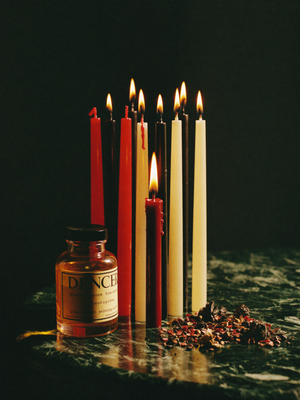
Ritual Taper Candles — 12 Colored Spell Candles
Imbolc is the candle festival, and twelve tapers covers it: white for Brigid on the night itself, and the rest of the colors for the year's work that starts here. Short burn, so a taper suits a single evening's intention rather than a week's vigil.
$26.95 · ships within 3 business days · shipping calculated at checkout
See the taper setIf you would rather build from singles, the beeswax spell candles are the closest thing to what would actually have been burned, and the wider ritual candles range covers vigil and pillar formats if you want something that lasts past the evening.
Setting an Imbolc altar
Imbolc altars are the sparest of the year, and that is the point — the abundance has not arrived yet. Working from the documented customs rather than from vibes:
| Item | Source of the custom |
|---|---|
| Candles, several, lit at dusk | Candlemas overlay; the returning-light half of the festival |
| Milk, butter, or cream | Lambing and ewe's milk; Tochmarc Emire |
| Bread — bannock, barmbrack | Recorded Brigid's Eve suppers, portion set aside |
| Brigid's cross, rushes or reeds | Irish household custom, hung at door or window |
| A strip of cloth (brat Bríde) | Left out overnight, kept for the year |
| A bowl of clean water | Holy-well visits; the washing instruction in Hibernica Minora |
| Seeds, still in the packet | Modern, and honest about it — the season's promise, not its harvest |
Working in a room you share, or somewhere an altar cannot stay out? The same set collapses to a tray or a windowsill — our notes on keeping an altar in a shared room apply directly here, and Imbolc's short list makes it easier than most sabbats.
Imbolc candle colors
There is no ancient color scheme for Imbolc — the surviving customs specify objects, not colors. What follows is the common modern correspondence, which is coherent and worth using as long as you know which part is old and which is recent.
| Color | Used for |
|---|---|
| White | Brigid herself, milk, snow, the washing; the default if you use one candle |
| Pale yellow | Returning sunlight, the lengthening day |
| Red | Brigid's forge and hearth fire; smithcraft |
| Pale green | First growth — anticipated, not present |
Our fuller breakdown of candle color meanings covers how these systems came together, and dressing a candle covers what to do with one once it is chosen.
Imbolc vs Ostara vs Candlemas vs Groundhog Day
Four things happen within days of each other in early February and they get conflated constantly. They are genuinely different, and one of them descends from another.
| Observance | Date | What it marks |
|---|---|---|
| Imbolc | Feb 1 | Gaelic cross-quarter; lambing, washing, Brigid |
| Candlemas | Feb 2 | Christian feast; blessing of the year's candles |
| Groundhog Day | Feb 2 | The same animal weather-divination, carried to North America |
| Ostara | ~Mar 20 | Spring equinox; the next sabbat, seven weeks later |
The Groundhog Day line is not a stretch. Irish lore held that if a hedgehog came out on Brigid's Day and stayed out, mild weather was coming. The Cailleach version runs the other way: bright sun on Imbolc meant the hag was out gathering firewood and winter would run long; foul weather meant she was asleep and winter was nearly done. That is Groundhog Day, with a different animal and better logic.
For where Imbolc sits in the full cycle, see the eight sabbats of the Wheel of the Year, and the 2027 sabbat dates if you are planning the year out. Coming from the other side of winter, winter solstice rituals is the sabbat immediately before this one.
Is Imbolc the first day of spring?
In the Gaelic reckoning, yes — February 1 opened spring, and the Tochmarc Emire gloss says so outright: "spring's beginning". In the modern meteorological and astronomical reckonings, no; spring starts March 1 or at the equinox around March 20.
This is not a contradiction so much as two different jobs. The Gaelic calendar marked when the signs turn — ewes in milk, days visibly longer, ground starting to move. The astronomical calendar marks the geometry. Imbolc is the festival of noticing, seven weeks before anything looks like spring. That gap is the whole character of the day, and it is why an Imbolc that pretends to be Ostara always rings false.
Imbolc in the Southern Hemisphere
If you are in Australia, New Zealand, South Africa or South America, February 1 is high summer, and the festival's content is upside down. Two approaches, both defensible:
- Shift by six months and keep the meaning: observe Imbolc around August 1, when your own light is returning. Most Southern Hemisphere practitioners do this, and it keeps the festival about what it is actually about.
- Keep the date and accept it as a calendar observance shared with the Northern tradition. Some lineages prefer this for continuity.
If you shift, note that you swap with Lughnasadh, not with Ostara.
Do you say "Happy Imbolc" or "Blessed Imbolc"?
Both are in use and neither is wrong. "Blessed Imbolc" and "Imbolc blessings" are the more common forms in practice, and they carry the tone of the day better — this is a quiet festival, not a celebratory one. "Happy Imbolc" is perfectly fine and nobody will correct you. In Irish, Beannachtaí na Féile Bríde is the greeting for St Brigid's Day.
Voices from practice
We do not print invented testimonials, so here is what the record itself carries — practices documented by the people who kept them, which is more useful than a manufactured quote.
In the Outer Hebrides, the ashes of the fire were raked smooth before bed on Brigid's Eve, and in the morning the household looked for a mark in them — a sign that Brigid had come through. In Irish households a family member would circle the house three times carrying rushes, knock three times, and be admitted on the third asking. Girls carried a Brídeóg, a small Brigid made of rushes dressed in cloth and flowers, from house to house, receiving food or another decoration at each door; in some districts young men in conical straw hats and masks — the strawboys, or Biddy boys — walked with them.
What is striking across all of these is how domestic they are. No priesthood, no grove, no formula. A door, a fire, a bit of cloth, and a household willing to open up at the right hour.
Which Imbolc practice should you start with?
Three questions. The point is to pick one thing and do it properly rather than attempt the whole list and finish none of it.
Practically: how to work with this
An Imbolc that works in a normal week, without taking the day off:
- Jan 31, before bed: Put a scarf or cloth strip outside. Rake or wipe the hearth or stovetop smooth. Wash — hands, feet, head.
- Feb 1, dusk: Light your candles. Set out milk and bread. Say what you are asking for out loud once, plainly. Do not make it a list.
- Feb 1, before bed: Snuff rather than blow out. Leave the food overnight.
- Feb 2, morning: Bring in the cloth and keep it. Look at the ash. Dispose of the food outdoors or compost it.
- Across that week: Clean one room to completion. That is the offering that costs something.
On timing: Imbolc is a fixed festival, so it does not need a moon phase, but if you want to align a working with both, our note on choosing the timing for a working covers how to stack a sabbat with a lunar phase without tying yourself in knots. If you are burning herbs rather than candles, what to burn across the darker sabbats carries over, and a pinch of the right salt covers the cleaning half.
What we don't promise
Plainly, because this is where most sabbat writing goes soft:
- None of this changes the weather, your health, or your finances. The hedgehog and the Cailleach are folklore, recorded as folklore. They are not forecasting methods and we are not presenting them as any.
- A Brigid's cross does not prevent fire, lightning or illness. That is what the custom said it was for. It is a documented belief, not a working mechanism.
- The etymology is genuinely unresolved. Anyone stating flatly that Imbolc "means in the belly" is choosing one proposal and not telling you there are others.
- Much of the modern practice is modern. The candle color scheme, the seed-planting, the crystal correspondences — recent, coherent, and fine to use. We have marked which is which above rather than dressing new practice in old authority.
- The Brigid goddess-to-saint question is open. Scholars disagree. We have said so rather than picking the version that makes a better story.
Imbolc's opposite on the wheel is the first harvest, six months away and built on the same logic in reverse — where Imbolc is the first stirring with nothing to show for it, Lughnasadh is the first return with the work already done.
Frequently asked
When is Imbolc 2027?
Imbolc 2027 is celebrated on Monday, February 1, traditionally beginning at sunset on Sunday, January 31. The astronomical cross-quarter — the exact midpoint between solstice and equinox — falls on February 3 at 8:46 PM Eastern, 5:46 PM Pacific.
How do you pronounce Imbolc?
Roughly ih-MOLK or im-OLK, with the b silent or very soft. The Modern Irish spelling Imbolg gives ih-MOLG. A hard stressed "im-BOLK" is an English spelling-based reading rather than the Irish pronunciation.
Is Imbolc a fire festival?
It is usually grouped with the Gaelic fire festivals, and the candle and hearth customs support that. But the one surviving Old Irish instruction for the day concerns washing, not burning, so calling it purely a fire festival flattens it. Light and water both belong to Imbolc.
Is Imbolc always on a full moon?
No. Imbolc is a fixed solar-calendar festival on February 1 and has no connection to the moon phase. Any year it coincides with a full moon is coincidence.
Is Imbolc the same as Candlemas?
They are adjacent and overlapping, not identical. Imbolc is the Gaelic cross-quarter on February 1; Candlemas is the Christian feast on February 2 centred on blessing the year's candles. The Metrical Dindshenchas already uses the two more or less interchangeably, which shows how early the overlap set in.
What do you eat at Imbolc?
Dairy and bread are the documented foods, fitting the lambing season: milk, butter, cream, and breads such as bannock or barmbrack. Recorded Brigid's Eve suppers also include colcannon, sowans and dumplings, with a portion set aside for Brigid.
Do I need to be Wiccan or Pagan to observe Imbolc?
No. Most of the customs here are Irish household folk practice rather than the property of any tradition — cleaning, washing, lighting candles, leaving out cloth and food. They ask nothing of you doctrinally.
What is the difference between Imbolc and Imbolg?
Only spelling. Imbolc is the Old Irish form, Imbolg the Modern Irish. Older manuscripts also give Oimelc, imolg, imbuilg and Iomfhoilcc. All refer to the same festival.
Sources & further reading
- Tochmarc Emire, 10th-century version — earliest list of Imbolc among the four festivals.
- Book of Leinster, 12th century — Táin Bó Cúailnge, Imbolc dated three months after Samhain.
- Kuno Meyer (trans.), Hibernica Minora, 1894 — the Old Irish festival poem: "washing the hands, the feet, the head".
- Cormac's Glossary (Sanas Cormaic), 9th–10th century — the Oímelc entry, "the beginning of spring".
- Cogitosus, Vita Sanctae Brigidae, late 7th century — earliest record of Brigid's feast at Kildare on February 1.
- Metrical Dindshenchas — "iar n-imbulc, ba garb a ngeilt".
- Joseph Vendryes on imb- + folc; Eric P. Hamp on the Proto-Indo-European root — the two principal etymological proposals.
- Wikipedia, "Imbolc" (accessed 2026) — useful consolidated overview of the manuscript record and the recorded customs.
- Cross-quarter times computed from the JPL DE421 ephemeris via Skyfield, 2026–2028.
More from Folklore & Origins
All stories →
Ears Burning Meaning: Left Ear, Right Ear, Superstition


Lughnasadh: How to Celebrate the First Harvest, and When It Falls