





Is Astral Projection Dangerous? An Honest Answer


Contents
Astral projection is not dangerous in the way horror stories suggest: nobody gets stuck outside the body, nothing occupies it, and the silver cord is a literary image popularized in 1929, not a life-support line. The real risks are ordinary — fear during the transition, sleep paralysis, disorientation afterwards, escapism, and genuine sleep loss from techniques that interrupt the night on purpose. Sleep paralysis is REM muscle atonia persisting a few seconds into wakefulness; it affects roughly 7.6% of the general population at least once and is harmless. Anyone with narcolepsy, untreated sleep apnea, a seizure disorder, bipolar disorder, a psychosis history or PTSD with nighttime symptoms should speak to a physician before practicing.
Sleep paralysis is the muscle atonia of REM sleep persisting into wakefulness for seconds to a couple of minutes; it is self-limiting and not physically harmful.
Source/tradition: Sleep medicine; standard description of REM atonia and isolated sleep paralysis
A 2011 systematic review by Sharpless and Barber pooling more than 36,000 people found a lifetime prevalence of sleep paralysis of about 7.6% in the general population, with higher rates among students and psychiatric populations.
Source/tradition: Sharpless & Barber, Lifetime prevalence rates of sleep paralysis: a systematic review, Sleep Medicine Reviews, 2011
The silver cord as a tether between body and projected self was popularized by Sylvan Muldoon and Hereward Carrington in The Projection of the Astral Body, published in 1929.
Source/tradition: Muldoon & Carrington, The Projection of the Astral Body, 1929; history of the out-of-body literature
Folklore across cultures describes a pressing figure on the sleeper's chest, from the Newfoundland Old Hag to the night hag of British and colonial American accounts.
Source/tradition: Folklore studies on sleep paralysis traditions
Clearing the room, setting a spoken boundary, grounding afterwards and keeping a practice log are the common safety routine among practitioners.
Source/tradition: Widespread practice among experienced practitioners; energetic protection itself is not demonstrable
An entity can occupy the body during an out-of-body experience, the silver cord can be severed, or a practitioner can be trapped outside the body.
Source/tradition: Spiritual interpretation and fiction; no supporting reports in a century of first-hand accounts
VERIFIED = verifiable in scientific or official sources · TRADITIONAL = historically or culturally recorded · LIVED PRACTICE = widely practiced, experiential knowledge · NOT PROVEN = spiritual interpretation, not scientifically established.
Ask the internet whether astral projection is dangerous and you get two answers, both useless. One says it is completely safe and pure light. The other says something will crawl into your body while you are out. Neither is written by anyone who has thought carefully about what is actually happening in that bed.
Here is the version that holds up. The famous supernatural risks have no support behind them. The real difficulties are ordinary, physiological and psychological, and they are the ones nobody warns beginners about. This piece separates the two, then gives you seven rules that keep the practice stable. If you have not tried it at all yet, start with our beginner's walkthrough.
The short version
The supernatural fears are unfounded; the mundane ones are real. Nobody gets stuck, nothing takes the body, and the "silver cord" is a literary image from the 1920s rather than a life-support cable. What does happen: sleep paralysis on the way in or out — common, harmless, genuinely terrifying the first time — plus disorientation afterwards, escapism, and real sleep loss from techniques that interrupt the night on purpose. If you have narcolepsy, a seizure disorder, untreated sleep apnea, bipolar disorder, a psychosis history or PTSD with nighttime symptoms, talk to a doctor before you start.
The three fears, taken one at a time
"If the silver cord is cut, I die."
The cord is worth knowing the history of, because knowing it deflates the fear on its own. The image appears in Ecclesiastes, but the version practitioners mean — a luminous filament tethering the projected self to the body — was popularized in 1929 by The Projection of the Astral Body, written by Sylvan Muldoon, a young man from Iowa who had these experiences repeatedly, with the American researcher Hereward Carrington. It is a vivid metaphor from a specific book at a specific moment. In a century of first-hand accounts since, nobody has reported a severed one. The literature describes it as unbreakable, which is another way of saying the idea was never load-bearing.
"Something will get into my body."
This one comes from films, not from practice. There is no mechanism behind it, no accumulation of reports, and nothing in the experiential record that supports it. What it does have is enormous emotional grip, which is exactly why it deserves to be named and set down rather than argued around. A settled room and an unhurried attitude are all the tradition has ever actually asked for here.
"I won't find my way back."
The reverse is the actual complaint. Attention returns to the body at the slightest provocation — a thought about your hands, a swallow, a car outside. Most beginners are frustrated by how brief the whole thing is. Knowing this in advance removes more fear than any protection ritual, because it turns the exit into something you control rather than something that has to be granted.

For rule one: clear the room
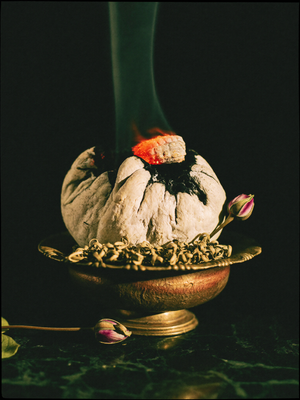
Palo Santo & White Sage Smudge Stick
Rule one of a settled practice is a room that feels finished before you lie down. This is the bundle we reach for — four inches, burns in minutes, no ceremony required. Crack a window and let it move through.
See the bundle — $8.95What is actually happening: the sleep-science layer
During REM sleep, the brainstem actively suppresses voluntary muscle tone. This is not incidental — it is what stops you from physically acting out a dream. Normally that suppression lifts before consciousness returns. Sometimes the order reverses: awareness comes back first, the atonia is still running, and for a few seconds up to a couple of minutes you are awake in a body that will not move.
That is sleep paralysis, and it is common. A 2011 systematic review by Brian Sharpless and Jacques Barber, pooling more than 36,000 people, found a lifetime prevalence of roughly 7.6% in the general population, considerably higher among students and psychiatric populations. Roughly one in thirteen people has had this at least once, most of them without ever practicing anything.
It frequently arrives with company: a crushing weight on the chest, a certainty that someone is in the room, sometimes a shape at the edge of vision. Those are hypnagogic and hypnopompic hallucinations — dream imagery bleeding into a waking visual field. They feel unambiguously real because the machinery generating them is the same machinery that makes dreams feel real while you are inside them.
Anglophone folklore has been describing this for centuries under other names — the Old Hag of Newfoundland tradition, the night hag of British and colonial American accounts, the pressing figure in Fuseli's The Nightmare. Every culture that has looked at this has produced a figure sitting on the sleeper's chest. That consistency is not evidence of an entity. It is evidence that a specific neurological state produces a specific experience in humans, reliably, everywhere.
The risks that are actually worth managing
| Risk | What it looks like | What to do |
|---|---|---|
| Fear during the transition | Vibrations, pressure, roaring, the paralysis itself. The most common reason people quit after one attempt. | Learn what the transition feels like before you try. Expected sensations are far less frightening than ambush. |
| Disorientation afterwards | Ten to thirty minutes of feeling half-here, especially after an intense session. | Ground deliberately: water, food, feet on the floor, daylight. Do not drive straight afterwards. |
| Escapism | The practice starts feeling better than the day. Sessions get longer, life gets thinner. | Honest check-in. If the practice is more attractive than your waking life, the practice is not the problem to solve. |
| Sleep debt | The most effective techniques deliberately fragment the night. Repeated nightly, that is chronic sleep restriction. | Cap attempts at one or two nights a week. Sleep normally the rest of the time. This is the risk beginners most reliably underestimate. |
Who should sit this one out
Most people can practice this without incident. Some should check with a physician first, and the reasons are concrete rather than cautionary boilerplate:
- Narcolepsy — sleep paralysis is part of the condition and far more frequent; deliberately provoking it is not a good idea.
- Untreated sleep apnea — nights are already fragmented; techniques that fragment them further make things worse.
- Seizure disorders — sleep deprivation is a recognized seizure trigger.
- Bipolar disorder — sleep loss is among the best-documented triggers of a manic episode.
- A history of psychosis — vivid, convincing perceptual experiences are worth discussing with your own clinician first.
- PTSD with nighttime symptoms — the paralysis-plus-presence experience can land squarely on existing trauma.
And a general one: this is a practice for a steady stretch of life. In the middle of an acute crisis, grief or burnout, it is the wrong tool.
Seven rules for a stable practice
- Clear the room first. Smoke or spray, open a window, put the phone in another room. The point is partly energetic and entirely practical: you cannot settle in a room that still feels unfinished.
- Set a boundary in words. Picture a sphere of light and say what you mean — "only what is well-meaning comes near." Whether you consider this literal or psychological, stating an intention out loud measurably settles people down before an unfamiliar experience.
- Have one clear intention. Where you want to go, or what you want to see. Aimless attempts produce anxious drifting.
- Never practice frightened, exhausted or altered. Not after a bad day, not on alcohol, not on substances. Calm is the entire prerequisite.
- Know the exit before you need it. One thought about your hands ends it. That single piece of knowledge removes more fear than everything else on this list combined.
- Ground afterwards, on purpose. Water, something to eat, bare feet on the floor, a few minutes outside. Closing the session properly is what prevents the foggy afternoon.
- Keep a log. Date, technique, what happened, how you felt an hour later. Patterns appear within a month — including the pattern of which nights you should not have tried.
Sleep paralysis: what to do in the moment
The thirty-second protocol
- Name it. "This is sleep paralysis. It ends on its own." Naming it is not a platitude — it is the intervention. It converts a terror into a known event.
- Breathe normally. The diaphragm is not affected by the atonia. The feeling of not being able to breathe is the chest wall being unresponsive, not the airway closing.
- Move something small. Do not try to sit up; the large muscles will not answer. One fingertip, one toe, your eyes. Peripheral movement usually breaks the state within seconds.
- Let the figure be a figure. If there is a presence in the room, you do not have to interpret it, banish it or negotiate with it. It resolves when the state does.
- Afterwards, sit up and turn on a light before going back to sleep, or you may drop straight back into it.
If the episodes are frequent, if they are wrecking your sleep, or if dread of them is starting to shape your evenings, that is worth a conversation with a doctor. Sleep paralysis is one of the more treatable things a sleep clinic deals with, and improving sleep hygiene alone reduces it for many people.
The honest summary
Astral projection is not dangerous in the sense the fear market sells. There is nothing to be possessed by, no cord to sever, no lock on the door from the outside. It is, however, a practice that deliberately interferes with sleep, produces experiences that feel unarguably real, and can quietly become a place to hide. Those are ordinary risks, they are manageable, and they are the ones worth respecting.
The people who practice this for years without trouble are not the ones with the most elaborate protection. They are the ones who sleep enough, keep a log, stop when it stops being good, and treat the whole thing as one part of a life rather than an exit from it. If you want to approach the territory from a gentler direction first, lucid dreaming shares much of the same ground with less of the drop.
Frequently asked questions
Is astral projection actually dangerous?
Not in the way the horror-movie version suggests. Experienced practitioners describe it as unremarkable once the entry stops frightening them. The genuine difficulties are psychological and physiological: fear during the transition, sleep paralysis, disorientation afterwards, escapism, and lost sleep from techniques that deliberately interrupt the night.
Can I get stuck outside my body?
No case of it exists outside fiction. In practice the opposite problem dominates: attention snaps back to the body far too easily. A single thought about your hands, a swallow, a deliberate breath — the experience ends. Beginners almost universally complain about how short it is, not how hard it was to return.
What is sleep paralysis and is it harmful?
During REM sleep the body suppresses voluntary muscle movement so you don't act out dreams. Sleep paralysis is that suppression persisting for a few seconds to a couple of minutes while awareness has already returned. It is common — a 2011 systematic review pooling more than 36,000 people put lifetime prevalence at about 7.6% in the general population — self-limiting, and not physically harmful. Frightening is not the same as dangerous.
What do I do while it is happening?
Do not fight the whole body; it will not move. Breathe normally — the diaphragm is unaffected — and move one small peripheral muscle: a fingertip, a toe, the eyes. That usually breaks it within seconds. Telling yourself in advance what it is takes most of the terror out of it the next time.
Who should not practice this?
Anyone with narcolepsy, untreated sleep apnea, a seizure disorder, bipolar disorder, a history of psychosis, or PTSD with nighttime symptoms should talk to a physician first — several of these both raise sleep-paralysis frequency and are worsened by fragmented sleep. The same goes for anyone currently in acute crisis. This is a practice for a stable stretch of life, not a hard one.
Should I stop if it starts scaring me?
Yes, and without treating that as a failure. If dread builds before bed, if sleep is deteriorating, or if you notice yourself preferring the practice to your actual life, take a break of a few weeks. A practice is supposed to add to a life, not quietly replace it.