




Labradorite Meaning, Properties and Why It Flashes
Labradorite is a plagioclase feldspar with a Mohs hardness of 6 to 6.5, first described from the coast of Labrador, Canada, around 1770. Its blue, green and gold flash, called labradorescence, is caused by light interfering in microscopic layers inside the stone, not by pigment, so it does not fade. In modern crystal tradition it is the stone of protection, intuition and change, linked to the third eye chakra. It can be rinsed briefly, but it cleaves, so protect it from knocks. Spectrolite is the Finnish variety; rainbow moonstone is white labradorite. The spiritual meanings are tradition, not proven effects.

Labradorite looks like nothing at all until you tilt it. Then a sheet of electric blue, green or gold slides across a gray stone and vanishes again a few degrees later. That effect has its own name, labradorescence, its own physics, and a northern-lights legend attached to it. In crystal practice labradorite is the stone for people who take on too much from others, and the one handed over at turning points. Here is the full picture: what it is, why it flashes, what tradition says, how to use and care for it, and how to buy a good one from a photo.
Contents
Labradorite is a plagioclase feldspar with a Mohs hardness of 6 to 6.5, first described from the coast of Labrador, Canada, around 1770. Its blue, green and gold flash, called labradorescence, is caused by light interfering in microscopic layers inside the stone, not by pigment, so it does not fade. In modern crystal tradition it is the stone of protection, intuition and change, linked to the third eye chakra. It can be rinsed briefly, but it cleaves, so protect it from knocks. Spectrolite is the Finnish variety; rainbow moonstone is white labradorite. The spiritual meanings are tradition, not proven effects.
Labradorite is a plagioclase feldspar with a Mohs hardness of 6 to 6.5 and two directions of cleavage.
Source/tradition: Mindat.org; Handbook of Mineralogy (Mineralogical Society of America)
Labradorescence is produced by interference of light in alternating microscopic lamellae inside the feldspar, not by pigment.
Source/tradition: Boggild 1924; Bolton et al., physica status solidi 18, 1966
The mineral was first described from the Labrador coast near Nain around 1770; spectrolite was found at Ylamaa, Finland, in 1940.
Source/tradition: Mindat.org; Geological Survey of Finland (GTK)
Oregon sunstone, state gemstone of Oregon since 1987, is a transparent labradorite with copper inclusions.
Source/tradition: Oregon Department of Geology and Mineral Industries
A legend says the northern lights were trapped in the rocks of Labrador until a warrior freed them with his spear, leaving some light in the stone.
Source/tradition: Widely repeated in gem and crystal literature as an Inuit legend; no primary recorded source located
In modern crystal practice labradorite is carried as a boundary stone by people who absorb the moods of others and is assigned to the third eye chakra.
Source/tradition: Contemporary crystal literature
Labradorite shields the aura from other people's energy or strengthens intuition.
Source/tradition: No scientific evidence
Labradorite loses its flash in sunlight.
Source/tradition: Contradicted by the structural origin of the color; no fading mechanism known
VERIFIED = verifiable in scientific or official sources · TRADITIONAL = historically or culturally recorded · LIVED PRACTICE = widely practiced, experiential knowledge · NOT PROVEN = spiritual interpretation, not scientifically established.
At a glance
Mineral: a plagioclase feldspar, between sodium-rich albite and calcium-rich anorthite
Hardness: 6 to 6.5 on the Mohs scale, with two directions of cleavage — hard enough to wear, but it can split on impact
Optical effect: labradorescence: interference of light in microscopic internal layers, not pigment
Main sources: Madagascar, Labrador in Canada, Finland (spectrolite); gem-clear labradorite from Oregon
Traditional meaning: protection of your own energy, intuition, change
Chakra: third eye and throat in modern crystal practice
What labradorite actually is
Labradorite is a feldspar, a member of the most common mineral family in the Earth's crust. More exactly it is a plagioclase, the series that runs from sodium-rich albite to calcium-rich anorthite, and labradorite sits in the middle of the calcium-rich half. Chemically that is a sodium calcium aluminum silicate. It is the main mineral in dark igneous rocks such as gabbro, basalt and anorthosite, which means there is an enormous amount of it in the world. Almost none of it flashes. The gem material is the small fraction in which the crystal happened to cool in exactly the right way.
Its hardness is 6 to 6.5, a little under quartz. The more important number for an owner is the cleavage: like all feldspars, labradorite splits cleanly along two directions that meet at close to a right angle. That is why polished pieces show flat internal planes and hairline cracks, and why a labradorite palm stone dropped on tile tends to break into neat, flat-sided pieces. For the difference between scratching and breaking, see the Mohs scale for crystals.
Why it flashes: labradorescence
The color in labradorite is not in the stone the way green is in malachite. Grind a blue-flashing piece to powder and the powder is gray. The flash is made by structure.
As the crystal cooled, deep underground and very slowly, its sodium-rich and calcium-rich components separated into alternating sheets, each only tens to a couple of hundred nanometers thick. Light entering the stone is partly reflected at every one of those boundaries. Reflections from neighboring sheets overlap, and depending on the spacing, some wavelengths reinforce each other while the rest cancel. Thinner layers return blue; thicker layers return green, yellow, orange and finally red. It is the same physics as the color on a soap bubble or an oil film, repeated through thousands of layers. The Danish mineralogist O. B. Boggild worked out the layered structure in 1924, and that zone of the feldspar series still carries his name.
Two practical consequences follow. First, the flash is directional. The layers lie in one orientation, so the color appears only when light, stone and eye line up, and a cutter's whole job is to put that plane parallel to the face of the piece. Second, the flash does not wear off and does not fade. It is architecture, not dye.
Labrador, Finland, Madagascar, Oregon
Labrador. The stone entered European science around 1770, when Moravian missionaries working among the Inuit on the Labrador coast sent home pieces from Paul Island, near their mission at Nain. The German mineralogist Abraham Gottlob Werner gave it the name that stuck. Labradorite is the official provincial mineral of Newfoundland and Labrador.
Finland. In 1940, soldiers building the Salpa Line fortifications near Ylamaa in southeastern Finland were breaking local rock for anti-tank obstacles and found that it flashed in every color at once. The geologist Aarne Laitakari named it spectrolite. Strictly, spectrolite means labradorite from Finland: a nearly black body with the full spectrum, including the oranges, reds and purples that are scarce elsewhere. The name gets borrowed for any vivid multicolor piece, which is a courtesy, not a locality.
Madagascar. The source of most of what is on the market: palm stones, spheres, hearts, freeforms and beads, typically with a gray-green body and blue to gold flash.
Oregon. An American relative worth knowing. Oregon sunstone, the state gemstone since 1987, is a transparent labradorite from the high desert of Lake and Harney counties. It does not show labradorescence. Its glitter comes from microscopic platelets of native copper inside the crystal, and you can dig your own at the public collection area near Plush.
The names that travel with it
| Sold as | What it is |
|---|---|
| Spectrolite | Labradorite from Ylamaa, Finland; loosely, any full-spectrum piece on a dark body |
| Rainbow moonstone | White, translucent labradorite with blue flash. A feldspar cousin of moonstone, not moonstone itself |
| Black labradorite, "Norwegian moonstone," blue pearl | Larvikite, a Norwegian igneous rock whose feldspar crystals shimmer silver-blue. Handsome, common as countertops, and not labradorite |
| Golden labradorite | Transparent pale-yellow labradorite, faceted; no flash |
| Sunstone (Oregon) | Transparent labradorite with copper inclusions |
The moonstone confusion is explained in detail in moonstone versus rainbow moonstone.
The northern lights legend
The story you will find in nearly every shop description goes like this: the northern lights were once trapped in the rocks along the Labrador coast, until a warrior struck the stones with his spear and set most of the light free. What he could not release stayed behind in the rock as labradorite.
It is a good story, and it is presented everywhere as an Inuit legend. We have looked for the original and can only say what we found: the tale circulates through gem and crystal literature, usually without a named storyteller, community or collector, and we have not been able to trace it to a recorded Inuit source. That does not make it false. It does mean it should be passed on as "a legend told about the stone," not as documented Inuit teaching. If you want to know what the aurora means to Inuit of Nunatsiavut, the people of the Labrador coast are the ones to ask and to read. For the aurora itself, see our note on this month's geomagnetic storm watch.
 |
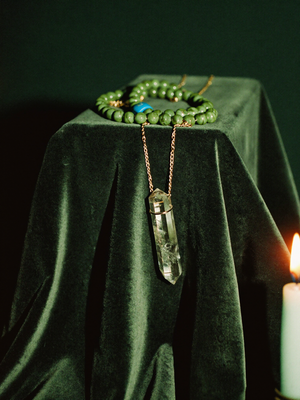
Labradorite you count with Black Onyx, Rose Quartz & Labradorite Mala — 108 Beads, $21.95. Labradorite is the stone tradition gives to people who absorb every mood in the room, and the practice that goes with it is not wearing a shield, it is coming back to your own breath. A mala makes that concrete: 108 beads, one breath each. This one alternates labradorite with black onyx and rose quartz in 8 mm (0.3 in) beads, so the flash turns up every few counts. A tool for a daily five minutes, not a promise that other people will stop being tiring. |
What labradorite means in crystal tradition
Labradorite has no ancient pedigree in European stone lore; it was unknown there before 1770. Its meanings were built in the modern crystal movement, and they follow the stone's behavior closely: something plain that turns luminous when the angle changes.
| Theme | What tradition assigns to it |
|---|---|
| Protection | A boundary around your own energy; the classic stone for people who soak up other people's moods, and for those in caring professions |
| Intuition | Sharper inner perception, vivid dreams, noticing coincidences; linked to the third eye |
| Transformation | Steadiness during a job change, a breakup, a move — the period between two versions of your life |
| Creativity | Getting unstuck; seeing a familiar problem from a new angle |
The chakra assignments are the third eye and, for bluer pieces, the throat. See the third eye chakra explained and the throat chakra explained. It regularly appears on lists of crystals for protection, where we note the same caveat as here: none of them has a measurable shielding effect.
Modern astrology columns pair labradorite with Scorpio, Sagittarius and Aquarius. It is not a traditional birthstone for any month, and the best guide remains the unglamorous one: pick the piece whose flash you keep turning back to.
How people actually use it
- Worn. Pendants and bracelets are the most common form, on the reasoning that a boundary stone belongs on the body. Pendants are the safer choice; a bracelet takes more knocks. See which wrist to wear a crystal bracelet on.
- Carried. A palm stone in a coat pocket for crowded places, difficult meetings, hospital corridors. Touch it, exhale, remember which feelings are yours.
- On a desk. Angled so the flash catches when you look up. People in client-facing or caregiving work use it as a between-appointments reset.
- In meditation. Lying down with the stone on the forehead, or simply held, watching what images come without steering them.
- On the nightstand. For dream recall, with a notebook next to it. The notebook does most of the work.
If you recognize yourself in "takes on everyone's mood," our piece on empath versus highly sensitive person is the useful companion read.
What people often report
We do not print invented testimonials. This is the pattern we see repeatedly in English-language crystal forums, reviews and comment threads, written as typical accounts and attributed to no one:
- Nurses, therapists, teachers and retail workers are overrepresented among people who say they carry one, and they tend to describe it as a reminder to "clock out" emotionally, not as a force field.
- Many say the appeal is simply the flash: turning the stone under a lamp for a minute is calming in itself.
- A frequent disappointment: the piece that arrived looks gray. Usually it is the same stone as in the listing, photographed at its one perfect angle. Sometimes it really is low-grade material.
- A frequent accident: a palm stone or tower dropped once on a hard floor and split along a flat plane.
Care: water, light and knocks
Labradorite is sturdier than the internet suggests in two ways and more fragile in one.
Water. A quick rinse under lukewarm water and a soft cloth is fine; feldspar does not dissolve. What to avoid is long soaking, salt water, hot water and sudden temperature changes, because liquid creeps into the cleavage cracks that almost every piece has, and steam or ultrasonic cleaners can widen them.
Light. The flash is structural and does not fade in sun. There is no pigment to bleach. Guides that warn about sunlight are passing on a general crystal rule that applies to amethyst and rose quartz, not to this stone; see crystals that fade in sunlight. Just do not leave it somewhere it gets hot and then cold.
Knocks. This is the real risk. Keep it off the edge of shelves, do not carry it loose with keys, and store it away from quartz and harder stones, which scratch it; see crystals that should not be kept together.
For energetic cleansing, smoke, sound and moonlight all work without any risk to the stone. How often is up to you; the weekly schedule some books prescribe is a habit, not a requirement. More in how to cleanse crystals.
Buying labradorite: what to look for
Outright fake labradorite is uncommon, because the real thing is plentiful and the effect is hard to copy. The buying problems are about grade and naming.
- Ask for a video. A still photo shows the one angle where the flash is strongest. Ten seconds of the piece being turned under a single light shows how much of the face lights up and from how many angles.
- Coverage beats color. A good piece flashes across most of its face. A weak one has a small patch surrounded by dead gray.
- Know the color ladder. Blue and green are the most common. Gold and orange are less so. Purple, pink and red are scarce and priced up.
- Expect lines. Straight internal lines and stripes of dark and light are twinning and cleavage planes, a normal part of the mineral. Open cracks that catch a fingernail are a durability problem.
- Check the name. "Black labradorite" with a silvery glitter in separate grains is probably larvikite. "Spectrolite" should mean Finland; ask.
- Be wary of rainbow coatings. A uniform metallic rainbow over the whole surface, from every angle, is a vapor-deposited coating on quartz or glass, as explained in aura quartz: how it is made. Real labradorescence switches on and off.
What we do not promise
Labradorite is not a shield and not a treatment. Its mineralogy and optics are checkable; its meanings are modern tradition and lived practice, and that is how we present them. No stone stops other people's moods from reaching you, sharpens intuition on its own or carries you through a major change. If exhaustion from caring for others has become your normal, that is burnout territory and worth raising with a doctor or therapist. If you are in crisis in the U.S., you can call or text 988 at any time. What a labradorite can honestly do is give you a small, beautiful reason to pause and check which feelings are actually yours.
Frequently asked questions
What is labradorite good for?
In crystal tradition labradorite is a stone of protection, intuition and transformation. It is recommended to people who absorb the moods of others and to anyone going through a major change, and it is linked to the third eye chakra. These are modern traditional meanings and lived practice, not proven effects.
Why does labradorite flash?
The effect is called labradorescence. Inside the feldspar are alternating microscopic layers of slightly different composition. Light reflecting from those layers interferes with itself, strengthening some colors and canceling others. Thinner layers give blue, thicker ones green, gold or red. It is structural color, like a soap bubble, not pigment.
Can labradorite go in water?
A brief rinse in lukewarm water is fine, and the stone does not dissolve. Avoid long soaking, salt water, hot water, steam and ultrasonic cleaners, because labradorite has cleavage planes and fine cracks that water and heat can open up.
Does labradorite fade in sunlight?
No. The flash comes from the internal layer structure of the stone, not from a pigment, so sunlight does not bleach it. Avoid strong heat and rapid temperature swings, which can stress the cleavage planes.
Which chakra is labradorite associated with?
Mainly the third eye chakra, for intuition and inner sight. Blue-flashing pieces are also used for the throat chakra. These assignments come from modern Western crystal practice.
What is the difference between labradorite and spectrolite?
Spectrolite is the trade name for labradorite from Ylamaa in Finland, found in 1940. It has a very dark body and flashes in the full spectrum, including orange, red and purple. Ordinary labradorite, mostly from Madagascar, usually shows blue, green and gold on a gray body.
Is rainbow moonstone the same as labradorite?
Mineralogically, yes: rainbow moonstone is a white, translucent variety of labradorite with blue flash. True moonstone is a different feldspar, orthoclase, with a softer, floating glow called adularescence.
Sources and further reading
- Mineralogy: labradorite as a plagioclase feldspar, Mohs 6 to 6.5, two cleavages; Mindat.org and the Handbook of Mineralogy (Mineralogical Society of America).
- Structure behind the color: O. B. Boggild, "On the labradorization of the feldspars," Det Kongelige Danske Videnskabernes Selskab, Mathematisk-fysiske Meddelelser, 1924; H. C. Bolton, L. A. Bursill, A. C. McLaren and R. G. Turner, "On the origin of the colour of labradorite," physica status solidi, vol. 18, 1966.
- Discovery on the Labrador coast around 1770 and the type locality at Paul Island near Nain: Mindat.org locality record; Geological Survey of Newfoundland and Labrador.
- Spectrolite, Ylamaa, 1940, named by Aarne Laitakari: Geological Survey of Finland (GTK).
- Oregon sunstone as copper-bearing labradorite, state gemstone 1987: Oregon Department of Geology and Mineral Industries; Bureau of Land Management, Sunstone Public Collection Area.
- Larvikite: Geological Survey of Norway (NGU).
- Rainbow moonstone as labradorite: GIA gem encyclopedia, moonstone and labradorite entries.
- In the magazine: Moonstone vs. rainbow moonstone · Crystals for protection · Third eye chakra · How to cleanse your aura · Crystal meanings chart
- Questions about an order or a product: 28@templeofdesire.com
The spiritual meanings in this article are tradition and lived practice, not scientifically proven, and they are no substitute for medical care.