




Libra Season 2026: Dates, Meaning & What to Expect


In American time zones, Libra season starts on the evening of Tuesday, September 22, 2026 — not the 23rd, which is the date most calendars print. This is the full run of dates for the next four weeks in Eastern and Pacific time, what the equinox and the sign change actually have to do with each other, and what Libra stands for in the tradition: not harmony, but the act of weighing.
Contents
In US time zones Libra season 2026 begins on the evening of Tuesday, September 22 at 8:05 p.m. Eastern (5:05 p.m. Pacific) and runs to about October 23. Calendars printing September 23 are using Universal Time, where the same instant is 00:05 UTC on the 23rd; both dates describe one moment. The Sun entering Libra and the fall equinox are the same event, because the tropical sign begins exactly where the Sun reaches 180 degrees of ecliptic longitude and crosses the celestial equator. Two moon dates fall inside the season: the Full Moon in Aries on September 26 at 12:44 p.m. Eastern, and the New Moon in Libra on October 10 at 11:50 a.m. Eastern, which ritual tradition treats as the real starting line. Libra is the only zodiac sign that is an object rather than a living being -- a tool that can do nothing but compare -- and it was carved out of the Scorpion's claws, which is why its brightest stars are still called the northern and southern claw. The traditional themes are relationship, negotiation, contracts and form, with harmony-as-avoidance as the named shadow. None of that is a measurable effect; what does hold up is that committing to a specific date makes people more likely to follow through.
The September 2026 equinox occurs at 00:05 UTC on September 23, which is 8:05 p.m. EDT and 5:05 p.m. PDT on September 22.
Source/tradition: Astronomical calendar data for the 2026 September equinox; conversion to US Eastern and Pacific time.
The Sun entering tropical Libra and the September equinox are the same instant, because the sign begins where the Sun reaches 180 degrees of ecliptic longitude.
Source/tradition: Definition of the tropical zodiac in positional astronomy.
Because of precession, the Sun stands in front of the constellation Virgo during Libra season, not Libra.
Source/tradition: Precession of the equinoxes; roughly thirty degrees of offset between tropical signs and constellations.
Libra's brightest stars are named Zubeneschamali and Zubenelgenubi, Arabic for the northern and southern claw, retained from when this region of sky belonged to Scorpio.
Source/tradition: Star names of Beta and Alpha Librae; the constellation was separated from the Scorpion's claws.
Libra is the only sign of the zodiac represented by an object rather than an animal or human figure.
Source/tradition: Composition of the twelve tropical zodiac signs.
Committing to a specific date and place for an intended action measurably increases follow-through.
Source/tradition: Gollwitzer & Sheeran (2006), meta-analysis of 94 studies on implementation intentions, Advances in Experimental Social Psychology 38, 69-119.
Libra is ruled by Venus and its weeks are held to favour negotiation, contracts, and matters of form and taste.
Source/tradition: Classical rulership doctrine of Western astrology.
The New Moon in Libra on October 10 is treated as the season's starting point for beginnings and intentions.
Source/tradition: Widespread ritual practice of working new moons as points of initiation.
The Sun's zodiacal position influences how conversations, contracts or relationships turn out.
Source/tradition: No known physical mechanism and no better-than-chance results in studies of astrological interpretation.
A zodiac season affects a person according to their sun sign.
Source/tradition: Even within the astrological model the relevant factor is the house position, which depends on birth time; no external evidence for sun-sign effects.
VERIFIED = verifiable in scientific or official sources · TRADITIONAL = historically or culturally recorded · LIVED PRACTICE = widely practiced, experiential knowledge · NOT PROVEN = spiritual interpretation, not scientifically established.
Why your calendar says the 23rd and your sky says the 22nd
At 8:05 p.m. Eastern on Tuesday, September 22, 2026, the Sun reaches the point where its apparent geocentric longitude is exactly 180 degrees. At that same moment it crosses the celestial equator heading south. Astronomically, fall begins. Astrologically, Libra season begins — the same instant, because the tropical sign Libra is defined as the twelfth of the Sun's path that starts at exactly that point.
That works out to 5:05 p.m. Pacific, and to 00:05 Universal Time on September 23. This is the reason you will find both dates in print. Almanacs and astronomy sites that publish in UTC say September 23; anything computed for a U.S. time zone says September 22. Neither is wrong. If you are reading this anywhere in the contiguous United States, your equinox is Tuesday evening.
It is worth being clear about one more thing, because it is where most of the confusion around zodiac seasons lives: the Sun is not in front of the constellation Libra during Libra season. Precession of Earth's axis has shifted the signs and the constellations against each other by roughly thirty degrees over two thousand years. Step outside on October 1 and the Sun is against the stars of Virgo. Western astrology tracks the solar year, not the stellar background. Both systems are internally consistent. They are simply two different things.
What does change is something you can feel without a calendar. Day and night are close to equal, and from here the ratio tips for good. Libra season is the only stretch of the year that opens on a balance which is immediately lost again. It would be hard to invent a better image for the sign.
The four dates of Libra season 2026
Four weeks, four dates worth putting in your calendar. All times are U.S. Eastern with Pacific in parentheses.
| Date (ET) | Event | Why it matters |
|---|---|---|
|
Tue, Sep 22, 8:05 p.m. (5:05 p.m. PT) |
Sun enters Libra | Fall equinox. The season opens. |
|
Sat, Sep 26, 12:44 p.m. (9:44 a.m. PT) |
Full Moon in Aries | The first full moon of the season sits exactly opposite, on the Libra–Aries axis. |
|
Sat, Oct 10, 11:50 a.m. (8:50 a.m. PT) |
New Moon in Libra | The traditional starting line for anything meant to begin in this window. |
| Around Fri, Oct 23 | Sun enters Scorpio | Season ends. Mercury turns retrograde in Scorpio shortly after. |
The full moon on October 26 is already in Taurus and falls outside this window. If you want the whole retrograde picture for the fall, we have written up Mercury retrograde 2026 separately, and the mechanics of retrograde motion in what retrograde actually means.
The only sign that isn't alive — and the proof is still in the star names
Eleven zodiac signs are animals or people. One is an object. Libra is a tool, and a tool that can do nothing except compare.
That is not a footnote, it is the whole interpretation in one sentence. A balance scale produces nothing, owns nothing, wants nothing. It reports a ratio. And it only reports anything once there is something in both pans. Alone, a scale is meaningless.
This is why Libra is the sign of relationship in the astrological tradition — not romance first, but relationship in the literal sense: what arises between two things. It governs the seventh axis of the chart, the house of the other person. And it sits opposite the axis that begins with Aries: "I want" on one side, "and you?" on the other.
Libra is also a latecomer, and the evidence is still overhead. In the oldest Babylonian zodiacs this stretch of sky belonged to the Scorpion's claws; the Romans made it an independent Libra. The star names never caught up. Libra's two brightest stars are still called Zubeneschamali and Zubenelgenubi — Arabic for the northern claw and the southern claw. The scales are wearing the scorpion's hand-me-downs, and you can look it up in any star atlas. The section was named for the calendar, not for a picture in the sky: it fell on the equinox, the day of the level pans.
Venus rules Libra — and what that means in practice
Libra is traditionally assigned to Venus, the second of the two signs she rules. In Taurus, Venus shows up as pleasure, possession, the senses. In Libra she shows up as form: taste, tone, aesthetics, diplomacy. Same force, the airier and cooler half of it.
In practice that turns out to be less esoteric and more ordinary than people expect. Weeks assigned to this sign are traditionally held to suit anything negotiated between people: the conversation you owe someone. The contract that has been sitting on the table too long. The agreement you keep pushing out. And anything to do with form — the apartment you have been meaning to make nice, the clothes, the way you show up.
It matters to say plainly that these are the assignments of a centuries-old symbolic language, not measurable effects. They are still not useless. A window of time in which you have decided to have a particular conversation works — not because of where the Sun is, but because you gave yourself a date. Anyone working honestly with astrology knows which part is which.
From the temple

Libra Scales Zodiac Spell Candle — $22.95
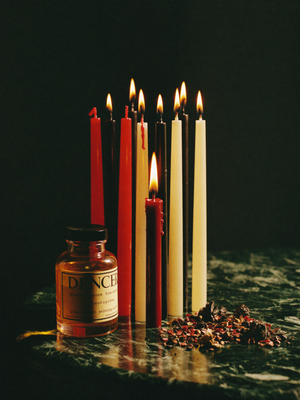
If you want something to mark the four weeks with rather than just a note in your calendar, this is what we use: a beeswax candle in the shape of the scales. Light it when you sit down to write the first sentence of the conversation you have been postponing. It does not make the conversation go well. It makes the appointment harder to ignore.
See the Libra candleFull Moon in Aries, September 26: the opposite pan
Four days after the season opens, the Moon stands exactly opposite the Sun — Sun in Libra, Moon in Aries. Full moons always fall in the opposite sign, and this is one of the clearest axes in the zodiac.
Aries is the beginning, the impulse, the unfiltered "I." Libra is consideration, negotiation, the "we." When both are lit at once, what often becomes visible is where somebody has drifted too far onto one side over a period of months. In practice this is the full moon at which people notice they have been putting themselves last in a relationship, a job or a friendship for a long time — or the reverse, that they have been moving at a speed that leaves everyone behind.
That is not a prediction. It is an image made available on a marked date. What you look at with it is up to you.
New Moon in Libra, October 10: the actual starting line
If you want to begin something this season, Saturday, October 10 at 11:50 a.m. Eastern is the moment the tradition points to. New Moon and Sun are both in Libra, the sign is doubly emphasized, and in ritual practice the new moon has always been the point for beginnings and intentions.
What fits this window follows from the sign itself: anything two-sided. Starting a conversation instead of planning it. Renegotiating an arrangement. Deciding something you have been weighing for months. Ending things belongs here too — a scale that stays permanently suspended has not done its job.
The shadow side: when weighing becomes avoiding
No sign is described so kindly and so rarely honestly. Libra gets called charming, balancing, diplomatic. The shadow of those qualities can be named precisely, and in practice it is the single most common theme there is.
Harmony as avoidance. Someone who reliably smooths conflicts is not having them. What is not had, stays. The friendliest person in the room is sometimes the one who has been carrying something around longest.
The endless weighing. A scale in motion is a scale that gives no answer. In practice this shows up as indecision that presents itself as thoroughness. At some point the weighing is itself the decision — for nothing.
Disappearing into the other person. The sign of relationship has a characteristic failure mode: looking at the far pan so long that your own is empty. If you notice during Libra season that you have no honest answer to "and what do you want?", you have found the real subject of the four weeks.
The part that actually holds up
Here is the honest division, because it is the most useful thing in this article.
There is no demonstrated connection between the Sun's position in the zodiac and how a conversation, a contract or a relationship turns out. What the season offers is a marked window.
The marked window, though, is not nothing — and this is the one piece of the practice with real research behind it. Psychologists call it an implementation intention: committing in advance to a specific when and where for an action, rather than just intending to do it. A large meta-analysis by Peter Gollwitzer and Paschal Sheeran, covering 94 studies, found a medium-to-large effect on whether people actually follow through. Setting the date is doing real work. The Sun is not.
Which means the useful way to read a zodiac season is roughly: the sky supplies the calendar entry, you supply everything else. That is a smaller claim than most astrology writing makes, and it is the one that survives contact with evidence.
What the season means if you're not a Libra
A solar transit does not only concern people born under the sign. In classical interpretation the Sun moves through a particular house of your chart — and which house that is depends on your rising sign, not your sun sign. This is the reason newspaper horoscopes miss so often.
As a rough orientation without a birth time: for Libras it is their own season, traditionally tied to new beginnings and a personal turn of the year. For Aries, the other person is in the light — partnership, contracts, unfinished business with someone. For Cancer and Capricorn the axis touches home and career instead. For the air signs Gemini and Aquarius the weeks usually run easier, because the element is familiar.
Anything more precise needs a full birth chart with date, time and place. Everything short of that is a very rough approximation, and it should be treated as one.
What we don't promise
We do not promise you that these four weeks will run differently from any others. There is no established link between the Sun's zodiacal position and the outcome of conversations, contracts or relationships.
We do not promise you a prediction. A transit describes a theme, not an event. Anyone who tells you what will happen to you in October is claiming more than the method can deliver.
We do not promise any health or psychological effect. If a relationship is making you ill, if a decision has been paralyzing you for months, or if exhaustion will not lift, that belongs with a professional. A new moon date does not replace therapy or legal advice.
What we can tell you: tying an intention to a date you did not invent yourself changes the odds that you act on it. That is very little in astronomical terms and quite a lot in practical ones.
How to actually use it
Put in four dates, not forty. September 22, September 26, October 10, around October 23. A calendar full of astrological entries gets ignored.
Pick one thing, not five. One conversation, one contract, one decision. Using Libra season to "sort out all my relationships" reliably ends with none of them sorted.
Write the first sentence down in advance. Not the whole conversation — just the opening. That is the part most attempts die on.
Give the weighing an end date, not another criterion. If you are undecided, one more comparison will not help. October 10 is convenient because it is already marked.
And check honestly at the end whose pan was full. Around October 23, look back at the four weeks: where did you give way, and was it worth it to you? That question is the actual yield of the season.
Frequently asked questions about Libra season 2026
When exactly does Libra season 2026 start and end?
The Sun enters Libra on Tuesday, September 22, 2026 at 8:05 p.m. Eastern (5:05 p.m. Pacific), which is 00:05 UTC on September 23 — the reason you will see both dates published. That is the same moment the Sun crosses the celestial equator and astronomical fall begins. It leaves the sign for Scorpio around October 23. The exact crossing shifts by a few hours each year because the solar year is not exactly 365 days.
Is the fall equinox 2026 on September 22 or September 23?
Both, depending on where you are. The instant is 00:05 UTC on September 23, which lands on the evening of September 22 in every U.S. time zone: 8:05 p.m. Eastern, 5:05 p.m. Pacific. Sources publishing in Universal Time say the 23rd; sources computed for the United States say the 22nd. It is one moment with two local dates, not a disagreement.
Why does Libra season begin on the equinox?
Because they are the same point. The tropical sign Libra begins by definition where the Sun reaches 180 degrees of ecliptic longitude, and that is exactly where it crosses the celestial equator. The zodiac of Western astrology is anchored to the solar year, not to the background stars. Historically the section probably got its name for that reason: after the level pans of day and night.
Is the Sun actually in the constellation Libra?
No. Precession of Earth's axis has shifted the signs and the constellations about thirty degrees apart over the millennia. During Libra season the Sun is in front of the stars of Virgo. This is not an error in astrology; it follows from Western astrology working with the solar year rather than the fixed stars.
Which moon dates fall in Libra season 2026?
Two. The Full Moon on Saturday, September 26 at 12:44 p.m. Eastern is in Aries, exactly opposite the Sun on the Libra–Aries axis. The New Moon on Saturday, October 10 at 11:50 a.m. Eastern is in Libra itself and counts in ritual tradition as the season's real starting point. The Full Moon of October 26 is already in Taurus and falls outside the window.
What does Libra stand for in astrological interpretation?
For the ratio between two things. Libra is the only zodiac sign that is not a living being but a tool — one that can do nothing except compare. Hence the classic assignments: relationship, negotiation, contracts, form and taste, ruling planet Venus. The shadow is named just as clearly: harmony used as avoidance, and weighing that turns into evasion.
Does Libra season apply to me if I'm not a Libra?
Yes, but in a different place. In classical interpretation the Sun moves through a particular house of your chart, and which house depends on your rising sign — that is, on your birth time, not your sun sign. This is exactly why newspaper horoscopes miss so often. Without a full birth chart, any statement stays a rough approximation.
Sources & further reading
- Time of the September 2026 equinox: 00:05 UTC on September 23, equivalent to 8:05 p.m. EDT and 5:05 p.m. PDT on September 22. Definition of the equinox via the Sun's apparent geocentric longitude of 180 degrees.
- Moon phase data for 2026: Full Moon September 26 at 12:44 p.m. EDT in Aries; New Moon October 10 at 11:50 a.m. EDT in Libra; Full Moon October 26 in Taurus.
- Star names of Libra: Beta Librae Zubeneschamali ("northern claw") and Alpha Librae Zubenelgenubi ("southern claw"), retained from the period when this region of sky belonged to the Scorpion's claws.
- On precession and the offset between the tropical zodiac and the constellations: standard positional astronomy.
- On implementation intentions and follow-through: Gollwitzer, P. M., & Sheeran, P. (2006), meta-analysis of 94 studies, Advances in Experimental Social Psychology 38, 69–119.
- Further reading: Mercury retrograde 2026 dates · What retrograde actually means · How to work a new moon · Is Mabon actually ancient? · Fall equinox 2026: date, time and a Mabon ritual
More from Astrology & Zodiac
All stories →
NOAA Issues G1 Geomagnetic Storm Watch for October 2: Auroras Possible Across the Northern U.S.

Jupiter Retrograde 2026 and 2027: Dates, Degrees and the Shadow Period