




Fall Equinox 2026: Date, Time and a Mabon Ritual


Contents
The fall equinox 2026 falls on the evening of Tuesday, September 22 across the United States — 8:05 PM Eastern, 7:05 PM Central, 6:05 PM Mountain, 5:05 PM Pacific — which is 00:05 UTC on September 23. At that moment the sun crosses the celestial equator heading south and enters Libra. Day and night are not exactly equal: in the continental US daylight still runs about seven to nine minutes longer, because sunrise and sunset are timed from the sun's upper edge and atmospheric refraction keeps it visible longer; the genuinely equal day, the equilux, comes a few days later. The name Mabon comes from Mabon ap Modron in medieval Welsh literature but was attached to this festival only in 1974 by the American author Aidan Kelly. It is kept as the second harvest — apples, grapes, nuts, grain — with a written look back over the year and a gesture of thanks.
The fall equinox 2026 occurs at 00:05 UTC on September 23, which is the evening of September 22 across all United States time zones; at that moment the sun crosses the celestial equator from north to south and enters the sign of Libra.
Source/tradition: Astronomical ephemerides for 2026
Day and night are not exactly equal at the equinox: in the continental United States daylight still runs roughly seven to nine minutes longer, because sunrise and sunset are defined by the sun's upper limb and atmospheric refraction keeps it visible after it is geometrically below the horizon. The day of truly equal light and dark, the equilux, falls a few days later depending on latitude.
Source/tradition: Standard astronomical definition of sunrise and sunset; refraction correction
Mabon ap Modron is a figure of medieval Welsh narrative literature, appearing above all in Culhwch ac Olwen in the Mabinogion; the name means roughly son of the mother.
Source/tradition: Culhwch ac Olwen, Mabinogion; standard Celtic studies literature
The name Mabon was given to the autumn festival of the neopagan year by the American author Aidan Kelly in 1974, together with Ostara and Litha; no pre-modern connection between Mabon ap Modron and the equinox is documented.
Source/tradition: Aidan Kelly's own account; scholarly discussion of the history of modern paganism
The eight-fold Wheel of the Year was assembled in the 1950s around Gerald Gardner and Ross Nichols by combining four attested Irish festivals with the four astronomical solar points.
Source/tradition: Religious-historical accounts of the emergence of Wicca and modern druidry
Building a harvest altar with apples, grain, nuts and two candles, and writing a year-in-review at the equinox, is widespread practice today.
Source/tradition: Lived practice in neopagan and spiritual circles
A ritual performed at the equinox works more strongly than on any other day, or gratitude practice heals physical or psychological illness.
Source/tradition: No evidence of efficacy; persistent symptoms belong with a physician or psychotherapist
VERIFIED = verifiable in scientific or official sources · TRADITIONAL = historically or culturally recorded · LIVED PRACTICE = widely practiced, experiential knowledge · NOT PROVEN = spiritual interpretation, not scientifically established.
The fall equinox is the one hinge in the year that nobody has to take on faith. The sun crosses the celestial equator heading south, the northern hemisphere tips into its dark half, and from that evening on the nights are longer than the days until spring. Everything else about the holiday is interpretation. That part is astronomy.
Here is when it happens in your time zone in 2026, what actually occurs that day (including the thing the name gets wrong), where "Mabon" really comes from — a shorter story than you have been told — and a ritual you can run in about forty-five minutes with things already in your kitchen.
The short version
In 2026 the fall equinox lands on the evening of Tuesday, September 22 across the United States — 8:05 PM Eastern, 5:05 PM Pacific — which is 00:05 UTC on September 23. The sun crosses the celestial equator southbound and enters Libra. Day and night are not equal that day; in the continental US daylight still wins by roughly seven to nine minutes. The name Mabon comes from the Welsh figure Mabon ap Modron but was attached to this festival only in 1974, by the American author Aidan Kelly. It is celebrated as the second harvest — apples, grapes, nuts, grain — with a look back over the year and a gesture of thanks.
When it happens where you are
| Time zone | Local date and time |
|---|---|
| Eastern (EDT) | Tuesday, September 22 · 8:05 PM |
| Central (CDT) | Tuesday, September 22 · 7:05 PM |
| Mountain (MDT) | Tuesday, September 22 · 6:05 PM |
| Pacific (PDT) | Tuesday, September 22 · 5:05 PM |
| Alaska (AKDT) | Tuesday, September 22 · 4:05 PM |
| Hawaii (HST) | Tuesday, September 22 · 2:05 PM |
| Coordinated Universal Time | Wednesday, September 23 · 00:05 UTC |
Convenient timing for once: on the East Coast the exact moment falls after dinner and before bed. You can light the candle at the actual instant, which is not something the calendar usually offers.
After 2026 — and why this page still works. The equinox is an instant, not a day, and it drifts roughly five hours and forty-nine minutes later each year until a leap year pulls it back. In 2027 it falls at about 06:00 UTC on September 23 — around 2 a.m. Eastern on the 23rd, but still late on the evening of September 22 on the West Coast. Published times vary by a few minutes between sources; the split date is normal and will keep recurring.
Everything below the dates — the history, the altar, the ritual — is not tied to the exact minute. As we say further down, nothing about this works better at 8:05 p.m. than it does three days later. For the full run of dates in the weeks that follow, see Libra season 2026.
Two things not to confuse it with. Meteorological fall began on September 1 — a bookkeeping convention so weather agencies can compare whole months, unrelated to the sun. And the harvest moon, the full moon nearest the equinox, is a separate event on its own schedule.
What actually happens that day
The name overpromises. Equinox means equal night, and day and night are not equal on it.
Across the continental United States, the daylight on September 22 still runs about seven to nine minutes longer than the darkness. Two causes, both structural:
- The definition. Sunrise is logged the instant the sun's upper edge clears the horizon and sunset the instant that same edge disappears. Half a solar disk gets counted as daytime at each end of the day.
- Atmospheric refraction. The atmosphere bends incoming light, so the sun stays visible for several minutes after it has geometrically already set. The day gets stretched at both ends.
The day when light and dark genuinely balance has its own name — the equilux — and it arrives a few days after the equinox, later the farther north you are. In Miami it comes sooner; in Seattle, later. So if you want the literally balanced day, you get to observe twice. If you want the symbolically balanced one, observe once and know why.

For the smoke part of the evening
Cedar, Orange & Cinnamon Smudge Stick
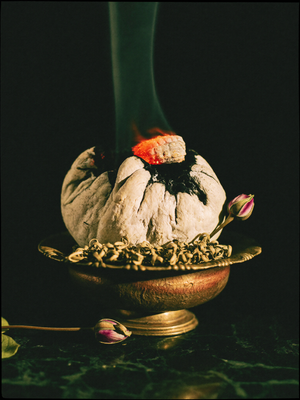
Cedar, orange peel and cinnamon — the scent profile the season already smells like, in a four-inch bundle. Light it once before you set the table and let the room change. Open a window; skip it entirely if anyone in the house has asthma.
See the bundle — $7.95Where the name Mabon comes from
Nearly every page on this subject copies the same sentence: Mabon is an ancient Celtic harvest festival. It is not, and the real story is more interesting.
Mabon ap Modron is a genuine figure of medieval Welsh literature — the name means roughly "son of the mother," the divine son of the divine mother. He appears in the Mabinogion, most substantially in the tale of Culhwch ac Olwen: taken from his mother as an infant, imprisoned for years, and finally located and freed with the help of the oldest animals in the world. A story about loss, darkness and return — but not a story about the harvest, and not connected to the equinox in any medieval source.
That connection was made in the twentieth century, in California. The American author Aidan Kelly has described naming three of the neopagan year's festivals in 1974, festivals that until then were simply called "solstice" and "equinox": Ostara, Litha and Mabon. For the autumn one he wanted a myth structured like the Greek Persephone story — abduction, time in the underworld, return — and Mabon ap Modron fit.
This is not a scandal. It is how religion has always worked: tradition happens because somebody makes it. But it does change the honest sentence. "People have celebrated Mabon for thousands of years" is false. "People have marked the equinox under this name for about fifty years, and the choice of a myth about darkness and return was a good one" is true, and better. We took this apart in more detail in is Mabon actually ancient?
How the eight-spoke year came together
The Wheel of the Year that nearly every modern witch and druid uses is likewise a twentieth-century construction. It combines four attested Irish festivals — Imbolc, Beltane, Lughnasadh, Samhain — with the four astronomical points of the solar year: two solstices, two equinoxes. The assembly happened in 1950s Britain, around Gerald Gardner (Wicca) and Ross Nichols (Order of Bards, Ovates and Druids). The individual sources are real; the even eight-fold rhythm is modern. Our overview of the eight sabbats lays out the full circle.
The American harvest calendar this drops into
Worth noticing if you are marking this in the United States: late September is a genuinely empty slot here. The old English-speaking harvest observance closest to it, Michaelmas on September 29, faded from American life a long time ago. Our national harvest feast, Thanksgiving, sits in late November — long after the actual harvest, and built around a very different story.
What fills September instead is regional and secular: county and state fairs, apple picking, the first cider of the year, the corn maze, the first night the porch is too cold to sit on. Mabon lands in a gap the American calendar leaves open, which is part of why it took hold here. And it sits perfectly comfortably next to a church harvest service or a fair on the same weekend. These are the same gesture in different registers.
What the day is actually about
Balance, and the moment just after it. Twice a year the scale is level, and then it tips. After the equinox the nights are longer than the days and stay that way until spring. The content of the day is not the balance — it is the last moment of it.
The second harvest. In the neopagan calendar Lughnasadh in early August is the first harvest (grain), Mabon the second (fruit, wine, roots), Samhain the third and last (meat, stores). The three-part scheme is a modern tidying, but it maps decently onto what ripens when across most of the US.
Thanks — as accounting, not obligation. The honest question is not what you are grateful for in the abstract. It is: what actually grew this year? What did I plant and not harvest? What comes with me into the winter, and what stays here?
The turn inward. Mabon is where a lot of people's practice rotates from outward to inward — from projects and visibility toward review, clearing out and shadow work.
The altar
Nothing on this list needs to be bought. It is a table of what is outside right now.
- Colors: rust, ocher, gold-brown, deep green, wine red.
- Fruit: apples — cut one crosswise so the five-pointed star in the core shows — grapes, blackberries, elderberries, rose hips.
- From the field: wheat or barley stalks, an ear of corn, sunflower seeds.
- From the woods: acorns, chestnuts, hickory nuts, turned leaves, a piece of bark.
- Roots and squash: carrots, beets, a small pumpkin or a delicata.
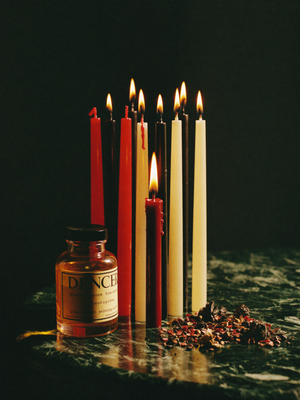
- Two candles: one light, one dark — for what has been and what is coming.
- A vessel: bowl, pitcher or cup for cider, juice or wine.
Gather what you can yourself. A walk taken specifically to look is already half the ritual. And leave things where you find them if there is not plenty — never strip a bush, and check the rules before foraging on public land.
An equinox ritual, step by step
Budget about forty-five minutes. You need: two candles (one light, one dark), an apple, a knife, a sheet of paper, a pen, a bowl, and something to drink.
- Set up. Candles side by side, light one on the left, dark on the right. Air out the room. Everything with a screen goes off. Sit down and take ten slow breaths before you light anything.
- The light candle. Light it and say out loud what grew this year. Not what you intended — what is actually there. Small things count. Unspectacular things count double.
- Cut the apple. Crosswise, so the star in the core is visible. Eat half of it slowly. The other half goes in the bowl, as the portion that is not yours.
- Write the review. Two columns. Left: what comes with you into the winter. Right: what stays here. Take real time over this. The right column is the harder one, which is why it is the point.
- The dark candle. Light it from the light one — the dark half of the year comes out of the bright one, not against it. Read the right column aloud and after each item say: "This stays here."
- Drink. A mouthful of cider, juice or wine. A splash into the bowl.
- Close. Put out the light candle first; let the dark one burn five minutes longer, then put that out too. Keep the paper until Samhain.
- The next morning. Take what is in the bowl outside — under a tree, at the edge of a field, into the compost. No plastic, nothing cooked, nothing salted.
Candle safety: never leave a flame unattended, use a heatproof surface, and keep distance from curtains and dry material. Dried wheat on an altar looks wonderful and burns extremely well. Give it room.
Smoke, food and drink
Resinous and warming notes suit the season: frankincense, myrrh, benzoin, with mugwort, sage, rosemary, cedar and a little cinnamon or clove. Use less than you think, open a window, and skip it entirely if anyone in the house has asthma or a respiratory condition. Our guide to what to burn for Mabon, Samhain and Yule goes through the dark half of the year in order.
On the table: whatever is being harvested near you. Baked apples, a plum cake, squash soup, bread with nuts, roasted root vegetables, cider. A second-harvest feast is cooked from what is there, not from a shopping list. And it is a lovely habit to set one more place than you need — for the people who are gone, or for whoever turns up unannounced.
If you have twenty minutes and no altar
Light one candle. Say one thing that grew and one thing you are putting down. Cut an apple crosswise, eat half, leave the other half outside in the morning. That is the ritual with the ornament stripped off, and it does the same work. Living in a small apartment is not a disqualification — our piece on celebrating Mabon in a small apartment was written for exactly that.
One last honest note: nothing about a ritual works better on September 22 than it would on September 25, and gratitude practice does not treat illness. What the date gives you is a reason to sit down and count, at the one moment in the year when the sky is visibly doing the same thing. That is enough. Next stop on the wheel is Samhain.
Frequently asked questions
When exactly is the fall equinox in 2026?
The moment is 00:05 UTC on September 23, 2026 — which across the United States falls on the evening of Tuesday, September 22: 8:05 PM Eastern, 7:05 PM Central, 6:05 PM Mountain, 5:05 PM Pacific, 2:05 PM in Hawaii. Anyone in the US who marks it on the 22nd is marking it correctly.
Are day and night actually equal on the equinox?
No, and by a bigger margin than most people expect. Across the continental US the equinox day still runs roughly seven to nine minutes longer than the night. Two reasons: sunrise is timed from the moment the sun's upper edge appears, so half a solar disk gets counted as daylight, and atmospheric refraction keeps the sun visible for a few minutes after it is geometrically below the horizon. The genuinely equal day, the equilux, comes a few days later depending on your latitude.
Is Mabon an ancient Celtic harvest festival?
No, and this is the most-repeated error on the subject. Mabon ap Modron is a real figure from medieval Welsh literature, but nothing pre-modern connects him to the equinox. The American author Aidan Kelly gave the autumn festival that name in 1974, along with Ostara and Litha. The observance is roughly fifty years old under this name.
What goes on a Mabon altar?
Whatever is actually ripe near you. Apples — one cut crosswise so the five-pointed star in the core shows — plus grapes, nuts, acorns, wheat, turning leaves, root vegetables, a small squash. Two candles, one light and one dark. A cup for cider. Nothing on that list needs to be bought.
What is the difference between the astronomical and meteorological start of fall?
Meteorological fall began on September 1. That is a bookkeeping convention so climate records can be compared in whole months; it has nothing to do with where the sun is. The astronomical season starts at the equinox itself.
What should I actually do if I only have twenty minutes?
Light one candle. Say out loud one thing that grew this year and one thing you are leaving behind. Cut an apple crosswise, eat half, and put the other half outside the next morning. That is the whole ritual with the ornamentation removed, and it works.