





Polecat & Ferret Spirit Animal: Meaning and Symbolism
The masked hunter and its tame descendant: what a polecat or ferret encounter means as a sign, spirit animal and dream image, from the famous smell to the black-footed ferret's comeback.


The polecat wears a mask, smells of self-defense and stocks a larder like almost no other animal. Its tame descendant, the ferret, sleeps on American couches, and its wild American cousin, the black-footed ferret, was once declared extinct and has since come back from the brink. Here is what an encounter with a polecat or a ferret can mean spiritually, what is behind the famous smell, and how to tell the animals apart.
Contents
In modern spirit animal work, the polecat is read as an animal of boundaries, foresight and the mask: an encounter is taken as an invitation to draw clear boundaries and to check what lies behind your own facade. The domestic ferret is its tamed form and adds curiosity and play. Biologically the polecat is a shy, nocturnal member of the weasel family with a pale face mask; it lives near water, stores frogs and toads in larders and defends itself with a strong-smelling secretion. In North America its native relative is the endangered black-footed ferret. There is no old, fixed tradition for the polecat as a spirit animal, and it is not an omen of good or bad luck.
The European polecat can release a strong-smelling secretion from its anal glands to fend off enemies.
Source/tradition: Deutsche Wildtier Stiftung, Waldiltis
Polecat larders holding more than 100 frogs or toads have been found.
Source/tradition: Deutsche Wildtier Stiftung, Waldiltis
The black-footed ferret was rediscovered in 1981 near Meeteetse, Wyoming, and in 2020 the clone Elizabeth Ann became the first cloned native endangered species in the US.
Source/tradition: U.S. Fish and Wildlife Service, Black-footed Ferret Recovery Program
Ferrets have been used to hunt rabbits since antiquity; Strabo describes the practice in the Balearic Islands.
Source/tradition: Strabo, Geography, Book 3; hunting history
Lemongrass oil is the base of Van Van oil, a New Orleans hoodoo formula for clearing a space.
Source/tradition: catherine yronwode, Hoodoo Herb and Root Magic (2002)
The polecat is read as a spirit animal of boundaries, foresight and the mask.
Source/tradition: Modern spirit animal practice, derived from behavior
An encounter with a polecat or ferret announces good luck, bad luck or a specific event.
Source/tradition: No evidence
Working with the polecat as a spirit animal has a healing effect.
Source/tradition: No evidence
VERIFIED = verifiable in scientific or official sources · TRADITIONAL = historically or culturally recorded · LIVED PRACTICE = widely practiced, experiential knowledge · NOT PROVEN = spiritual interpretation, not scientifically established.
At a glance
- Spirit animal theme: boundaries, foresight, and what lies behind a mask.
- Typical encounter: in Europe a wild polecat at dusk near water, hedges or ditches; in the US almost always a pet ferret, an escaped one, or a black-footed ferret on a prairie dog colony in the West.
- Remarkable fact: polecat larders with more than 100 frogs and toads have been found.
- A word to know: in parts of the American South, "polecat" is an old name for the skunk. It is a different animal.
- What it is not: a harbinger of bad luck. Its smell is defense, not a portent.
What it means to meet a polecat or a ferret
The polecat is an animal hardly anyone expects to see. It is nocturnal, starts hunting at dusk and lives so hidden that many people in Europe go a whole lifetime without meeting one. If you do see one, you tend to remember the moment exactly: the dark, almost black body, the short legs, and then that face with the pale markings that look like a mask.
In North America the encounter usually looks different. The masked face you meet is most often a domestic ferret, the tamed form of the European polecat: in a friend's apartment, at a pet store, or, now and then, an escaped one under a porch. A few lucky people in Wyoming, South Dakota, Montana, Colorado or Arizona glimpse a black-footed ferret, the continent's only native ferret, in the spotlight of a night survey. All three share the mask, and in spirit animal work they share much of their meaning.
Contemporary spirit animal practice has no long, fixed tradition for the polecat the way it has for the raven, the wolf or the bear. Its meaning is read from its life, and that life says a lot. The polecat stands for clear boundaries, because it defends itself with a smell nobody ignores. It stands for foresight, because it stores food when there is plenty. And it stands for the question of the mask: what do you show, and what lies behind it?
Its message is often put this way: You are allowed to be unpleasant when someone will not hear your boundary. For many people that is an unfamiliar permission. The polecat is not an animal that wants to be liked. It is an animal that survives.
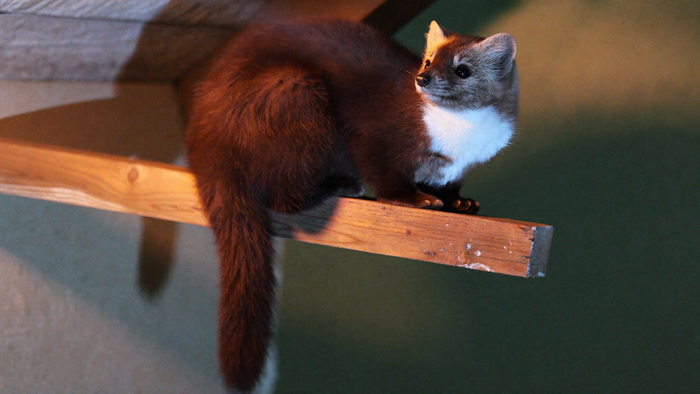
Like the marten, the weasel and the badger, the polecat belongs to the weasel family, the mustelids. All of them are read as animals that look unremarkable and carry surprising strength.
Polecat, ferret or marten? How to tell who you saw
For the reading, it helps to know who actually crossed your path. These animals are easily confused, and in the US a skunk is sometimes called a polecat as well.
| Feature | European polecat | Domestic ferret | Black-footed ferret | Marten |
|---|---|---|---|---|
| Face | pale mask around the muzzle and over the eyes, dark eye band | often like the polecat, but also all white (albino) or cream | black "bandit" mask on a pale, buff face | no mask, pale throat patch |
| Coat | dark brown to black, yellowish underfur shows through | highly variable | buff to tan, black legs and black tail tip | brown to golden |
| Body | stocky, short legs, fairly short tail | like the polecat | long and slim | slim, long bushy tail |
| Where | Europe: water, hedges, field edges, sometimes farmyards | homes; escaped animals rarely survive long outdoors | prairie dog colonies on the Great Plains and in the West | northern and mountain forests |
The polecat's ears are small, round and edged in white. Males are clearly larger than females: up to about 18 inches of body length and roughly 3.7 pounds, against at most about 15 inches and 2 pounds. If you see a pale-faced animal with no fear of people in your yard, think of an escaped ferret. Wild polecats keep their distance. And if the animal is black and white with a bushy tail and you smelled it before you saw it, that was a skunk, the "polecat" of Southern speech.
The mask: what lies behind the face
The facial markings are what stays in the memory. Dark patches around the eyes, rimmed in white, and a whitish muzzle. In the reading, the mask is the central image of this animal, and it is read in two directions.
The first reading is protection. A mask lets you move through the world without giving everything away. If you are living in an environment that does not handle openness well, the polecat gives you permission not to show everything to everyone.
The second reading is a question: are you still holding on to your mask where you could have taken it off long ago? People who have to keep functioning sometimes experience an encounter with a polecat or a ferret as a mirror. The animal shows a face that looks like a disguise and asks back when you were last without one. If that question lands, the shadow work tradition offers a language for it.
The smell: boundaries nobody can miss
The polecat can release a strong-smelling secretion from its anal glands to fend off enemies, and it marks its territory with it. That reputation clings to the English name. The first half of "polecat" is often traced to the Old French word for chicken, a nod to its reputation as a henhouse raider, but the origin of the word is not settled. "Ferret" is clearer: it goes back through Old French furet to Latin fur, "thief". And when Americans "ferret out" a secret, they are borrowing the image of an animal sent down a burrow to find what is hidden.
Spiritually, the smell may be the polecat's most important message. It does not attack to win. It makes itself unpleasant so that it will be left alone. If you keep staying friendly while your boundaries are being crossed, the polecat can teach you that a clear no, even an uncomfortable one, is not a character flaw. Anyone who recognizes the pattern of always saying yes will find more in our piece on people-pleasing.
The shadow side belongs to the picture too: whoever only fends off becomes lonely. Outside the breeding season, the polecat lives alone. So the question for you is not only whether you set boundaries, but also whether you open them again once the danger has passed.
The larder: foresight instead of fear
A large part of the polecat's diet is amphibians, especially frogs and toads, along with mice, rats, birds and eggs. It is famous for its larders. The German Wildlife Foundation (Deutsche Wildtier Stiftung) reports that more than 100 frogs or toads have been found in such caches. It is often described that the polecat paralyzes its prey with a targeted bite so that it stays fresh.
In the reading, this becomes a message about foresight. The polecat gathers when there is plenty so that it will not go hungry in lean times. That is not greed and not fear, but prudence. If you meet a polecat, you can ask yourself: am I providing for later, or am I living hand to mouth? And the reverse: am I hoarding out of fear more than I will ever need?
Because the polecat seeks out water and lives on frogs, the reading also connects it with transitions. The frog and the toad are animals of transformation. The polecat lives on them. Read this way, it is one who turns change into nourishment.
Its American cousin tells the same story with a harder edge. Around 90 percent of a black-footed ferret's diet is prairie dogs, and it lives in their burrows. When prairie dog colonies were poisoned and plowed under across the Plains, the ferret nearly vanished with them. Its fate is a lesson in dependence: provide for yourself, yes, but know which ground you are standing on.
The polecat and the ferret in tradition and history
The tamed wild one. The domestic ferret descends from the European polecat. According to the German Wildlife Foundation, it was domesticated more than 2,000 years ago as a hunter of small prey; exactly when and where is not fully settled. The Greek geographer Strabo, writing around the turn of the first century, described animals from Libya being sent into burrows to drive out rabbits in the Balearic Islands, a passage usually read as the first description of ferreting. For centuries ferrets were used to hunt rabbits, and "ferreting" is still practiced in Britain today. That makes the polecat one of the few predators with a tame form living alongside humans, while the polecat itself stayed wild.
In the reading, this is often taken as an image of two sides within one person: the adapted side that lives in the house and makes itself useful, and the wild side that hunts out by the ditch. Both come from the same root.
The ferret in America. Domestic ferrets are popular pets in the US, playful, curious and famous for the hopping "weasel war dance" and the soft chuckling sound owners call dooking. They are also a lesson in local rules: ferrets are banned as pets in California and Hawaii and in New York City, and some other places require permits. A ferret is not a small cat. It sleeps much of the day, needs a ferret-proofed home and a vet who knows the species.
The ferret that came back twice. The black-footed ferret was thought to be extinct in the 1970s. In 1981 a ranch dog near Meeteetse, Wyoming, brought a dead one home, and a small wild population was found. When disease struck that colony, the last survivors were taken into captivity; the entire species today descends from a handful of those animals. Captive breeding and reintroduction brought it back to the Plains. In December 2020 a black-footed ferret named Elizabeth Ann was born as a clone of a ferret that had died in 1988, the first clone of a native endangered species in the US, meant to bring back lost genetic diversity. It is hard to find a better real-life image for a second chance.
Protected in Europe. In Switzerland, Pro Natura named the polecat Animal of the Year 2024; there it has been protected since 1978 and is considered threatened. In Germany it is on the early-warning list of the Red List.
The reputation. For a long time the polecat was seen as a chicken thief and a stinker, and in American English "polecat" was once a common insult for a low, sneaky person. That says less about the animal than about our relationship with wildlife. If you read it as a spirit animal today, you turn the perspective around: what we found repulsive about it was its way of protecting itself.
The polecat and ferret as a spirit animal
As a spirit animal, the polecat and its tame cousin are connected with four qualities:
- Boundaries. A clear no sometimes has to be unpleasant in order to be heard.
- Foresight. It gathers in good times for bad ones without letting fear drive it.
- Hiddenness. It lives in secret and needs places to retreat. If you feel it as a companion, you may give yourself protected spaces.
- Strength beyond size. The polecat overpowers prey bigger than itself. It reminds you that impact does not depend on size.
The ferret adds a fifth: play. A ferret treats the world as something to be explored, stolen from and hidden under the sofa. If a ferret keeps turning up in your life, the reading is often lighter than the polecat's: curiosity, mischief, and permission not to take everything so seriously.
If you have several animal encounters in a short span, it often helps to lay them side by side. Polecat, marten and weasel together make a clear picture: agility, territory, boundaries. Our guide on how to find your spirit animal shows a simple way to do that.
 |
For a boundary you can smell Lemongrass Essential Oil, $19.95. Certified organic, 10 mL, sweet, lemony and green. The polecat marks its space with scent; people have long done the same. Lemongrass is the base of Van Van oil, the old New Orleans formula used to clear a space and mark a new start. A few drops in a diffuser or diluted on a cotton pad by the door is enough for the boundary ritual further down. It will not keep anyone out for you. It turns your decision into something you can notice every time you walk in. |
Polecats and ferrets in dreams
Dreams about a polecat or a ferret are rare, and precisely for that reason they stay with you. In dream interpretation the animal is usually connected with defense and hidden things. A polecat looking at you is taken as a hint that something else is waiting behind a friendly facade, in you or in someone close to you. A polecat defending itself or giving off a smell is read as a wish to finally set a boundary. Feeding or taming one is interpreted as an attempt to bring a wild, inconvenient side into your life. A ferret stealing and hiding things points to something you have tucked away and would rather not look at. And an animal with a larder points to the question of what you are gathering for right now.
As with every animal dream, the feeling in the dream tells you more than the animal. Disgust, curiosity, admiration or fear are the actual message. Our guide to interpreting dream symbols explains how to work with that.
Your polecat reader
How did you meet the polecat or ferret, and which theme is on your mind right now? The reader shows how the encounter is read in spirit animal work and gives you a question for the next few days. 36 combinations.
Polecat reader
What does the polecat want to show you?
Two answers, one question for the week.
Common situations
No quotes and no names, only the situations in which the polecat or ferret typically comes up in spirit animal work:
- The encounter on the way home after an argument. Many describe the animal appearing just as they were asking themselves whether they had been too hard or too soft.
- The smell in the shed. Often the animal is first a noseful, then a question: who has marked their territory here?
- The ferret in the family. People who keep ferrets often see in the wild polecat for the first time how much wildness lives inside a familiar animal.
What we do not promise
- No omen. A polecat or ferret announces neither bad luck nor good luck. There is no evidence that animal encounters predict events.
- No fixed tradition. The spirit animal reading of the polecat is modern practice, derived from its behavior, not ancient lore.
- No license to handle. Wild polecats and black-footed ferrets are wild animals, and the black-footed ferret is federally endangered. An injured animal belongs with a licensed wildlife rehabilitator or your state wildlife agency.
- No healing. Working with a spirit animal does not replace medical or therapeutic help.
In practice: what to do after an encounter
- Identify first, then interpret. Pale face mask, dark coat, short legs, shy: polecat. Pale throat patch, long tail: marten. Tame and fearless: most likely an escaped ferret. Black and white with a bushy tail: skunk.
- Keep your distance. Do not touch or feed a wild animal. If a ferret seems to be someone's lost pet, contact your local animal shelter; for an injured wild animal, call a wildlife rehabilitator.
- Write down a boundary. Note one sentence you have wanted to say to someone for a long time, and phrase it so clearly that it cannot be missed.
- Mark your space. If you like working with scent, choose one you connect with your decision and let it greet you at the door for a week. Always dilute essential oils, and keep diffusers and undiluted oils away from pets: ferrets and cats are especially sensitive, and the ASPCA Animal Poison Control Center lists many essential oils as a hazard to animals.
- Build a reserve. It can be money, time or quiet. Deliberately set something aside for a lean week.
- Observe for a week. Every evening, note where you wore a mask and where you could have taken it off.
Frequently asked questions
What does it mean spiritually to see a polecat or a ferret?
In modern spirit animal work, the polecat is read as an animal of boundaries, foresight and the mask. An encounter is taken as an invitation to draw clear boundaries and to check what lies behind your own facade. The ferret adds curiosity and play. Neither is an omen of good or bad luck.
Is a ferret a polecat?
The domestic ferret is the domesticated form of the European polecat. It was tamed more than 2,000 years ago as a hunting helper and is still used for rabbit hunting in some countries. The wild polecat, by contrast, is shy and avoids people.
Are there polecats in the United States?
The European polecat does not live wild in North America. The native relative is the black-footed ferret of the Great Plains, an endangered species brought back through captive breeding. In parts of the South, "polecat" is also an old name for the skunk, which belongs to a different family.
Why does the polecat smell?
The polecat can release a strong-smelling secretion from its anal glands to fend off enemies and to mark its territory. Spiritually, this is read as an image of a boundary nobody can miss.
What does a polecat or ferret mean in a dream?
In dream interpretation the animal stands for defense and hidden things: something lies behind a friendly facade, or you wish to finally set a boundary. A ferret hiding things points to something you have tucked away. The feeling in the dream matters most.
Is the black-footed ferret still endangered?
Yes. The black-footed ferret was rediscovered in 1981 near Meeteetse, Wyoming, after being thought extinct, and every living black-footed ferret descends from a small group of captive animals. It remains listed as endangered, and reintroduction depends on healthy prairie dog colonies.
Sources and further reading
- Biology and larders: Deutsche Wildtier Stiftung (German Wildlife Foundation), "Waldiltis" (face mask, closeness to water, caches of more than 100 frogs or toads, anal glands, domestication into the ferret).
- Measurements and protection status: European polecat, Mustela putorius, IUCN Red List; Red List of Mammals of Germany; Pro Natura, Animal of the Year 2024 (Switzerland).
- Black-footed ferret: U.S. Fish and Wildlife Service, Black-footed Ferret Recovery Program (rediscovery at Meeteetse 1981, captive breeding, the clone Elizabeth Ann, 2020).
- Ferreting in antiquity: Strabo, Geography, Book 3 (Balearic Islands).
- Word origins: Merriam-Webster and the Online Etymology Dictionary, "polecat" and "ferret".
- Van Van oil: catherine yronwode, Hoodoo Herb and Root Magic (2002).
- Pet safety: ASPCA Animal Poison Control Center, essential oils and pets.
- Further reading here: Marten · Weasel · Badger · Skunk · Frog · Herbs for protection
The spiritual readings in this piece are modern spirit animal practice, not scientific findings. Last updated: September 29, 2026. Questions about an order: 28@templeofdesire.com.