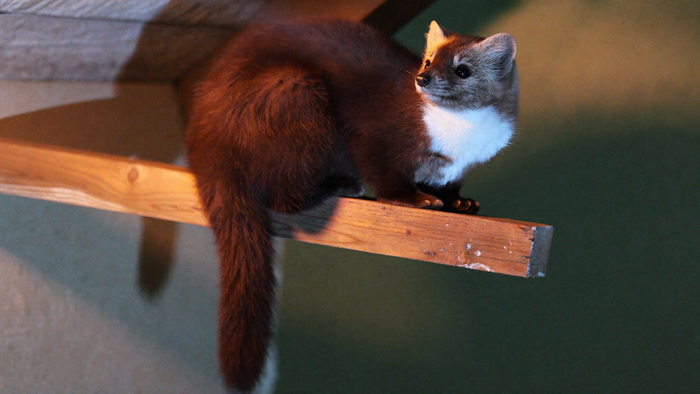
Weasel Symbolism: Spiritual Meaning & Spirit Animal
The smallest carnivore on earth, and one people only dared to call by pet names: what a weasel means as a sign, spirit animal and dream image.


The weasel is the smallest carnivore on earth, and people once feared it so much that across half of Europe they would only call it by pet names. Here you can read what it means when a weasel crosses your path, which weasel you actually saw, what the myths of Ovid and Pliny made of this little hunter, what it says as a spirit animal and in dreams, and what biology knows about it.
Contents
In the reading of animal encounters, a weasel crossing your path is a call to alertness: look closely before you trust, stay flexible, and do not underestimate yourself. The least weasel is the smallest carnivore in the world, at roughly 1 to 9 ounces. In myth, Ovid's servant Galanthis was turned into a weasel for outwitting a goddess; the white ermine became a symbol of purity. A weasel predicts nothing.
The least weasel (Mustela nivalis) is the smallest living member of the order Carnivora.
Source/tradition: Standard mammalogy references; Smithsonian National Museum of Natural History
The ermine keeps a black tail tip year-round, including in its white winter coat.
Source/tradition: Species accounts, state wildlife agencies
Ovid tells how the servant Galanthis was turned into a weasel after tricking the birth goddess Lucina.
Source/tradition: Ovid, Metamorphoses 9.273-323
In European folk belief the weasel was an omen of bad luck and was given flattering taboo names.
Source/tradition: European folklore; comparative linguistics of donnola, comadreja, belette
People who work with animal encounters read the weasel as a call to watchfulness and flexibility.
Source/tradition: Modern spirit animal practice
Seeing a weasel foretells deception, luck or misfortune.
Source/tradition: No evidence for predictive animal omens
VERIFIED = verifiable in scientific or official sources · TRADITIONAL = historically or culturally recorded · LIVED PRACTICE = widely practiced, experiential knowledge · NOT PROVEN = spiritual interpretation, not scientifically established.
At a glance
- Core themes: alertness, agility and a courage that does not depend on size.
- Myth: Galanthis, the servant girl who tricked a goddess and was turned into a weasel.
- Two faces: the brown weasel as an omen of bad luck, the white ermine as a symbol of purity.
- Biology: the least weasel weighs roughly 1 to 9 ounces and hunts mice inside their own tunnels.
- The limit: a weasel announces nothing. It invites you to look more closely.
What it means when a weasel crosses your path
Most people see a weasel for two or three seconds at most: a brown streak that shoots across the trail, disappears between the stones of a wall and perhaps pokes its head out one more time. That brevity is exactly what makes the encounter so vivid. People who have seen a weasel tend to remember it for years.
In today's reading of animal encounters, the weasel stands for alertness: looking carefully before you act and noticing what goes unsaid. It stands for agility, the knack of getting through any gap and finding a way where others only see a wall. And it stands for a courage that has nothing to do with size, because the weasel attacks animals many times its own weight. An encounter is therefore usually read as a question rather than a message: where are you underestimating yourself right now, and where should you look more closely before you trust?
The weasel belongs to a group of small, quick animals that folklore has always watched with mixed feelings. The fox is read as cleverness, the badger, a cousin from the same family, as stubborn persistence. The weasel is the smallest of them and has perhaps the sharpest message: stay awake.
Least weasel, ermine or long-tailed weasel: which one did you see?
The European folklore in this article grew up around two species that also live in North America, plus one that is purely American. Telling them apart is worth the trouble, because tradition means very specific animals when it says "weasel."
- Least weasel. The smallest carnivore in the world: about 4 to 10 inches from nose to rump, a short tail without a black tip, and a weight of roughly 1 to 9 ounces. In North America it lives mainly in the northern states, Canada and Alaska, and it is rarely seen.
- Ermine, also called the stoat or short-tailed weasel. A little larger, up to about 13 inches and 12 ounces, and always with a black tail tip, which is the safest way to identify it. In winter it turns white in snowy regions; the tip stays black. That white winter animal is the "ermine" of kings' robes.
- Long-tailed weasel. The weasel most Americans meet, found from southern Canada deep into South America. It is larger again, with a long tail that also ends in black, and in the Southwest it often wears a pale "bridled" face mask.
Anything noticeably bigger with a bushy tail is usually a mink or a marten, relatives from the same family, the mustelids, but not weasels. The domestic ferret is a tamed polecat, also a relative (more in our piece on the polecat and ferret as a spirit animal). None of this changes the spiritual reading very much, but it changes what you can say with certainty about what you saw.
Encounters and how they are read
| Situation | Traditional reading | Natural explanation |
|---|---|---|
| A weasel crosses your path | In old European folk belief a warning; today more often: watch what you are getting into | Weasels hunt along field edges, stone walls and hedgerows |
| It stands up and looks at you | Attention: you are being seen, and you should look too | Standing upright gives a small animal an overview of tall grass |
| It keeps popping out of the same hiding place | Curiosity and stamina: stay with one thing | Weasels are curious and return to a known den |
| A white ermine in the snow | Purity, clarity, a fresh start after a dark time | The winter coat is camouflage; the black tip distracts hawks |
| A weasel in the woodpile or shed | A house spirit that protects you, or watches you | It is hunting mice there, usually to the owner's benefit |
| A dead weasel | The end of a phase of vigilance: you may let go | In the wild most weasels live only one or a few years |
| A weasel in a dream | Something hidden wants to be noticed | The brain likes to process restlessness in quick, darting images |
Galanthis: the servant who outwitted a goddess
The best-known weasel story of antiquity is told by Ovid in Book 9 of the Metamorphoses. Alcmene has been in labor for days, because Juno, jealous of Jupiter's son, has sent the birth goddess Lucina to prevent the birth. Lucina sits outside the door with her legs and fingers crossed, murmuring spells. The servant Galanthis sees through the trick. She calls out that the child has already been born; Lucina jumps up in surprise, uncrosses her limbs, and Hercules comes into the world.
As punishment for her mockery, Galanthis is turned into a weasel. Because she had lied with her mouth, the ancient story goes, she would now give birth through her mouth. In the version of Antoninus Liberalis, the goddess Hecate takes pity on her and makes her an attendant, and Heracles is said to have later dedicated a shrine to her in Thebes. In this reading the weasel is not an animal of misfortune at all. It is the animal of presence of mind: the small creature that finds the right word at the right moment and saves a life with it. Readers who know Hecate's Deipnon will recognize the goddess of crossroads here as a protector of the overlooked.
Why people sweet-talked the weasel
One of the strangest traces the weasel left is in language. In many European languages it is not simply called "weasel" but has a pet name. In Italian it is donnola, "little lady"; in Spanish comadreja, "little godmother"; in French belette, "little pretty one." Linguists read these as taboo names: you called an animal you feared by a friendly name so as not to provoke it.
The fear had its reasons. In rural folk belief the weasel was a bad omen, and during the witch trials it could be suspected of being a demonic familiar. An animal that appears out of nowhere, fits through any crack and can kill chickens was no small matter for a farm. The pet name was a small protective charm: speak kindly, and you will be spared.
English went the other way. Americans say someone "weaseled out" of a promise, and "weasel words" are slippery phrases that sound like commitments but are not. The phrase appeared in print in 1900 and was made famous by Theodore Roosevelt in a 1916 speech; he explained it with the old belief that a weasel sucks the contents out of an egg and leaves the shell looking whole. The children's song "Pop! Goes the Weasel," a dance tune from 1850s London that crossed the Atlantic quickly, keeps the animal in American nurseries to this day, even though nobody quite agrees what the weasel in it originally was.
The weasel and the basilisk
Pliny the Elder reports in his Natural History that the basilisk, a serpent whose gaze and breath kill, has only one enemy: the weasel. You throw a weasel into the basilisk's hole, and its smell kills the monster, though the weasel dies too. Medieval bestiaries loved this story and made the weasel an image of the small creature that defeats overwhelming evil.
The same books claimed that the weasel conceives through the ear and gives birth through the mouth, or the other way round, depending on the source, which is an echo of the Galanthis myth. Some commentators turned it into a sermon: whoever hears the word and does not put it into practice is like the weasel. As biology it is all fable. As an image it has proven remarkably durable.
 |
For the moment you want to look closer Intuition Candle Spell Booster Pack, $33.95. Four hand-poured blue beeswax tapers, a consecrated oil, herbs, a tumbled stone and a petition paper. It is designed as an add-on to a Parlour of Wonders candle spell kit, but the contents are enough for the simple weasel exercise below: one taper, one question on the petition paper, and a quiet evening of paying attention. It sharpens your focus on the question, not your fortune. |
The ermine: white, pure and royal
The white winter coat made the ermine a luxury. Coronation robes and royal mantles were lined with ermine, and the black tail tips were sewn on as dark spots. Heraldry turned the pattern into a tincture of its own. At the same time the ermine became a symbol of purity, tied to the motto malo mori quam foedari, "better to die than be defiled." The legend behind it says an ermine would rather be caught than escape through mud.
The most famous ermine in art sits in a young woman's arms: Leonardo da Vinci's Lady with an Ermine, painted around 1490 and now in Krakow. The sitter is usually identified as Cecilia Gallerani. The animal is read on several levels: as purity, as a pun on the Greek word for weasel, gale, which echoes in "Gallerani," and as a nod to her patron Ludovico Sforza, who belonged to the Order of the Ermine.
On this side of the Atlantic, white ermine skins carried their own prestige. On the Great Plains, ermine tails and pelts decorated the shirts and headdresses of respected men among several nations, which made the small white hunter a visible sign of honor. That use belongs to living traditions, and it is best learned from the nations themselves rather than from a symbol dictionary.
The weasel as a spirit animal
In modern spirit animal work the weasel is usually connected with three themes:
- Observation. The weasel sees a lot and shows little. As a spirit animal it stands for the ability to notice moods and hidden intentions before anyone puts them into words.
- Staying flexible. It fits into any tunnel a mouse can use. The weasel encourages you not to cling to a single route.
- Courage in proportion. The smallest carnivore hunts prey bigger than itself. As a spirit animal it reminds you that determination is not a matter of body size.
The shadow side belongs to the picture, and English has given it a name. Anyone who works with the weasel also asks: where am I being evasive, where am I using weasel words, and where would a clear sentence take more courage than a clever dodge?
A simple exercise many people use after an encounter: write down three situations from the past week in which you felt something was off but said nothing. Pick one, and decide what you would need to look at more closely before you trust it again. That is the weasel's gift in practical form, and it works without any candle at all.
What biology knows about weasels
- The smallest carnivore in the world. The least weasel is the smallest member of the order Carnivora, and females are clearly smaller than males.
- A body that is always hungry. Its long, thin shape loses heat fast and gives it a very high metabolism. A weasel has to eat several times a day and can take a large share of its body weight in food daily.
- The mouse hunter in the tunnel. The least weasel is slim enough to follow voles and mice into their burrows. For farmers it was more helper than pest.
- The "war dance." Stoats have been seen leaping, twisting and somersaulting in front of rabbits until the prey seems to freeze and watch. Why they do it has not been fully explained.
- A short life. In the wild, least weasels rarely live longer than three to five years, and most die much sooner.
In the United States weasels are generally wild furbearers managed by each state. Watching one is always legal; trapping, keeping or relocating one is regulated, so leave that to your state wildlife agency.
The weasel in dreams
Dreams of weasels are rare, which is why they stand out. A darting weasel you cannot catch is often read as something you cannot get hold of: a feeling, a truth, a person who avoids you. A weasel that looks at you calmly is taken as an invitation to trust a hunch. A weasel inside the house can point to something that has slipped into your life unnoticed.
A white ermine in a dream is often linked with clarity and a clean new start. As with all dream symbols, your own feelings in the dream say more than any list; our guide on how to interpret dream symbols explains how to work with them.
Common situations
No quotes and no names here, just the situations in which the weasel typically comes up when people talk about animal encounters:
- The encounter at the field's edge. Weasels are mostly seen on walks along hedgerows, fences and stone walls, often in a phase when someone is weighing a decision.
- The animal that looks back. Many describe the moment the weasel stands up and stares at them as the most striking part, and it often stays in memory longer than the encounter itself.
- The mix-up with a mink. The "weasel" at the creek or under the deck quite often turns out to be a mink. The reading changes less than you would think; the identification changes completely.
What we do not promise
- No prediction. A weasel on your path announces neither luck nor misfortune.
- No verdict on people. The weasel reading can stir up mistrust. It does not prove that anyone is deceiving you.
- No healing. Spirit animal work is a tool for self-reflection and does not replace therapy or medical treatment.
- No invitation to touch. Weasels are wild animals and will bite when cornered. Watch them from a distance.
In practice: what to do after an encounter
- Identify it. Black tail tip? Ermine or long-tailed weasel. Tiny and no tip? Least weasel. Larger, dark and near water? Probably a mink.
- Write it down. Place, time, and what was on your mind. The reading lives on context.
- Take one question with you. Where should you look more closely, and where should you be braver?
- Keep your distance. Do not follow, feed or reach into hiding places. An undisturbed weasel is more likely to come back.
- Leave it a shelter. A rock or brush pile at the edge of the yard is worth more to a weasel than any interpretation, and it pays you back with fewer mice.
Frequently asked questions
What does it mean when a weasel crosses your path?
In today's reading of animal encounters, the weasel stands for alertness, agility and courage that does not depend on size. An encounter is taken as a reason to look more closely and not to underestimate yourself. It does not announce any event.
Is a weasel a sign of bad luck?
In old European folk belief the brown weasel was an omen of misfortune, which is why many languages gave it pet names. The white ermine, by contrast, was a symbol of purity. Neither reading is proven.
What is the difference between a weasel and an ermine?
The ermine, or stoat, is a slightly larger weasel with a black tail tip that stays black even in its white winter coat. The least weasel is smaller, has a short tail without a black tip and rarely turns white.
What does the weasel mean as a spirit animal?
As a spirit animal the weasel stands for observation, flexibility and determination. It reminds you to notice moods early, keep more than one route open and not make yourself smaller than you are.
What does a weasel mean in a dream?
A darting weasel you cannot catch is often read as something you cannot get hold of. A weasel that looks at you is taken as an invitation to trust a hunch. Your own feelings in the dream matter most.
What story does Ovid tell about the weasel?
In the Metamorphoses, Ovid tells of the servant Galanthis, who tricked the birth goddess Lucina during the birth of Hercules. As punishment she was turned into a weasel.
Where does the phrase weasel words come from?
It appeared in print in 1900 and was popularized by Theodore Roosevelt in 1916. It draws on the old belief that a weasel sucks out an egg and leaves the shell looking intact, just as evasive words empty a statement of meaning.
Sources and further reading
- Myth: Ovid, Metamorphoses 9.273-323 (Galanthis); Antoninus Liberalis, Metamorphoses 29 (Galinthias, Hecate, Thebes).
- Ancient natural history: Pliny the Elder, Natural History, Book 8 (weasel and basilisk); medieval bestiaries in the tradition of the Physiologus.
- Art: Leonardo da Vinci, Lady with an Ermine, c. 1489-1491, Czartoryski Museum, Krakow.
- Language: Stewart Chaplin, "The Stained-Glass Political Platform," Century Magazine, 1900; Theodore Roosevelt, speech in St. Louis, 1916 ("weasel words").
- Biology: species accounts for the least weasel, ermine and long-tailed weasel (Smithsonian's National Museum of Natural History, state wildlife agencies); body measurements and life span from standard mammalogy references.
- Read more on the Desire Diaries: mouse · squirrel · skunk · wren
The spiritual readings in this piece are tradition and modern interpretation, not scientific findings. Questions about an order: 28@templeofdesire.com.
More from Animal Symbolism
All stories →
Polecat & Ferret Spirit Animal: Meaning and Symbolism

Spider Spirit Animal: Meaning, Symbolism and Totem