




Saturn Return: Ages, Timing and What It Really Is
Saturn's 29.46-year orbit sets three returns in a lifetime. When yours falls, why it lasts years, and which parts of the story are ancient and which are modern.


Contents
A Saturn return is the moment Saturn comes back to the exact zodiac degree it held at your birth. Saturn's orbital period is 29.46 years, so the first falls roughly between ages 28 and 31, the second near 58, the third near 88. It is not a single day: because Saturn turns retrograde for about four and a half months each year, it crosses the birth degree either once or three times, stretching the passage over two to three years. Exact timing needs a full birth chart with time and place. In 2026 Saturn moves through Aries, so people born roughly 1996-1999 are in their first return and those born around 1967-1969 in their second. The interpretation - that unsound structures come apart so sounder ones can be built - is astrological meaning, not a measured effect. Saturn as a hard, limiting planet is genuinely ancient; the named Saturn return as a rite of passage near thirty is twentieth-century. If this period tips into real crisis, exhaustion or persistent low mood, that belongs with a doctor or therapist.
Saturn's sidereal orbital period is 29.46 years, which places the returns near ages 29, 59 and 88.
Source/tradition: NASA planetary fact sheet
Saturn stations retrograde roughly once every 12.4 months for about four and a half months, so it crosses a given degree either once or three times.
Source/tradition: Standard ephemeris data
Saturn is characterised as the greater malefic, associated with time, limitation and old age, in Hellenistic astrology.
Source/tradition: Hellenistic astrological tradition
The title Lord of Karma attaches to Saturn through theosophically influenced esotericism of the 19th and 20th centuries, not through older astrological sources.
Source/tradition: Theosophical and post-theosophical esoteric writing
Stocktaking, routine-building and letting-go rituals are widely used as accompanying practice during the return.
Source/tradition: Common practice in psychologically oriented astrology
The Saturn return is a maturity test in which structures not built authentically come apart.
Source/tradition: Astrological interpretation; no demonstrated link between planetary position and life events
Timing major decisions around the return produces better outcomes.
Source/tradition: Spiritual interpretation; no supporting evidence
VERIFIED = verifiable in scientific or official sources · TRADITIONAL = historically or culturally recorded · LIVED PRACTICE = widely practiced, experiential knowledge · NOT PROVEN = spiritual interpretation, not scientifically established.
Saturn takes just under thirty years to go around the Sun. That single number generates the whole idea: three moments in an ordinary lifespan when Saturn stands where it stood on the day you were born. Here is when yours falls, why it lasts years rather than days, and which parts of the story are old and which were invented recently.
What a Saturn return actually is
Strip the language back and the mechanism is simple arithmetic. Saturn orbits the Sun once every 29.46 years. From Earth we watch it travel the full circle of the zodiac in about that same span. At some point in your late twenties it arrives back at the precise degree it held at your birth, and that arrival is your first Saturn return.
Nothing about the planet changes. It does not get closer, brighter or heavier. What returns is a geometric relationship between where Saturn is now and where it was on one particular day. Every interpretation stacked on top of that — maturity, reckoning, the end of an extended adolescence — is meaning assigned to the geometry, not something the geometry produces.
That distinction is worth holding onto, because it is the difference between using the cycle as a prompt and treating it as a forecast. The cycle is real and predictable to the minute. What it is supposed to mean is a tradition.
When yours falls: the three windows
Because Saturn's period is so regular, the ages are nearly fixed for everyone.
| Return | Approximate age | What the tradition assigns to it |
|---|---|---|
| First | 28–31 | Building a first structure that is genuinely yours — work, place, commitments |
| Second | 57–60 | Taking stock; deciding what the second half is actually for |
| Third | 86–90 | Completion, legacy, what gets handed on |
The spread inside each window comes from two things: the degree of your natal Saturn, and whether Saturn is retrograde when it reaches that degree. Someone with Saturn late in a sign can wait more than a year longer than a friend born in the same calendar year.
Whether yours is happening right now
Through 2026 Saturn is travelling through Aries. Saturn was last in Aries in the late 1990s, before that the late 1960s, and before that the late 1930s. Which gives a rough but usable shortcut:
| If you were born around | You are likely in your |
|---|---|
| 1996–1999 | First Saturn return |
| 1967–1969 | Second Saturn return |
| 1937–1940 | Third Saturn return |
Treat this as a shortlist, not a verdict. Saturn sits in a sign for roughly two and a half years and the boundaries are blurred by retrograde motion, so birth years at the edges can fall either side. The only way to date your own window properly is a chart with your birth time and place.
From the shop
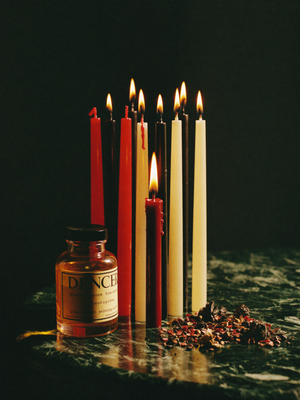
Saturn Oil Candle
A refillable ritual candle kept for discipline and focus rather than for outcomes. If you work this passage with a weekly sit-down — what is actually mine, what am I carrying for someone else — this is the thing you light while you do it.
The honest correction: how old is this idea?
Two different things get bundled together here, and they have very different ages.
Saturn as the hard planet is genuinely ancient. In Hellenistic astrology Saturn is the greater malefic, associated with cold, limitation, time, old age and obstruction. That characterisation is well attested and runs continuously through Arabic and medieval European astrology.
"The Saturn return" as a named life-stage event is not. The phrase, and the idea of it as a rite of passage clustered around the thirtieth birthday, belongs to twentieth-century astrology — and its spread into ordinary conversation is more recent still, carried largely by American popular astrology writing and then by the internet. The return itself was always calculable. Treating it as a branded crisis with a name is modern packaging.
The same applies to "Lord of Karma." That title attaches to Saturn through theosophically influenced esotericism of the nineteenth and twentieth centuries, not through the older astrological sources. It is a real tradition with a real history. It is just a much shorter history than it is usually given.
What people actually report
The descriptions are consistent enough to be worth naming, even without a mechanism behind them. Arrangements that were inherited rather than chosen start to feel intolerable. Work that was fine at 24 is not fine at 29. Relationships either deepen into something deliberate or end. Responsibility stops being abstract — sometimes as exhaustion, sometimes as the plain realisation that no one is coming to handle it.
None of that requires Saturn. It requires being roughly thirty in a culture that front-loads its major commitments into that decade. Which is precisely why the transit works well as a prompt: it asks the questions that stage of life is already asking.
How to work with it
- Take an inventory before you take an action. Saturn's reputation is for structure, so start structurally: what have you built, what did you inherit without choosing, what are you maintaining out of habit. Write it down. The passage is long enough that memory will edit it.
- Finish before you start. The common pattern is a pile of unfinished things. Closing three of them usually does more than beginning a fourth.
- Distinguish a boundary from a wall. Saturn is traditionally the planet of limits, and the useful version of that is deciding what you will no longer do. The unhelpful version is cutting everyone off and calling it maturity.
- Don't schedule your life around a transit. Waiting for a return to end before making a decision hands the decision to an ephemeris. Use the window as a review period, not as permission to postpone.
What we don't promise
No study has demonstrated a link between the position of Saturn and the events of a person's life, and no physical mechanism has been proposed that would produce one. We are not telling you that a difficult period is cosmically scheduled, that it will resolve on a particular date, or that a candle will shorten it. What the cycle offers is a well-timed, unusually well-defined invitation to look at the structure of your life. That is genuinely worth something. It is not a forecast.
Venus retrograde 2026: dates and meaning · Mercury retrograde 2026: the dates · The houses in astrology, explained · Shadow work and where it comes from
Frequently asked questions
At what age is the Saturn return?
The first falls roughly between 28 and 31, the second between 57 and 60, and the third between 86 and 90. Saturn's orbital period is 29.46 years, which sets the spacing. Your exact dates depend on the degree of your natal Saturn.
How long does a Saturn return last?
Usually two to three years from first approach to final departure. Saturn crosses your birth degree either once or three times depending on where its yearly retrograde period falls, which is why the experience varies so much in length.
How do I know when mine is?
You need your natal Saturn's sign and degree, which requires a birth chart calculated from your date, time and place of birth. Birth year alone gives a rough window and nothing more precise.
Is the Saturn return an ancient idea?
Partly. Saturn as the planet of limitation and hardship is well attested in Hellenistic astrology. The specific notion of a named "Saturn return" as a rite of passage near thirty is twentieth-century, and its popular spread is more recent than that.
Does everyone have a hard time during it?
No. Reports vary widely, and the ages involved coincide with life stages that are demanding for reasons that have nothing to do with astrology. There is no evidence that the transit itself causes difficulty.
Should I avoid big decisions until it's over?
Waiting out a two-to-three-year window usually costs more than it protects. The transit is better used as a prompt to examine decisions carefully than as a reason to defer them.
What if I'm really struggling right now?
Then treat it as what it is rather than as a transit. Persistent low mood, exhaustion that does not lift, or thoughts of self-harm are medical matters. Speak to a doctor or licensed therapist; in the US the 988 Suicide & Crisis Lifeline is reachable by call or text.
Sources & further reading
- Saturn's sidereal orbital period of 29.46 years — NASA planetary fact sheet.
- Saturn's annual retrograde period of roughly 140 days — standard ephemeris data.
- Saturn as greater malefic — Hellenistic astrological tradition.
- "Lord of Karma" attribution — theosophically influenced esoteric writing, 19th–20th century.
Questions about an order or a piece? Write to 28@templeofdesire.com.
More from Astrology & Zodiac
All stories →
NOAA Issues G1 Geomagnetic Storm Watch for October 2: Auroras Possible Across the Northern U.S.

Jupiter Retrograde 2026 and 2027: Dates, Degrees and the Shadow Period