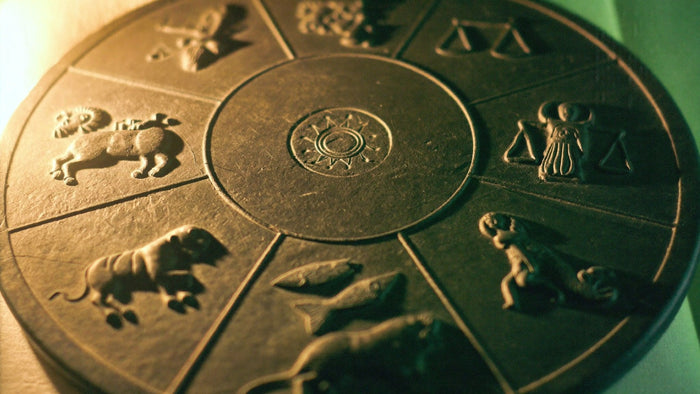





Sun Sign: What It Means in Your Birth Chart
What the Sun placement in a birth chart describes, the tropical zodiac and the Ophiuchus story, why the boundary dates move from year to year, the Sun through signs and houses, the solar return, and what a sun sign cannot tell you.


Almost every American knows the answer to one astrology question. Ask a stranger what their sign is and you will get a word back — Leo, Scorpio, Pisces — usually with a small apology attached, or a small challenge. What almost nobody knows is what astrologers actually mean by that word, and how little of the chart it covers.
Contents
Your sun sign is the zodiac sign the Sun occupied at your birth, and it is what people mean by "star sign." Astrologers read it on three levels: the sign gives the style, the house gives the area of life, the aspects give what it has to negotiate with. Western charts use the tropical zodiac, twelve equal 30-degree slices measured from the spring equinox rather than from the constellations, which is why news reports about a thirteenth sign never change anything. Because the Sun crosses each boundary at an exact instant, anyone born within about a day of a boundary needs their birth time and time zone to know their sign. It is a description of what you are organized around, not a prediction and not a compatibility score.
Western astrology uses the tropical zodiac: twelve equal 30-degree divisions measured from the spring equinox, not the constellations, whose IAU boundaries of 1930 put thirteen constellations on the Sun's apparent path including Ophiuchus.
Source/tradition: IAU constellation boundaries, 1930; NASA Space Place explainer on the zodiac
Precession of the equinoxes moves the equinox point against the stars by about one degree every 72 years, so a tropical sign and the constellation of the same name now differ by roughly 24 degrees.
Source/tradition: Standard positional astronomy; precession rate approx. 50.3 arcseconds per year
The Sun enters each tropical sign at an exact instant that shifts by up to about eighteen hours between years, so published date ranges cannot decide the sign for a birth near a boundary.
Source/tradition: Ephemeris ingress times; the tropical year is about 365.2422 days
English 'Sunday' comes from Old English Sunnandaeg, a direct translation of Latin dies Solis, while the Romance languages replaced it with forms of dies Dominica (domingo, dimanche).
Source/tradition: Old English and Romance etymology of the planetary week
A solar return is the moment the Sun regains its exact natal longitude; because the tropical year exceeds 365 days it often falls a day before or after the calendar birthday.
Source/tradition: Ephemeris calculation of the solar return instant
The newspaper sun-sign column began with R. H. Naylor's August 1930 piece in the Sunday Express on the birth of Princess Margaret, and the twelve-paragraph format spread from there.
Source/tradition: Press history of the astrological column, Sunday Express 1930
In 1988 former White House chief of staff Donald Regan wrote that an astrologer had been consulted about the scheduling of presidential events; the White House confirmed that astrological advice on timing had been given.
Source/tradition: Donald Regan, For the Record (1988); contemporaneous White House statements
The sun sign is the sign the Sun occupied at birth and corresponds to what popular usage calls the star sign.
Source/tradition: Standard definition in Western astrology since the Hellenistic tradition
The Sun rules Leo, governs Sunday in the planetary week, and is associated with gold among the seven metals.
Source/tradition: Hellenistic rulership scheme and the classical planet-metal correspondences
People mark the solar return as a personal new year with a candle and a written intention.
Source/tradition: Widespread contemporary astrological practice
The Sun's position describes a person's core self, will and vitality.
Source/tradition: Astrological interpretation; controlled studies of sun sign and personality have not found the effect
Hard aspects to the Sun produce character maturation and personal growth.
Source/tradition: Interpretive convention of psychological astrology, not a testable claim
VERIFIED = verifiable in scientific or official sources · TRADITIONAL = historically or culturally recorded · LIVED PRACTICE = widely practiced, experiential knowledge · NOT PROVEN = spiritual interpretation, not scientifically established.
Your sun sign is one point out of roughly forty that a working astrologer reads. It is the most important single one, and it is also the reason so many people decide astrology does not describe them: they have compared their whole personality to a twelfth of the sky and found the fit poor. This article is about what the Sun is actually claimed to describe, the astronomy that decides which sign you get, and the reason the answer changes depending on the year you were born.
What the Sun actually describes in a chart
In the traditional scheme the Sun is not your behaviour and not your mood. It is what you are organized around — the thing that stays when the roles come off. Older texts connect it to vitality, to the father, to leadership and to the heart, in the sense of what you would defend if you had to pick one thing.
Astrologers read three layers. The sign is the style: how that vitality is coloured. The house is the arena: which part of life you pour it into. The aspects are the negotiations: which other planets it has to get along with. Where the Moon sign describes what you need in order to feel safe and the rising sign describes the first impression you make, the Sun describes the long project — what you are slowly becoming.
That distinction matters for a practical reason. People often recognize their Venus or their Mars immediately, because those describe things you do this week. The Sun is the placement people grow into. A twenty-two-year-old often reads their Sun description and shrugs. The same person at forty tends to read it differently.
The astronomy that decides your Sun sign
Your sun sign is simply the zodiac sign the Sun occupied, from Earth's point of view, at the moment you were born. That sounds like an observation about stars. It mostly is not.
Western astrology uses the tropical zodiac: twelve equal thirty-degree slices measured from the spring equinox, not from the constellations. The constellations are irregular — Virgo sprawls, Scorpius is brief — and the International Astronomical Union's 1930 boundaries put thirteen constellations, not twelve, on the Sun's apparent path. The thirteenth is Ophiuchus, the serpent bearer, and every few years an American news cycle rediscovers it and announces that everyone's sign has changed.
It has not, because the tropical signs were never the constellations. They are a calendar of the solar year, anchored to the equinox. Aries begins where spring begins in the northern hemisphere, and it has meant that since Hellenistic astronomers fixed it. Meanwhile the equinox point itself drifts against the stars by about one degree every seventy-two years — the precession of the equinoxes — which is why the tropical sign and the constellation of the same name now sit roughly twenty-four degrees apart. Vedic astrology takes the other option and keeps the signs tied to the stars, which is why a Western Leo is frequently a Vedic Cancer. Neither system is lying. They are measuring different things.
Born on the edge: why your sign can move between years
Here is the part that generates the most mail. The Sun does not change signs at midnight on a fixed calendar date. It crosses each thirty-degree boundary at an exact instant, and that instant drifts by up to about eighteen hours from year to year because the tropical year is not a whole number of days. Leap years pull it back.
The practical consequence: if you were born on the twenty-second or twenty-third of a month, the published date ranges in a magazine cannot tell you your sign. You need the year, the clock time, and the time zone. Someone born at 9 p.m. Pacific on 22 August in one year is a Leo; someone born the same calendar day and hour in a different year is a Virgo. A birth in Honolulu and a birth in Boston on the same calendar date can land on opposite sides of the line.
Astrologers do not recognize a "cusp sign." There is no blended placement. The Sun is in one sign or the other, down to the minute. What people call cusp energy is usually a chart in which the Moon, Mercury or Venus sits in the neighbouring sign — which is common, and which a full chart shows in ten seconds.
Altar · refillable zodiac candle
Leo Oil Candle
The Sun has no candle of its own left on our shelf, so this is the next honest thing: the candle for the sign the Sun is said to rule. It is a refillable oil candle, which is the part we would actually argue for — you top it up instead of throwing a jar away, and one wick can carry a year of birthdays. It will not change your chart, improve your vitality or do anything to your year. It is a good flame to sit with for an hour once a year, which is all the solar-return practice below asks of you. $25.95
See the candle →The Sun through the twelve signs
The sign colours how the vitality moves. Read these as descriptions of a direction rather than a verdict, and note the second column — the shadow is not a flaw, it is the same trait spending itself badly.
| Sun sign | What it is organized around | The same trait, overspent |
|---|---|---|
| Aries | Starting things; being first through the door | Beginning more than it can finish |
| Taurus | Steadiness, comfort, keeping what is worth keeping | Refusing a change that is already necessary |
| Gemini | Curiosity, language, moving between worlds | Skimming everything and landing nowhere |
| Cancer | Care, memory, making a place feel like home | Tending others as a way of avoiding itself |
| Leo | Making something and standing behind it | Needing the room to agree before it can rest |
| Virgo | Usefulness, craft, improving the actual thing | Correcting what did not need correcting |
| Libra | Fairness, relationship, the well-made compromise | Postponing a decision to keep the peace |
| Scorpio | Depth, honesty about motive, what is really going on | Holding back information as leverage |
| Sagittarius | Meaning, distance, the larger frame | Treating a detail as beneath it |
| Capricorn | Responsibility, structure, building something that lasts | Measuring a life only by what it produced |
| Aquarius | Independence, systems, the group over the clique | Principle used as distance from people |
| Pisces | Compassion, imagination, the part that is not literal | Dissolving into whatever is nearest |
The Sun through the houses — where you are most visible
The house needs your birth time, and it is the layer that makes two people with the same sun sign look nothing alike. The sign says how; the house says where.
A first-house Sun shows up as presence — people notice the person arriving. A fourth-house Sun spends itself on home, family and the private room nobody else sees; a tenth-house Sun on work, title and public standing, which is why it is the placement most often mistaken for ambition when it is really a need to be identified with something. A fifth-house Sun needs to make things. A seventh-house Sun becomes itself through one-to-one relationship, which sounds romantic and is more often about partnership of any kind. A ninth-house Sun goes looking — travel, study, belief. A twelfth-house Sun does its real work out of sight and is often the last to be recognized, including by itself. The twelve houses are the framework underneath all of this.
Sun aspects people actually ask about
An aspect is the angle between the Sun and another planet. Astrologers treat conjunctions, squares and oppositions as tension and trines and sextiles as ease, and the useful part is not the label but the pairing.
Sun–Moon is the relationship between what you want and what you need; when they agree, decisions are quick, and when they do not, the person is often described as complicated by people who mean something kinder. Sun–Mercury can never be far apart — Mercury stays within twenty-eight degrees of the Sun — so almost everyone has some version of it. Sun–Saturn is the one people report as a biography: a long apprenticeship, a late arrival, authority that had to be earned rather than assumed. Sun–Pluto is intensity around identity and control. Sun–Neptune is the artistic, permeable one, with the standing question of who you are behind the image.
Why you might not recognize yourself in your Sun sign
This is the most common complaint about astrology and it has a boring answer. The Sun is one factor. A Sagittarius Sun with a Capricorn Moon and a Virgo rising will read the Sagittarius column and find a stranger who travels too much.
There is a second reason worth naming. The Sun is a description of a direction, and people are frequently raised in the opposite one. Astrologers see the mismatch as a task rather than an error — the sign describes what a person grows toward, not what they were permitted to be at nineteen. That framing is generous, and it is also unfalsifiable: a description that fits when you agree with it and describes your unlived potential when you do not cannot be wrong. Keep that in view. It is the strongest objection to the whole method, and it deserves to be stated by the people who use it.
Your solar return — the birthday that is not always your birthday
A solar return is the moment the Sun comes back to the exact degree, minute and second it held when you were born. It happens once a year and it is a real astronomical event you can calculate. It also frequently lands on the day before or the day after your calendar birthday, because the tropical year runs about six hours longer than 365 days.
Two things follow, one technical and one practical. The technical one: a solar return chart is cast for that exact instant and for wherever you physically are, which is why some practitioners travel for it. The practical one: if you want to mark it, you can find out the actual hour rather than defaulting to midnight. In the United States that means checking the time zone of your birthplace, not your current one, and remembering that daylight saving rules have changed several times — a birth certificate reading 2:30 a.m. in April 1974 is not necessarily the hour the ephemeris wants.
Sunday, gold, and the day English kept
The seven-day planetary week came into Latin as dies Solis, the Sun's day. When Christianity took hold, the Romance languages replaced it: Spanish domingo and French dimanche both come from dies Dominica, the Lord's day. English did not. Old English translated the Latin name directly as Sunnandæg, and German did the same with Sonntag.
So the English-speaking world still says the Sun's name once a week without noticing, and the metal that went with it in the old correspondences — gold, incorruptible, the one that does not tarnish — is still the one people reach for when they want to say something is the real version of itself. The tradition is not evidence of anything. It is a reminder that this symbolism is not an import from a wellness catalogue; it is baked into the calendar on the wall.
What the newspaper column did to the Sun sign
The reason "what's your sign" means the sun sign and nothing else is a piece of media history, not doctrine. In August 1930 the British astrologer R. H. Naylor wrote a piece for the Sunday Express on the newborn Princess Margaret; the paper wanted more, and the format that emerged — twelve short paragraphs, one per sign — was the only version of a chart that fits in a newspaper column. American syndication took it from there. By mid-century the sun-sign column was a daily fixture in hundreds of papers.
It reached the top of American public life at least once. In 1988 Donald Regan, the former White House chief of staff, wrote in his memoir that an astrologer had been consulted about the scheduling of presidential events; the White House confirmed that a friend of Mrs. Reagan had provided astrological advice on timing. Whatever one makes of it, the column had gone from the back page to the West Wing in under sixty years — and the thing it carried was one placement out of forty.
A birthday practice that asks nothing of anyone else
If you want a solar-return practice, here is the whole of it, and it is deliberately small. Find the actual time of your solar return. Put aside one hour near it. Write one sentence that begins "I am most myself when I…" and finish it with the motif of your sign rather than with your job. Then write down one thing from the past year that you would not repeat and one you would.
Light something if you like. The candle is not the mechanism; the hour is. What makes this useful is not the astrology but the fact that almost nobody schedules an annual review of their own life, and a birthday is an easier appointment to keep than a January resolution.
What a Sun placement does not do
It does not predict events, and it does not measure compatibility. Studies designed to test whether sun signs correlate with personality traits, occupation or marital outcome have not found the effect; the largest of them worked with samples in the tens of thousands. We are not going to pretend otherwise, and an astrologer who tells you your sign disqualifies you from a relationship or a career is selling you something.
It is also not a diagnosis. If you read a description of your sign and recognize something that worries you — a pattern you cannot stop, a flatness that has lasted months — that is a conversation for a doctor or a therapist, not for a chart. Astrology is a language for talking about yourself. It is a poor instrument for deciding anything you cannot undo.
Frequently asked questions
Is my sun sign the same as my star sign?
Yes. Star sign, sun sign and zodiac sign all refer to the same thing in ordinary American usage: the sign the Sun occupied when you were born.
Do I need my birth time to know my sun sign?
Usually not — but if you were born within a day of a sign boundary, yes, and you need the time zone as well. The time is always required for the house and the rising sign.
Did NASA change the zodiac signs?
No. NASA published an explainer noting that the Sun's path crosses thirteen constellations, including Ophiuchus. Tropical astrology divides the year from the equinox into twelve equal parts and never used the constellation boundaries, so nothing in a Western chart changed.
What is a cusp sign?
Not a thing, technically. The Sun is in one sign or the next, to the minute. What people call cusp energy is usually another planet sitting in the neighbouring sign.
Which matters more, my Sun, Moon or rising?
They answer different questions: what you are built around, what you need, and how you come across. If someone says one of them is the real you, ask which question they were answering.
Why do I not relate to my sun sign at all?
Most often the Moon or the rising sign is doing the visible work. It is also common to grow into a Sun description later than you expect.
Where to go next
The Sun makes most sense with its neighbours next to it. Read the Moon sign for what you need, the rising sign for how you land in a room, and Venus and Mars for attraction and drive. For the slower layers, there is the Saturn return, Neptune, Pluto and the lunar nodes. If you want the framework rather than the pieces, start with the twelve houses.
Questions about an order or anything on this site: 28@templeofdesire.com.
More from Astrology & Zodiac
All stories →
NOAA Issues G1 Geomagnetic Storm Watch for October 2: Auroras Possible Across the Northern U.S.

Jupiter Retrograde 2026 and 2027: Dates, Degrees and the Shadow Period