






The Book of Abramelin: What the Manuscripts Say


A book promises you a meeting with your own guardian angel, and asks eighteen months of your life in exchange. It presents itself as the testament of a fourteenth-century Jewish scholar, and is probably four hundred years younger than that. And the translation that made it famous in English quietly cuts the required time to a third.
Contents
The Book of Abramelin presents itself as the testament of a Jewish scholar, Abraham of Worms, to his son Lamech. Its core is a long retreat with one aim: the Knowledge and Conversation of the Holy Guardian Angel. Work with letter squares and the binding of spirits follows only afterward. The oldest surviving witnesses are German manuscripts of the early seventeenth century, among them one at Wolfenbuttel; the version the English-speaking world inherited is S. L. MacGregor Mathers' translation of 1897, made from a younger French manuscript in Paris. There the operation runs six months, in the German copies eighteen. Scholarship treats the text not as medieval or Jewish in origin but as an early seventeenth-century magical text written to look Jewish. Whether the procedure does anything is not a question a source can answer.
The Book of Abramelin survives in several German manuscripts of the early seventeenth century, among them one in the Herzog August Bibliothek at Wolfenbuttel, plus a German printing that gives Cologne 1725 as its place of publication.
Source/tradition: Wolfenbuttel and Dresden manuscript holdings; critical edition of the German text
The internationally known English version is by Samuel Liddell MacGregor Mathers, published in 1897 as 'The Book of the Sacred Magic of Abramelin the Mage', translated from a French manuscript in the Bibliotheque de l'Arsenal, Paris.
Source/tradition: Mathers 1897, preface; Bibliotheque de l'Arsenal, MS 2351
In the German manuscripts the preparation runs eighteen months; in the French version Mathers translated it runs six. The German copies also contain an entire book absent from Mathers.
Source/tradition: Georg Dehn (ed.), critical edition 2001; 'The Book of Abramelin: A New Translation', Ibis Press 2006
Philological scholarship classifies the text not as a medieval Jewish writing but as an early seventeenth-century magical text composed to appear Jewish.
Source/tradition: Finding of the critical edition; current scholarship
Aleister Crowley acquired Boleskine House on Loch Ness in 1899 in order to carry out the Abramelin operation there, and broke it off.
Source/tradition: Crowley, Confessions; standard biographies
That a hermit named Abramelin lived on the Nile and passed the procedure to Abraham of Worms is the frame narrative of the text and is attested nowhere outside it.
Source/tradition: The book's own frame narrative; no independent attestation
In contemporary ceremonial practice the Abramelin operation is regarded as the most demanding single undertaking in Western ritual magic and is usually performed in adapted, shortened form.
Source/tradition: Contemporary practice in Thelemic and Golden Dawn currents
That the ritual brings about the presence of a guardian angel or binds spirits is a claim the text makes about itself and is not testable.
Source/tradition: No scientific investigation; the claim is not of a testable kind
A months-long retreat with fasting, restricted sleep and isolation can place a person under serious psychological strain and may trigger a crisis in those predisposed.
Source/tradition: No studies exist on this specific practice; the caution rests on general clinical experience with isolation and sleep restriction
VERIFIED = verifiable in scientific or official sources · TRADITIONAL = historically or culturally recorded · LIVED PRACTICE = widely practiced, experiential knowledge · NOT PROVEN = spiritual interpretation, not scientifically established.
This is a guide to what the Abramelin manuscripts actually contain: the frame story, why the German copies matter more than the famous English one, the six-versus-eighteen-month problem, what the operation really demands, the letter squares, and the American afterlife of the whole thing. It does not claim the procedure works.
What the Book of Abramelin is
Among the grimoires of the Western tradition, Abramelin holds an odd place, for a reason that sounds unremarkable at first: it asks for time.
The Solomonic keys hand you pentacles and conjurations. The Picatrix tells you when to cut which planetary talisman. Both are toolboxes — you look up what you need and do it. Abramelin works the other way around. It gives you no tool at all to begin with. It gives you a deadline: a year and a half in which you pray, withdraw and wait. The magic proper starts only afterward.
That is what makes it a test case among practitioners to this day. It is also what makes it one of the most cited and least finished books in the field.
The frame story: Abraham, Lamech and a hermit
The text presents itself as an inheritance. A man named Abraham, said to be born around 1362 in Worms, writes to his younger son Lamech. The elder son, the story goes, received the Kabbalah; this other knowledge is meant for Lamech.
Abraham narrates his search — study under a teacher named Moses, travel to Constantinople, Egypt, Palestine. Everywhere he meets people who promise magic, and everywhere they turn out to be frauds. The book is startlingly disillusioned about its own subject for long stretches. Only in Egypt, in a small desert settlement on the Nile, does he find a hermit named Abramelin who hands over the procedure: in exchange for a promise to pass it on, and for alms to the poor.
Worth fixing in mind before anything else: in the book, Abramelin is not the author but the teacher. The author is the narrator, Abraham. The title names the source, not the writer — inside the fiction, at least.
And that it is a fiction is the scholarly position. There is no independent attestation for Abraham of Worms, none for Abramelin, and the internal features of the text — language, theological shape, stock of motifs — point to the early seventeenth century rather than the fourteenth. The critical edition carries the finding in its subtitle: a magical text of the early seventeenth century, written to look Jewish. That does not devalue the book. It only changes what the book is evidence of — not medieval Judaism, but the religious imagination of early modern Europe.
The manuscripts, and why the German ones come first
Almost everything written about Abramelin in English goes back to a translation published in London in 1897. Which is curious, because the oldest surviving copies are in German.
| Witness | Language, date | What is distinctive |
|---|---|---|
| Wolfenbuttel manuscript (Herzog August Bibliothek) | German, c. 1608–1613 | Oldest complete witness; basis of the critical edition |
| Dresden manuscript | German, 17th century | The second principal German witness |
| Printed edition giving "Cologne 1725" | German, 18th century | The place of printing is considered fictitious — routine for magical books of the period |
| Paris manuscript, Bibliotheque de l'Arsenal | French, 18th century | Mathers' source; one book fewer, and the term cut in half |
| Mathers, London 1897 | English | The version the whole English-speaking world inherited |
Samuel Liddell MacGregor Mathers, a founder of the Hermetic Order of the Golden Dawn, worked from the French manuscript in Paris and published The Book of the Sacred Magic of Abramelin the Mage in 1897. It is a real feat of transmission and it is also a translation of the youngest, shortest witness. For an American reader that has one immediate consequence: the free public-domain text you will find online is Mathers, and it is not the fullest version of the book. The modern scholarly route is Georg Dehn's German edition of 2001, available in English as The Book of Abramelin: A New Translation (Ibis Press, 2006), which works from the German manuscripts and restores the missing material.
For the daily part, not the eighteen months
Sacred Incense Collection — Four Blends
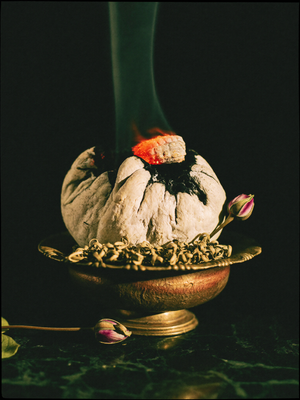
Whatever else the operation asks, its spine is a daily appointment kept in the same room at the same hour. Incense is the oldest way of marking that a room has changed use for twenty minutes — which is the honest, small version of what an oratory is. Four blends, so a daily practice does not become one unvarying smell you stop noticing. It confers nothing and binds no one. $24.95
See the collection →Six months or eighteen?
This is the single most consequential difference between the versions, and most summaries never mention it.
In the French manuscript that Mathers translated, the preparation runs six months. In the German manuscripts it runs eighteen, structured in phases of six. The German text also contains an entire book that is absent from Mathers.
The practical effect is that two people can both say "I am doing the Abramelin operation" and mean undertakings that differ by a year. Most of the English-language discussion since 1897 has silently assumed the six-month figure. If you are reading a modern account of someone's attempt, it is worth asking which text they were following, because the shorter term is a feature of the youngest manuscript rather than of the tradition.
What the operation actually asks for
Stripped to essentials, the text asks for conditions that are hard to arrange in any century and particularly hard in a rented apartment:
- A dedicated room. An oratory used for nothing else, with an altar, kept clean, ideally opening onto an uncovered terrace or lodge where the working can move outdoors.
- Daily prayer at fixed hours, in your own words rather than a set formula — the text is insistent on this — increasing in length as the months pass.
- Withdrawal from ordinary business, arranged in advance so that obligations do not interrupt. The text expects you to settle your affairs first, like a man preparing for a long absence.
- Moral conditions: truthfulness, restraint, charity. The alms Abraham promises are not decorative; they are part of the bargain as the book frames it.
- Escalating purity rules toward the end — washing, dress, diet, seclusion — culminating in the days when the encounter is expected.
Note what is missing from that list: no circle, no seals, no names of power, nothing to buy. For a grimoire, the equipment list is close to empty until the very end.
The Holy Guardian Angel — and what comes after
The goal has a name that has outlived the book: the Knowledge and Conversation of the Holy Guardian Angel. In the text, this is not a metaphor for self-knowledge. It is a personal presence that instructs you, and everything afterward depends on it.
Afterward is the part people forget. Once contact is made, the operator is to summon and bind the kings and dukes of the spirits — the hierarchy the book spends its later chapters cataloguing. Abramelin is not a book about enlightenment with a magical appendix. It is a book about acquiring authority over spirits, with a very long spiritual entrance requirement placed in front of it.
The phrase itself, more than the procedure, is what entered modern practice. In Thelema and in much of the American ceremonial scene, "attaining the K&C of the HGA" became shorthand for the central task of a magical life, detached from the eighteen months and the spirit hierarchy alike.
The letter squares
The final book is a catalogue of squares: grids of letters, each labelled with an effect. They are the part that gets photographed and posted, and they are also the part the text itself treats as least important — the tool you are given only once you have a teacher who can tell you how to use it.
Formally they belong to an old family of word squares, of which the Latin SATOR square is the best-known European example. Some Abramelin squares are palindromic, some are not; several are corrupt in transmission, and the differences between the German and French copies mean that two printed versions of "the same" square may not match. Anyone working from a modern edition is working from an editor's reconstruction, which is worth knowing before treating a particular arrangement of letters as exact. If drawing charged symbols is what draws you here, our practical guide to making a sigil is a saner starting point, and grimoire versus book of shadows explains why the distinction matters.
Golden Dawn, Crowley, and a house on Loch Ness
Mathers' translation landed in the middle of the Golden Dawn, and from there it shaped nearly everything that followed. Its most famous reader bought real estate over it: in 1899 Aleister Crowley acquired Boleskine House on the shore of Loch Ness specifically because it met the book's requirements for an isolated oratory with the right exposure. He began the operation there and broke it off, called away by the order's internal politics. He returned to the Holy Guardian Angel as a concept for the rest of his life and made it the hinge of his system.
That episode is why Abramelin matters to American occultism at all. The route runs Mathers to Crowley to the Thelemic and post-Golden-Dawn currents that took root in the United States in the twentieth century — which is also how a sixteenth- or seventeenth-century German text ended up as a standard reference in Rosicrucian-adjacent and ceremonial circles from California to New England. The related Ars Notoria, which promised learning rather than an angel, travelled a similar road.
Voices from practice
Personal accounts — experiences, not evidence:
- "I got four months in before a job change ended it. What stayed with me was not anything mystical. It was finding out how much of my day I had assumed was fixed and was not."
- "Nobody tells you the hard part is the room. I live in a one-bedroom. A space used for nothing else for a year and a half is a wealthy person's requirement."
- "I read Mathers first and thought I understood the book. Reading the fuller translation afterward was like discovering a film had a third act."
What we don't promise
We do not claim that the operation produces the presence of a guardian angel, or that anything can be bound by it. Those are claims the text makes about itself; they are not the kind of statement a source can settle. We do not claim that Abraham of Worms existed or that a hermit named Abramelin taught anyone anything.
One thing we will say plainly rather than romantically. A months-long retreat involving fasting, restricted sleep and isolation is not a neutral undertaking. There are no studies of this specific practice, but isolation and sleep restriction are well understood to destabilise people, and anyone with a history of psychosis, mania, an eating disorder or severe anxiety should treat the full regimen as off-limits and talk to a clinician before attempting anything resembling it. The book itself warns repeatedly against imitation without preparation, which is unusual candour for a grimoire and worth taking at face value.
Practically: how to approach this
Read the fuller translation, not only the free one. Mathers is public domain and easy to find; the Dehn/Guth edition is the one with the missing book and the eighteen-month term.
Know which version anyone is talking about. Six months or eighteen is the fastest way to tell whether an account is working from the French or the German line.
Do not improvise the retreat. Practitioners who take it seriously today almost always run adapted, shortened forms, and say so.
Read it as a historical document first. As a window into early modern religious imagination it is genuinely rich — and that reading costs nothing and risks nothing.
Keep a clinician in the picture if you are drawn to the ascetic parts specifically. That pull is worth talking about with someone, whatever you decide.
Frequently asked questions
What is the Book of Abramelin about?
A long retreat with a single aim: the Knowledge and Conversation of the Holy Guardian Angel. Work with letter squares and the binding of spirits follows only afterward.
Who wrote the Book of Abramelin?
The text names Abraham of Worms, writing to his son Lamech, and credits an Egyptian hermit called Abramelin as the source. Scholarship treats both as fictional and dates the text to the early seventeenth century.
How long does the Abramelin operation take?
Six months in the French manuscript Mathers translated in 1897; eighteen months in the older German manuscripts, which also contain a book missing from his version.
Which translation of Abramelin should I read?
Mathers (1897) is free and historically important but works from the youngest, shortest witness. Georg Dehn's edition, in English from Ibis Press in 2006, follows the German manuscripts.
What is the Holy Guardian Angel?
In the book, a personal spiritual presence that instructs the operator, and the precondition for everything that follows. The phrase was later adopted by Crowley and became central to Thelema, largely detached from the original procedure.
Is the Abramelin operation dangerous?
The full regimen involves prolonged isolation, fasting and restricted sleep, which can destabilise people. There is no research on this specific practice, but the general risks of isolation and sleep loss are well documented, and the text itself warns against unprepared imitation.
Sources & further reading
Herzog August Bibliothek Wolfenbuttel and the Dresden manuscript (German witnesses, early 17th century) · Bibliotheque de l'Arsenal, Paris, MS 2351 (French witness) · S. L. MacGregor Mathers, The Book of the Sacred Magic of Abramelin the Mage (London, 1897) · Georg Dehn (ed.), critical German edition (2001); English as The Book of Abramelin: A New Translation, trans. Steven Guth (Ibis Press, 2006) · Aleister Crowley, Confessions, and standard biographies, on Boleskine House · our guides to the Golden Dawn, the Ars Notoria and Franz Bardon's system.
Questions about an order or anything on this site: 28@templeofdesire.com.