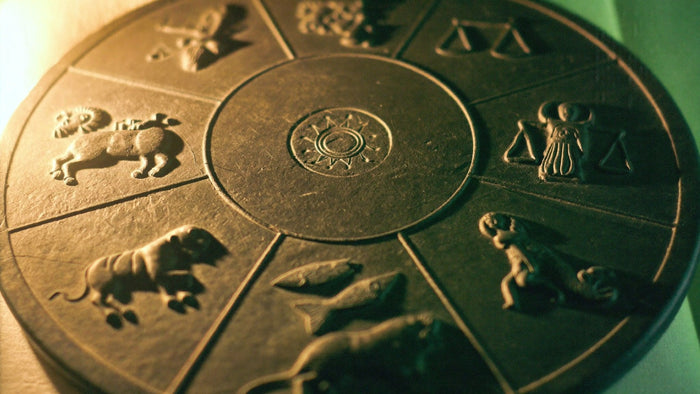
Picatrix: What the Talisman Grimoire Actually Says
What the Picatrix contains, where it came from, how it reached Europe, and why its talisman theory needs elective astrology rather than a recipe.


It is the most famous book of talismanic magic in the Western tradition, and for most of its life almost nobody could read it. The Picatrix was never printed in the Middle Ages or the Renaissance — it circulated hand to hand, in copies, among people who had reason not to advertise owning it. A complete English translation only became widely available in this century. That gap is why the book has a reputation far larger than its readership.
Contents
The Picatrix is a handbook of astral magic compiled in Moorish Spain; its Arabic title is Ghayat al-Hakim, "The Goal of the Wise." Long attributed to the Madrid mathematician Maslama al-Majriti (d. c. 1007), it is now more often credited to Maslama ibn Qasim al-Qurtubi of Cordoba, following the argument of the Arabist Maribel Fierro. Around 1256 Alfonso X of Castile had it translated into Castilian at Toledo; the Latin version descended from that, and the name Picatrix appears only in the Latin West. It runs to four books: a philosophical foundation, the images and assignments of planets and zodiac signs, a long practical book of invocations, suffumigations and correspondences, and a miscellany that includes the perfect city of Adocentyn. Its core subject is the talisman, understood not as a lucky charm but as a vessel that concentrates a celestial power already at work - which requires the right material, the right planetary hour and, above all, elective astrology: waiting for a moment rather than declaring one. The Picatrix also contains passages involving poisonous substances and harm to animals that should not be reproduced. It is a historical source to read, not a recipe book to perform.
The Arabic title of the work is Ghayat al-Hakim, "The Goal of the Wise," and the text was compiled in Moorish Spain.
Source/tradition: Arabic manuscript tradition; Ritter's edition of the Arabic text
The attribution to Maslama al-Majriti of Madrid is doubtful; Maribel Fierro proposed Maslama ibn Qasim al-Qurtubi of Cordoba, now the more accepted identification.
Source/tradition: Maribel Fierro on the authorship of the Ghayat al-Hakim
Around 1256 Alfonso X of Castile had the work translated into Castilian; the Latin version descended from that translation.
Source/tradition: Translation history of the court of Alfonso X; Pingree, Picatrix. The Latin Version, 1986
A complete English translation of the Latin version was published by Dan Attrell and David Porreca with Penn State University Press in 2019.
Source/tradition: Attrell and Porreca, Picatrix: A Medieval Treatise on Astral Magic, Penn State University Press, 2019
The book assigns each of the seven classical planets a metal and a weekday - gold to the Sun, silver to the Moon, iron to Mars, tin to Jupiter, copper to Venus, lead to Saturn.
Source/tradition: Picatrix Book II; the planetary metal scheme of ancient and medieval astrology
The 28 lunar mansions and the decans are used in the book as timings rather than as descriptions of character.
Source/tradition: Picatrix Books II and III; Arabic lunar-mansion tradition
A talisman made according to the Picatrix produces an effect in the world.
Source/tradition: No controlled studies exist; the doctrine is self-explaining
The teaching descends unbroken from ancient Egypt, as the hermetic frame of the text suggests.
Source/tradition: Origin story internal to the source; documented transmission begins in Moorish Spain
Calculating planetary hours by hand for a season, and keeping one planet's weekday, is how readers commonly begin with the book.
Source/tradition: Reader reports; the book's own requirement of elective astrology
VERIFIED = verifiable in scientific or official sources · TRADITIONAL = historically or culturally recorded · LIVED PRACTICE = widely practiced, experiential knowledge · NOT PROVEN = spiritual interpretation, not scientifically established.
What this article gives you: what the Picatrix actually contains, where it came from, how it reached Europe, what its talisman theory really requires, and why it is not a recipe book. What it does not give you: instructions. This is a historical source with passages no one should reproduce, and saying so is part of reading it honestly.
What the Picatrix is
A handbook. That sounds flat, and it should: the Picatrix is not a revelation or a narrative but a collection of instructions, correspondence tables, recipes, and philosophical arguments for why those instructions ought to work at all.
Its subject is astral magic — the idea that the powers of the heavens can be drawn down into earthly things, if the right material is brought into the right form at the right moment. A piece of copper is not merely copper. It belongs to Venus. Work it during an hour assigned to Venus, while the sky itself stands favorably, and it takes something of that order into itself. That is the whole principle, followed through with real rigor. The book describes craft, not wonders: which metal, which suffumigation, which planetary hour, which lunar mansion, which words.
Where it came from — and who wrote it
The Arabic title is Ghayat al-Hakim, "The Goal of the Wise." It was compiled in Moorish Spain, in a scholarly world that held Greek philosophy, Indian astronomy, Persian star-lore and older Mesopotamian layers inside one system of thought.
For a long time the same answer was given about authorship: Abu l-Qasim Maslama al-Majriti, the mathematician and astronomer of Madrid, died around 1007. That attribution appears in many manuscripts, and it is nonetheless doubtful. The Arabist Maribel Fierro argued that a different Maslama is meant — Maslama ibn Qasim al-Qurtubi, a traveler and traditionist of Córdoba — and that is now the more widely accepted identification.
The dispute is worth keeping rather than skipping, because it says something about the genre. A book like this rarely carried its author proudly on the first page. It was dangerous knowledge. A famous, respectable name both protected the text and concealed it. Anyone reading the Picatrix today is reading a work that deliberately hid behind an authority — the same move visible in the Greek magical papyri, and later in the grimoires attributed to Solomon.
Toledo, and a name the book never had
Around 1256 Alfonso X of Castile — Alfonso the Wise — had the work translated into Castilian. His court was a translation workshop: Arabic learning was systematically opened up for Latin Europe, astronomy, law, history, and also the material one did not discuss loudly.
From that Castilian version the Latin one descended, and with it came the name the book became famous under: Picatrix. Where the word comes from has never been settled. The usual proposals derive it either from a corruption of al-Majriti or from an authority named inside the text. What is certain is only this: in Arabic the book is called something else entirely, and the Latin West gave it a name it did not know it had.
For English readers the practical history is recent. Hellmut Ritter established the Arabic text and, with Martin Plessner, published a German translation at the Warburg Institute in 1962; David Pingree edited the Latin version there in 1986. Those are the scholarly foundations. The book only reached ordinary American practitioners in the last two decades, through the English translation of the Latin by John Michael Greer and Christopher Warnock, and later through the complete scholarly translation by Dan Attrell and David Porreca (Penn State University Press, 2019). That is the same pattern as the Golden Dawn material, which existed for decades before Israel Regardie put it in print: in both cases a translator, not a magician, decided what the next generation would practice.
Planetary hours · Thursday
Jupiter Cosmos Incense — Basil & Frankincense Sticks for Thursdays
The Picatrix will not let you practice it without first learning to tell time its way. The cheapest way to start is to pick one planet and keep its day for a season — and Jupiter's Thursday is the gentlest entry, because nothing in the tradition asks you to hurry it. A stick that burns for about an hour is a serviceable planetary-hour timer, which is very nearly what the book means by one. $26.95
View it →Four books, one aim
The Picatrix is divided into four books, and the order is not arbitrary.
| Book | What is in it |
|---|---|
| I | The foundation: what magic is, how the heavens are built, why the world hangs together by correspondence. The philosophical part, and harder than most readers expect. |
| II | Images of the planets, the assignments of the zodiac signs, the groundwork of talisman-making. Which metal belongs to which star is settled here. |
| III | The long practical book: properties of the planets, their invocations, the assignment of plants, animals, stones and human types, and the suffumigations. The working heart. |
| IV | Miscellany — recipes, stories, procedures that fit nowhere else, including the celebrated description of a perfect city. |
One thing is consistent throughout: the text warns about itself. It demands purity, preparation, knowledge. It describes magic as something that presupposes education — astronomy, natural history, philosophy. The notion that one might open it at a recipe and begin is foreign to the book.
Talismans: the heart of it
In the Picatrix a talisman is not a lucky charm. It is a vessel. A celestial power already at work is gathered at a particular place and in a particular material, the way a burning glass concentrates light that was falling anyway. The difference from a modern charm is exactly this: nothing is being invented, and nothing is being asked for. Something ambient is being focused. If you want the vocabulary sorted out first, we have a separate piece on amulet versus talisman versus charm.
For that focusing to work, the doctrine requires several conditions at once.
| Planet | Metal | Day |
|---|---|---|
| Sun | Gold | Sunday |
| Moon | Silver | Monday |
| Mars | Iron | Tuesday |
| Mercury | Quicksilver or mixed metal | Wednesday |
| Jupiter | Tin | Thursday |
| Venus | Copper | Friday |
| Saturn | Lead | Saturday |
The day is the easy part; the same seven-fold scheme still orders the week in English, and we set it out in planetary incense by weekday. The hard part is the rest. The Picatrix requires elective astrology — you wait for a moment rather than declaring one. That can take weeks. Someone who does not know what the planets mean cannot recognize the moment when it comes, which is precisely why the book puts the philosophy first and the recipes third.
And one more thing has to be said plainly. The Picatrix contains instructions that are not carried out today and should not be: preparations using poisonous substances, and passages that involve harm to animals. Reading a historical source honestly means seeing that too, rather than editing it out.
Lunar mansions, decans, and the images of the stars
Alongside the planets the book works with two finer grids, both less familiar to modern readers.
The 28 lunar mansions divide the Moon's path across the sky into twenty-eight sections, one for each day of a circuit. Each mansion carries its own character and its own recommendation: what should be begun in it, avoided in it, made in it. The system comes from an older, Moon-first astronomy and was worked out with particular care in the Arabic world.
The decans divide each zodiac sign into three ten-degree sections. For every decan the Picatrix describes an image — figures that rise, with attributes, postures, colors. On first reading they seem strange, almost dreamlike. They are survivals of a very old pictorial language that traveled from Egypt and Mesopotamia into Arabic and then European transmission.
The crucial difference from modern practice: these systems are not character descriptions. They are timings. They do not answer who you are. They answer when something should be done.
Adocentyn, the perfect city
In the fourth book sits a passage whose influence ran far beyond the text: the description of a city, called Adocentyn in the Latin. Hermes, it says, built it — a lighthouse at the center shining in changing colors, images at the four gates that kept the unworthy away, and talismans that secured the climate, the order and the wellbeing of its inhabitants.
You can read that as a fairy tale. You can also read it as what it probably is: a utopia written in the language of magic. The city describes what astral magic promises at its largest scale — not one person's wish, but a commonwealth in accord with the heavens. The historian Frances Yates showed how strongly such images shaped the self-understanding of early modern magicians. Anyone who wants to know why educated sixteenth-century men considered magic a serious science will find a key here.
✨ Temple tip: learn the hours before anything else
Planetary hours are arithmetic, not mystery: divide the time from sunrise to sunset by twelve, divide sunset to sunrise by twelve, then run the fixed Chaldean order from the ruler of the day. Do it by hand for one week with your own local sunrise and sunset and the whole book changes shape — because you will finally be reading its instructions in the units they were written in.
What it set off in Europe
The book circulated in manuscript, not in print. It was too compromising. Even so — or because of it — its trail runs a long way.
Marsilio Ficino, who translated Plato into Latin and shaped the Florentine Academy, worked in his writings on star magic with ideas close to the Picatrix. Heinrich Cornelius Agrippa took over assignments and procedures into De occulta philosophia, the work from which nearly all later European magic draws. From there a straight line runs into the ritual systems of the nineteenth and twentieth centuries — as far as authors like Franz Bardon, whose graded paths are unthinkable without this prehistory. The same current shaped the folk grimoires too, including the Sixth and Seventh Books of Moses that reached American hoodoo by way of German immigration.
Anyone who today assigns a candle to a planetary power, picks a weekday for a purpose, or chooses a metal for a piece of jewelry by its symbolism is standing — usually without knowing it — in that chain.
Practical: how to work with it
- Get a proper edition. Attrell and Porreca for a complete scholarly English translation of the Latin; Pingree for the critical Latin text; Ritter and Plessner for the Arabic in German. Extracts without provenance are almost always abridged and frequently wrong.
- Read Book I before you open Book III. Without the worldview the instructions look arbitrary. With it they suddenly make sense — even if you do not share that worldview.
- Learn the planetary hours first. If you cannot calculate them, you cannot work with the book at all.
- Limit yourself to one planet. Observing one for a year teaches more than seven at once. Write down what you do and when, or you will later remember only what matched your expectation.
- Carry out nothing you do not understand. Burn no unknown substances, ingest nothing, involve no animals. That rule is not negotiable.
Voices from practice
Subjective reader reports, not evidence:
- "It took me two years to understand that the Picatrix is not a recipe book. I had copied out lists — metal, day, suffumigation — and wondered why nothing happened. The point was the elective astrology. You do not act when you feel like it. You wait."
- "What still moves me is the passage about the city. I had always thought of magic as a very private thing, wishes and worries. And then you read a description of a commonwealth in good order because somebody took the sky seriously."
- "I started from an extract I found online and copied a suffumigation without knowing the ingredients. That was stupid. There are things in that book you should not burn. Now I only read the scholarly editions — at least they tell you what you are looking at."
What we don't promise
- That a talisman made by the Picatrix works. There are no controlled studies, and within this framework there could hardly be any. What the book describes is a closed doctrine: it explains itself from itself, not from a tested effect.
- That it heals. No metal, no suffumigation and no planetary hour replaces medical assessment. If something is troubling you physically or mentally, that belongs in a clinic, not in a grimoire.
- That this is unbroken knowledge from ancient Egypt. The hermetic origin story is part of the source, not evidence for it. The Picatrix is a work of Moorish Spain that absorbed and reshaped older layers — which is remarkable enough.
- And we do not advise reproducing it. The text contains passages that are neither legally nor ethically defensible today. A historical source is read; it is not performed blind.
Frequently asked questions
What does the name Picatrix mean?
It has never been settled. The Arabic title is Ghayat al-Hakim, "The Goal of the Wise." The name Picatrix appears only in the Latin West. The usual explanations derive it either from a corruption of the author's name al-Majriti or from an authority named inside the text. Both remain conjecture.
Who wrote the Picatrix?
Traditionally the work is attributed to the mathematician Maslama al-Majriti of Madrid, died around 1007. That attribution is now considered unsafe. The Arabist Maribel Fierro proposed Maslama ibn Qasim al-Qurtubi of Córdoba instead, which is currently the more accepted identification. Only the origin in Moorish Spain is certain.
How did the book reach Europe?
Through Toledo. Around 1256 Alfonso X of Castile had the text translated into Castilian at a court where Arabic learning was systematically opened up for Latin Europe. The Latin version descended from that one and circulated in manuscript; the Picatrix was not printed in the medieval or early modern period.
What are the 28 lunar mansions?
A division of the Moon's circuit into twenty-eight sections, one for each day of a lunar month. Each mansion carries its own character and a recommendation about what should be begun or avoided in it. Unlike zodiac signs, the mansions do not describe a character but a moment: they answer when, not who.
Can a beginner use the Picatrix?
Read it, yes. Perform it, hardly. The book assumes astronomical and astrological knowledge that takes months to build, above all the calculation of planetary hours and the reading of a sky chart. On top of that come passages involving poisonous substances and animals that should not be imitated. As a historical source the Picatrix is superb; as a beginner's manual it is unsuitable.
Is there a complete English translation?
Yes. Dan Attrell and David Porreca published a complete English translation of the Latin version with Penn State University Press in 2019. An earlier English rendering by John Michael Greer and Christopher Warnock brought the Latin text to practitioners and is the version most American readers met first.
Sources & further reading
- Hellmut Ritter and Martin Plessner, "Picatrix." Das Ziel des Weisen von Pseudo-Magriti, Studies of the Warburg Institute, London 1962 — the standard German translation of the Arabic text.
- David Pingree (ed.), Picatrix. The Latin Version of the Ghayat al-Hakim, Warburg Institute, London 1986 — the critical edition of the Latin.
- Dan Attrell and David Porreca, Picatrix: A Medieval Treatise on Astral Magic, Penn State University Press, 2019 — complete English translation of the Latin.
- Maribel Fierro on the authorship of the Ghayat al-Hakim, proposing Maslama ibn Qasim al-Qurtubi — the basis of the current scholarly discussion.
- Frances A. Yates, Giordano Bruno and the Hermetic Tradition, 1964 — on the effect of hermetic and astral-magical ideas on Ficino, Agrippa and the Renaissance.
- On the translation history: the court of Alfonso X of Castile systematically rendered Arabic works into Castilian from the mid-thirteenth century; the Latin Picatrix descends from that work.
- More in the magazine: The Emerald Tablet · Planetary incense by weekday · Spiritual alchemy explained
This article describes a historical source. It contains no working instructions and makes no claim of effect.
The oldest talisman manual in the West asks for one thing first: patience with the sky. #TempleOfDesire
More from Astrology & Zodiac
All stories →
NOAA Issues G1 Geomagnetic Storm Watch for October 2: Auroras Possible Across the Northern U.S.

Jupiter Retrograde 2026 and 2027: Dates, Degrees and the Shadow Period