At a glance
-
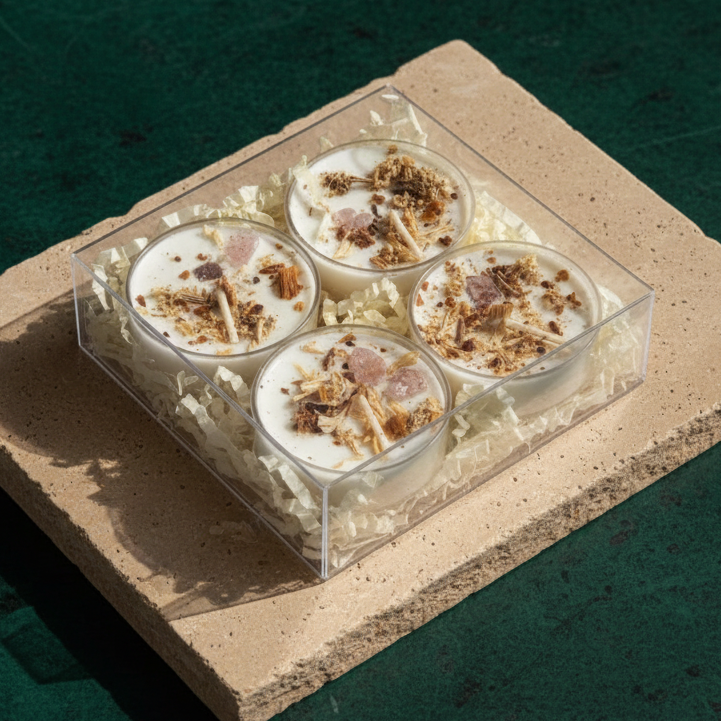
Hand-poured devotional tealights, dressed and ready to light
-
Dressed with strawberry, amber, rose, cypress, and poppy
- Topped with genuine strawberry quartz
-
A few hours of burn each — sized for daily offering, not a seven-day working
-
Named for Freyja, the Norse goddess of love, fertility, gold, and seiðr
How to use it
-
Light one as an offering, not a request. Devotional practice runs on regularity; the asking, if there is any, comes later and in a smaller voice.
-
Keep it short and repeatable. A few minutes at the same time of day beats an elaborate rite you manage twice.
-
Friday is the traditional day — the etymology carries it, from Old English Frīgedæg, the day of Frigg, whose relationship to Freyja is one of the genuinely open questions in Norse scholarship.
-
Put out an offering alongside the flame if your practice includes one. In the Norse sources these are typically food, drink, or something made.
-
Keep the strawberry quartz on the altar rather than carrying it, if the practice is devotional rather than personal.
The two devotional tealight sets
| Set |
Dressed with |
Stone |
Best for |
| Shakti Devotional Tealight Set |
Hibiscus, amber, cinnamon, rose, jasmine, orange |
Carnelian chips |
Opening work — before you create, perform, or step into visibility |
| Freyja Devotional Tealight Set |
Strawberry, amber, rose, cypress, poppy |
Strawberry quartz |
Daily offering at the altar rather than a long working |
✨ Temple Tip — pick the time of day before you pick the words
Devotional practice fails on scheduling far more often than on sincerity. Choose the two minutes — after the kettle boils, before you open the laptop — and attach the flame to that. The words tend to sort themselves out once the slot exists.
Questions we get asked
How long does each tealight burn?
A few hours, as tealights do. They are sized for a single daily devotion rather than for a continuous working; a 7-day glass candle is the format for the latter.
Do I need to follow Norse practice to use these?
No, and we would rather say so plainly. They are offered as devotional tools with the tradition named. What you bring to them is your business.
What is the difference between this and the Shakti set?
Freyja is a daily-offering set for regular altar devotion. Shakti is an opening set, used before creative or outward-facing work. Same format, different job.
Are the botanical correspondences historically attested?
No, and we will not pretend otherwise. The surviving Norse sources say very little about what was offered to Freyja specifically. The correspondences here are modern devotional practice rather than an invented lineage.
What should I do with the strawberry quartz?
For devotional practice, keep it on the altar rather than carrying it. Carrying tends to suit personal work more than offering work.
California Proposition 65 warning: Burning this product produces combustion by-products. Use in a well-ventilated space.
Care & safety: Burn in a heat-proof holder that catches wax, within sight, away from drafts and anything flammable, never unattended or within reach of children and pets. Dressed tealights carry loose botanicals on the surface that will catch as the wax melts. A ritual tool — no outcome is promised. The botanical correspondences here are modern devotional practice rather than attested Norse ritual.
What the Norse sources actually say about her is thinner and stranger than the internet suggests — the sources, honestly. For the practical side, an altar in a shared room. More sets in Ritual Candles.
Most days, briefly, at the same hour. That is the whole practice. #TempleOfDesire