




Astrology Aspects Explained: Trine, Square and More
What aspects are in astrology: the five major angles, minor aspects, orbs, patterns like the T-square and grand trine, and a step-by-step way to read them in your own chart.


Planets in a birth chart do not speak alone. They talk to each other, and in astrology those conversations are called aspects: the geometric angles between two planets. An aspect is what tells an astrologer whether two forces in a chart are read as reinforcing each other, challenging each other or rubbing against each other. Your sun sign says one thing. How your sun stands to your moon, your Saturn or your Mars says a great deal more. This guide explains what aspects are, the five major ones and the most common minor ones, how orbs work, what the famous patterns such as the T-square and the grand trine mean, and how to read the lines in your own chart step by step.
Contents
Aspects are the angles between two planets in a chart, measured along the 360-degree zodiac. The five major aspects, going back to Ptolemy, are the conjunction (0°), sextile (60°), square (90°), trine (120°) and opposition (180°). An aspect counts within a tolerance called the orb, often 6 to 8 degrees. Trines and sextiles are read as easy, squares and oppositions as tense, but tension is read as the driver of growth, not as bad luck. Minor aspects such as the quincunx (150°) and patterns such as the T-square add detail. The angles are geometry; their meanings are tradition.
Aspects are angular distances between two points on the 360-degree ecliptic circle and can be calculated exactly from planetary positions.
Source/tradition: Geometry; ephemeris calculation
The five major aspects are described in Claudius Ptolemy's Tetrabiblos from the second century CE.
Source/tradition: Ptolemy, Tetrabiblos, Book I
Johannes Kepler proposed additional aspects, including the quintile and sesquiquadrate, in Harmonices Mundi in 1619.
Source/tradition: Kepler, Harmonices Mundi (1619)
Trines and sextiles are traditionally read as harmonious, squares and oppositions as challenging, and the conjunction as intensifying.
Source/tradition: Classical and modern astrological literature
Working astrologers commonly start chart reading with aspects to the sun, moon and ascendant and with the tightest orbs.
Source/tradition: Contemporary astrological practice
That aspects in a birth chart determine personality or predict events has not been demonstrated in controlled studies.
Source/tradition: Carlson, Nature 318 (1985); no evidence for astrological prediction
VERIFIED = verifiable in scientific or official sources · TRADITIONAL = historically or culturally recorded · LIVED PRACTICE = widely practiced, experiential knowledge · NOT PROVEN = spiritual interpretation, not scientifically established.
Aspects at a glance
- What they are: angles between planets, measured on the 360° zodiac circle
- The big five: conjunction 0°, sextile 60°, square 90°, trine 120°, opposition 180°
- Orb: the allowed tolerance, often 6–8° for major aspects
- Origin: Ptolemy's Tetrabiblos, second century CE; minor aspects added by Kepler in 1619
- Rule of thumb: planet = what, sign = how, house = where, aspect = in dialogue with whom
What an aspect is
Picture the zodiac as a circle of 360 degrees. Every planet in a chart sits at a specific degree of that circle. When two planets stand a particular distance apart, they form an aspect. Not every distance counts. Astrology mainly uses angles that divide the circle into simple fractions: the whole circle, half, a third, a quarter and a sixth.
Here is how the math works in practice. Say your sun is at 15° Aries and your moon at 17° Leo. On the full circle, Aries starts at 0° and Leo at 120°, so the sun sits at 15° and the moon at 137°. The distance is 122°. That is 2° away from an exact trine of 120°, so the sun and moon are in trine with an orb of 2°. Chart software does this for you, but knowing the arithmetic makes the lines on the wheel much less mysterious.
An aspect is almost never exact. It counts within a range called the orb. The closer to exact, the stronger it is read. For the major aspects many astrologers allow roughly 6 to 8 degrees, and a little more when the sun or moon is involved, because the two lights are considered the most important points in a chart. Orbs are a convention, not a law, and different schools draw the lines differently.
The five major aspects
The core set goes back to the Greek-Egyptian astronomer Claudius Ptolemy, whose Tetrabiblos in the second century CE described them, which is why they are still called the Ptolemaic aspects.
| Aspect | Angle | Nature | Traditional reading |
|---|---|---|---|
| Conjunction | 0° | Neutral, intensifying | Two forces merge and act as one; depends heavily on which planets are involved |
| Sextile | 60° | Harmonious | Opportunity, talent, an easy flow that still needs a small push to use |
| Square | 90° | Challenging | Tension, friction, drive; the push that forces growth |
| Trine | 120° | Harmonious | Ease, natural gifts, things that work without effort |
| Opposition | 180° | Polarizing | Mirroring, projection onto others, a balancing act between two poles |
Each aspect also has a logic rooted in the signs. A trine usually connects signs of the same element, fire to fire or water to water, which is why it reads as easy. A square usually connects signs of the same mode but different elements, for example cardinal Aries and cardinal Cancer, which is why it reads as friction. An opposition connects complementary signs across the wheel. When an aspect falls across a sign boundary, astrologers call it out of sign, or dissociate, and many read it as weaker or odder than usual.
Harmonious does not mean good, and tense does not mean bad
The most common misunderstanding is that trines and sextiles are pleasant and squares and oppositions are problems. Most working astrologers read it the other way around, or at least with more nuance. Tense aspects create the pressure that sets development in motion. A lot of real achievement, in art, sports or business, is read as rooted in squares. Easy aspects flow so smoothly that their potential sometimes sleeps, because nothing forces you to use it.
An example makes this concrete. A moon square Saturn is read as a pull between the need for comfort and the need for control: someone who learned early to manage feelings instead of showing them. That same square is also read as the source of unusual emotional resilience and reliability once it is worked with. A moon trine Venus, by contrast, is read as natural warmth and ease with affection, which can make it easy to avoid anything that feels uncomfortable. Neither placement decides a life; each describes a pair of needs and the way they tend to meet.
So a chart full of trines is not automatically a charmed life, and a chart full of squares is not a curse. The practical question is always the same: which two needs meet here, and how can they be reconciled?
The most common minor aspects
In 1619, in Harmonices Mundi, the astronomer Johannes Kepler proposed adding further angles to Ptolemy's five, among them the quintile and the sesquiquadrate. Today most astrologers use a handful of minor aspects with tight orbs of 1 to 3 degrees.
| Aspect | Angle | Traditional reading |
|---|---|---|
| Semi-sextile | 30° | A slight, neighborly link between adjacent signs; subtle, easy to miss |
| Semi-square | 45° | Irritation, low-level friction; half a square |
| Quintile | 72° | Creative talent, a personal style; one of Kepler's additions |
| Sesquiquadrate | 135° | Restless tension that builds up; a square and a half |
| Quincunx (inconjunct) | 150° | An awkward fit that needs constant adjustment |
If you are just starting out, it is fine to ignore the minor aspects entirely. The big five with sensible orbs already carry most of what a chart has to say.
 |
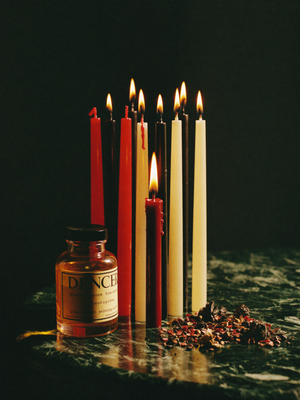
For a chart full of squares Tranquility Candle Spell Booster Pack, $33.95. Four blue beeswax tapers, Peace and Tranquility oil, herbs, glass glitter, a tumbled stone and a petition paper, handmade by Parlour of Wonders. It is designed as an add-on to their candle spell kits, and the contents are enough for a quiet evening with your chart and the reconciliation question below. It resolves no aspect; it gives the tension you are working with a calm place to be looked at. |
Aspect patterns: when several planets form a figure
Sometimes three or four planets connect through several aspects at once and form a recognizable shape. Astrologers pay special attention to these patterns because they tie several themes into one story.
- T-square. Two planets in opposition, both square to a third. The third planet, the apex, becomes the pressure point of a central life theme.
- Grand cross. Four planets, two oppositions crossing at right angles, four squares. A chart with a lot of built-in tension and a lot of built-in drive.
- Grand trine. Three planets each about 120° apart, usually in the same element. Read as a closed circuit of talent that can feel effortless, and sometimes too comfortable.
- Yod. Two planets in sextile, both in quincunx to a third. Often nicknamed the finger of God and read as a sense of a specific, sometimes uncomfortable calling.
- Stellium. Not an aspect pattern in the strict sense, but three or more planets conjunct in one sign or house, concentrating a lot of energy in one area.
How to read aspects in your own chart
In a birth chart, aspects appear as colored lines in the inner circle. Many chart programs draw harmonious aspects in blue or green and tense ones in red, and list them again in a grid beside the wheel. To get your chart, you need your birth date, the exact time and the place; without the time, the moon and rising sign can be off. Then work through it in this order:
- Start with the big three. Look first at aspects to your sun, your moon and your rising sign. They are read as the strongest.
- Go by orb. Tight aspects, within one or two degrees, are read as more noticeable than wide ones.
- Look for patterns. Check whether any T-square, grand trine or yod ties several planets together.
- Ask the reconciliation question. For each aspect: which two needs meet here, and how could they work together instead of against each other?
A sentence that holds it all together: the planet says what, the sign says how, the house says where, and the aspect says with whom that force is in conversation. Our guide to the astrology houses covers the where.
Aspects beyond the birth chart: transits and relationships
Aspects are not only a feature of the natal chart. When a planet moving through the sky today forms an angle to a planet in your birth chart, that is a transit aspect, and it is how most forecasting astrology works. The famous Saturn return is simply transiting Saturn making a conjunction with natal Saturn around age 29. A current example is the Uranus retrograde in Gemini, which matters most to charts with planets in the first few degrees of Gemini, Sagittarius, Virgo or Pisces, exactly the degrees it aspects by conjunction, opposition and square.
The same logic applies between two people. Synastry, relationship astrology, compares two charts and looks at the aspects between them: one person's Venus trine the other's Mars, one person's moon square the other's Saturn. The rules are identical; only the two ends of each line belong to different people.
What we do not promise
Aspects are geometry: the angles themselves can be calculated precisely. What those angles are said to mean is tradition. Controlled studies have not found that astrology predicts personality or events; the best-known is a double-blind test by physicist Shawn Carlson published in Nature in 1985, in which astrologers could not match charts to personality profiles better than chance. We present aspect readings as a language for reflection, not as a diagnosis and not as a forecast.
Frequently asked questions
What are aspects in astrology?
Aspects are the angles between two planets or points in a chart, measured along the 360-degree zodiac. They describe whether two forces in a chart are read as blending, supporting each other or pulling against each other.
What are the five major aspects?
The conjunction (0°), sextile (60°), square (90°), trine (120°) and opposition (180°). They go back to Ptolemy's Tetrabiblos in the second century and are still called the Ptolemaic aspects.
What is an orb in astrology?
The orb is the tolerance around the exact angle within which an aspect still counts. Many astrologers use about 6 to 8 degrees for the major aspects and allow somewhat more when the sun or moon is involved. The tighter the orb, the stronger the aspect is read.
Are squares and oppositions bad aspects?
No. Squares and oppositions are read as tension, and tension is what drives change. Many astrologers see them as the source of a person's greatest strengths. Easy aspects like trines, on the other hand, can flow so smoothly that their potential goes unused.
What is a T-square?
A T-square is an aspect pattern in which two planets oppose each other and both square a third planet. That third planet, called the focal or apex planet, is read as the pressure point of a central life theme.
What is a quincunx?
The quincunx, or inconjunct, is a minor aspect of 150°. It links two signs that share neither element nor mode, and it is read as an awkward fit that needs constant adjustment. Two quincunxes to the ends of a sextile form the pattern called a yod.
How do I find the aspects in my birth chart?
Enter your birth date, exact time and place into any chart calculator. The aspects appear as lines in the center of the wheel and usually in a grid beside it. Start with aspects to your sun, moon and rising sign, and with the tightest orbs.
Sources and further reading
- Claudius Ptolemy, Tetrabiblos, Book I (2nd century CE), on the configurations of the planets.
- Johannes Kepler, Harmonices Mundi (1619), on new aspects including the quintile and sesquiquadrate.
- Shawn Carlson, "A double-blind test of astrology," Nature 318 (1985), 419–425.
- Modern astrological textbooks on orbs, aspect patterns and chart interpretation.
- More in the magazine: Venus in your birth chart · Mars in your birth chart · Chiron in astrology
Astrological readings are described here as traditions, not predictions. Questions about an order: 28@templeofdesire.com.
More from Astrology & Zodiac
All stories →
NOAA Issues G1 Geomagnetic Storm Watch for October 2: Auroras Possible Across the Northern U.S.

Jupiter Retrograde 2026 and 2027: Dates, Degrees and the Shadow Period