




How to Use a Cauldron in Witchcraft: Fire, Water and What Cracks


A cauldron is the one witchcraft tool people buy first and use least. It sits on the altar looking the part while the actual work happens in a bowl — because nobody explained what goes in it, what it does to the table underneath, or why the pretty one cracked the first time it met a flame.
Contents
A cauldron is a heatproof working vessel, not a decoration. Cast iron is the only common material that takes open flame; ceramic and carved stone are for cold work - water, herbs, offerings, crystals. Burn only small, dry material, on a layer of sand, on a trivet, never directly on a table.
A cauldron is historically a cooking vessel that also served ritual use
The three-witches cauldron image derives from Shakespeare's Macbeth (c. 1606)
Welsh and Irish literature describe cauldrons of rebirth and plenty
Practitioners consecrate a new cauldron before first use
A sand bed is used to insulate the base and smother embers
Cast iron takes open flame; glazed ceramic and carved stone crack from thermal shock
A cauldron makes a working stronger or more effective
VERIFIED = verifiable in scientific or official sources · TRADITIONAL = historically or culturally recorded · LIVED PRACTICE = widely practiced, experiential knowledge · NOT PROVEN = spiritual interpretation, not scientifically established.
Quick answer
A cauldron is a heatproof working vessel, not a decoration. Cast iron is the only common material that takes open flame; ceramic and carved stone are for cold work — water, herbs, offerings, crystals. Burn only small, dry material, on a layer of sand, on a trivet, never directly on a table. Cast iron reaches well over 400 °F on the outside within minutes, so it is handled with the same respect as a hot skillet.
What a cauldron is actually for
Strip away the silhouette and a cauldron is a container built to survive what you do inside it. Historically that meant a cooking pot on a hearth: a round-bellied iron vessel on three legs so it could stand in embers without tipping. Everything the tool means in modern practice descends from that one fact — it was the thing in the house that could take fire and not be ruined.
That gives you the honest definition. A cauldron is where you put a working that produces heat, ash, smoke, liquid or mess, so the working is contained instead of spreading across your altar. It is a boundary as much as a bowl. Anything you could do just as safely in a teacup does not need a cauldron, and the practitioners who use theirs most are usually the ones who bought the plainest one.
What it is not: a required tool. Nothing in candle work, herb work, divination or devotional practice breaks if you do not own one. If you are setting up a first altar, a cauldron belongs well down the list — behind a heatproof surface, a way to put a fire out, and something to hold water. Our walkthrough on what an altar actually needs puts the order of purchase in plain terms.
Cast iron, ceramic or stone: which cauldron do you need?
This is the decision that determines everything else, and most listings will not tell you straight, because a seller who says "decorative only" sells fewer cauldrons. The material sets the ceiling on what the vessel can do.
| Material | Open flame | Charcoal disc | Water & wet work | Main failure mode |
|---|---|---|---|---|
| Cast iron | Yes | Yes, on sand | Yes, but dry it at once | Rust if left wet; burns you if left unattended |
| Glazed ceramic | No | Only with a deep sand bed, and many still fail | Yes | Thermal shock — cracks from uneven heating |
| Carved stone | No | No | Yes — this is what it is for | Splits along natural seams under heat |
| Enamelled iron | Low flame only | Not recommended | Yes | Enamel chips and discolours permanently |
| Brass or copper | No | No | Avoid — reacts with salt and acid | Tarnish, verdigris, warping |
The practical reading: if you intend to burn anything, buy plain cast iron and accept that it looks like a small cooking pot, because that is what it is. If you intend to hold things — water for scrying, herbs for mixing, offerings, written petitions, crystals — then stone or ceramic is not a compromise, it is the correct tool, and it will look better doing it.

For the cold work
Crystal Cauldron — Carved Gemstone Vessel
If what you actually need is a vessel for water, herbs, offerings and petitions rather than fire, this is the honest answer: a carved stone bowl that holds the shape without pretending it can take a flame. We do not currently stock cast iron — if fire is your use case, buy plain cast iron from a cookware supplier and spend the difference on what goes in it.
$19.95
Can you burn things in a cauldron indoors?
Yes, within limits, and the limits are the whole answer. Small quantities of dry plant material, a single charcoal disc, or one tealight-sized flame are manageable indoors in a cast iron vessel standing on a trivet with a sand bed. Loose paper, resin in quantity, alcohol, or anything that flares is not, because the failure mode is not a small fire — it is a column of flame at face height in a room with a smoke alarm.
The part the internet skips is ventilation. Burning herbs and resins indoors produces particulate smoke, and the volume that feels atmospheric in a large room is genuinely unpleasant in a studio apartment with the windows shut. We covered the practical side of that — extraction, alarms, and what sets them off — in our guide to burning incense in an apartment.
And before anything goes in: not every plant is safe to burn. Several common garden and houseplant species release genuinely harmful compounds when smouldered, and a few of them circulate in ritual lists anyway. Our list of plants you should never burn as incense is worth reading once, properly, before you improvise.
How hot does a cauldron actually get?
Hotter than people expect, and the outside catches up with the inside fast. Cast iron conducts heat through the wall and into the feet, which is exactly why the traditional vessel had three legs and stood in a hearth rather than on furniture. These are the rough working ranges for the fuels people put in cauldrons:
Approximate burning temperature by fuel
Figures are typical ranges for these fuels in open air, given for scale rather than precision. What matters for your table is that all four are far above the scorch point of wood and varnish.
The rule that follows is simple and non-negotiable: the cauldron never sits directly on furniture during or after a burn. A metal trivet, a stone tile, or a cast iron pan lid underneath. And it stays hot for a long time after the visible fire is out — cast iron holds heat for the better part of an hour.
How to build a small cauldron fire safely
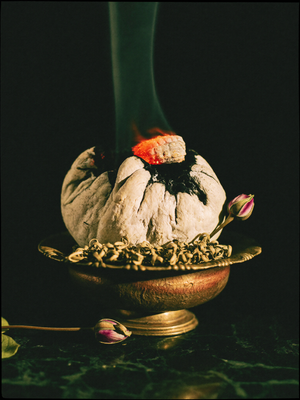
The sand layer is the single thing most guides omit, and it is what separates a contained burn from a cracked vessel and a scorched table. Sand insulates the base, absorbs heat, lets you bury an ember to kill it, and gives you something to stand a charcoal disc in.
The order of operations
- Clear the surface. Nothing flammable within arm's reach — no loose cloth, no paper, no hair down, no sleeves.
- Put the extinguisher in place before you light anything: a lid that fits the cauldron, or a bowl of sand. Not water — water on hot iron spits and can crack ceramic.
- Trivet down, cauldron on the trivet, one to two inches of dry sand in the base.
- Light the fuel with long matches or a stem lighter, not a pocket lighter that puts your fingers in the vessel.
- Add material a pinch at a time. The instinct to load it up is the instinct that produces the flare.
- Kill it by smothering — lid on, or bury the ember in the sand. Then leave the cauldron where it stands until it is cold.
How to season a cast iron cauldron
New cast iron arrives with a factory coating that is not meant to be burned, and bare iron rusts the first time it meets damp air. Seasoning is the same process used for cookware: wash with hot water and a little soap, dry it completely over low heat, wipe a very thin film of neutral oil over every surface including the outside and the legs, then heat it until the oil stops smoking and let it cool.
Two points specific to ritual use. First, the smoke from that first seasoning is substantial — do it with ventilation, and not in the room where you keep textiles. Second, if you intend to burn resins and herbs, the seasoning will darken and build up into a black patina over time. That is not damage; it is the surface doing its job. Scrubbing it back to bare metal every time undoes the protection.
Water in the cauldron: scrying, moon water and offerings
The wet uses are where ceramic and stone vessels genuinely outperform iron, and where a cauldron stops being a fire pit and starts being a mirror. A dark vessel filled with water is the oldest scrying surface there is — older than the black glass mirror, which is a later refinement of the same idea. If the reflective work is what draws you, our walkthrough on making and actually using a black scrying mirror covers the technique, and it transfers directly to a water-filled bowl.
Moon water is the other common wet use, and the cauldron's wide mouth is genuinely better suited to it than a sealed jar, provided you cover it against insects and do not leave it standing for days. The practical cautions — what is safe to drink, what is not, and why the answer is usually "do not" — are set out in our guide to making moon water safely.
A note on iron and water together: do not leave them together. Standing water in a cast iron vessel will begin to rust it within hours, and salt water will do it faster. Wet work goes in stone, ceramic or glass. If you only own iron, use it and dry it immediately, all the way down to the legs.
Herbs, resins and loose incense without an open flame
A large share of cauldron work involves no fire at all, and this is the part beginners tend to skip past on the way to the dramatic version. A cauldron is an excellent mixing vessel: it has a deep belly, a rolled rim you can pour from, and enough mass that it does not skate across the table while you work.
Blending loose incense in the cauldron and then burning a pinch of it elsewhere is both safer and more controllable than burning in the vessel itself — our guide to blending your own loose incense has workable ratios to start from. When you do want the smoke, the charcoal disc method is the one worth learning properly, including the part about scorching, which is the usual reason a first attempt smells like burnt hair: see burning resin incense on a charcoal disc.
Why did my cauldron crack?
Almost always thermal shock: one part of the vessel expanded faster than the part next to it, and the material gave way along the stress line. It is not a sign about the working, and it is not the vessel "taking" something on your behalf — it is physics, and it is predictable enough to avoid.
The three reliable causes: heat applied to a cold vessel too quickly; water introduced to a hot vessel; and heating a material that was never rated for flame. Glazed ceramic is especially prone, because the glaze and the clay body expand at different rates, so the glaze crazes and then the body follows. Carved stone splits along its natural seams — a crystal cauldron that has been near a flame will often fail along a vein that was invisible when you bought it.
If it does crack, retire it from heat permanently. A hairline fracture in a vessel you intend to put fire in is a vessel that will fail completely at the worst moment, and the contents will land on whatever is underneath.
Temple Tip
Keep a second, cheap vessel purely for the messy work — ash, wax scrapings, burnt petition paper, anything that stains. The cauldron you like looking at stays clean for water, offerings and herbs, and the ugly one absorbs the wear. Practitioners who own one good cauldron tend to use it for nothing; practitioners who own one good one and one scruffy one use both constantly.
How to clean and store a cauldron
Ash and soot come out with a dry brush and a paper towel — do this while the vessel is cold and before the residue absorbs moisture, because damp ash is mildly caustic and will pit iron. Wax is the harder case: let it set completely, then flex the vessel if it is iron, or freeze a ceramic one for twenty minutes and lift the disc out whole. Never chisel at wax in a stone vessel.
For cast iron, the rule is the cookware rule: dry it completely, re-oil it lightly, store it somewhere with air movement, and never put the lid on tight for storage — trapped moisture is what turns a seasoned surface orange. For ceramic and stone, ordinary washing is fine, and salt residue should come off rather than be left to sit.
Do you need to consecrate a cauldron before using it?
Depending on tradition, and the honest answer is that practice varies more than the guides admit. Formal Wiccan and ceremonial lineages generally do consecrate tools, with a defined rite, because in those systems the tool is understood to be set apart for a purpose. Much of folk practice does not, on the reasoning that a working tool earns its character by being worked.
What is consistent across both: the vessel gets cleaned before first use, and it gets a moment of attention where you state what it is for. Whether you call that consecration or common sense is a question of vocabulary. If you have inherited the vessel rather than bought it, that changes the calculation somewhat, and we have written separately about what to do with inherited ritual tools.
Where the image of the cauldron comes from
The three witches with a cauldron are Shakespeare's, from Macbeth in 1606, and the scene did more to fix the image in the English-speaking imagination than any folk source. Before that, the cauldron in European literature is more often a vessel of plenty or rebirth than of malice — the Welsh Mabinogion has a cauldron that restores the dead, and Irish material has the Dagda's cauldron from which no company went unsatisfied.
That matters practically, because the modern association with brewing and bubbling is a theatrical inheritance rather than a traditional instruction. Historic cauldrons were cooking pots that also did ritual duty, which is why almost everything useful you can do with one turns out to be a variation on holding, mixing, containing or burning — and almost nothing turns out to be brewing a potion.
Which cauldron do you actually need?
Four questions. Answer them honestly rather than aspirationally — the commonest buying mistake is equipping for the practice you imagine having rather than the one you have.
Loading…
Nothing is stored or sent. This runs entirely in your browser.
Voices from practice
We do not print invented testimonials, so what follows is a description of what recurs — drawn from open practitioner discussion in places like r/witchcraft and r/SASSWitches, summarised rather than quoted, with no names attached.
Three patterns come up repeatedly. The first is buyer's regret about decorative vessels: people who bought a cauldron for its appearance and discovered it could not take the one use they wanted it for. The second is the sand discovery — practitioners describe the sand layer as the change that made cauldron burning feel controlled rather than nervous, and they usually report learning it after a scorch mark rather than before. The third is quieter and more interesting: a number of long-term practitioners say they stopped burning in the cauldron altogether and now use it exclusively as a container, having concluded that the fire was theatre and the containment was the point.
None of that is evidence about efficacy. It is evidence about what people find workable, which is a different and more useful thing when you are deciding what to buy.
What we don't promise
A cauldron does not make a working stronger. Nothing about the shape, the material, or the age of the vessel changes what a ritual does — a bowl from your kitchen holds a petition just as well, and every tradition that uses cauldrons also has practitioners who get on perfectly well without one.
We make no claim that any vessel, stone, herb or blend produces a specific outcome in your life, protects you from harm, or influences another person. Carved stone is carved stone. We sell tools for a practice, and we are not going to tell you they are more than that.
Nor is this a safety certification. The guidance here is ordinary fire caution written down plainly, not a substitute for the fire regulations where you live, your building's rules, or your own judgement in your own room. If you rent, check what your lease says about open flame before you light anything. If a burn gets away from you, the correct response is the fire brigade, not a ritual.
Practically: how to work with this
If you own a cauldron and have never used it, start with the cold work this week: put water in it and sit with it for ten minutes, or use it to mix a herb blend you were going to mix anyway in a bowl. The point is to break the ornament habit. A tool you have used once is a tool you will use again.
If you are about to buy one, buy for the use you can name. "Burning small amounts of herb on charcoal, on a tiled hearth, about once a month" is a use. "Witchcraft" is not, and it is how people end up with a vessel that does not fit their practice. Measure the space it will live in first — the commonest size complaint is that a cauldron looked modest in a photograph and arrived either too small to hold a charcoal disc safely or too large for the altar.
And if you are setting up from nothing, the cauldron is not the first purchase. A heatproof surface, a way to put a fire out, and a vessel for water will carry you further. The rest of the smoke and cleansing supplies can follow once you know which direction your practice is actually going.
Frequently asked questions about cauldrons
Can I use a regular cooking pot instead of a cauldron?
Yes. A cast iron skillet, a Dutch oven or a small camp pot does everything a cauldron does, because a cauldron is a cooking pot. The only real consideration is that once a vessel has burned resins and herbs, the residue is difficult to remove fully, so keep it separate from the one you cook in.
What size cauldron should I buy?
For indoor work, four to six inches across the mouth handles a charcoal disc with room for sand and is small enough to smother quickly. Anything under three inches is too shallow to hold a sand bed and a burning disc safely. Larger sizes are outdoor vessels in practice, whatever the listing says.
Why does my cauldron rust even though I dried it?
Usually the legs and the rim, which are the last places to dry and the easiest to miss, or storage with the lid on, which traps humidity inside. Dry over low heat rather than with a towel, re-oil thinly, and store the lid beside the vessel rather than on it.
Can I burn a whole petition paper in a small cauldron?
Fold it small and burn it in pieces rather than dropping in a full sheet. A loose sheet of paper catches at once, lifts on its own draught, and can leave the vessel while alight. If the paper matters to you, burning it in a larger vessel outdoors is the calmer option.
Is a crystal or stone cauldron useless if it cannot take fire?
No — it is simply a different tool. A large share of cauldron practice is holding rather than burning: water for scrying, herb blending, offerings, petitions kept rather than destroyed, crystals. A stone vessel does all of that and does not rust, which iron will.
What do I do with the ash afterwards?
Let it go cold completely — several hours, not minutes, since embers survive under ash. After that, practice varies: some keep the ash, some scatter it outdoors, some bin it. There is no consensus rule. What is not optional is the cold part, because warm ash in a waste bin is a genuine fire risk.
Does the cauldron need to be a particular shape to work?
No. The three-legged round belly is a hearth design — the legs let it stand in embers and the shape suits a hanging chain. Both features solve problems you do not have on a table. Choose for stability and a rim you can grip, not for silhouette.
Can I put a cauldron on a stovetop?
A true cast iron vessel with a flat base, yes. A three-legged one, no — it will not sit flat, and on a glass or induction top the legs can scratch or simply fail to register. Ceramic and stone cauldrons never go on a stovetop.
Sources & further reading
- William Shakespeare, Macbeth, first performed c. 1606 — the source of the three-witches cauldron scene that shaped the modern image.
- The Mabinogion, medieval Welsh prose tales (surviving manuscripts 14th century, material considerably older) — the Cauldron of Rebirth in the Second Branch, Branwen ferch Llŷr.
- Ronald Hutton, The Triumph of the Moon: A History of Modern Pagan Witchcraft, Oxford University Press, 1999 (2nd edn 2019) — on how modern ritual tool sets were assembled and when.
- Ronald Hutton, The Stations of the Sun: A History of the Ritual Year in Britain, Oxford University Press, 1996 — on hearth practice and the domestic vessel in folk custom.
- U.S. Consumer Product Safety Commission, public guidance on candle and open-flame fire safety in the home, 2024 — for the ordinary precautions summarised above.
- National Fire Protection Association, home candle-fire statistics and safety guidance, 2024 — on unattended flame as the dominant cause of domestic ignition.
Temperature ranges given above are typical published figures for these fuels burning in open air and are included for scale, not as measurements of any particular product.