




Jupiter Sign: Luck, Growth and Your Jupiter Return
What Jupiter describes in a birth chart, when your Jupiter return falls, Jupiter through the signs and houses, the moons you can see with binoculars, and where the luck framing turns into a sales pitch.


Everyone has one area of life where things have always come a little easier. Not effortless — easier. Doors open a crack when you knock, people put in a word for you, the work you do there feels like expansion rather than grind. Ask around and most people can name theirs in a sentence. That is the part of the chart Jupiter is pointing at.
Contents
Jupiter in a birth chart describes where a person grows, gives and takes risks. It orbits in 11.86 years, about one year per sign, so it returns to its birth position roughly every twelve years - at about 12, 24, 36, 48, 60, 72 and 84. Because it spends a year in each sign, everyone born within about twelve months of you shares the sign; the house is what makes it yours. It names a temperament, not an income forecast.
Jupiter completes one orbit of the Sun in 11.86 years, about one year per sign, returning to its natal position roughly every twelve years.
Source/tradition: Orbital period of Jupiter, NASA planetary fact sheet
Jupiter appears retrograde for about four months of each year, roughly a third of the time.
Source/tradition: Synodic period of Jupiter; apparent retrograde motion is a line-of-sight effect
Galileo observed four moons beside Jupiter in January 1610 and recorded their changing positions over successive nights.
Source/tradition: Galileo Galilei, Sidereus Nuncius, 1610
The Great Red Spot has been under continuous observation since at least 1831 and has measurably shrunk over the past century.
Source/tradition: Historical drawings and modern imaging; possible earlier sighting by Cassini in 1665
NASA's Juno spacecraft entered orbit around Jupiter in July 2016 and found that the Great Red Spot extends hundreds of kilometres below the cloud tops.
Source/tradition: NASA Juno mission results
English 'Thursday' comes from Old English Thunresdaeg, the day of the thunder god who was matched to Jupiter when the Roman seven-day week was translated into Germanic languages.
Source/tradition: Old English etymology; compare Latin dies Iovis, French jeudi, Spanish jueves
Jupiter rules Sagittarius and, in traditional astrology, Pisces; it is exalted in Cancer.
Source/tradition: Hellenistic dignity scheme; Pisces reassigned to Neptune by most modern western astrologers after 1846
Tin is the metal assigned to Jupiter.
Source/tradition: Standard planet-metal correspondence in European sources
Marking the Jupiter return at roughly 12, 24, 36 and 48 as a year of growth.
Source/tradition: Contemporary astrological practice
A Jupiter placement or transit indicates that money is coming.
Source/tradition: No evidence; the traditional material describes temperament, not income
A Jupiter return predicts a specific outcome in a person's life.
Source/tradition: Everyone living to 84 has seven; a cycle shared by all cannot single anyone out
VERIFIED = verifiable in scientific or official sources · TRADITIONAL = historically or culturally recorded · LIVED PRACTICE = widely practiced, experiential knowledge · NOT PROVEN = spiritual interpretation, not scientifically established.
Jupiter has been called the Greater Benefic since Hellenistic times, which in plain English means: the planet the tradition expects good things from. It is also the placement most easily oversold, and this article tries to do both jobs — explain what astrologers actually read from it, and be straight about where the "luck" framing turns into something you should not buy.
What Jupiter describes in a chart
Jupiter is the principle of increase. Whatever it touches, the tradition says, gets bigger — which is why the same placement is read as generosity and as excess, as faith and as overreach. It governs growth, meaning, travel, higher learning, law, teaching, and the particular confidence that lets a person try something they are not yet qualified for.
Read the sign for the flavour of that growth, the house for where it shows up, and the aspects for what it amplifies. One practical note that matters more than any of the sign descriptions: because Jupiter magnifies whatever it contacts, it is not automatically pleasant. Jupiter on a difficult placement makes that placement larger, not softer.
The twelve-year clock, and your Jupiter return
Jupiter takes 11.86 years to orbit the Sun. Divide that by twelve signs and you get the single most useful fact about the planet: roughly one year per sign, and a return to its birth position about every twelve years.
That puts Jupiter returns at approximately ages 12, 24, 36, 48, 60, 72 and 84. Astrologers read them as openings: a year in which the direction of growth becomes visible again. It is a gentler idea than the Saturn return, which arrives around 29 and has become genuine American slang for the crisis of the late twenties. Jupiter's version is the same structural idea — a slow planet coming home — with none of the dread attached.
The twelve-year spacing also means something less flattering and worth saying: a Jupiter return is common. Everyone who lives to 84 gets seven. Any framework that hands out a significant year to every person at the same ages is describing a calendar, not a destiny.
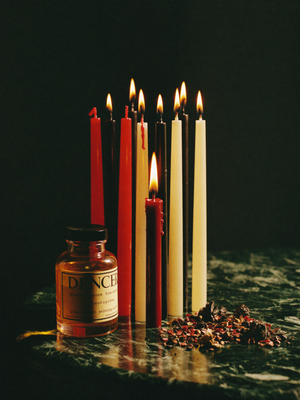
Candle · refillable
Sagittarius Oil Candle
Jupiter rules Sagittarius in the traditional scheme, so this is the sign candle for the sign Jupiter runs. It is an oil candle rather than a wax one — refillable, meant to be topped up and kept, not consumed and replaced. That happens to suit a planet whose whole theme is a cycle that comes back around every twelve years. It scents a room and holds a flame. It will not expand anything. $25.95
View it →Jupiter through the twelve signs
Because Jupiter spends about a year in each sign, everyone born within roughly twelve months of you shares this placement. It is a cohort flavour, not a personal fingerprint — the house is where it becomes yours.
| Jupiter in | Where growth comes from | What gets overdone |
|---|---|---|
| Aries | Starting before you are ready | Too many beginnings, no middles |
| Taurus | Patience, craft, holding on | Accumulation for its own sake |
| Gemini | Learning, talking, connecting people | Breadth with no depth anywhere |
| Cancer | Care, family, making a place | Taking on other people's lives |
| Leo | Creative nerve and open-handedness | Needing the room to notice |
| Virgo | Usefulness, skill, being trusted with detail | Improving what was already fine |
| Libra | Partnership and fair dealing | Agreeing past the point of honesty |
| Scorpio | Depth, crisis survived, hard truths | Intensity mistaken for meaning |
| Sagittarius | Distance, study, conviction — Jupiter at home | Certainty that outruns the evidence |
| Capricorn | Structure, patience, the long build | Growth deferred until it is too late to enjoy |
| Aquarius | Ideas, networks, the common good | Principle at the expense of the person |
| Pisces | Compassion, art, the unmeasurable | Giving with no edges on it |
Jupiter through the houses
This is where a shared sign becomes a specific life. Jupiter in the 1st reads as presence — people expect something of you before you have done anything. In the 2nd it concerns earning and self-worth, which the tradition links closely. In the 4th it is the large household, literal or figurative. In the 5th, creative output and, in older texts, children. In the 6th, growth through the daily job and the body. In the 7th, through the people you commit to. In the 9th Jupiter is in its own natural territory: travel, study, belief, the long view. In the 10th it is public standing. In the 11th, friends and causes. In the 12th it is the quiet one — growth through solitude, retreat and things done without credit.
Dignity: the inherited scheme
| Condition | Sign | Traditional reading |
|---|---|---|
| Rulership | Sagittarius; Pisces (traditional) | Expansion in its own idiom |
| Exaltation | Cancer | Generosity with warmth behind it |
| Detriment | Gemini; Virgo | The wide view broken into small pieces |
| Fall | Capricorn | Increase meeting limit; growth on a budget |
Modern astrology usually gives Pisces to Neptune and leaves Jupiter with Sagittarius alone. As with Mars and Scorpio, both conventions are in circulation, and a disagreement between two books is often just this.
Jupiter retrograde
Jupiter appears retrograde for about four months of every year — roughly a third of the time. That frequency is worth pausing on, because it means a retrograde Jupiter in a birth chart is not rare or ominous: something close to a third of everyone has one.
The usual reading is that the growth is internally sourced. Confidence comes from your own conviction rather than from being told you are doing well; the benefit arrives late, quietly, and on your own terms. The astronomy is the same line-of-sight effect described in our Mercury retrograde piece: Earth overtakes the slower outer planet, and the planet appears to slide backwards for a while.
Thursday, tin, and Thor in the calendar
Jupiter's day is Thursday and its metal is tin. The Romance languages keep the planet's name in the day — jeudi, jueves, giovedì, from Latin dies Iovis, the day of Jove. English swapped in the local equivalent: Thursday is Old English Þunresdæg, the day of Thunor, the thunder god the Romans matched to Jupiter because both threw lightning.
So the English week quietly preserves an argument about which god owns the thunder, and Americans say it five times a week without noticing. The same substitution runs through the whole week; our planetary days guide lays the pairs out.
The one planet you can check for yourself
Jupiter is where astrology and a pair of binoculars meet, and the reason that matters is that almost nothing else in a chart can be verified from a backyard.
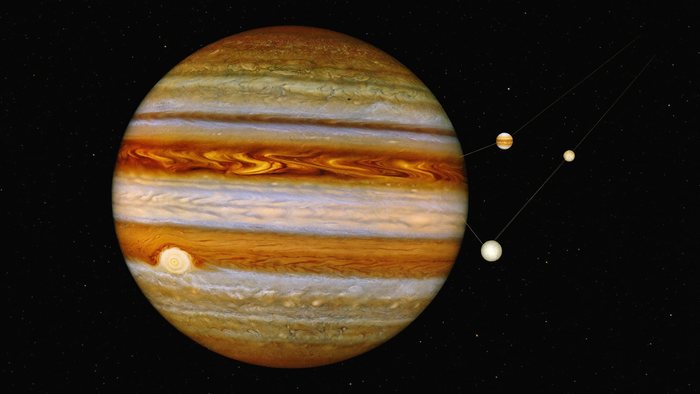
In January 1610 Galileo turned a new telescope on Jupiter and found four points of light beside it that changed position night after night. They were moons — Io, Europa, Ganymede and Callisto — and their existence ended the idea that everything in the sky went around the Earth. Any pair of ordinary binoculars, held steady against a fence post, will show them tonight if Jupiter is up. They look like a short line of tiny stars, and the line rearranges itself from one evening to the next.
The Great Red Spot is the other feature worth knowing about. It is a storm wider than Earth that has been under continuous observation since at least 1831, with a possible earlier sighting by Cassini in 1665. It has been measurably shrinking for over a century and is now much less elongated than nineteenth-century drawings show. NASA's Juno spacecraft, in orbit since July 2016, found that its roots go hundreds of kilometres deep.
Knowing this changes how the astrological material reads. The planet the tradition calls the Greater Benefic is a ball of hydrogen with a storm on it that has been running for at least two centuries, and you can go outside and see its moons move. Both facts can be true at once — one of them is just easier to check.
Where the luck framing turns into a sales pitch
This section exists because Jupiter is the placement most often used to sell something in the United States, and an article that skipped it would not be honest.
The traditional material says Jupiter describes where a person grows, gives, believes and takes risks. That is a description of temperament. What it gets turned into — in courses, in manifestation programmes, in prosperity teaching that borrows the vocabulary — is a promise: that a placement or a transit means money is coming, and that the right practice will bring it in.
Nothing in the astrological tradition supports that, and nothing outside it does either. A Jupiter return does not predict income. A well-placed Jupiter is not a financial indicator. We are not financial advisers, and any programme that reads your chart and then asks you for money on the strength of what it found there is selling the reading, not the outcome.
The version of Jupiter that survives scrutiny is smaller and more useful: it names the area where you are inclined to be generous, curious and a bit reckless. That is genuinely worth knowing about yourself. It is just not a forecast.
Three ways to work with the placement
Widen something on purpose. A subject, a route, a group of people. Jupiter's domain is the ninth house — travel, study, the foreign — and the practice attached to it is simply to keep enlarging the map.
Give something away on a schedule. Time, teaching, attention, money if you have it to spare. The tradition is consistent that Jupiter works by circulation rather than accumulation, and a fixed small commitment beats an occasional large gesture.
Write down what you are already lucky in. Not gratitude as a mood — an inventory. Most people can name the area where doors have opened for them and have never said it out loud. That sentence is a more accurate Jupiter reading than a sign description, and unlike a sign description it is yours.
If your Jupiter return falls inside a retrograde arc, it happens three times rather than once. Jupiter retrograde 2026–2027 covers 17° to 27° Leo, with the exact station times in Eastern and Pacific and what the triple pass means in practice.
Frequently asked questions
How do I find my Jupiter sign?
Any natal chart calculator with date, time and place. Because Jupiter spends about a year per sign, your birth year narrows it down immediately; only births near a sign change need the exact time.
When is my Jupiter return?
Roughly every twelve years — approximately at 12, 24, 36, 48, 60, 72 and 84. The exact date depends on your chart, since the orbit is 11.86 years rather than a clean 12.
Does Jupiter bring money?
The tradition associates it with increase and generosity, not with income. It is not a financial indicator and we are not financial advisers. Treat any reading that promises money as a sales claim.
Is retrograde Jupiter in my chart bad?
No, and it is common — Jupiter is retrograde about a third of the year, so roughly a third of people have it natally. It is usually read as growth that comes from inner conviction rather than outside approval.
Why do some books say Jupiter rules Pisces?
Because traditional astrology assigned Pisces to Jupiter before Neptune was discovered in 1846. Modern texts usually give Pisces to Neptune. Both schemes are still in use.
Can I actually see Jupiter's moons?
Yes. Ordinary binoculars braced against something solid will show the four Galilean moons as a short line of faint points beside the planet, and their arrangement visibly changes from night to night.
Where to go next
Jupiter reads best against its opposite number. Start with the Saturn return for the planet of limit, then the Mars sign for drive and the Venus sign for taste and value. The twelve houses explain why a placement shared with everyone born that year still lands differently in each life, and the lunar nodes cover direction over a lifetime.
Questions about an order or anything on this site: 28@templeofdesire.com.
More from Astrology & Zodiac
All stories →
NOAA Issues G1 Geomagnetic Storm Watch for October 2: Auroras Possible Across the Northern U.S.

Jupiter Retrograde 2026 and 2027: Dates, Degrees and the Shadow Period