




Agnihotra: The Vedic Sunrise Fire Ritual
What Agnihotra is, why the vessel, the fuel and the minute are all fixed, how to get your local sunrise time right, and what the Homa Therapy claims do and do not support.


Most ritual can be moved. You light the candle when you get home, you pull the card when you have a minute. Agnihotra cannot be moved. It happens at the exact minute the sun clears the horizon where you are standing, and at the exact minute it goes under — and if you are four minutes late, the tradition says you did something else.
Contents
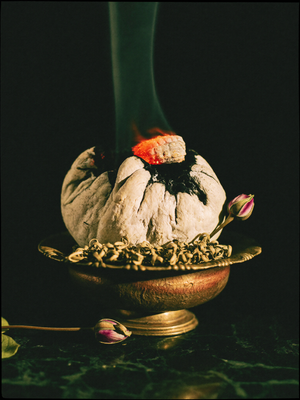
Agnihotra, also written Agni Hotra, is a Vedic fire ritual from India and part of the homa tradition: agni means fire, hotra the offering. It is performed at the exact moment of sunrise and of sunset, because those transitions are held to carry a particular quality. What is needed: a copper vessel in the prescribed inverted-pyramid form on a fireproof surface, dried cow dung as fuel, ghee, and a few grains of unbroken whole rice. The sequence: light the fire a few minutes ahead, speak the two Sanskrit mantras at the exact solar time and offer a pinch of rice with a drop of ghee at each svaha, then sit in silence until the flame burns down; the cooled ash, called vibhuti, is kept. The act itself takes minutes; with preparation and meditation, fifteen to twenty. There is no robust scientific evidence for the far-reaching physical or health effects claimed in the Homa Therapy literature, and the rite replaces no medical treatment.
Agnihotra comes from the Vedic tradition of India and belongs to the homa practice; the name means literally fire-offering.
Source/tradition: Vedic ritual literature, homa tradition
The fixed form — copper pyramid, dried cow dung, ghee, unbroken rice and two Sanskrit mantras at the exact solar time — is transmitted as prescribed and is what distinguishes Agnihotra from free-form burning.
Source/tradition: Prescriptions of the classical Agnihotra transmission
The practice spread outside India from the 1970s onward under the name Homa Therapy, which is why the copper pyramids sold today are standardized.
Source/tradition: History of the twentieth-century Homa Therapy transmission
Sunrise and sunset times differ by several minutes across a single US time zone and shift daily, so they have to be calculated for the practitioner's coordinates.
Source/tradition: NOAA Solar Calculator; US Naval Observatory sunrise and sunset tables
Practitioners keep the rite daily as an anchor point and report deeper meditation, better sleep and a sense of inner order.
Source/tradition: Experience reports from daily practitioners of Homa Therapy
The ash, called vibhuti, is held to be sacred and is worked into plants, put into water, or applied externally.
Source/tradition: Widespread application within the homa tradition
The rising smoke purifies the atmosphere energetically and has a healing effect on the body and the surroundings.
Source/tradition: Homa Therapy teaching; robust scientific evidence is absent
Agnihotra ash improves soil, crop yield or air quality in a measurable way.
Source/tradition: Claims of the Homa Therapy literature; no robust independent evidence
VERIFIED = verifiable in scientific or official sources · TRADITIONAL = historically or culturally recorded · LIVED PRACTICE = widely practiced, experiential knowledge · NOT PROVEN = spiritual interpretation, not scientifically established.
What this article gives you: what Agnihotra actually is, what the vessel and the fuel have to be and why, how to get your own sunrise time to the minute, the step-by-step sequence, and where American practitioners get the one material that is hard to find here. What it does not give you: the Homa Therapy claims about air purification and crop yield presented as fact.
What Agnihotra is
Agnihotra (also written Agni Hotra) comes out of the Vedic tradition of India and belongs to the broader family of homa — fire offering. Agni means fire; hotra, the offering. It is among the oldest continuously performed fire rites in the world.
What sets it apart from every other fire practice in this magazine is the binding to the sun. It is performed precisely at the moment of sunrise and the moment of sunset, because those two transitions are held to carry a quality the rest of the day does not. Traditionally what burns is dried cow dung, ghee and a few grains of unbroken whole rice, while two short Sanskrit mantras are spoken.
Unlike free-form burning, Agnihotra follows a precise form — and it is exactly that discipline that makes it a daily anchor for the people who keep it. The act itself takes minutes. With preparation and the silence afterward, plan on fifteen to twenty.
How it got to the United States
Agnihotra is old. Its presence in America is not. The practice spread outside India in the 1970s under the name Homa Therapy, carried by teachers who presented it as a daily household rite rather than a priestly one, and it took root first in small rural communities and among people already practicing yoga and Ayurveda. That is why the copper pyramids sold in the United States are standardized: they come out of that twentieth-century transmission, not from a temple supply chain.
Worth holding onto, because it is the same pattern as with several other systems in this magazine: the rite is genuinely ancient, the packaging you can buy is recent, and the claims attached to the packaging are recent too.
What you need — and why each piece is fixed
| Item | What the tradition specifies | Where Americans actually get it |
|---|---|---|
| The vessel | Copper, square, and an inverted truncated pyramid — narrow at the base, opening out to a square rim. Sizes are standardized by the tradition, not chosen. | Homa Therapy groups and Indian ritual suppliers; not interchangeable with a fire bowl |
| The fuel | Flat cakes of dried cow dung, nothing else. No charcoal, no wood, no fire starter. | Indian grocers sell them as upla or gobar cakes; practitioner groups make their own |
| The ghee | Real clarified butter, to start the flame and to feed each offering | Any true ghee — see ghee versus butter for what the label has to say |
| The rice | A pinch of whole, unbroken grains. Broken grains are specifically excluded. | Plain white rice, sorted by hand — it takes a minute |
| The time | The exact local sunrise and sunset minute, recalculated daily | The NOAA solar calculator or a Homa timetable for your zip code |
The copper matters to the tradition, which treats it as a purifying metal. The shape matters because the tradition specifies it. The rice being unbroken matters because an offering is supposed to be whole. None of these are efficiency choices, and substituting them produces a nice fire that is not this rite.
The practical handbook
Agnihotra: Havan on Earth — A Practical Guide to the Vedic Fire Ceremony
We do not sell the pyramid, the dung cakes or the timetable, and an article is a poor place to learn the mantras. This is the book we point people to instead: a step-by-step guide to the ceremony written for someone starting from nothing, including the parts we have deliberately left out here. Read it before your first sunrise rather than during it. $24.95
View it →Getting your sunrise time right
This is where most American beginners go wrong, and it is worth being precise about.
- The weather app is not accurate enough. Many round to the minute of a city center that may be thirty miles from you. Across a wide state, sunrise can differ by several minutes within one time zone.
- Use a calculator that takes latitude and longitude. The NOAA solar calculator and the US Naval Observatory tables both do. Enter your actual coordinates, not your city name.
- Recalculate daily. Sunrise moves roughly a minute a day near the equinoxes and much less near the solstices. A weekly note on the fridge drifts.
- Handle the clock changes deliberately. Daylight saving time shifts the wall-clock number by an hour overnight in March and November. The sun does not move; your alarm has to.
- Be ready several minutes early. The fire has to already be burning when the moment arrives.
The sequence, step by step
- Establish the exact time for today, at your coordinates, and be set up a few minutes before it.
- Set the pyramid on a fireproof surface. Stone, tile, a sheet of metal. It gets genuinely hot, and copper conducts.
- Layer small pieces of dried dung inside, with one piece in the middle smeared with ghee to catch.
- Light it a few minutes ahead so it is burning well at the exact solar moment.
- Have the rice ready — a pinch, with a drop of ghee on it, in two portions.
- At the moment itself, speak the first mantra and place the first offering in the fire at its svaha; then the second mantra with the second offering.
- Sit in silence in front of the fire and let it burn down by itself. This is not the epilogue. It is part of the rite.
- Let the ash cool completely, then keep it. In the tradition it is vibhuti, held to be sacred.
We have not printed the mantras here. They are short, they are in Sanskrit, and they are worth learning from a person or a proper source rather than from a transliteration on a web page you are reading at 5:40 in the morning.
Doing this in an American home
Practical constraints most guides skip:
- Smoke detectors. A dung fire is a small fire, but it is an open flame producing real smoke indoors. Many people do it on a porch, patio, balcony or by a wide-open window for exactly this reason.
- Leases and HOAs. Open flame is restricted in plenty of apartment buildings and some homeowners' associations. That is not a spiritual problem, it is a fire-code problem, and it is worth reading before you buy a pyramid.
- Pets. Smoke indoors is a load on any animal and a serious one for birds. The rules are in is incense safe for cats, dogs and birds, and they apply here at least as much.
- Dry season. In much of the West, open burning outdoors is prohibited outright for months at a time. Check your county's burn status, not the calendar.
The ash, and what is claimed for it
The ash left after the rite — vibhuti — is treated in the tradition as especially valuable. It is worked into plants, put into water, or applied to the forehead.
The Homa Therapy literature goes considerably further than that, claiming measurable effects on air quality, soil, crops and health. Those claims are not supported by robust evidence, and we are not repeating them as if they were. What the practice demonstrably has is a fixed form, a fixed time, and a daily repetition — and that combination is doing plenty of work on its own.
Common mistakes
Wrong timing. Agnihotra lives on the precise solar minute; even a few minutes off counts as not having done it. Check the time for your location, today.
Unsuitable fuel. Only pure dried cow dung and real ghee go in the fire. Charcoal, lighter fluid, wood and fire starters are all outside the form, and lighter fluid is dangerous besides.
Rushing. The silent sit after the offering is part of the rite, not the cooldown.
Taking the rite without its origin. This comes from a living tradition that belongs to people who are still practicing it. Learning it from within that tradition, rather than from a product listing, is the difference between practice and appropriation. If you keep this daily, find the community that keeps it too.
If you cannot hold a daily fire — most people cannot — the honest alternative is not a shortened Agnihotra. It is a different practice entirely: a smoke cleanse or a fixed sitting practice that does not pretend to be this one.
What we do not promise
We do not claim that the rising smoke purifies the atmosphere, improves soil, or has a healing effect on the body or the environment. Those are claims of the Homa Therapy teaching, and robust evidence for them is missing.
We do not claim that keeping the rite produces any particular outcome. What practitioners describe — deeper meditation, better sleep, a sense of order — are experience reports, and they are inseparable from the fact of getting up before dawn every day.
Nothing here is medical advice, and no fire ritual replaces treatment.
Frequently asked questions
Why does Agnihotra have to be at the exact solar time?
The Vedic tradition assigns a particular quality to the two transitions between day and night. The exact timing is the core of the rite, not a detail of it.
Do I really need a copper pyramid?
For traditional Agnihotra, yes. Copper and the inverted pyramid shape are part of the prescribed form. For free-form fire or smoke rituals, different rules apply — and it is more honest to call those something else.
How long does the ritual take?
The act itself takes only a few minutes. With preparation and the silent sitting afterward, allow fifteen to twenty.
Where do I get dried cow dung cakes in the United States?
Indian grocery stores often carry them as upla or gobar cakes, and Homa Therapy groups supply them or make their own. Do not substitute charcoal.
What do I do with the ash?
Traditionally it is kept and used in plants, in water, or externally. Always let it cool completely first.
Is Agnihotra the same as burning incense?
No. Smoke cleansing is free and flexible. Agnihotra follows a fixed Vedic form with exact timing, prescribed materials and spoken mantras.
Sources & further reading
- Vedic ritual literature on the homa tradition and the daily agnihotra as a householder rite.
- Prescriptions of the classical Agnihotra transmission: copper vessel, dried cow dung, ghee, unbroken rice, and the two mantras spoken at the solar moment.
- Homa Therapy literature of the twentieth-century transmission, including the claims about atmosphere and agriculture that we have marked as unproven.
- NOAA Solar Calculator and US Naval Observatory sunrise and sunset tables, for determining local solar times by coordinate.
- More in the magazine: Ghee versus butter · Is incense safe for cats, dogs and birds · How to smoke-cleanse a house · Shamanic journeying: the drum method
This article describes a living religious practice and its documented form. It is not medical advice, and it makes no claim that the rite affects air, soil or health.
The form is the point. So is the hour. #TempleOfDesire
