






How to Cleanse Tarot Cards Without Ruining the Deck

Almost every guide to cleansing a tarot deck recommends salt, sunlight or a night on the windowsill under the full moon. Those are the three things a paper conservator would tell you never to do to a printed card.
Contents
Shuffle the deck, sort it back to its original order, then knock the stack once on the table. That is a complete cleanse and it costs the cards nothing. If you want more, pass the deck through incense smoke for a few seconds. Skip salt, sunlight and overnight moonlight — all three damage paper.
Light damage to paper is cumulative, follows the reciprocity principle and cannot generally be reversed by conservation treatment (Library of Congress, Limiting Light Damage).
Ultraviolet radiation weakens, bleaches and yellows paper; paper expands and contracts as relative humidity rises and falls, and 30-60 % RH is the recommended band for paper collections (NEDCC Preservation Leaflet 2.1).
Sodium chloride is hygroscopic and takes up atmospheric water above its deliquescence point, recrystallising as humidity falls (Chen & Chou, Chemical Engineering Science, 2012).
Almost every deck-cleansing method shares one structure: interrupt the deck's current order, mark the break with a sensory act, and return the deck to a known state.
The methods that carry no physical risk to the cards are also the ones that need no equipment, which is why they are the ones people are still doing a year later.
Early published tarot handbooks concern the handling, wrapping and storage of a deck rather than any cleansing procedure; routine cleansing is a later convention.
Cleansing removes negative energy from a deck, makes readings more accurate, or can be confirmed by any test.
VERIFIED = verifiable in scientific or official sources · TRADITIONAL = historically or culturally recorded · LIVED PRACTICE = widely practiced, experiential knowledge · NOT PROVEN = spiritual interpretation, not scientifically established.
Quick answer. Shuffle the deck, sort it back to its original order, then knock the stack once on the table. That is a complete cleanse and it costs the cards nothing. If you want more, pass the deck through incense smoke for a few seconds. Skip salt, sunlight and overnight moonlight — all three damage paper.
What cleansing a tarot deck actually means
Cleansing a deck means deliberately interrupting its current state and returning it to a known starting point. That is the part every tradition agrees on, whatever the method.
Strip away the language and the methods have the same three beats. You stop. You do something with your hands or senses that marks the break — smoke, sound, a knock, a re-sort. Then you close, usually by putting the deck away in a fixed place. The method is the container for the attention, not the active ingredient.
This matters practically, because it means the question is not "which method is strongest". It is "which method can I repeat without thinking twice, and what does it cost the deck". A deck is a physical object you will handle thousands of times. Some popular methods shorten its life considerably.
What your deck is made of, and why it matters
A tarot card is not paper in the way a notebook page is paper. It is a laminate sandwich, and each layer fails differently.
Most decks are printed on a multi-ply board: two or three layers of paper pressed together, usually with a thin dark or opaque core in the middle that stops light passing through when you hold a card up. The printed image sits on the outer ply. Over that goes a coating — a varnish, a plastic film, or an embossed linen finish — which is what gives cards their slip and lets them shuffle.
Two consequences follow, and they explain nearly every piece of advice further down this page.
Light fades the ink, permanently. The Library of Congress puts it plainly: light damage is cumulative and follows the reciprocity principle — dim light over a long period is just as damaging as bright light over a short period — and in most cases conservation treatment cannot reverse it. Ultraviolet radiation in particular weakens, bleaches and yellows paper.
Moisture makes the layers fight. Paper is hygroscopic: it absorbs moisture and expands as humidity rises, releases it and shrinks as humidity falls. When the plies of a card take up moisture at different rates, or when one face is exposed and the other is not, the card curls. That is the warped deck that no longer riffles cleanly. The Northeast Document Conservation Center recommends a 30–60 % relative humidity band for paper collections, and warns that warm, damp conditions let mould become active.
None of this makes a deck fragile. It makes it predictable. You can cleanse a deck every single day for twenty years without harming it — as long as you pick a method that does not involve water, salt or hours of direct light.
The nine methods, side by side
Here is every method that appears repeatedly in tarot practice, with what it takes, what it does, and what it costs the deck.
| Method | Time | What it does | Risk to the deck |
|---|---|---|---|
| Knocking the stack | 2 seconds | Marks a clean break between readings | None |
| Sorting back to order | 3–5 minutes | Full reset; you handle every card | None |
| Thorough shuffle | 1 minute | Breaks up clumped cards from the last spread | None (edge wear over years) |
| Sound — bell, bowl, voice | 1 minute | Sensory marker, no contact with the cards | None |
| Fresh air | 10 minutes | Clears trapped odour from storage | None indoors, shaded |
| Incense or herb smoke | 20 seconds | Strong sensory marker | Low — residue if held in smoke |
| Crystal on the stack | Hours, passive | Sets the deck's resting place | Low — weight and grit |
| Moonlight overnight | 8 hours | Nothing the deck registers | High — dew, damp, curling |
| Salt burial | Hours to days | Nothing the deck registers | High — abrasion and drawn moisture |
| Direct sunlight | Minutes upward | Nothing the deck registers | Highest — permanent fading |
Read the right-hand column as a list and something jumps out. The five methods that cost the deck nothing are the five that need no equipment at all. The four that carry real risk are the four that photograph well.
How to cleanse tarot cards for the first time
For a brand-new deck, sort it into its printed order first — that is the one cleanse that matters more with a new deck than with any other.
New decks arrive in order: Major Arcana from the Fool through the World, then each suit from Ace to King. Most people shuffle that order away in the first ten minutes and never see it again. Going through the deck card by card, in sequence, before you ever read with it does three things at once. You check for printing faults and stuck cards while the deck is still returnable. You see all seventy-eight images deliberately rather than in the random dribble of readings. And you give the deck a baseline state you can return it to for the rest of its life.
After that, break the factory slip. New cards are cut in a stack and often cling; a few rounds of riffle and overhand shuffling separates them. Then close it however you intend to close every session — a knock, a word, putting it in its box.
If you want something more than that, add smoke or sound. But the sort is the substance. Everything else is punctuation.
How to cleanse tarot cards without tools
You do not need a single object to cleanse a deck. Three motions with your hands do the whole job.
The three-motion cleanse
- Knock. Square the deck and rap it once, firmly, on the table. In card play this is simply how you settle a stack. Here it also marks a full stop.
- Shuffle through. Overhand or riffle, long enough that cards which sat together in the last spread are no longer neighbours. Thirty seconds is plenty.
- Cut and square. Cut the deck once, put the halves back together, square the edges against the table, and put it away.
This is the method to use if you read daily, because it is the only one you will actually keep doing. It also answers the awkward question of what to do when you are reading in a café, on a train, or in a house where you cannot light anything.
A fourth motion is worth adding when a reading has been heavy: hold the squared deck between both palms for a slow breath in and out, then put it down. No claim attaches to that. It gives you a beat in which to stop reading and go back to the room.
How to cleanse tarot cards without incense
Every smoke method has a smoke-free equivalent that does the same job to the deck: it marks the moment with a sense other than sight.
Sound is the closest substitute. A bell, a singing bowl, two chime rods, a struck glass — any clear tone held over the deck for as long as it rings. Sound never touches the cards, which makes it the safest of all the tool-based methods and the obvious choice in a flat where smoke sets off alarms or bothers a housemate.
A cleansing spray is the other common answer, and it needs one warning: mist the air and the space, never the deck. Two or three pumps into the room a metre away from the cards, then let it settle. Spraying a card directly wets the outer ply, and a card that has been wetted on one face and not the other will curl and stay curled.
Fresh air works better than its reputation. Fan the deck out on a cloth in a shaded, dry room for ten minutes — indoors, out of any direct beam of light. This is the fix for the particular problem of a deck that smells of the drawer it lived in.
If you want to keep a smoke practice in a home where you cannot burn anything, our note on what to burn instead of white sage covers the smokeless options in more detail.
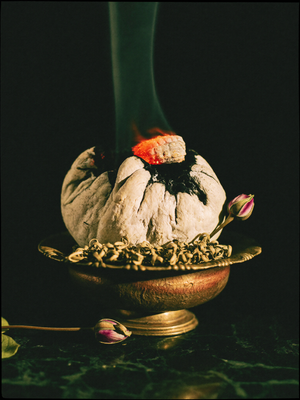
How to cleanse tarot cards with incense
Pass the deck through the smoke; do not hold it in the smoke. That single distinction is the difference between a clean method and a slow staining.
Smoke carries fine particulate and resinous tar. Held steadily in a plume, a coated card surface will pick up a faint film, and light-coloured card backs show it first as a yellowish cast along the edges where you hold them. Passed through, the deck gets the scent and the gesture and almost no deposit at all.
The working method: light the incense and let the flame go out so it is smouldering rather than burning. Hold the squared deck in one hand. Move it through the rising smoke two or three times, a couple of seconds each pass, turning it so both faces get a pass. Put the deck down. Let the incense finish somewhere other than directly over the cards.
Resin on charcoal makes far more smoke than a stick and is correspondingly easier to overdo; if you work with resin, one pass is enough. Our guide to burning resin incense on charcoal covers the handling.
Keep the deck at least a hand's width from the ember. The risk there is not soot but a spark, and a spark on a laminated card leaves a permanent brown pinhole.

If you want to work with this yourself, this is what we use
Purification Ritual Incense — Mystical Gardens for Space Clearing
A slow, low-smoke stick. Enough plume for two or three passes over a deck without filling the room. $24.95 · ships within 3 business days · shipping calculated at checkout.
See the incenseHow to cleanse tarot cards with crystals
Resting a stone on the deck is a storage habit rather than an event, and it is a good one as long as the stone is smooth and light.
The practice is simple: the deck lives in its box or cloth with a stone sitting on or beside it, and the stone stays there between readings. What it reliably does is give the deck a fixed home. A deck with a designated resting place gets left out on the table far less often, and a deck that is not left out on the table is not sitting in daylight.
Two practical cautions. Weight: a heavy tower or sphere left on a stack for weeks will emboss the top card. Use something flat and light, or set it beside the deck rather than on it. Grit: raw, unpolished specimens shed fine particles, and the crumbliest of them is the one most often recommended for this job. Selenite is gypsum, soft enough to scratch with a fingernail, and it sheds a fine white dust along its fibres. Sitting a raw selenite wand directly on card faces is how you get micro-scratches on a coating. Put a cloth between them, or keep the stone alongside.
What a stone does not do is verifiable. There is no test that distinguishes a deck that has spent a night under selenite from one that has not. We cover the claim itself, and what selenite actually is, in how to use selenite; the general care rules are in how to cleanse crystals.
How to cleanse tarot cards with salt
Do not bury a deck in salt. This is the one piece of common advice we will argue with flatly, and the reason is physical rather than spiritual.
Salt is hygroscopic. Above roughly three-quarters relative humidity, sodium chloride does not merely sit there — it takes up water from the air and begins to dissolve in it. A deck buried in a jar of salt in an ordinary kitchen or bathroom is in a container that is actively collecting moisture and holding it against the cards. That is precisely the warm, damp micro-climate that conservation guidance warns about.
Salt is also a crystal with edges. Cards pushed into it and pulled out again get dragged across those edges. On a matte or linen finish the result is a dulled, slightly scuffed surface; on a gloss finish it is fine scratching that catches the light.
If salt is part of how you work, keep it in the room and off the cards. A small dish of salt on the table during a reading, or in the corner of the drawer where the deck lives, gives you the element without putting abrasive hygroscopic crystals in contact with paper. Which salt, and why it varies, is covered in which salt to use in witchcraft.
How to cleanse tarot cards with sage or palo santo
Both work the same way as any incense — pass, do not hold — but they differ in how much smoke they put out and in what you should know before buying them.
A bundled smudge stick produces a great deal of smoke very quickly, which makes it the easiest way to over-smoke a deck. If you use one, light it, let it flame out, and pass the deck through the thinner smoke at the edge of the plume rather than the thick column directly above the ember. Palo santo burns cooler and sparser and is more forgiving for something as small as a card stack.
There is a sourcing question underneath both. White sage and palo santo are bound up with specific living traditions and with real supply pressure, and neither is the only option. We have written about that at length in palo santo vs sage and white sage, honestly, and the practical handling is in how to burn a smudge stick properly. For a deck specifically, a single stick of incense does the job with a fraction of the smoke and none of the sourcing problem.
Cleansing tarot cards in the full moon
Put the deck on an inside windowsill for the evening, not outside overnight — the outdoor version is the single most common way people damage a deck without noticing.
The problem is dew. Outdoor surfaces cool through the night, air near them reaches saturation, and moisture condenses. A deck left on a balcony rail, a garden table or an outside sill from midnight to morning is very likely to come in damp even if it never rained. Card plies take up that moisture unevenly, and the deck curls. The curl does not always show the next morning; it shows a week later when the cards no longer riffle straight.
An open window is the same problem with extra steps. Humid night air moving across a deck for eight hours is humid night air moving across a deck.
The indoor version keeps everything people actually want from the practice. Deck on the sill behind closed glass, from moonrise until you go to bed, then back in its box. You get the timing, the deliberate placement, and the association with the lunar cycle, and the deck stays dry and flat. If you want the moon to structure your practice rather than your storage, tying readings to the phases — as in our full moon ritual — does more work than leaving cardboard outdoors.
Sunlight: the fastest way to fade a deck
Never put a deck in direct sun. Of everything on this page, this is the one with a guaranteed, permanent, visible cost.
Ink fades under ultraviolet light, and the damage accumulates and cannot be undone. The Library of Congress is explicit that light damage is cumulative and that conservation treatment cannot reverse it in most cases. Yellows and reds go first, which on a Rider-Waite-style deck means the golden skies and the red robes — the two things the deck's whole colour language rests on.
It is also uneven. The top card of a stack takes the exposure; the rest do not. A few afternoons on a sunny sill and you have a deck where the Fool is visibly paler than the Magician, and it stays that way.
The same caution applies to a deck stored on an open shelf across from a bright window. Nothing dramatic happens in a week. Over a couple of years it is the reason secondhand decks so often look washed out.
Temple Tip — the control card
If you want to know whether your storage is actually safe, run the test conservators run. Take a spare card — a promotional card, a duplicate, the deck's title card, anything you will not read with. Cut a strip of dark card and tape it across one half so that half is covered and half is exposed.
Leave it exactly where your deck lives. Six months later, take the strip off. If you can see the line, the spot is fading your deck too, and you have found that out on a card you do not care about rather than on the Star.
How often should you cleanse your tarot cards?
There is no interval a deck needs. Cleanse at the transitions that matter to you, and the most useful of those is the end of a reading rather than a date on a calendar.
Four moments account for nearly everything people do in practice. After a reading that took something out of you — the knock and a shuffle are enough, and doing them immediately is the point. When someone else has handled the deck, especially at a market or a party, where it is as much about re-setting your own grip on the object as anything else. When you come back after a long gap and the deck feels unfamiliar, where a full sort is worth the ten minutes. And when a deck is new or new to you.
Outside those, weekly or monthly schedules tend to quietly die. A practice that happens at the end of every reading does not, because it is attached to something you were doing anyway.
Cleansing a secondhand or inherited deck
Start with the physical condition, because with a used deck that is the part that actually needs attention.
Count the cards against a list before anything else. Incomplete secondhand decks are common, and it is better to know on day one. Check for the tell-tales of previous storage: a curl across the short edge means damp, a pale top card means light, a sticky or tacky feel means the deck lived somewhere warm next to something that off-gassed.
Then wipe, gently and dry. A clean, dry microfibre cloth over each face lifts dust and skin oil, which is the actual residue on a used deck. No water, no alcohol, no wipes — solvents attack the coating and water lifts the plies.
Then sort the deck to order, which on an inherited deck does double duty: it is the cleanse and it is the inventory. Then whatever marking you want — smoke, sound, a knock.
An inherited deck raises a separate question that has nothing to do with cardstock, which is whether you want to read with it at all. Our notes on cleansing a secondhand object and on how to dispose of old tarot cards cover both directions of that decision.
Which method should you use?
Four questions. Answer them honestly and the deck will tell you what it needs.
Question 1 of 4
Is the deck new to you, or one you already read with?
Storing your deck so it needs cleansing less often
Most of what people cleanse away is the result of where the deck sat between readings. Fix the storage and the cleansing gets shorter.
Four conditions do nearly all the work. Dark, because light damage is cumulative and a closed box is a complete solution. Dry and steady, because it is the swing between damp and dry that curls cards, not humidity by itself — an interior shelf beats a bathroom or an exterior wall. Flat and unweighted, so nothing embosses the top card. And consistent, because a deck with one home gets left in sunlight far less than a deck that lives wherever the last reading ended.
The traditional answers — a silk or cotton wrap, a wooden box, a drawer — turn out to be good conservation advice by accident. A cloth wrap inside a box is dark, buffers the humidity swing, and keeps the edges from knocking about.
One caution on the box: airtight plastic is not an upgrade. Sealed containers trap whatever moisture was in the air when you closed them. A wooden box, a card box or a cloth bag on a dry shelf is better than a sealed tub.
Voices from practice
We do not publish invented testimonials, and there is no shortage of tarot pages that do. What follows are patterns we see repeatedly in our own shop and in open tarot communities, written as patterns rather than put in anyone's mouth.
The most common regret by a distance is the moonlight one, and it is always the same shape: the deck went outside, nothing seemed to happen, and some weeks later the cards had stopped riffling cleanly. People rarely connect the two events, because the damage appears long after the night that caused it.
The second pattern is that elaborate cleansing routines are abandoned within a couple of months, and the people still cleansing a year later are almost always doing something that takes under a minute. This is the ordinary arithmetic of any habit, and it is why the three-motion cleanse is the one we teach first.
The third is that a surprising number of readers discover they cannot name the order their deck came in. Sorting a deck to sequence is the step most often skipped and the one most often described as unexpectedly satisfying — you see seventy-eight images on purpose, which almost never happens once a deck is in rotation.
What we don't promise
Cleansing a deck is a practice, not a mechanism, and we would rather be straight about where the evidence stops.
We do not claim that any method removes negative energy, and we do not claim it can be measured. There is no instrument, and no test that tells a cleansed deck from an uncleansed one. We do not claim cleansing makes readings more accurate, or that skipping it makes them wrong. We do not claim any stone charges, clears or fixes a deck — the stone gives the deck a home, which is a real benefit of a different kind.
What we will claim is the physical half, because that part is testable and it is where the useful advice lives. UV fades ink, and the damage is cumulative and irreversible. Moisture curls multi-ply card. Salt is hygroscopic and abrasive. Smoke leaves residue when cards are held in it. Those four statements are why this page recommends the methods it recommends, and they hold whatever you believe about the rest.
Practically: how to work with this
If you take one thing from this page, make it the end-of-reading habit: knock, shuffle through, cut, square, put away. Thirty seconds, no equipment, works anywhere, costs the deck nothing.
Add a second layer only if you want one. Incense passed under the deck two or three times, or a bell rung over it, for readings that felt heavy. Sort the deck to its printed order when it is new to you, when you come back after months away, or once a year if you like the ritual of it.
And set a floor rather than a schedule: the deck lives in one dark, dry, interior place, and it never goes outside, into salt, or onto a sunny sill. That floor will preserve a deck for decades, and it removes the only decisions on this page that are genuinely hard to undo.
Where to take it next: tarot spreads if you want to put the clean deck to work, the best first tarot deck compared if you are still choosing, and our tarot, books and divination shelf if you are looking for a deck, a cloth or a box. The smoke and cleansing materials mentioned above sit in sacred smoke and cleansing.
Frequently asked questions
Do I need to cleanse a new tarot deck before using it?
You do not have to, but there is one step worth doing once: go through the deck in its printed order, card by card. It lets you spot printing faults while the deck is still returnable, separates cards that are clinging from the factory cut, and gives you a baseline order you can always return to. Any smoke, sound or knock you add on top of that is punctuation rather than substance.
How do I cleanse tarot cards without incense?
Use sound or use your hands. A bell, a singing bowl or two chime rods held over the deck for as long as the tone rings does the same job and never touches the cards. Failing that, the three-motion cleanse needs nothing at all: knock the squared deck once on the table, shuffle it through for about thirty seconds, then cut, square and put it away. If you prefer a spray, mist the air a metre from the deck — never the cards themselves.
Can I cleanse tarot cards with salt?
Keep salt in the room and off the cards. Salt is hygroscopic: above roughly three-quarters relative humidity it draws water out of the air, so a deck buried in a jar of salt sits in a container that is actively collecting moisture and holding it against the paper. Salt crystals are also abrasive, and pushing cards into salt and pulling them out again scuffs the coating. A dish of salt on the table or in the drawer gives you the element without the contact.
Is it safe to leave tarot cards in the moonlight overnight?
Not outdoors. Outdoor surfaces cool through the night and moisture condenses on them, so a deck left on a balcony, a garden table or an outside sill usually comes in damp even when it has not rained. The plies of a card take up that moisture unevenly and the deck curls, often only showing a week or two later when the cards stop riffling straight. An inside windowsill behind closed glass keeps the timing and the placement and leaves the deck dry.
How often should tarot cards be cleansed?
There is no interval a deck needs. In practice four moments cover almost everything: after a reading that took something out of you, after someone else has handled the deck, when you come back to it after a long gap, and when it is new to you. Attaching the habit to the end of a reading works far better than a weekly or monthly schedule, because it is tied to something you were already doing.
Can I cleanse tarot cards with selenite?
You can rest a piece with the deck, with two cautions. Selenite is gypsum and soft enough to scratch with a fingernail, and raw pieces shed fine dust along their fibres — so put a cloth between the stone and the card faces, or set the stone beside the deck rather than on it. Avoid heavy towers or spheres on a stack, which will emboss the top card over weeks. What the stone genuinely does is give the deck a fixed, dark home; no test distinguishes a deck that has sat under selenite from one that has not.
How do I cleanse a secondhand tarot deck?
Deal with the physical condition first. Count the cards against a list, since incomplete secondhand decks are common. Look for a curl across the short edge, which means damp storage, and a pale top card, which means light. Wipe each face with a clean dry microfibre cloth to lift dust and skin oil — no water, no alcohol and no wipes, because solvents attack the coating. Then sort the deck to its printed order, which serves as both the cleanse and the inventory.
Does cleansing a tarot deck make readings more accurate?
We make no such claim, and there is no test that would settle it. What cleansing reliably does is mark a boundary: it separates one reading from the next and it returns the deck to a known state. That is worth doing for its own sake. The measurable part of this page is the physical half — light fades ink permanently, moisture curls multi-ply card, salt is hygroscopic and abrasive — and that is what our recommendations rest on.
Sources & further reading
- Library of Congress, Limiting Light Damage — Collections Care: light damage is cumulative, follows the reciprocity principle, and cannot generally be reversed by conservation treatment.
- Northeast Document Conservation Center, Preservation Leaflet 2.1: Temperature, Relative Humidity, Light, and Air Quality (2012, rev.): 30–60 % RH for paper collections; paper expands and contracts with humidity; UV weakens, bleaches and yellows paper.
- Library of Congress, Preserving Your Books: Storing: dark, dry, stable interior storage for paper-based collections.
- Chen & Chou, “Caking of sodium chloride: role of ambient relative humidity in dissolution and recrystallization”, Chemical Engineering Science, 2012: sodium chloride takes up atmospheric water above its deliquescence point and recrystallises as humidity falls.
- A. E. Waite, The Pictorial Key to the Tarot, 1910: the early published instructions concern the handling, wrapping and storage of a deck rather than any cleansing procedure.
More from Practical Magic & Rituals
All stories →
How to Manifest: 5 Steps, Mistakes and What Works


Burning Cedar: Meaning, How to Do It and Safety


