





Theurgy: What the Neoplatonists Actually Practiced


Theurgy is the ritual practice of the late-antique Neoplatonists: joining the soul to the gods through actions, symbols and invocations. It is the opposite number of goetia, which compels spirits to do things. This is where the word comes from, what Iamblichus actually argued around the year 300, why the treatise you will find in English has the wrong title, and what survives of it in modern ceremonial magic.
Contents
Theurgy (Greek theourgia, 'god-work') is the ritual practice of the late-antique Neoplatonists for joining the soul to the gods through actions, symbols and invocations, as distinct from goetia, which constrains spirits to serve a purpose. The word first appears in the Chaldean Oracles (second century); Iamblichus defends the practice around 300 CE in the treatise known since Ficino as De mysteriis, answering Porphyry's doubts; Proclus lives it in fifth-century Athens until Justinian ends the teaching there in 529. The core doctrine: the gods laid signs (symbola) into stones, plants, scents and names, and the rite wakes those signs rather than the human will producing the effect. What is documented is the history of the texts; the effects themselves - visions of light, nearness to the gods, rain miracles - are tradition. The term reached modern magic through the Renaissance (Ficino) and orders such as the Golden Dawn, which is the channel most American practitioners actually inherited.
The word theurgy is first attested in the Chaldean Oracles, a collection of Greek hexameters from the second century attributed to Julian the Theurgist and his father Julian the Chaldean.
Source/tradition: Majercik, The Chaldean Oracles (1989); Lewy, Chaldaean Oracles and Theurgy (1956/1978)
Iamblichus' treatise, known as De mysteriis since Ficino's Latin version of 1497, was written around 300 CE as a reply to Porphyry's sceptical letter to the Egyptian priest Anebo and is the most detailed ancient defense of theurgy.
Source/tradition: Iamblichus, De mysteriis, ed. and trans. Clarke/Dillon/Hershbell (2003); Shaw, Theurgy and the Soul (1995)
Proclus (412-485) led the Platonic Academy in Athens and wrote hymns and a treatise on the hieratic art; the emperor Justinian ended teaching at the Athenian school in 529.
Source/tradition: Marinus, Vita Procli; Proclus, Hymns, ed. van den Berg (2001); Watts, City and School in Late Antique Athens (2006)
Proclus is said to have brought rain and averted an earthquake by theurgic rite, and Plotinus is said to have been shown a god rather than a daimon at a consultation in the Iseum at Rome.
Source/tradition: Marinus, Vita Procli 28; Porphyry, Vita Plotini 10 - students' reports, no independent attestation
In the Chaldean Oracles Hekate mediates between the world of thought and the world of matter, and the Oracles are held to have been dictated to the theurgists by the gods themselves.
Source/tradition: Fragments in Proclus, Damascius and Psellos; Johnston, Hekate Soteira (1990) - the tradition's self-understanding
Current ritual practice combines invocation, assumption of a godform, incense, stones and divine names in the name of theurgy, mostly following Golden Dawn templates and their successors.
Source/tradition: Regardie, The Golden Dawn (1937-40) and the ritual literature built on it
Theurgic rites actually bring gods or higher beings into contact with people, redeem the soul, or change weather and health.
Source/tradition: No verifiable attestation outside the tradition; reports of effects are self-testimony
VERIFIED = verifiable in scientific or official sources · TRADITIONAL = historically or culturally recorded · LIVED PRACTICE = widely practiced, experiential knowledge · NOT PROVEN = spiritual interpretation, not scientifically established.
What theurgy means — and how it differs from magic
The Greek theourgía means "god-work," and the accent falls on who is doing the working. In goetia — the word English-language occultism knows from the seventy-two spirits of the Lemegeton — a practitioner constrains a spirit to perform a task. The operator's will is the engine. In theurgy the claim is the reverse: the gods have laid signs, symbola, into stones, plants, scents and names, and the rite wakes those signs. The human being supplies the arrangement, not the power.
That distinction is not a modern tidy-up. It is the whole argument of the tradition, and it is why theurgy was defensible to philosophers who despised sorcery. It is also the single point most often lost in English-language summaries, which tend to present theurgy as "ritual magic, but with gods instead of demons." On Iamblichus' own account, if your will is what makes it work, you are not doing theurgy.
The Chaldean Oracles: the text it all started with
The word first appears in the Chaldean Oracles, a collection of Greek hexameters from the second century attributed to Julian the Theurgist and his father Julian the Chaldean. The Oracles survive only in fragments, quoted by later Neoplatonists — Proclus, Damascius, Psellos — which means we possess them the way we possess a mosaic recovered one tile at a time from other people's walls. What can be reconstructed is a cosmology in which Hekate mediates between the world of thought and the world of matter, and in which the soul ascends by means the gods themselves provided.
The tradition's own account is that the Oracles were dictated by the gods to the theurgists. That is the tradition's self-understanding, and worth stating as such rather than as history. What is documented is the text's transmission and reception; what happened at its origin is not.
Plotinus against Iamblichus: the argument about the ascent
Plotinus, the founder of Neoplatonism, held that the soul rises by contemplation — thought purified until it reaches the One. Ritual is, on that view, at best a crutch. His student Porphyry inherited the doubt and sharpened it into a sceptical letter addressed to an Egyptian priest named Anebo, asking the obvious embarrassing questions: if the gods are impassive, how does a rite move them? If they are good, why do they answer to threats? If the divine is everywhere, what is a temple for?
Iamblichus answered that letter, around 300 CE, with the most thorough defense of theurgy antiquity produced. His answer is not that rites move the gods. It is that rites move us — that a soul embodied in matter cannot climb out of matter by thinking alone, and that the gods, knowing this, seeded the material world with the tokens by which the ascent becomes possible. The rite is not a lever applied to heaven. It is a ladder heaven left leaning against the wall.
 |
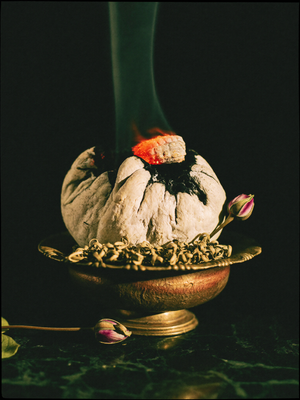
What we hold for this Energetic Cleanse Ritual Incense — Frankincense & Myrrh, $24.95. Frankincense and myrrh are the two resins late-antique rites actually burned, and burning something is the part of this tradition you can honestly reproduce at home. What you cannot reproduce is the rest: a temple, a priesthood, a functioning cult and a cosmology you believe. Two honest notes — these are modern sticks with a modern blend, not a reconstruction of anything; and Iamblichus' own position was that the substance does the work and the operator does not, which, if you take it seriously, is an argument against buying anything at all on the strength of a feeling. |
How the rite is supposed to work
The mechanism Iamblichus describes rests on sympatheia: a chain of correspondence running from each god down through the ranks of being into the physical world. A particular stone, herb, animal, scent, hour and name belong to a particular god the way a note belongs to a key. Assemble enough of them correctly and the whole chain resonates — not because you have pulled on it, but because it was strung that way.
This is the ancestor of every table of correspondences in English-language occultism, from the talismanic material of the Picatrix to the planetary incense assignments you will still find in print. The tables got copied for seventeen centuries. The metaphysics that made them mean anything mostly did not.
Two features are worth naming because modern practice inherited them without the argument. The first is the use of voces magicae — names and sounds held to be effective precisely because they are untranslatable, which is why the tradition insisted they not be rendered into Greek. The second is the divine statue, animated by the same sympathetic material; the practice of inviting a god into an image has a long documented history and an equally long history of being denounced.
Proclus and the last flowering in Athens
Proclus (412–485) led the Platonic Academy in Athens, wrote hymns to the gods and a treatise on the hieratic art, and lived the practice as a daily discipline: fixed prayers, dietary rules, observances for Egyptian and Greek festivals alike. His biographer Marinus reports that he brought rain by theurgic rite and turned aside an earthquake. Those are a student's reports about a teacher, with no independent attestation, and they belong under tradition rather than record.
What is documented is the ending. In 529 the emperor Justinian shut down the teaching at the Athenian school. The institutional life of pagan Neoplatonism stops there; the texts went on travelling without it.
Why the book you will find has the wrong title
Iamblichus' defense has no ancient title of that name. It is known today as De mysteriis Aegyptiorum — "On the Mysteries of the Egyptians" — because that is what Marsilio Ficino called it when he published his Latin version in 1497, and the label stuck. The work is a reply to Porphyry's letter, written by a Syrian Greek philosopher, using an Egyptian priestly persona as a rhetorical frame. It is not an Egyptian book.
This matters for American readers more than it might seem. A large share of English-language esoteric publishing since the nineteenth century has traded on Egypt, and a Renaissance mistitle is one of the reasons a Syrian Neoplatonist keeps being shelved as an Egyptian mystery text. If you order the standard scholarly edition you will get the honest apparatus along with it; if you order something with a pyramid on the cover, check what it is actually a translation of.
From prohibition to return: Ficino, Psellos, the Golden Dawn
Augustine attacked theurgy directly, and the Christian polemic against it set the terms for a thousand years: what the philosophers called god-work, the Church called demon-work under a better name. In eleventh-century Constantinople, Michael Psellos preserved a great deal of the Chaldean material precisely by writing commentary against it — one of those cases where the fragments survive in the mouth of the prosecution.
Ficino's Florence put the texts back into circulation in Latin, and the nineteenth century put them into English. The channel most American practitioners actually inherited runs through the Hermetic Order of the Golden Dawn and, after 1937, through Israel Regardie's published corpus — which is why "theurgy" turns up in US occult writing attached to godform assumption, banishing rituals and elaborate correspondence tables. That lineage is real. It is also about fifteen hundred years downstream of Iamblichus, filtered through Christian kabbalah, Rosicrucianism and Victorian scholarship, and it is not a reconstruction of the ancient rite.
Theurgy, goetia and modern ritual magic
| Theurgy | Goetia | |
|---|---|---|
| Who acts | The gods, through signs they placed in matter | The operator, through constraint |
| Aim | Ascent and union of the soul | A specific result in the world |
| Core texts | Chaldean Oracles; Iamblichus; Proclus | Early modern grimoires |
| Period | 2nd–6th century, revived from 1497 | Mostly 16th–19th century in the form we have |
| Status of the operator | Receptive; purified; arranged | Commanding; protected; in charge |
The pair is worth holding in mind whenever a modern book uses the two words as synonyms for "high" and "low" magic. That framing is a Victorian value judgment laid over an ancient technical distinction. What the sources mean by a demon shifts underneath both terms across the same centuries.
What "theurgy" means today
In current practice the word covers a wide range: Golden Dawn–descended ritual, reconstructionist Hellenic polytheism with a philosophical bent, academic-adjacent Neoplatonic study groups, and a certain amount of marketing. The honest distinctions are simple. Are the invocations addressed to gods the practitioner believes in, or used as psychological scaffolding? Is the material chosen because a source assigns it, or because it looked right? Is the stated aim the ascent of the soul, or a result?
None of those answers is disqualifying. Iamblichus would have found most modern ritual unrecognisable and would have had a great deal to say about doing any of this without a functioning cult around it. But a practice that knows which questions it is answering is in better shape than one that does not, and writing your own rite from scratch tends to surface the answers fast.
What we don't promise
- No contact. That theurgic rites put a person in touch with gods or higher beings is not established. The reports of effects are self-testimony from inside the tradition.
- No results in the world. Rain, health, averted earthquakes — these are hagiographical claims about Proclus, reported by his own student. We pass them on as tradition, not as record.
- No reconstruction. Nobody practices ancient theurgy. The ritual detail did not survive in usable form, and the cosmology that made it coherent is not something you can adopt by deciding to.
- No instructions here. This is a history, not a manual. We have not given you an invocation, and that is deliberate.
Practically: how to handle this subject
- Start with the reply, not the summary. Iamblichus' answer to Porphyry is readable in a good modern edition and clears up most of what popular writing gets wrong in one sitting.
- Check what any "Chaldean Oracles" edition actually is. The text exists only as fragments in later quotation. An edition that reads like a continuous scripture has done something to it.
- Watch for the Egyptian label. If a book leans on Egypt to sell a Syrian Greek philosopher, that is Ficino's title doing marketing work five centuries later.
- Keep the two words apart. Theurgy and goetia describe who is supposed to be acting. They are not grades of respectability.
- Notice where your correspondences came from. Most tables in circulation descend from this chain. Knowing that is more useful than memorising another one.
Frequently asked questions
What is theurgy?
The ritual practice of the late-antique Neoplatonists — from Greek theourgía, "god-work" — aimed at joining the soul to the gods through actions, symbols and invocations. Its doctrine is that the gods placed signs in stones, plants, scents and names, and that the rite wakes those signs rather than the practitioner's will producing an effect.
How is theurgy different from magic?
The difference is who acts. Goetia constrains spirits to produce a result; theurgy holds that the gods act through material they themselves seeded, and that the practitioner is receptive rather than commanding. The aim differs too: ascent of the soul rather than an outcome in the world.
Where does the word first appear?
In the Chaldean Oracles, a collection of Greek hexameters from the second century attributed to Julian the Theurgist and his father. The Oracles survive only as fragments quoted by later writers.
What is De mysteriis?
Iamblichus' defense of theurgy, written around 300 CE as a reply to Porphyry's sceptical letter to the Egyptian priest Anebo. It is the most detailed ancient argument for the practice. The familiar title comes from Marsilio Ficino's Latin version of 1497, not from antiquity.
Did theurgy work?
Outside the tradition there is no verifiable attestation. The famous cases — Proclus bringing rain, Plotinus shown a god rather than a daimon in the Iseum at Rome — come from a student's biography and from Porphyry's life of his teacher respectively. They document what the school said about itself.
Is modern ceremonial magic theurgy?
It descends from it, through Ficino, Christian kabbalah, Rosicrucianism and the Golden Dawn, and much of its vocabulary and its correspondence tables come down that line. It is not a reconstruction of the ancient practice, and the metaphysics underneath has changed more than the furniture has.
Sources & further reading
- Iamblichus, De mysteriis — edited and translated by Emma C. Clarke, John M. Dillon and Jackson P. Hershbell (2003): the standard English scholarly edition of the reply to Porphyry.
- Ruth Majercik, The Chaldean Oracles: Text, Translation, and Commentary (1989); Hans Lewy, Chaldaean Oracles and Theurgy (1956, revised 1978).
- Gregory Shaw, Theurgy and the Soul: The Neoplatonism of Iamblichus (1995) — on the argument that embodiment, not contemplation alone, is the problem theurgy addresses.
- Sarah Iles Johnston, Hekate Soteira (1990) — on Hekate's mediating role in the Chaldean system.
- Marinus, Life of Proclus; Porphyry, Life of Plotinus — the ancient biographical reports, read as what they are.
- Proclus, Hymns, edited by R. M. van den Berg (2001); Edward J. Watts, City and School in Late Antique Athens (2006) on the closure of 529.
The spiritual readings in this piece are tradition and are not scientifically established. Questions about an order: 28@templeofdesire.com.