

Collection: Candles Under $20
Every candle in the shop under twenty dollars, in one place — nineteen of them, in four formats: seven-day glass candles, 8 oz herb-dressed jars, devotional tealight sets and a beeswax heart taper. In short: the $11.95 seven-day candle burns about five times longer per dollar than anything else on the shelf.
-
Freyja Devotional Tealight Set — Altar & Daily Offerings
Regular price $12.95Regular priceUnit price / perSale price $12.95 -
Fiery Wall of Protection 7-Day Candle — Strong Warding
Regular price $10.95Regular priceUnit price / perSale price $10.95 -
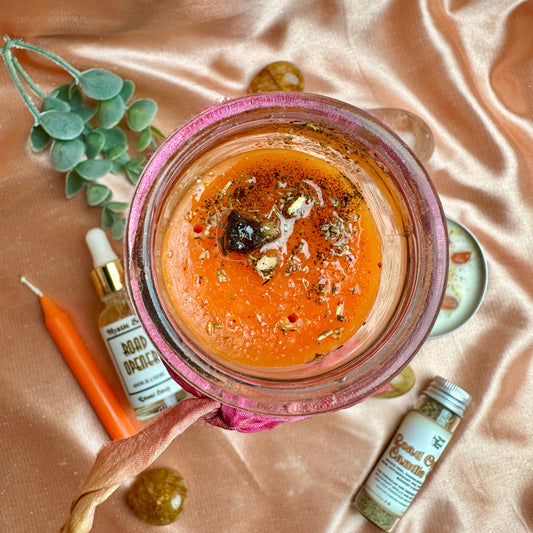
Road Opener 7-Day Candle — Abre Camino & New Doors
Regular price $10.95Regular priceUnit price / perSale price $10.95 -
Shakti Devotional Tealight Set — Vitality & Creative Fire
Regular price $12.95Regular priceUnit price / perSale price $12.95
Choosing a candle under $20
Nineteen candles sit on this shelf in four quite different formats, and they share nothing but a price bracket. The cheapest one burns the longest by a factor of five. That is the first thing to understand before you choose, because on this page price is a very poor guide to what you are getting. If you are starting from nothing, candle magic for beginners sorts what you actually need from what can wait, and most of what it lists is on this page.
The four formats, and what each is for
Eight seven-day glass candles at $11.95 or $13.95 are hand-dressed in small batches by Mystic Soul Ritual Shop, anointed with a matching ritual oil, topped with a stone and printed with a blank label panel for a name, birthdate and petition. Eight 8 oz jar candles — seven at $18.00, one at $18.95 — are hand-poured by Circe Boutique in a coconut-soy blend with a cotton wick, a named scent, one herb and one crystal, and burn up to 50 hours. Two devotional tealight sets at $14.95 give four dressed tealights of a few hours each, sized for a daily offering rather than a working. And one beeswax heart taper at $15.95, hand-poured at Parlour of Wonders from pure beeswax with no fragrance at all, carries eight hearts down its length that can be inscribed one at a time.
Every candle on the shelf, by format
The seven-day candles. Five at $11.95: New Moon (New Moon oil and kief, rainbow moonstone — lit on the new moon or within the following 48 hours, one intention on the label), Love Drawing (pink, dressed with rose, jasmine, chamomile, hibiscus and clove, rose quartz on top), Money Drawing (an oil of cinnamon, vetiver, ginger, patchouli, peppermint and basil, green aventurine on top), Road Opener (the abre camino formula, garnet on top) and Fiery Wall of Protection (red, obsidian chips). Three at $13.95, the clearing and clarity tier: Uncrossing (shungite), Banishing (labradorite) and Spiritual Clarity (a clear quartz point, built for the preparation before a reading or a decision rather than for the working itself). Because the herbs and stones are placed by hand, no two look identical, and the botanicals darken as the flame reaches them — that is the format working as intended. How to read a 7-day candle covers soot, wax and flame, and what it means when a 7-day candle cracks answers the question that arrives on day four.
The 8 oz jars. Seven at $18.00, each with its scent, herb and crystal named on the product page: Healing (lavender vanilla; lavender and chamomile; amethyst), Fiery Wall of Protection (cedarwood; cloves; black obsidian), Spiritual Cleansing (cedarwood sage; crushed sage; tiger's eye), Home Blessing (sandalwood amber; rosemary and thyme; aquamarine), Love & Attraction (apple cinnamon; rose petals; strawberry quartz), Money Drawing Prosperity (watermelon basil; basil and vervain; citrine) and Road Opener (coconut and lemongrass; lemon balm; clear quartz). The eighth, at $18.95, is Good Fortune (nectarine and white ginger; chamomile; citrine) — luck work rather than money work, a distinction success work vs money work draws properly.
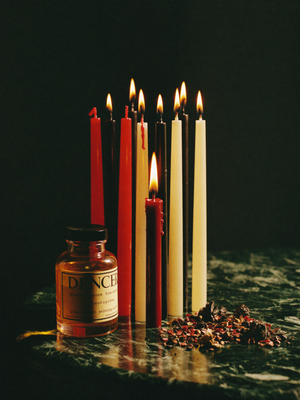
The tealight sets and the taper. The Freyja Devotional Tealight Set (dressed with strawberry, amber, rose, cypress and poppy; strawberry quartz) is the one for a daily offering at the altar, Friday being the traditional day; the Shakti Devotional Tealight Set (hibiscus, amber, cinnamon, rose, jasmine and orange; carnelian chips) is for opening work before you create, perform or step into visibility. Both are four tealights of a few hours each, and how to tell if an offering was accepted is the question that follows a devotional practice. The Beeswax Love Spell Heart Taper is the odd one out: 6.5" of pure beeswax, no fragrance, eight inscribable hearts, ten colors, up to 5 hours of burn, worked one heart a day across four days or all in one sitting.
Price does not track burn time here
A seven-day candle at $11.95 burns for about a week of continuous flame — roughly 120–170 hours depending on draft and room — which works out at about 7 to 10 cents an hour. An 8 oz jar at $18.00 gives up to 50 hours, around 36 cents an hour. A $14.95 tealight set gives four candles of a few hours each and is the most expensive thing on the page by the hour — well over ten times the seven-day rate. The ranking is the exact inverse of what the price tags suggest. If burn time is what you are buying, the decision is already made and it costs $11.95.
But burn time is not the only thing anyone buys, and the formats are genuinely not interchangeable. The seven-day candle is designed as one continuous burn: you light it and let it run, which is the point of the format and also its constraint — it is not a candle for twenty-minute sittings. The 8 oz jar is the opposite, a repeatable session candle you light and extinguish across many evenings, with a scent worth having in the room. The tealight sets are sized for one morning or one evening devotion and nothing grander. The beeswax taper is built to be worked in stages, one heart per day. Pick the format that matches how you actually sit down, not the one with the best hourly rate.
The cheapest complete sequence in the shop
Most traditions that use dressed candles converge on an order of operations: uncross first, banish if needed, protect, and only then draw. This shelf happens to carry all four steps in the seven-day format — Uncrossing at $13.95, Banishing at $13.95, Fiery Wall of Protection at $11.95 and any of the drawing candles (Road Opener, Money Drawing, Love Drawing, New Moon) at $11.95. That is $51.80 for roughly four weeks of continuous burn and a complete sequence, which is less than a single mid-range jar candle costs elsewhere. If you have found yourself repeating the same drawing candle without result, the missing step is usually at the front of that order rather than the back; the magazine covers why the order runs uncross, banish, protect, draw, when banishing is the wrong call and where the Fiery Wall formula comes from. For the drawing step itself, road opener or money candle settles the one question most people bring to this shelf, the money candle ritual and the love drawing candle walk each working through, and the new moon candle cycle explains why the New Moon candle is lit at the start of the month and not the end. The eight seven-day candles split into five at $11.95 and three at $13.95; the higher tier is the clearing and clarity work.
Color, and the one candle here that is chosen by color
The beeswax heart taper is the only item on this shelf sold in color variants rather than by named working — ten of them, from red for passion and pink for romance through black for protection, green for generosity, purple for power and brown for grounding and fidelity. If you work with candle color correspondences, this is the cheapest way on the site to run a color-specific working, and the eight inscribable hearts let you build it over four days rather than in one sitting; love spells and consent is the read before any love working. The rest of the beeswax spell candles follow the same logic at other shapes and sizes, and beeswax vs paraffin explains why the wax costs what it does. Every other candle here is chosen by its named job, and the dressing is already done — but if you want to anoint a jar or write a petition for a seven-day candle, how to dress a candle with oil and how to write a petition paper are the two short reads.
What quality looks like at this price
Below twenty dollars, look for the things that cost a maker money: whole dressed herbs rather than dust, a named crystal rather than "crystal chips", a stated wax type and wick material, and a stated burn time. Every candle on this page carries at least three of those, and the makers are named rather than anonymous — three of them across nineteen products. A glass-encased candle should have its wick centered in the glass, and the herbs on a dressed candle belong on the surface of the wax rather than packed against the glass where they can scorch. If a flame starts behaving oddly mid-working, a candle burning black is far more often a draft or an off-center wick than an omen. When the working is finished, there is a customary way to handle the leftover wax. For anything below this bracket, see Under $10; for the full range, the ritual candles shelf.
These candles are traditionally used for focus, reflection and ritual practice. Such associations are cultural and traditional rather than scientifically established, and nothing here replaces medical, legal or financial advice. Never leave a burning candle unattended.
Frequently asked questions
Why is the cheapest candle here the longest-burning one?
Because the seven-day format is built for volume of burn rather than finish. The glass is plain, the wax is a simple poured column, and the whole object exists to run for about a week. The more expensive 8 oz jars pay for a coconut-soy blend, a named fragrance, a crystal and a jar you keep. You are buying different things, not more or less of the same thing.
How long does a seven-day candle actually burn?
About seven days of continuous burn, which in practice means roughly 120–170 hours depending on draft, room temperature and how level the candle stands. At $11.95 that is about 7–10 cents an hour, the cheapest burning on this page by a wide margin.
Can I blow out a seven-day candle and relight it later?
You can, and many practitioners do — snuff or pinch it rather than blowing it out. But the format assumes a continuous burn and works best that way. If you know you need to stop and start across several sittings, an 8 oz jar candle is the better-suited object. Whichever you choose, keep the method consistent for the whole working.
Road Opener costs $11.95 in one form and $18.00 in another. Which is better?
Neither — they are different objects. The $11.95 version is a seven-day continuous burn, hand-dressed by Mystic Soul Ritual Shop to the traditional abre camino formula, topped with garnet and carrying a blank label panel for your name, birthdate and petition. The $18.00 version is an 8 oz coconut-soy jar from Circe Boutique scented with coconut and lemongrass, with lemon balm and a clear quartz, which you burn in sessions over weeks. Decide by format: one sustained working, or a candle you return to.
Is it safe to let a candle burn for seven days?
Only with sensible placement and supervision. Stand a seven-day candle on a heat-resistant, non-flammable surface such as stone, tile or a metal tray, well away from drafts, curtains and anything that can catch. Never leave any burning candle unattended, and extinguish it if the glass cracks, the flame gutters badly, or soot builds up on the glass. Continuous burn is the tradition, not a requirement — snuff it when you leave and relight at the next opportunity.
Do I keep the crystal?
Yes. On the seven-day candles, the 8 oz jars and the tealight sets alike, the stone does not melt or burn away. It stays behind once the wax is spent and can be washed and reused.