

Collection: Necklaces & Malas
Crystal and symbol pendants from $17.95, four hand-strung 108-bead malas, three necklaces handmade in Athens, and a vintage-glass statement line that runs into four figures.
In short: Decide the length before the stone — that is what decides whether a necklace gets worn. Note that the chains are listed in centimeters and the chokers in inches.
-
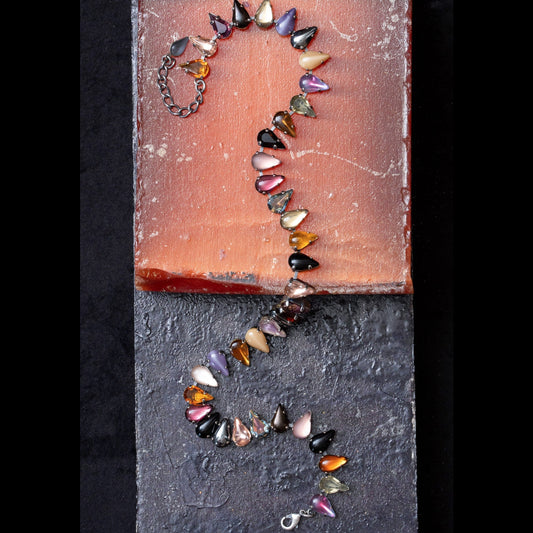
Fang Layering Choker in Punk Rocks — Silver Statement Choker
Regular price $346.95Regular priceUnit price / perSale price $346.95 -
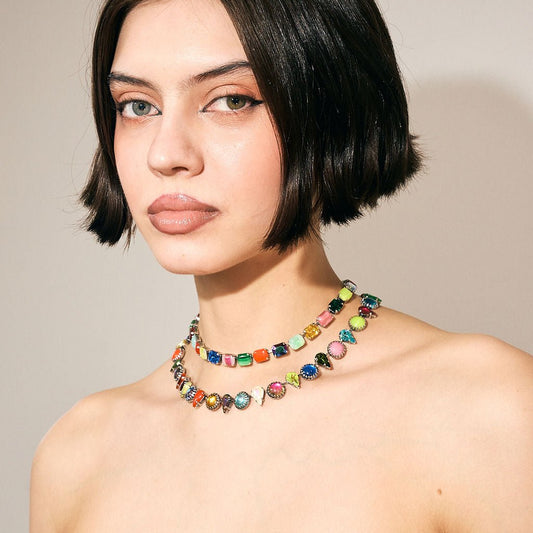
Aurora Baguette Layering Choker — Vintage Glass in Oxidized Silver
Regular price $306.95Regular priceUnit price / perSale price $306.95 -
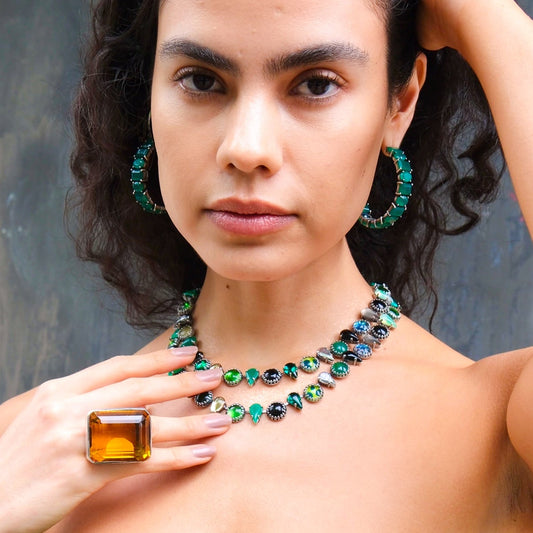
Alligator Layering Choker — Vintage Glass in Oxidized Silver
Regular price $346.95Regular priceUnit price / perSale price $346.95 -
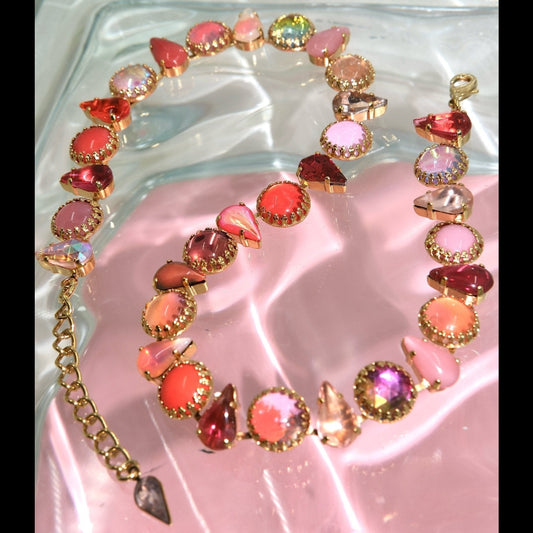
Shrimp Pink Layering Choker — Vintage Glass in 18k Gold Finish
Regular price $391.95Regular priceUnit price / perSale price $391.95 -
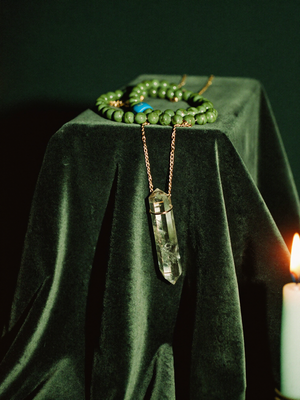
Green Fluorite Necklace — Raw Crystal Pendant for Clarity
Regular price $26.95Regular priceUnit price / perSale price $26.95
Necklaces and malas: how to choose one you will actually wear
The prices here run a long way apart. A stainless steel celestial pendant is $17.95; a tennis necklace in tiger eye and onyx is $1,287.95. They are not competing for the same buyer, and treating them as one category is the reason people bounce off this page. It is easier to read as four separate things that happen to hang around a neck.
Length decides more than the stone does
Almost every necklace that gets left in a drawer was the wrong length, not the wrong stone. There is one wrinkle here worth knowing before you order: the everyday pendants are specified in centimeters and the designer pieces in inches, because they come from different workshops. Nothing is wrong with either, but comparing 45 cm to 18.5 inches across two browser tabs is where mistakes happen.
| Length | Where it sits | In this collection |
|---|---|---|
| 40 cm (~16 in) | High on the throat, above most necklines | Short option on the hexagon wire-wrap and pentacle chain |
| 45 cm (~18 in) | Just below the collarbone — the default | Standard length for the raw crystal wire-wrap, triple moon and potion bottle |
| 50 cm (~20 in) | On the sternum, reads as a longer line | Long option on the crystal point pendant and hexagon column |
| 16–18.5 in | Choker at the base of the neck, with extender | The whole layering choker line, including Fang and Paint Pot |
| 14–18 in, adjustable | Between throat and collarbone, set by the extender | The Athens pieces: Daphne riviera (14–17 in) and the Cara emerald-cut necklaces (14.5–18 in) |
| 36 in | Hangs at the solar plexus, or wraps the wrist | The full-length carnelian mala (sold out at the moment) |
Four groups, and what separates them
Everyday pendants, $17.95 to $38.95. Stainless steel and gold-plated chains with a crystal or a symbol: gemstone columns, points, the glass vial you can fill with an oil, and the symbol pieces — pentacle, triple moon, tarot card. The top of this band is the raw green fluorite pendant at $38.95, wire-wrapped by hand, and the one piece here where no two stones are alike. These are the pieces to buy if you want to wear something specific without thinking about it, and the stainless steel ones tolerate daily wear.
Malas, $26.95 to $208.95. Four strands, three of them in stock as this is written, and they differ more than the category suggests — see the section below.
Handmade in Athens, $268.95 to $280.95. Three necklaces from one small family workshop, and the only pieces here that are built to be worn together: the Daphne riviera sets pink crystal in a continuous line all the way round with no chain interrupting it, and the Cara emerald-cut necklaces — also in green — are cut and sized to layer over it. All three are 24K gold plate with rhodium over brass, and all three adjust, which is why they are the easiest pieces in this collection to buy without measuring first.
The vintage-glass statement line, $275.95 to $1,287.95. 1960s dead-stock glass, tiger eye and onyx reassembled by hand in Germany onto gold-plated or oxidized silver: layering chokers in Aurora Baguette and Shrimp Pink, the Fang and Paint Pot pairs in both gold and silver, the Saber Tooth, the Square Goliath choker, the Obscura stacking shards and two tennis necklaces — gold and silver. This is jewelry bought to be looked at, priced accordingly, and it is a large part of what is actually in this collection. Nothing in the collection sits between $38.95 and $147.95, so if your budget lands in that gap, look at bracelets or rings and earrings instead of compromising here.
What the four malas actually are
A mala is a counting tool before it is a necklace: 108 beads plus a guru bead, one bead per mantra or per breath, and the loop back to the guru bead tells you the round is done. What varies here is length, and it varies a lot. The carnelian and Gobi agate mala is the traditional full length at 36 inches, and it is the one strand currently sold out. The onyx, rose quartz and labradorite mala is a standard 108-bead strand in 8 mm beads and the least expensive way in at $26.95. The lapis lazuli (16 in) and amethyst (16.5 in) strands are short — lovely to wear, and they layer under a longer chain without tangling, but they sit at the collarbone rather than hanging. If the mala is primarily for practice, the length is the specification to read first.
Who this collection is for
If you want one piece you will put on most mornings, buy a stainless steel pendant at 45 cm and stop there. If you are building a practice, the $26.95 mala will teach you whether you like counting on beads before you spend two hundred dollars finding out. And if you are shopping for a piece that has to carry a whole outfit, the layering chokers are what that money is for — they are made to be seen and stacked, not to disappear under a collar. For a stone worn closer to the skin all day, a bracelet is usually the better format.
From the Desire Diaries
- Real vs Treated Crystals — how to read a stone description, and which words signal dye or glass.
- Crystal Shapes Explained — what a point, a hexagon and a tumbled stone are actually for.
- How to Charge Crystals — the practical version, including which stones must stay out of water and sun.
- When a Crystal Breaks — worth reading before a strand goes; it happens to worn pieces.
- Crystals for Anxiety — what people reach for, and an honest account of what it does.
Frequently asked questions
What length necklace should I buy?
For a pendant you want visible above a neckline, 45 cm (about 17.7 inches) is the standard and the length most of the chains here come in; 40 cm sits high on the throat, 50 cm drops onto the sternum. The layering chokers are cut at 16 inches with an extender to 18.5 inches, so they sit at the base of the neck. The quickest way to decide is to cut a piece of string to each length, close it around your neck and look in a mirror — necklaces are returned for length far more often than for looks.
Why are some necklaces measured in centimeters and others in inches?
Because they come from different makers. The everyday crystal and symbol pendants are specified in centimeters — 40, 45 and 50 cm are the usual options — and the designer layering pieces are specified in inches. As a rough conversion: 40 cm is about 16 inches, 45 cm about 18 inches, and 50 cm about 20 inches. If a product page gives you centimeters and you think in inches, divide by 2.54. The three Athens necklaces sidestep the problem entirely: they are adjustable, 14 to 17 inches on the riviera and 14.5 to 18 inches on the emerald-cut pieces.
What is a 108-bead mala actually for?
It is a counting tool. You hold it in one hand, start at the bead beside the guru bead, and move one bead per repetition of a mantra or one bead per breath; arriving back at the guru bead means you have done 108 of them. The count is what the object is for — the point is that you can keep track without any part of your attention going to keeping track. Whether you wear it afterward is a matter of taste, not tradition.
Are all the malas here full length?
No, and this catches people out. The carnelian and Gobi agate mala is a full-length 36-inch strand that hangs long or wraps the wrist several times. The lapis lazuli mala is 16 inches and the amethyst mala is 16.5 inches — both sit at the collarbone, which makes them easier to wear but means they are short strands rather than the classical hanging mala. The black onyx, rose quartz and labradorite mala is a standard 108-bead strand in 8 mm beads. Check the stated length on the product page before you buy for practice rather than for wear.
Can I shower, swim or sleep in a crystal necklace?
Take it off for all three. Chlorine, salt water and soap film dull plating and creep into the space between a stone and its setting, and knotted cord holds water for a long time after the beads look dry. Sleeping in a beaded strand is the most common way people break one. Stainless steel pieces such as the pentacle chain and the tarot card pendant survive daily wear best; gold plate over any base metal is the finish that wears fastest at the points of friction.
How do I tell a good piece from a cheap one before it arrives?
Read the metal claim, not the color word. "Gold-tone" and "gold-plated" describe a surface over another metal; sterling silver and stainless steel describe what the piece is made of throughout. Then look at how the stone is held: a wire wrap and a bezel setting both hold, glue does not hold forever. And check whether the listing states a length and a weight at all — makers who measure their own work tend to say so, and the products in this collection that give you grams and inches are the ones you can plan around.